Thailand
Kingdom of Thailand · ประเทศไทย
The only Southeast Asian country never colonised. Absolute monarchy ended in 1932; over a dozen coups since, the latest in 2014.
See Thailand on the 3D globeTake a quiz
Population71.6 million
Area513,120 km²
CapitalBangkok
RegionSouth-Eastern Asia
Did you know?
- Bangkok's full ceremonial name is one of the longest place names
- The Thai calendar is 543 years ahead (2569 in 2026)
- The world's largest rice exporter for many years
Key facts about Thailand
- Government
- Parliamentary constitutional monarchy (frequent military influence)
- Religion
- Theravada Buddhism ~93%, Islam ~5%
- Founded / independence
- 1238 (Sukhothai)
- Rich in
- Cars, electronics, rice, rubber, tourism
- Languages
- Thai
Thai: Central, Isan (Lao), Northern, Southern dialects; Malay in the south - Currency
- Thai baht (฿)
- People are called
- Thai
- Main cities
- Bangkok, Nonthaburi, Chiang Mai, Hat Yai, Phuket
Timeline of Thailand
- 1238Sukhothai
- 1351Ayutthaya
- 1782Bangkok founded
- 1932Constitutional monarchy
- 2004Tsunami
- 2014Coup
- 2025Cambodia border clashes
Places to see in Thailand
- Grand Palace and Wat Phra Kaew
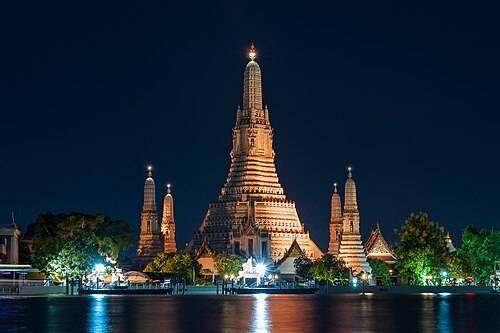
- Wat Arun
- Ayutthaya
- Chiang Mai temples
- Phi Phi Islands
- floating markets
Food and drink
Pad thai · tom yum · green curry · mango sticky rice · som tam
Culture and famous for
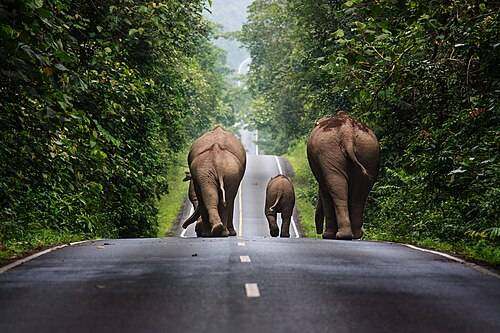
Never colonised; Songkran water festival; elephants
Popular sports
Muay Thai, football, badminton
Geography and climate
- Highest point
- Doi Inthanon, 2,565 m
- Rivers, lakes and seas
- Chao Phraya, Mekong
- Climate
- Tropical
- Coastline
- Has a sea coast
- Population density
- 140 people per km²
Wars and conflicts
- Burmese-Siamese wars
- Franco-Siamese War 1893
- southern insurgency
- Cambodia border war 2025
Alliances and memberships
Political unions and regional organisations
Economy and trade
Thailand in depth
Detailed facts from the CIA World Factbook (public domain, latest edition).
Overview
- History in brief
- Two unified Thai kingdoms emerged in the mid-13th century. The Sukhothai Kingdom, located in the south-central plains, gained its independence from the Khmer Empire to the east. By the late 13th century, Sukhothai’s territory extended into present-day Burma and Laos. Sukhothai lasted until the mid-15th century. The Thai Lan Na Kingdom was established in the north with its capital at Chang Mai; the Burmese conquered Lan Na in the 16th century. The Ayutthaya Kingdom (14th-18th centuries) succeeded the Sukhothai and would become known as the Siamese Kingdom. During the Ayutthaya period, the Thai/Siamese peoples consolidated their hold on what is present-day central and north-central Thailand. Following a military defeat at the hands of the Burmese in 1767, the Siamese Kingdom rose to new heights under the military ruler TAKSIN, who defeated the Burmese occupiers and expanded the kingdom’s territory into modern-day northern Thailand (formerly the Lan Na Kingdom), Cambodia, Laos, and the Malay Peninsula. In the mid-1800s, Western pressure led to Siam signing trade treaties that reduced the country’s sovereignty and independence. In the 1890s and 1900s, the British and French forced the kingdom to cede Cambodian, Laotian, and Malay territories that had been under Siamese control. Following a bloodless revolution in 1932 that led to the establishment of a constitutional monarchy, Thailand's political history was marked by a series of mostly bloodless coups with power concentrated among military and bureaucratic elites. Periods of civilian rule were unstable. The Cold War era saw a communist insurgency and the rise of strongman leaders. Thailand became a US treaty ally in 1954 after sending troops to Korea and later fighting alongside the US in Vietnam. In the 21st century, Thailand has experienced additional turmoil, including a military coup in 2006 that ousted then Prime Minister THAKSIN Chinnawat and large-scale street protests led by competing political factions in 2008-2010. In 2011, THAKSIN's youngest sister, YINGLAK Chinnawat, led the Puea Thai Party to an electoral win and assumed control of the government. In 2014, after months of major anti-government protests in Bangkok, the Constitutional Court removed YINGLAK from office, and the Army, led by Gen. PRAYUT Chan-ocha, then staged a coup against the caretaker government. The military-affiliated National Council for Peace and Order (NCPO) ruled the country under PRAYUT for more than four years, drafting a
Geography
- Location
- Southeastern Asia, bordering the Andaman Sea and the Gulf of Thailand, southeast of Burma
- Size compared
- about three times the size of Florida; slightly more than twice the size of Wyoming
- Land borders
- Total: 5,673 kmBorder countries: Burma 2,416 km; Cambodia 817 km; Laos 1,845 km; Malaysia 595 km
- Coastline
- 3,219 km
- Climate
- tropical; rainy, warm, cloudy southwest monsoon (mid-May to September); dry, cool northeast monsoon (November to mid-March); southern isthmus always hot and humid
- Terrain
- central plain; Khorat Plateau in the east; mountains elsewhere
- Elevation
- Highest point: Doi Inthanon 2,565 mLowest point: Gulf of Thailand 0 mMean elevation: 287 m
- Natural resources
- tin, rubber, natural gas, tungsten, tantalum, timber, lead, fish, gypsum, lignite, fluorite, arable land
- Major rivers
- Mae Nam Khong (Mekong) (shared with China [s], Burma, Laos, Cambodia, and Vietnam [m]) - 4,350 km; Salween (shared with China [s] and Burma [m]) - 3,060 km; Mun - 1,162 kmNote: [s] after country name indicates river source; [m] after country name indicates river mouth
- Major lakes
- Salt water lake(s): Thalesap Songkhla - 1,290 sq km
- Natural hazards
- land subsidence in Bangkok area resulting from the depletion of the water table; droughts
- Notes
- controls only land route from Asia to Malaysia and Singapore
- Environmental issues
- air pollution from vehicle emissions; water pollution from organic and factory wastes; water scarcity; deforestation; soil erosion; illegal hunting; hazardous waste disposal
People and society
- Population
- Total: 70,025,248 (2025 est.)Male: 34,101,016Female: 35,924,232
- Nationality
- Noun: Thai (singular and plural)Adjective: Thai
- Ethnic groups
- Thai 97.5%, Burmese 1.3%, other 1.1%, unspecified <0.1% (2015 est.)
- Languages
- Thai (official) only 90.7%, Thai and other languages 6.4%, only other languages 2.9% (includes Malay, Burmese); English is a secondary language among the elite (2010 est.)Major-language sample(s): สารานุกรมโลก - แหล่งข้อมูลพื้นฐานที่สำคัญ (Thai)The World Factbook, the indispensable source for basic information.
- Religions
- Buddhist 92.5%, Muslim 5.4%, Christian 1.2%, other 0.9% (includes animist, Confucian, Hindu, Jewish, Sikh, and Taoist) (2021 est.)
- Median age
- Total: 41.9 years (2025 est.)Male: 40.2 yearsFemale: 42.7 years
- Population growth
- 0.13% (2025 est.)
- Life expectancy
- Total population: 78.2 years (2024 est.)Male: 75.2 yearsFemale: 81.3 years
- Children per woman
- 1.55 children born/woman (2025 est.)
- Urbanization
- Urban population: 53.6% of total population (2023)Rate of urbanization: 1.43% annual rate of change (2020-25 est.)
- Largest cities
- 11.070 million BANGKOK (capital), 1.454 Chon Buri, 1.359 million Samut Prakan, 1.213 million Chiang Mai, 1.005 million Songkla, 1.001 million Nothaburi (2023)
- Literacy
- Total population: 91.1% (2022 est.)Male: 90.7% (2022 est.)Female: 91.5% (2022 est.)
- Years in school
- Total: 16 years (2023 est.)Male: 16 years (2023 est.)Female: 16 years (2023 est.)
Government
- Official names
- Conventional long form: Kingdom of ThailandConventional short form: ThailandLocal long form: Ratcha Anachak ThaiLocal short form: Prathet ThaiFormer: SiamEtymology: the name means "Land of the Thai," referring to the local population; the people's name comes from the Thai word tha, meaning "to be free;" the former name of Siam comes from the Sanskrit word syama, meaning "dark"
- Government type
- constitutional monarchy
- Capital
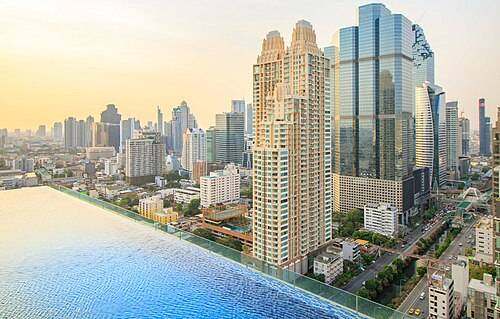
- Name: BangkokGeographic coordinates: 13 45 N, 100 31 ETime difference: UTC+7 (12 hours ahead of Washington, DC, during Standard Time)Etymology: the name is from the Thai words bang (region) and kok (olive trees); the city's full ceremonial name holds the world record for longest place name, Krungthepmahanakhon amonrattanakosin mahintharayutthaya mahadilokphop noppharatratchathaniburirom udomratchaniwetmahasathan amonphimanawatansathit sakkathattiyawitsanukamprasit, which means "City of angels, great city of immortals, magnificent city of the nine gems, seat of the king, city of royal palaces, home of gods incarnate, erected by Vishvakarman at Indra's behest"
- Regions
- 76 provinces (changwat, singular and plural) and 1 municipality* (maha nakhon); Amnat Charoen, Ang Thong, Bueng Kan, Buri Ram, Chachoengsao, Chai Nat, Chaiyaphum, Chanthaburi, Chiang Mai, Chiang Rai, Chon Buri, Chumphon, Kalasin, Kamphaeng Phet, Kanchanaburi, Khon Kaen, Krabi, Krung Thep* (Bangkok), Lampang, Lamphun, Loei, Lop Buri, Mae Hong Son, Maha Sarakham, Mukdahan, Nakhon Nayok, Nakhon Pathom, Nakhon Phanom, Nakhon Ratchasima, Nakhon Sawan, Nakhon Si Thammarat, Nan, Narathiwat, Nong Bua Lamphu, Nong Khai, Nonthaburi, Pathum Thani, Pattani, Phangnga, Phatthalung, Phayao, Phetchabun, Phetchaburi, Phichit, Phitsanulok, Phra Nakhon Si Ayutthaya, Phrae, Phuket, Prachin Buri, Prachuap Khiri Khan, Ranong, Ratchaburi, Rayong, Roi Et, Sa Kaeo, Sakon Nakhon, Samut Prakan, Samut Sakhon, Samut Songkhram, Saraburi, Satun, Sing Buri, Si Sa Ket, Songkhla, Sukhothai, Suphan Buri, Surat Thani, Surin, Tak, Trang, Trat, Ubon Ratchathani, Udon Thani, Uthai Thani, Uttaradit, Yala, Yasothon
- Independence
- 1238 (traditional founding date; never colonized)
- National holiday
- Birthday of King WACHIRALONGKON, 28 July (1952)
- Constitution
- History: many previous; latest drafted and presented 29 March 2016, approved by referendum 7 August 2016, signed into law by the king on 6 April 2017Amendment process: amendments require a majority vote in a joint session of the House and Senate and further require at least one fifth of opposition House members and one third of the Senate vote in favor; a national referendum is additionally required for certain amendments; all amendments require signature by the king
- Legal system
- civil law system with common law influences
- Voting age
- 18 years of age; universal and compulsory
- Flag meaning
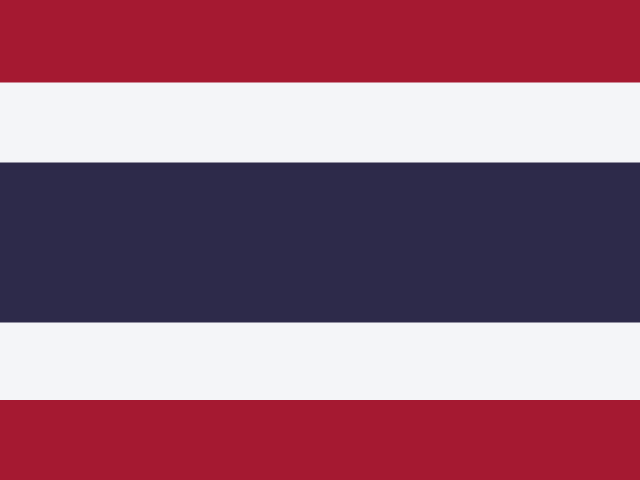
- Description: five horizontal bands of red (top), white, blue (double-width), white, and redMeaning: red stands for the nation and the blood of life, white for religion and the purity of Buddhism, and blue for the monarchy
- National symbols
- garuda (mythical half-man, half-bird figure), elephant
- National colours
- red, white, blue
- National anthem
- Title: "Phleng Sanlasoen Phra Barami" (A Salute to the Monarch)Lyrics/music: Narisara NUWATTIWONG and King VAJIRAVUDH/Pyotr SHCHUROVSKYHistory: royal anthem, played in the presence of the royal family and during certain state ceremonies
- UNESCO World Heritage Sites
- Total World Heritage Sites: 8 (5 cultural, 3 natural)Selected World Heritage Site locales: Historic City of Ayutthaya (c); Historic Sukhothai and Associated Historic Towns (c); Thungyai-Huai Kha Khaeng Wildlife Sanctuaries (n); Ban Chiang Archaeological Site (c); Dong Phayayen-Khao Yai Forest Complex (n); Kaeng Krachan Forest Complex (n); The Ancient Town of Si Thep and its Associated Dvaravati Monuments (n); Phu Phrabat, a testimony to the Sīma stone tradition of the Dvaravati period (c)
Economy
- Overview
- upper middle-income Southeast Asian economy; substantial infrastructure; major electronics, food, and automobile parts exporter; globally used currency; extremely low unemployment; ongoing Thailand 4.0 economic development
- GDP (PPP)
- $1.558 trillion (2024 est.)
- GDP per person (PPP)
- $21,700 (2024 est.)
- GDP growth
- 2.5% (2024 est.)
- Inflation
- 1.4% (2024 est.)
- Unemployment
- 0.7% (2024 est.)
- Below poverty line
- 5.4% (2022 est.)
- Farm products
- sugarcane, rice, cassava, oil palm fruit, maize, rubber, tropical fruits, chicken, mangoes/guavas, fruits (2023)
- Industries
- tourism, textiles and garments, agricultural processing, beverages, tobacco, cement, light manufacturing such as jewelry and electric appliances, computers and parts, integrated circuits, furniture, plastics, automobiles and automotive parts, agricultural machinery, air conditioning and refrigeration, ceramics, aluminum, chemical, environmental management, glass, granite and marble, leather, machinery and metal work, petrochemical, petroleum refining, pharmaceuticals, printing, pulp and paper, rubber, sugar, rice, fishing, cassava, world's second-largest tungsten producer and third-largest tin producer
- Exports
- $369.191 billion (2024 est.)
- Main exports
- machine parts, integrated circuits, trucks, cars, broadcasting equipment (2023)
- Export partners
- USA 18%, China 13%, Japan 7%, Australia 4%, Singapore 4% (2023)
- Main imports
- crude petroleum, integrated circuits, natural gas, gold, vehicle parts/accessories (2023)
- Import partners
- China 26%, Japan 11%, USA 7%, UAE 6%, Taiwan 5% (2023)
- Money sent home from abroad
- 1.8% of GDP (2024 est.)
Energy, internet and transport
- Electricity access
- Electrification - total population: 99.9% (2022 est.)Electrification - urban areas: 100%Electrification - rural areas: 100%
- Electricity sources
- Fossil fuels: 81.9% of total installed capacity (2023 est.)Solar: 2.7% of total installed capacity (2023 est.)Wind: 1.8% of total installed capacity (2023 est.)Hydroelectricity: 3.5% of total installed capacity (2023 est.)Biomass and waste: 10.1% of total installed capacity (2023 est.)
- Internet users
- Percent of population: 90% (2023 est.)
- Mobile phones
- Total subscriptions: 115 million (2024 est.)Subscriptions per 100 inhabitants: 161 (2024 est.)
- TV and radio
- 26 digital TV stations and 6 terrestrial TV stations broadcast nationally via relay stations, with 2 of the terrestrial stations military-owned and the other 4 state-owned or state-controlled; some leased to private enterprise; all required to broadcast government-produced news; multi-channel satellite and cable TV subscriptions available; radio frequencies allotted for over 500 government and commercial radio stations; many small community radio stations operate with low-power transmitters (2017)
- Airports
- 105 (2025)
- Railways
- Total: 4,127 km (2017)Standard gauge: 84 km (2017) 1.435-m gauge (84 km electrified)Narrow gauge: 4,043 km (2017) 1.000-m gauge
- Merchant ships
- Total: 884 (2023)By type: bulk carrier 28, container ship 28, general cargo 88, oil tanker 251, other 489
Military and space
- Armed forces
- Royal Thai Armed Forces (RTARF): Royal Thai Army (RTA), Royal Thai Navy (RTN; includes Royal Thai Marine Corps), Royal Thai Air Force (RTAF)Office of the Prime Minister: Royal Thai Police (2025)
- Military spending
- 1.1% of GDP (2024 est.)
- Military service
- 18 years of age for voluntary military service for men and women; all men register at 17 years of age and are subject to selective compulsory military service at 21; volunteer service obligation may be as short as 6-18 months, depending on educational qualifications; conscript service obligation also varies by educational qualifications, but is typically 24 months (2025)
- Space programme
- has an ambitious national space program focused on the acquisition, production, and operation of satellites, as well as research and development of related infrastructure, sciences, and technologies; operates communications and remote sensing (RS) satellites; manufactures scientific/research/testing cube satellites and is developing the capabilities to produce RS satellites (has historically built satellites with foreign assistance); works with a range of foreign space agencies and industries, including those of China, France, India, the Netherlands, Pakistan, Russia, South Korea, and the US; founding member of the China-led Asia-Pacific Space Cooperation Organization (APSCO); has a commercial space industry, including Southeast Asia’s first dedicated satellite manufacturing facility, which opened in 2021 (2025)
- Space milestones
- 1982 - established first satellite ground station1993 - first foreign-built commercial communications satellite (Thaicom-1) launched on European rocket2008 - first remote sensing satellite (Theos-1; aka Thaichote) co-developed with France and launched by Russia2018 - first domestically produced scientific/research satellite (KNACKSAT) launched by US2024 - signed memorandum of understanding with China for cooperation on Beijing's lunar research station project and space exploration; signed US-led Artemis Accords
Global issues
- Refugees and displaced people
- Refugees: 87,025 (2024 est.)IDPs: 19 (2023 est.)Stateless persons: 612,524 (2024 est.)
- Drug trade
- USG identification: major precursor-chemical producer (2025)
Neighbouring countries
- Phone code
- +66
- Internet domain
- .th