Costa Rica
Republic of Costa Rica
A stable democracy that abolished its army in 1948. About a quarter of its land is protected.
See Costa Rica on the 3D globeTake a quiz
Population5.2 million
Area51,100 km²
CapitalSan José
RegionCentral America
Did you know?
- Has about 5% of the world's biodiversity
- Abolished its army in 1948
- Runs on nearly 100% renewable electricity
Key facts about Costa Rica
- Government
- Presidential republic
- Religion
- Catholic ~50%, Evangelical ~25%
- Founded / independence
- 1821 (from Spain)
- Rich in
- Tourism (ecotourism), medical devices, coffee, bananas; nearly all renewable electricity
- Languages
- Spanish
Spanish; Limonese Creole, Bribri - Currency
- Costa Rican colón (₡)
- People are called
- Costa Rican
- Main cities
- San José, Alajuela, Cartago, Limón
Timeline of Costa Rica
- 1502Columbus arrives
- 1821Independence
- 1948Army abolished
- 1987Nobel Peace Prize for Óscar Arias
Places to see in Costa Rica
- Arenal Volcano
- Monteverde cloud forest
- Manuel Antonio NP
- Tortuguero turtles
- Corcovado
Food and drink
Gallo pinto · casado · tres leches
Culture and famous for
"Pura vida" lifestyle; ecotourism
Popular sports
Football
Geography and climate
- Highest point
- Cerro Chirripó, 3,820 m
- Rivers, lakes and seas
- Tempisque, San Juan
- Climate
- Tropical
- Coastline
- Has a sea coast
- Population density
- 102 people per km²
Wars and conflicts
- 1948 civil war
- abolished army in 1948
Empires and states that once stood here
Federal Republic of Central America 1823–1841
Alliances and memberships
Military and security
Political unions and regional organisations
Central American Integration SystemCELACOrganization of American States
Economy and trade
Costa Rica in depth
Detailed facts from the CIA World Factbook (public domain, latest edition).
Overview
- History in brief
- Although explored by the Spanish early in the 16th century, initial attempts at colonizing Costa Rica proved unsuccessful due to a combination of factors, including disease from mosquito-infested swamps, brutal heat, resistance from Indigenous populations, and pirate raids. It was not until 1563 that a permanent settlement of Cartago was established in the cooler, fertile central highlands. The area remained a colony for some two-and-a-half centuries. In 1821, Costa Rica was one of several Central American provinces that jointly declared independence from Spain. Two years later it joined the United Provinces of Central America, but this federation disintegrated in 1838, at which time Costa Rica proclaimed its sovereignty and independence.Since the late 19th century, only two brief periods of violence have marred the country's democratic development. General Federico TINOCO Granados led a coup in 1917, but the threat of US intervention pushed him to resign in 1919. In 1948, landowner Jose FIGUERES Ferrer raised his own army and rebelled against the government. The brief civil war ended with an agreement to allow FIGUERES to remain in power for 18 months, then step down in favor of the previously elected Otilio ULATE. FIGUERES was later elected twice in his own right, in 1953 and 1970.Costa Rica experienced destabilizing waves of refugees from Central American civil wars in the 1970s and 1980s, but peace in the region has since helped the economy rebound. Although it still maintains a large agricultural sector, Costa Rica has expanded its economy to include strong technology and tourism industries.
Geography
- Location
- Central America, bordering both the Caribbean Sea and the North Pacific Ocean, between Nicaragua and Panama
- Size compared
- slightly smaller than West Virginia
- Land borders
- Total: 661 kmBorder countries: Nicaragua 313 km; Panama 348 km
- Coastline
- 1,290 km
- Climate
- tropical and subtropical; dry season (December to April); rainy season (May to November); cooler in highlands
- Terrain
- coastal plains separated by rugged mountains including over 100 volcanic cones, of which several are major active volcanoes
- Elevation
- Highest point: Cerro Chirripo 3,819 mLowest point: Pacific Ocean 0 mMean elevation: 746 m
- Natural resources
- hydropower
- Natural hazards
- occasional earthquakes, hurricanes along Atlantic coast; frequent flooding of lowlands at onset of rainy season and landslides; active volcanoesVolcanism: Arenal (1,670 m) is the most active volcano in Costa Rica; a 1968 eruption destroyed the town of Tabacon; Irazu (3,432 m), situated just east of San Jose, has the potential to spew ash over the capital city, as it did between 1963 and 1965; other historically active volcanoes include Miravalles, Poas, Rincon de la Vieja, and Turrialba
- Notes
- four volcanoes, two of them active, rise near the capital of San Jose in the center of the country; one of the volcanoes, Irazu, erupted destructively in 1963-65
- Environmental issues
- deforestation, largely from clearing land for cattle ranching and agriculture; soil erosion; coastal marine pollution; fisheries protection; solid waste management; air pollution
People and society
- Population
- Total: 5,304,932 (2025 est.)Male: 2,654,314Female: 2,650,618
- Nationality
- Noun: Costa Rican(s)Adjective: Costa Rican
- Ethnic groups
- White or Mestizo 83.6%, Mulatto 6.7%, Indigenous 2.4%, Black or African descent 1.1%, other 1.1%, none 2.9%, unspecified 2.2% (2011 est.)
- Languages
- Spanish (official), EnglishMajor-language sample(s): La Libreta Informativa del Mundo, la fuente indispensable de información básica. (Spanish)The World Factbook, the indispensable source for basic information.
- Religions
- Roman Catholic 47.5%, Evangelical and Pentecostal 19.8%, Jehovah's Witness 1.4%, other Protestant 1.2%, other 3.1%, none 27% (2021 est.)
- Median age
- Total: 36 years (2025 est.)Male: 34.9 yearsFemale: 36.1 years
- Population growth
- 0.75% (2025 est.)
- Life expectancy
- Total population: 80.3 years (2024 est.)Male: 77.7 yearsFemale: 82.9 years
- Children per woman
- 1.45 children born/woman (2025 est.)
- Urbanization
- Urban population: 82.6% of total population (2023)Rate of urbanization: 1.5% annual rate of change (2020-25 est.)
- Largest cities
- 1.462 million SAN JOSE (capital) (2023)
- Literacy
- Female: 94.1% (2018 est.)
- Years in school
- Total: 16 years (2019 est.)Male: 15 years (2019 est.)Female: 16 years (2019 est.)
Government
- Official names
- Conventional long form: Republic of Costa RicaConventional short form: Costa RicaLocal long form: República de Costa RicaLocal short form: Costa RicaEtymology: the name means "rich coast" in Spanish; Christopher COLUMBUS named it in 1502, referring to the region's abundant vegetation and water
- Government type
- presidential republic
- Capital
- Name: San JoséGeographic coordinates: 9 56 N, 84 05 WTime difference: UTC-6 (1 hour behind Washington, DC, during Standard Time)Etymology: Spanish settlers originally named the city Villa Nueva in 1736; it was later renamed for Saint Joseph
- Regions
- 7 provinces (provincias, singular - provincia); Alajuela, Cartago, Guanacaste, Heredia, Limon, Puntarenas, San Jose
- Independence
- 15 September 1821 (from Spain)
- National holiday
- Independence Day, 15 September (1821)
- Constitution
- History: many previous; latest effective 8 November 1949Amendment process: proposals require the signatures of at least 10 Legislative Assembly members or petition of at least 5% of qualified voters; consideration of proposals requires two-thirds majority approval in each of three readings by the Assembly, followed by preparation of the proposal as a legislative bill and its approval by simple majority of the Assembly; passage requires at least two-thirds majority vote of the Assembly membership; a referendum is required only if approved by at least two thirds of the Assembly
- Legal system
- civil law system based on Spanish civil code; Supreme Court reviews legislative acts
- Voting age
- 18 years of age; universal and compulsory
- Flag meaning
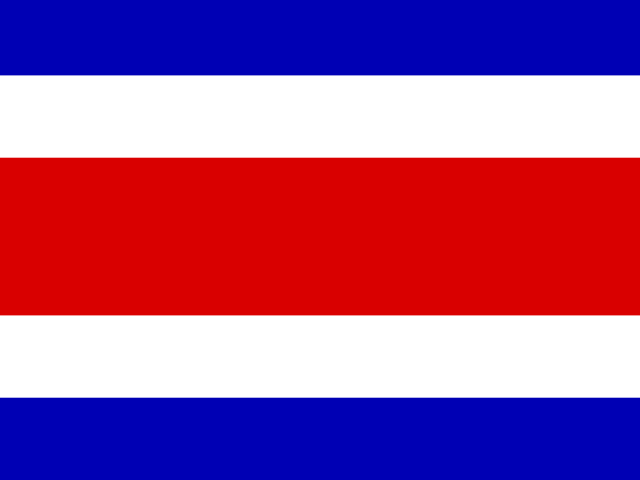
- Description: five horizontal bands of blue (top), white, red (double-width), white, and blue, with the coat of arms in a white elliptical disk placed toward the left side of the red bandMeaning: the blue is said to stand for the sky, opportunity, and perseverance; the white for peace, happiness, and wisdom; and the red for the blood shed for freedom, as well as Costa Ricans' generosity and vibrancyHistory: Costa Rica retained the earlier blue-white-blue flag of Central America until 1848 when, in response to revolutions in Europe, it was decided to incorporate the French colors by adding a central red stripe
- National symbols
- yiguirro (clay-colored thrush)
- National colours
- blue, white, red
- National anthem
- Title: "Himno Nacional de Costa Rica" (National Anthem of Costa Rica)Lyrics/music: Jose Maria ZELEDON Brenes/Manuel Maria GUTIERREZHistory: adopted 1949; the music was originally written for a welcome ceremony in 1852 for the US and UK diplomatic missions; the lyrics were added in 1900
- UNESCO World Heritage Sites
- Total World Heritage Sites: 4 (1 cultural, 3 natural)Selected World Heritage Site locales: Guanacaste Conservation Area (n); Cocos Island National Park (n); Precolumbian Stone Spheres (c); La Amistad International Park (n)
Economy
- Overview
- trade-based upper middle-income economy; green economy leader, having reversed deforestation; investing in blue economy infrastructure; declining poverty until hard impacts of COVID-19; lingering inequality and growing government debts have prompted a liquidity crisis
- GDP (PPP)
- $138.371 billion (2024 est.)
- GDP per person (PPP)
- $27,000 (2024 est.)
- GDP growth
- 4.3% (2024 est.)
- Inflation
- -0.4% (2024 est.)
- Unemployment
- 7.9% (2024 est.)
- Below poverty line
- 24.4% (2023 est.)
- Farm products
- sugarcane, pineapples, bananas, oil palm fruit, milk, fruits, oranges, chicken, cassava, beef (2023)
- Industries
- medical equipment, food processing, textiles and clothing, construction materials, fertilizer, plastic products
- Exports
- $36.77 billion (2024 est.)
- Main exports
- medical instruments, integrated circuits, orthopedic appliances, bananas, tropical fruits (2023)
- Export partners
- USA 40%, Netherlands 6%, China 5%, Guatemala 4%, Belgium 3% (2023)
- Main imports
- refined petroleum, plastic products, cars, medical instruments, broadcasting equipment (2023)
- Import partners
- USA 38%, China 15%, Mexico 6%, Brazil 3%, Guatemala 3% (2023)
- Money sent home from abroad
- 0.8% of GDP (2024 est.)
Energy, internet and transport
- Electricity access
- Electrification - total population: 100% (2022 est.)
- Electricity sources
- Fossil fuels: 0.1% of total installed capacity (2023 est.)Solar: 0.7% of total installed capacity (2023 est.)Wind: 12.7% of total installed capacity (2023 est.)Hydroelectricity: 72.9% of total installed capacity (2023 est.)Geothermal: 13.1% of total installed capacity (2023 est.)Biomass and waste: 0.5% of total installed capacity (2023 est.)
- Internet users
- Percent of population: 85% (2023 est.)
- Mobile phones
- Total subscriptions: 6.98 million (2024 est.)Subscriptions per 100 inhabitants: 136 (2024 est.)
- TV and radio
- over two dozen privately owned TV stations and 1 publicly owned TV station; cable network services are widely available; more than 100 privately owned radio stations and a public radio network (2022)
- Airports
- 132 (2025)
- Railways
- Total: 278 km (2014)Narrow gauge: 278 km (2014) 1.067-m gauge
- Merchant ships
- Total: 11 (2023)By type: other 11
Military and space
- Armed forces
- Ministry of Public Security (Ministerio de Seguridad Pública de Costa Rica): National Police (Fuerza Pública), Air Surveillance Service (Servicio de Vigilancia Aérea), National Coast Guard Service (Servicio Nacional de Guardacostas), Drug Control Police (Policía Control de Drogas), Border Police (Policia de Fronteras), Professional Migration Police (Policía Profesional de Migración)Ministry of Presidency: Directorate of Intelligence and Security (DIS), Special Intervention Unit (UEI) (2025)
- Military spending
- 0.6% of GDP (2024 est.)
- Space programme
- has a small, recently established program focused on using space to develop the country’s economy and industry, including acquiring and using satellites; has built a remote sensing (RS) cube satellite; has relations with US space agencies and commercial space industries, as well as with the ESA and the Latin American and Caribbean Space Agency (2025)
- Space milestones
- 2018 - first domestically produced remote sensing cube satellite (Irazú) for monitoring tropical forests and climate change launched by US and deployed from the International Space Station2021 - signed protocols for newly established Latin American and Caribbean Space Agency; opened US commercial company’s space radar facility for mapping and space situational awareness2022 - domestically produced scientific device (Proyecto Musa or Musa Project) launched on European rocket2024 - participated in first China-Latin America and the Caribbean Space Cooperation Forum
Global issues
- Refugees and displaced people
- Refugees: 249,521 (2024 est.)IDPs: 58 (2024 est.)Stateless persons: 345 (2024 est.)
- Drug trade
- USG identification: major illicit drug-producing and/or drug-transit countrymajor precursor-chemical producer (2025)
Neighbouring countries
- Phone code
- +506
- Internet domain
- .cr