Nicaragua
Republic of Nicaragua
The Somoza dictatorship fell to the Sandinistas in 1979. The current government has jailed or exiled most opponents.
See Nicaragua on the 3D globeTake a quiz
Population7 million
Area130,373 km²
CapitalManagua
RegionCentral America
Did you know?
- Lake Nicaragua has freshwater sharks
- You can sandboard down an active volcano
- Largest country in Central America
Key facts about Nicaragua
- Government
- Presidential republic (authoritarian co-presidency)
- Religion
- Catholic ~45%, Evangelical ~35%
- Founded / independence
- 1821 (from Spain)
- Rich in
- Gold, coffee, beef
- Languages
- Spanish
Spanish; Miskito, Creole English - Currency
- Nicaraguan córdoba (C$)
- People are called
- Nicaraguan
- Main cities
- Managua, León, Masaya, Granada
Timeline of Nicaragua
- 1524Spanish conquest
- 1821Independence
- 1937Somoza era
- 1979Sandinista revolution
- 1990Elections
- 2018Protests crushed
Places to see in Nicaragua
- Granada colonial town
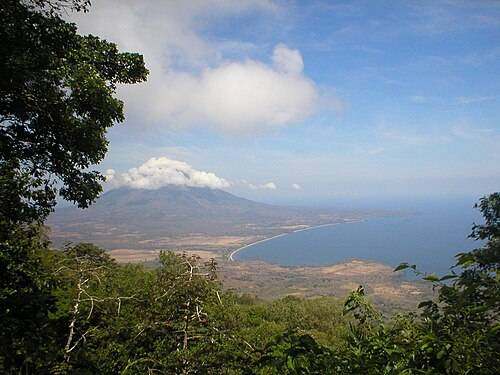
- Ometepe Island
- Masaya volcano
- León
- Corn Islands
Food and drink
Gallo pinto · nacatamal · vigorón
Culture and famous for
Poet Rubén Darío; volcano boarding at Cerro Negro
Popular sports
Baseball, boxing
Geography and climate
- Highest point
- Mogotón, 2,107 m
- Rivers, lakes and seas
- Lake Nicaragua (Central America's largest); San Juan River
- Climate
- Tropical
- Coastline
- Has a sea coast
- Population density
- 54 people per km²
Wars and conflicts
- US occupations
- Sandinista revolution 1979
- Contra War 1980s
- 2018 crackdown
Empires and states that once stood here
Federal Republic of Central America 1823–1841
Alliances and memberships
Political unions and regional organisations
Central American Integration SystemCELAC
Nicaragua in depth
Detailed facts from the CIA World Factbook (public domain, latest edition).
Overview
- History in brief
- The Pacific coast of Nicaragua was settled as a Spanish colony in the early 16th century. Independence from Spain was declared in 1821, and the country became an independent republic in 1838. Britain occupied the Caribbean Coast in the first half of the 19th century, but gradually ceded control of the region in subsequent decades. By 1978, violent opposition to governmental manipulation and corruption resulted in a short-lived civil war that brought a civil-military coalition to power in 1979, spearheaded by Marxist Sandinista guerrillas led by Daniel ORTEGA Saavedra. Nicaraguan aid to leftist rebels in El Salvador prompted the US to sponsor anti-Sandinista Contra guerrillas through much of the 1980s.After losing free and fair elections in 1990, 1996, and 2001, ORTEGA was elected president in 2006, 2011, 2016, and most recently in 2021. Municipal, regional, and national-level elections since 2008 have been marred by widespread irregularities. Democratic institutions have lost their independence under the ORTEGA regime as the president has assumed full control over all branches of government, as well as cracking down on a nationwide pro-democracy protest movement in 2018 and shuttering over 3,300 civil society organizations between 2018 and 2024. In the lead-up to the 2021 presidential election, authorities arrested over 40 individuals linked to the opposition, including presidential candidates, private sector leaders, NGO workers, human rights defenders, and journalists. Only five lesser-known presidential candidates from mostly small parties allied to ORTEGA's Sandinistas were allowed to run against ORTEGA. He then awarded the Sandinistas control of all 153 of Nicaraguan municipalities in the 2022 municipal elections, consolidating one-party rule.
Geography
- Location
- Central America, bordering both the Caribbean Sea and the North Pacific Ocean, between Costa Rica and Honduras
- Size compared
- slightly larger than Pennsylvania; slightly smaller than New York State
- Land borders
- Total: 1,253 kmBorder countries: Costa Rica 313 km; Honduras 940 km
- Coastline
- 910 km
- Climate
- tropical in lowlands, cooler in highlands
- Terrain
- extensive Atlantic coastal plains rising to central interior mountains; narrow Pacific coastal plain interrupted by volcanoes
- Elevation
- Highest point: Mogoton 2,085 mLowest point: Pacific Ocean 0 mMean elevation: 298 m
- Natural resources
- gold, silver, copper, tungsten, lead, zinc, timber, fish
- Major lakes
- Fresh water lake(s): Lago de Nicaragua - 8,150 sq km; Lago de Managua - 1,040 sq km
- Natural hazards
- destructive earthquakes; volcanoes; landslides; extremely susceptible to hurricanesVolcanism: significant volcanic activity; Cerro Negro (728 m) is one of Nicaragua's most active volcanoes; its lava flows and ash have been known to cause significant damage to farmland and buildings; other historically active volcanoes include Concepcion, Cosiguina, Las Pilas, Masaya, Momotombo, San Cristobal, and Telica
- Notes
- largest country in Central America; contains the largest freshwater body in Central America, Lago de Nicaragua
- Environmental issues
- deforestation; soil erosion; water pollution; drought
People and society
- Population
- Total: 6,739,380 (2025 est.)Male: 3,304,133Female: 3,435,247
- Nationality
- Noun: Nicaraguan(s)Adjective: Nicaraguan
- Ethnic groups
- Mestizo (mixed Indigenous and White) 69%, White 17%, Black 9%, Indigenous 5%
- Languages
- Spanish (official) 99.5%, Indigenous 0.3%, Portuguese 0.1%, other 0.1% (2020 est.)Major-language sample(s): La Libreta Informativa del Mundo, la fuente indispensable de información básica. (Spanish)The World Factbook, the indispensable source for basic information.
- Religions
- Roman Catholic 44.9%, Protestant 38.7% (Evangelical 38.2, Adventist 0.5%), other 1.2%, (includes Jehovah's Witness and Church of Jesus Christ), believer but not belonging to a church 1%, agnostic or atheist 0.4%, none 13.7%, unspecified 0.2% (2020 est.)
- Median age
- Total: 29.5 years (2025 est.)Male: 28.1 yearsFemale: 29.9 years
- Population growth
- 0.92% (2025 est.)
- Life expectancy
- Total population: 74.7 years (2024 est.)Male: 73.2 yearsFemale: 76.4 years
- Children per woman
- 1.82 children born/woman (2025 est.)
- Urbanization
- Urban population: 59.8% of total population (2023)Rate of urbanization: 1.45% annual rate of change (2020-25 est.)
- Largest cities
- 1.095 million MANAGUA (capital) (2023)
- Years in school
- Total: 12 years (2023 est.)Male: 12 years (2023 est.)Female: 12 years (2023 est.)
Government
- Official names
- Conventional long form: Republic of NicaraguaConventional short form: NicaraguaLocal long form: República de NicaraguaLocal short form: NicaraguaEtymology: 16th-century Spanish explorer Gil GONZALEZ Davila is said to have combined the name of a local chieftain, Nicarao, with the Spanish word agua (water), referring to the two large lakes in the west of the country (Lake Managua and Lake Nicaragua)
- Government type
- presidential republic
- Capital
- Name: ManaguaGeographic coordinates: 12 08 N, 86 15 WTime difference: UTC-6 (1 hour behind Washington, DC, during Standard Time)Etymology: the name comes from Lake Managua, whose name is composed of the Guaraní words ama (rain) and nagua (spirit) and refers to a local deity
- Regions
- 15 departments (departamentos, singular - departamento) and 2 autonomous regions* (regiones autonomistas, singular - region autonoma); Boaco, Carazo, Chinandega, Chontales, Costa Caribe Norte*, Costa Caribe Sur*, Estelí, Granada, Jinotega, Leon, Madriz, Managua, Masaya, Matagalpa, Nueva Segovia, Rio San Juan, Rivas
- Independence
- 15 September 1821 (from Spain)
- National holiday
- Independence Day, 15 September (1821)
- Constitution
- History: several previous; latest adopted 19 November 1986, effective 9 January 1987Amendment process: proposed by the president of the republic or assent of at least half of the National Assembly membership; passage requires approval by 60% of the membership of the next elected Assembly and promulgation by the president of the republic
- Legal system
- civil law system; Supreme Court may review administrative acts
- Voting age
- 16 years of age; universal
- Flag meaning
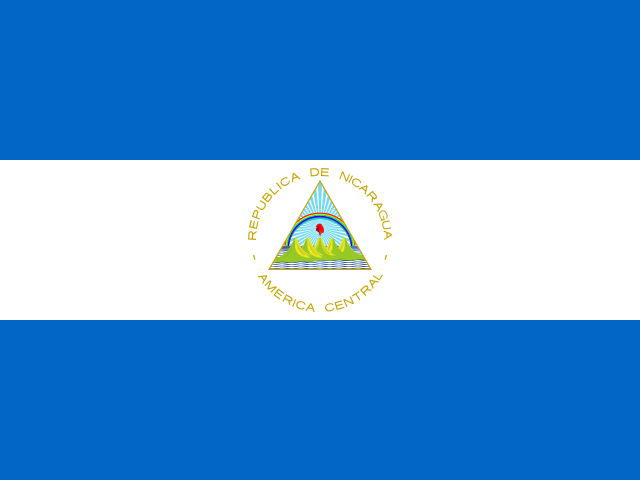
- Description: three equal horizontal bands of blue (top), white, and blue, with the national coat of arms centered in the white band; the coat of arms has a triangle with the words REPUBLICA DE NICARAGUA in an arc over it and AMERICA CENTRAL in an arc underneathMeaning: blue stands for the Pacific Ocean and the Caribbean Sea, and white for the land between the two bodies of waterHistory: the banner is based on the former blue-white-blue flag of the Federal Republic of Central America
- National symbols
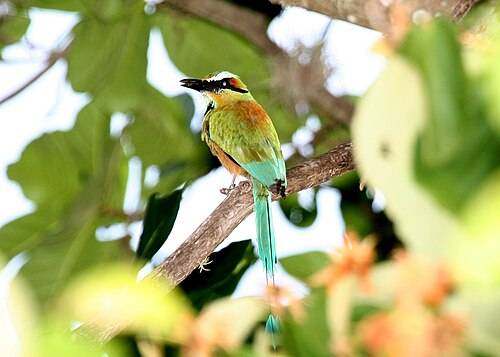
- turquoise-browed motmot (bird)
- National colours
- blue, white
- National anthem
- Title: "Salve a ti, Nicaragua" (Hail to Thee, Nicaragua)Lyrics/music: Salomon Ibarra MAYORGA/traditional, arranged by Luis Abraham DELGADILLOHistory: music was approved in 1918 and the lyrics in 1939
- UNESCO World Heritage Sites
- Total World Heritage Sites: 2 (both cultural)Selected World Heritage Site locales: Ruins of León Viejo; León Cathedral
Economy
- Overview
- low-income Central American economy; until 2018, nearly 20 years of sustained GDP growth; recent struggles due to COVID-19, political instability, and hurricanes; significant remittances; increasing poverty and food scarcity since 2005; sanctions limit investment
- GDP (PPP)
- $52.989 billion (2024 est.)
- GDP per person (PPP)
- $7,700 (2024 est.)
- GDP growth
- 3.6% (2024 est.)
- Inflation
- 4.6% (2024 est.)
- Unemployment
- 4.6% (2024 est.)
- Below poverty line
- 24.9% (2016 est.)
- Farm products
- sugarcane, milk, rice, oil palm fruit, maize, plantains, cassava, groundnuts, beans, chicken (2023)
- Industries
- food processing, chemicals, machinery and metal products, knit and woven apparel, petroleum refining and distribution, beverages, footwear, wood, electric wire harness manufacturing, mining
- Exports
- $8.135 billion (2024 est.)
- Main exports
- garments, gold, insulated wire, coffee, beef (2023)
- Export partners
- USA 51%, Mexico 12%, El Salvador 6%, Canada 6%, Switzerland 4% (2023)
- Main imports
- garments, refined petroleum, crude petroleum, plastic products, fabric (2023)
- Import partners
- USA 24%, China 13%, Mexico 9%, Honduras 9%, Guatemala 8% (2023)
- Money sent home from abroad
- 26.6% of GDP (2024 est.)
Energy, internet and transport
- Electricity access
- Electrification - total population: 86.5% (2022 est.)Electrification - urban areas: 100%Electrification - rural areas: 66.3%
- Electricity sources
- Fossil fuels: 35.5% of total installed capacity (2023 est.)Solar: 0.6% of total installed capacity (2023 est.)Wind: 12.9% of total installed capacity (2023 est.)Hydroelectricity: 14.9% of total installed capacity (2023 est.)Geothermal: 15.7% of total installed capacity (2023 est.)Biomass and waste: 20.4% of total installed capacity (2023 est.)
- Internet users
- Percent of population: 58% (2023 est.)
- Mobile phones
- Total subscriptions: 7.33 million (2024 est.)Subscriptions per 100 inhabitants: 106 (2024 est.)
- TV and radio
- multiple terrestrial TV stations, supplemented by cable TV in most urban areas; nearly all are state-owned or affiliated; more than 300 radio stations, both state-affiliated and privately owned (2019)
- Airports
- 39 (2025)
- Merchant ships
- Total: 5 (2023)By type: general cargo 1, oil tanker 1, other 3
Military and space
- Armed forces
- Armed Forces of Nicaragua (formal name is Army of Nicaragua or Ejercito de Nicaragua, EN): Land Force; Naval Force; Air Force (2025)
- Military spending
- 0.5% of GDP (2024 est.)
- Military service
- 18-30 years of age for voluntary military service (16-20 for cadets); no conscription; tour of duty 18-36 months (2025)
- Space programme
- stated mission is to promote the development of space activities with the aim of broadening the country’s capacities in education, industry, science, and technology; has cooperated with China and Russia; is a signatory of the convention establishing the Latin American and Caribbean Space Agency (2025)
- Space milestones
- 1994 - joined UN Committee on the Peaceful Uses of Outer Space2017 - Russia opened a satellite navigation system monitoring station in Nicaragua2021 - signed convention establishing the Latin American and Caribbean Space Agency2024 - joined the China-led International Lunar Research Station project, which aims to establish a permanent base on the Moon by the 2030s
Global issues
- Refugees and displaced people
- IDPs: 89 (2024 est.)
- Drug trade
- USG identification: major illicit drug-producing and/or drug-transit country (2025)
Neighbouring countries
- Phone code
- +505
- Internet domain
- .ni