Panama
Republic of Panama · Panamá
Broke from Colombia with US help to build the canal. The US handed the canal over in 1999.
See Panama on the 3D globeTake a quiz
Population4.5 million
Area75,417 km²
CapitalPanama City
RegionCentral America
Did you know?
- The canal saves ships about 13,000 km of sailing
- You can see the sun rise over the Pacific
- Uses the US dollar
Key facts about Panama
- Government
- Presidential republic
- Religion
- Catholic ~63%, Evangelical ~25%
- Founded / independence
- 1903 (from Colombia)
- Rich in
- Panama Canal, banking, shipping registry
- Languages
- Spanish
Spanish; Ngäbere, Kuna - Currency
- Panamanian balboa (B/.), United States dollar ($)
- People are called
- Panamanian
- Main cities
- Panama City, San Miguelito, Colón, David
Timeline of Panama
- 1513Balboa sights the Pacific
- 1903Independence
- 1914Canal opens
- 1989US invasion
- 1999Canal handed over
Places to see in Panama
- Panama Canal (Miraflores Locks)
- Casco Viejo
- San Blas Islands
- Bocas del Toro
- Boquete
Food and drink
Sancocho · patacones · ceviche
Culture and famous for
Guna molas textiles; Panama hats sold here
Popular sports
Baseball, football, boxing
Geography and climate
- Highest point
- Volcán Barú, 3,475 m
- Rivers, lakes and seas
- Chagres River
- Climate
- Tropical
- Coastline
- Has a sea coast
- Population density
- 60 people per km²
Wars and conflicts
- US invasion 1989
Empires and states that once stood here
Alliances and memberships
Military and security
Political unions and regional organisations
Central American Integration SystemCELACOrganization of American States
Panama in depth
Detailed facts from the CIA World Factbook (public domain, latest edition).
Overview
- History in brief
- Explored and settled by the Spanish in the 16th century, Panama broke with Spain in 1821 and joined a union of Colombia, Ecuador, and Venezuela that was named the Republic of Gran Colombia. When the union dissolved in 1830, Panama remained part of Colombia. With US backing, Panama seceded from Colombia in 1903 and promptly signed a treaty with the US allowing for the construction of a canal and US sovereignty over a strip of land known as the Panama Canal Zone on either side of the structure. The US Army Corps of Engineers built the Panama Canal between 1904 and 1914. In 1977, an agreement was signed for the complete transfer of the Canal from the US to Panama by the end of the century. Certain portions of the Zone and increasing responsibility over the Canal were turned over in the subsequent decades. With US help, Panamanian dictator Manuel NORIEGA was deposed in 1989. The entire Panama Canal, the area supporting the Canal, and remaining US military bases were transferred to Panama by the end of 1999. An ambitious expansion project to more than double the Canal's capacity by allowing for more Canal transits and larger ships was carried out between 2007 and 2016.
Geography
- Location
- Central America, bordering both the Caribbean Sea and the North Pacific Ocean, between Colombia and Costa Rica
- Size compared
- slightly smaller than South Carolina
- Land borders
- Total: 687 kmBorder countries: Colombia 339 km; Costa Rica 348 km
- Coastline
- 2,490 km
- Climate
- tropical maritime; hot, humid, cloudy; prolonged rainy season (May to January), short dry season (January to May)
- Terrain
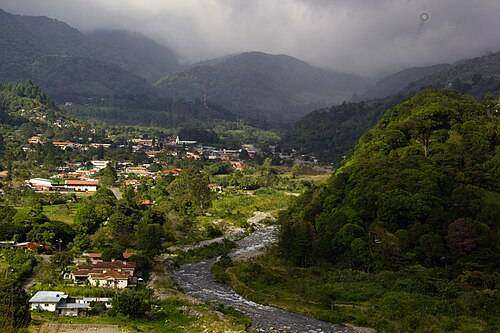
- interior mostly steep, rugged mountains with dissected, upland plains; coastal plains with rolling hills
- Elevation
- Highest point: Volcan Baru 3,475 mLowest point: Pacific Ocean 0 mMean elevation: 360 m
- Natural resources
- copper, mahogany forests, shrimp, hydropower
- Major lakes
- Salt water lake(s): Laguna de Chiriqui - 900 sq km
- Natural hazards
- occasional severe storms and forest fires in the Darien area
- Notes
- strategic location on eastern end of isthmus forming land bridge that connects North and South America; controls the Panama Canal, which links the North Atlantic Ocean with the North Pacific Ocean via the Caribbean Sea
- Environmental issues
- water pollution from agricultural runoff; deforestation of tropical rainforest; land degradation and soil erosion in Panama Canal; air pollution in urban areas; effects of mining
People and society
- Population
- Total: 4,536,008 (2025 est.)Male: 2,284,105Female: 2,251,903
- Nationality
- Noun: Panamanian(s)Adjective: Panamanian
- Ethnic groups
- Mestizo (mixed Indigenous and White) 65%, Indigenous 12.3% (Ngabe 7.6%, Kuna 2.4%, Embera 0.9%, Bugle 0.8%, other 0.4%, unspecified 0.2%), Black or African descent 9.2%, Mulatto 6.8%, White 6.7% (2010 est.)
- Languages
- Spanish (official), Indigenous languages (including Ngabere (Guaymi), Buglere, Kuna, Embera, Wounaan, Naso (Teribe), and Bri Bri), Panamanian English Creole (a mixture of English and Spanish with elements of Ngabere, also known as Guari Guari and Colon Creole), English, Chinese (Yue and Hakka), Arabic, French Creole, other (Yiddish, Hebrew, Korean, Japanese)Major-language sample(s): La Libreta Informativa del Mundo, la fuente indispensable de información básica. (Spanish)The World Factbook, the indispensable source for basic information.
- Religions
- Evangelical 55%, Roman Catholic 33.4%, none 10.1%, unspecified 1.5% (2023 est.)
- Median age
- Total: 31.7 years (2025 est.)Male: 31 yearsFemale: 31.9 years
- Population growth
- 1.44% (2025 est.)
- Life expectancy
- Total population: 79.2 years (2024 est.)Male: 76.4 yearsFemale: 82.2 years
- Children per woman
- 2.33 children born/woman (2025 est.)
- Urbanization
- Urban population: 69.5% of total population (2023)Rate of urbanization: 1.92% annual rate of change (2020-25 est.)
- Largest cities
- 1.977 million PANAMA CITY (capital) (2023)
- Literacy
- Total population: 96.3% (2024 est.)Male: 97.3% (2024 est.)Female: 95.9% (2024 est.)
- Years in school
- Total: 13 years (2016 est.)Male: 12 years (2016 est.)Female: 14 years (2016 est.)
Government
- Official names
- Conventional long form: Republic of PanamaConventional short form: PanamaLocal long form: República de PanamaLocal short form: PanamaEtymology: origin is unclear; may come from a Guarani word meaning "place of many fish"
- Government type
- presidential republic
- Capital
- Name: Panama CityGeographic coordinates: 8 58 N, 79 32 WTime difference: UTC-5 (same time as Washington, DC, during Standard Time)Etymology: origin is unclear; may come from a Guaraní word meaning "place of many fish"
- Regions
- 10 provinces (provincias, singular - provincia) and 4 indigenous regions* (comarcas); Bocas del Toro, Chiriquí, Coclé, Colon, Darien, Embera-Wounaan*, Guna Yala*, Herrera, Los Santos, Naso Tjer Di*, Ngabe-Bugle*, Panama, Panama Oeste, Veraguas
- Independence
- 3 November 1903 (from Colombia); 28 November 1821 (from Spain)
- National holiday
- Independence Day (Separation Day), 3 November (1903)
- Constitution
- History: several previous; latest effective 11 October 1972Amendment process: proposed by the National Assembly, by the Cabinet, or by the Supreme Court of Justice; passage requires approval by one of two procedures: 1) absolute majority vote of the Assembly membership in each of three readings and by absolute majority vote of the next elected Assembly in a single reading without textual modifications; 2) absolute majority vote of the Assembly membership in each of three readings, followed by absolute majority vote of the next elected Assembly in each of three readings with textual modifications, and approval in a referendum
- Legal system
- civil law system; Supreme Court of Justice reviews legislative acts
- Voting age
- 18 years of age; universal
- Flag meaning
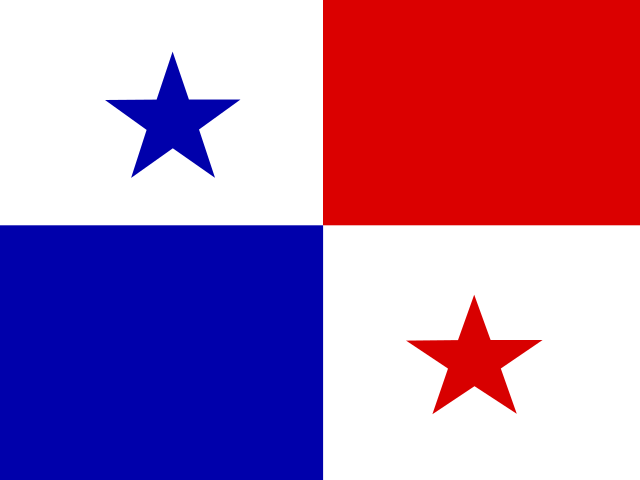
- Description: divided into four equal rectangles; one of the top quadrants is white (left side) with a five-pointed blue star in the center, and the other is plain red; one of the bottom quadrants is plain blue (left side), and the other is white with a five-pointed red star in the centerMeaning: blue and red stand for the main political parties, and white for peace between them; the blue star stands for the civic virtues of purity and honesty, and the red star for authority and law
- National symbols
- harpy eagle
- National colours
- blue, white, red
- National anthem
- Title: "Himno Istmeno" (Isthmus Hymn)Lyrics/music: Jeronimo DE LA OSSA/Santos A. JORGEHistory: adopted 1925
- UNESCO World Heritage Sites
- Total World Heritage Sites: 6 (3 cultural, 3 natural)Selected World Heritage Site locales: Caribbean Fortifications (c); Darien National Park (n); Talamanca Range-La Amistad National Park (n); Panamá Viejo and Historic District of Panamá (c); Coiba National Park (n); The Colonial Transisthmian Route of Panamá (c)
Economy
- Overview
- upper middle-income Central American economy; increasing Chinese trade; US dollar user; canal expansion fueling broader infrastructure investment; services sector dominates economy; historic money-laundering and illegal drug hub
- GDP (PPP)
- $164.484 billion (2024 est.)
- GDP per person (PPP)
- $36,400 (2024 est.)
- GDP growth
- 2.9% (2024 est.)
- Inflation
- 0.7% (2024 est.)
- Unemployment
- 6.6% (2024 est.)
- Below poverty line
- 21.8% (2021 est.)
- Farm products
- sugarcane, rice, bananas, oranges, oil palm fruit, chicken, plantains, maize, milk, pineapples (2023)
- Industries
- construction, brewing, cement and other construction materials, sugar milling
- Exports
- $37.376 billion (2024 est.)
- Main exports
- copper ore, ships, refined petroleum, bananas, fish (2023)
- Export partners
- China 25%, Japan 10%, USA 6%, Thailand 5%, Costa Rica 5% (2023)
- Main imports
- crude petroleum, ships, refined petroleum, nitrogen compounds, cars (2023)
- Import partners
- USA 15%, Colombia 13%, China 13%, Ecuador 13%, Japan 11% (2023)
- Money sent home from abroad
- 0.6% of GDP (2024 est.)
Energy, internet and transport
- Electricity access
- Electrification - total population: 95% (2022 est.)Electrification - urban areas: 99%Electrification - rural areas: 100%
- Electricity sources
- Fossil fuels: 38.2% of total installed capacity (2023 est.)Solar: 6.8% of total installed capacity (2023 est.)Wind: 6.9% of total installed capacity (2023 est.)Hydroelectricity: 47.8% of total installed capacity (2023 est.)Biomass and waste: 0.3% of total installed capacity (2023 est.)
- Internet users
- Percent of population: 78% (2023 est.)
- Mobile phones
- Total subscriptions: 6.98 million (2023 est.)Subscriptions per 100 inhabitants: 157 (2023 est.)
- TV and radio
- multiple privately owned TV networks and a government-owned educational TV station; multi-channel cable and satellite TV subscription services are available; more than 100 commercial radio stations (2019)
- Airports
- 77 (2025)
- Railways
- Total: 77 km (2014)Standard gauge: 77 km (2014) 1.435-m gauge
- Merchant ships
- Total: 8,174 (2023)By type: bulk carrier 2732, container ship 671, general cargo 1,428, oil tanker 866, other 2,477
Military and space
- Armed forces
- no regular military forcesMinistry of Public Security: National Police (Policía Nacional, PN), National Aeronaval Service (Servicio Nacional Aeronaval, SENAN), National Border Service (Servicio Nacional de Fronteras, SENAFRONT) (2025)
- Military spending
- 1.1% of GDP (2024 est.)
Global issues
- Refugees and displaced people
- Refugees: 10,801 (2024 est.)Stateless persons: 928 (2024 est.)
- Drug trade
- USG identification: major illicit drug-producing and/or drug-transit country (2025)
Neighbouring countries
- Phone code
- +507
- Internet domain
- .pa