Eswatini
Kingdom of Eswatini · eSwatini
One of the last absolute monarchies; renamed from Swaziland to Eswatini in 2018.
See Eswatini on the 3D globeTake a quiz
Population1.2 million
Area17,364 km²
CapitalLobamba
RegionSouthern Africa
Did you know?
- Sibebe is one of the largest granite monoliths in the world
- The king has many wives
- One of Africa's last absolute monarchies
Key facts about Eswatini
- Government
- Absolute monarchy
- Religion
- Christian ~90%
- Founded / independence
- 1968 (from UK)
- Rich in
- Sugar, soft drink concentrate, forestry
- Languages
- English, Swazi
Swazi (siSwati) and English - Currency
- Swazi lilangeni (L), South African rand (R)
- People are called
- Swazi
- Main cities
- Mbabane, Manzini, Lobamba
Timeline of Eswatini
- 1745Kingdom founded
- 1903British protectorate
- 1968Independence
- 2018Renamed Eswatini
Places to see in Eswatini
- Mlilwane Wildlife Sanctuary
- Hlane Royal Park
- Ezulwini Valley
- Sibebe Rock
Food and drink
Sishwala (maize porridge) · karoo lamb
Culture and famous for
Umhlanga Reed Dance; Incwala festival
Popular sports
Football
Geography and climate
- Highest point
- Emlembe, 1,862 m
- Rivers, lakes and seas
- Lusutfu River
- Climate
- Subtropical
- Coastline
- Landlocked
- Population density
- 69 people per km²
Wars and conflicts
- None significant
Alliances and memberships
Political unions and regional organisations
African UnionSADCCommonwealth of Nations
Eswatini in depth
Detailed facts from the CIA World Factbook (public domain, latest edition).
Overview
- History in brief
- A Swazi kingdom was founded in the mid-18th century and ruled by a series of kings, including MSWATI II, a 19th century ruler whose name was adopted for the country and its predominant ethnic group. European countries defined the kingdom’s modern borders during the late-19th century, and Swaziland (as it became known) was administered as a UK high commission territory from 1903 until its independence in 1968. A new constitution that came into effect in 2005 included provisions for a more independent parliament and judiciary, but the legal status of political parties remains unclear, and the kingdom is still considered an absolute monarchy. King MSWATI III renamed the country from Swaziland to Eswatini in 2018 to reflect the name most commonly used by its citizens.In 2021, MSWATI III used security forces to suppress prodemocracy protests. A national dialogue and reconciliation process agreed to in the wake of violence has not materialized. In November 2023, King MSWATI III appointed a new prime minister following peaceful national elections. Despite its classification as a lower-middle income country, Eswatini suffers from severe poverty, corruption, and high unemployment. Eswatini has the world's highest HIV/AIDS prevalence rate, although recent years have shown marked declines in new infections. Eswatini is the only country in Africa that recognizes Taiwan.
Geography
- Location
- Southern Africa, between Mozambique and South Africa
- Size compared
- slightly smaller than New Jersey
- Land borders
- Total: 546 kmBorder countries: Mozambique 108 km; South Africa 438 km
- Coastline
- 0 km (landlocked)
- Climate
- varies from tropical to near temperate
- Terrain
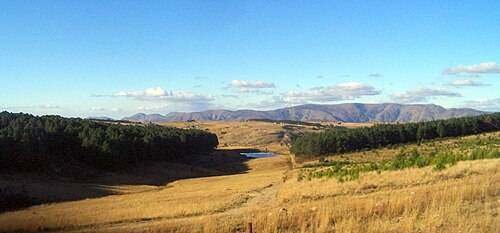
- mostly mountains and hills; some moderately sloping plains
- Elevation
- Highest point: Emlembe 1,862 mLowest point: Great Usutu River 21 mMean elevation: 305 m
- Natural resources
- asbestos, coal, clay, cassiterite, hydropower, forests, small gold and diamond deposits, quarry stone, and talc
- Natural hazards
- drought
- Notes
- landlocked; almost completely surrounded by South Africa
- Environmental issues
- limited supplies of potable water; overhunting depleting wildlife; population growth, deforestation, and overgrazing lead to soil erosion and soil degradation
People and society
- Population
- Total: 1,137,268 (2025 est.)Male: 557,204Female: 580,064
- Nationality
- Noun: liSwati (singular), emaSwati (plural); note - former term, Swazi(s), still used among English speakersAdjective: Swati; note - former term, Swazi, still used among English speakers
- Ethnic groups
- predominantly Swazi; smaller populations of other African ethnic groups, including the Zulu, as well as people of European ancestry
- Languages
- English (official, used for government business), siSwati (official)
- Religions
- Christian 90% (Zionist - a blend of Christianity and traditional African religions - 40%, Roman Catholic 20%, other Christian 30% - includes Anglican, Methodist, Church of Jesus Christ, Jehovah's Witness), Muslim 2%, other 8% (includes Baha'i, Buddhist, Hindu, indigenous, Jewish) (2015 est.)
- Median age
- Total: 24.8 years (2025 est.)Male: 23.4 yearsFemale: 25.8 years
- Population growth
- 0.87% (2025 est.)
- Life expectancy
- Total population: 60.7 years (2024 est.)Male: 58.7 yearsFemale: 62.8 years
- Children per woman
- 2.64 children born/woman (2025 est.)
- Urbanization
- Urban population: 24.8% of total population (2023)Rate of urbanization: 2.42% annual rate of change (2020-25 est.)
- Largest cities
- 68,000 MBABANE (capital) (2018)
- Literacy
- Total population: 90.8% (2022 est.)Male: 91.1% (2022 est.)Female: 90.4% (2022 est.)
Government
- Official names
- Conventional long form: Kingdom of EswatiniConventional short form: EswatiniLocal long form: Umbuso weSwatiniLocal short form: eSwatiniFormer: SwazilandEtymology: the country name derives from 19th century King MSWATI II, under whose rule Swati territory was expanded and unified
- Government type
- absolute monarchy
- Capital
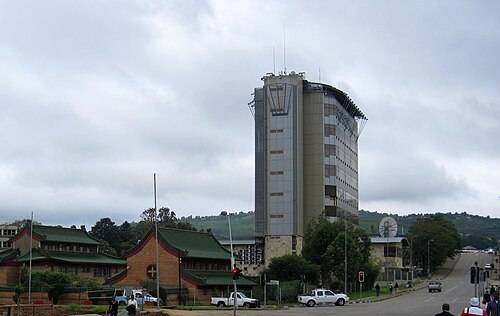
- Name: Mbabane (administrative capital); Lobamba (royal and legislative capital)Geographic coordinates: 26 19 S, 31 08 ETime difference: UTC+2 (7 hours ahead of Washington, DC, during Standard Time)Etymology: the origin of the name is unclear; it may come from the Mbabane River next to the city, whose name is said to derive from the word lubabe, a type of shrub; another theory cites a local chief, Mbabane KUNENE, as the source of the name
- Regions
- 4 regions; Hhohho, Lubombo, Manzini, Shiselweni
- Independence
- 6 September 1968 (from the UK)
- National holiday
- Independence Day (Somhlolo Day), 6 September (1968)
- Constitution
- History: previous 1968, 1978; latest signed by the king 26 July 2005, effective 8 February 2006Amendment process: proposed at a joint sitting of both houses of Parliament; passage requires majority vote by both houses and/or majority vote in a referendum, and assent of the king; passage of amendments affecting "specially entrenched" constitutional provisions requires at least three-fourths majority vote by both houses, passage by simple majority vote in a referendum, and assent of the king; passage of "entrenched" provisions requires at least two-thirds majority vote of both houses, passage in a referendum, and assent of the king
- Legal system
- mixed system of civil, common, and customary law
- Voting age
- 18 years of age
- Flag meaning
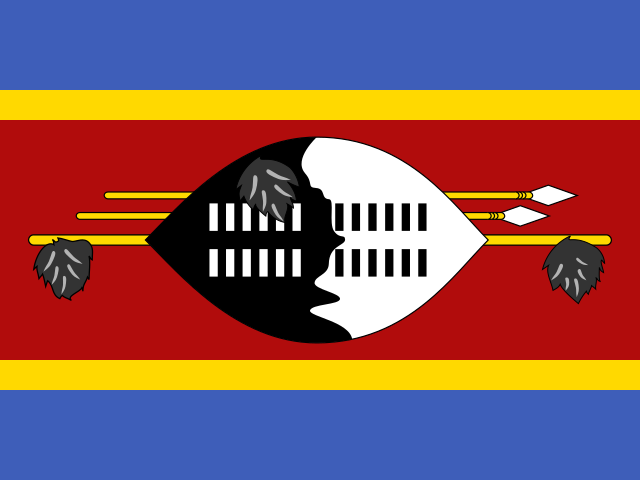
- Description: three horizontal bands of blue (top), red (triple-width), and blue; the red band is edged in yellow, with a large black-and-white shield in the center that covers two horizontal spears and a staff with feather tasselsMeaning: blue stands for peace and stability, red for past struggles, and yellow for the mineral resources of the country; the shield, spears, and staff symbolize protection from enemies, and the shield colors stand for ethnic groups living in peaceful coexistence
- National symbols
- lion, elephant
- National colours
- blue, yellow, red
- National anthem
- Title: "Nkulunkulu Mnikati wetibusiso temaSwati" (O God, Bestower of the Blessings of the Swazi)Lyrics/music: Andrease Enoke Fanyana SIMELANE/David Kenneth RYCROFTHistory: adopted 1968; uses elements of both ethnic Swazi and Western music styles
Economy
- Overview
- landlocked southern African economy; South African trade dependent and currency pegging; CMA and SACU member state; COVID-19 economic slowdown; growing utilities inflation; persistent poverty and unemployment; HIV/AIDS labor force disruptions
- GDP (PPP)
- $12.885 billion (2024 est.)
- GDP per person (PPP)
- $10,400 (2024 est.)
- GDP growth
- 2.6% (2024 est.)
- Inflation
- 2.6% (2019 est.)
- Unemployment
- 34.4% (2024 est.)
- Below poverty line
- 58.9% (2016 est.)
- Farm products
- sugarcane, maize, root vegetables, grapefruits, oranges, milk, pineapples, bananas, beef, sweet potatoes (2023)
- Industries
- soft drink concentrates, coal, forestry, sugar processing, textiles, and apparel
- Exports
- $2.174 billion (2023 est.)
- Main exports
- scented mixtures, raw sugar, industrial acids/oils/alcohols, garments, wood (2023)
- Export partners
- South Africa 61%, Ireland 4%, Mozambique 4%, Kenya 4%, Nigeria 3% (2023)
- Main imports
- refined petroleum, electricity, plastic products, cotton fabric, garments (2023)
- Import partners
- South Africa 71%, China 8%, India 4%, USA 2%, Mozambique 1% (2023)
- Money sent home from abroad
- 1.7% of GDP (2023 est.)
Energy, internet and transport
- Electricity access
- Electrification - total population: 82.3% (2022 est.)Electrification - urban areas: 86.1%Electrification - rural areas: 81.6%
- Electricity sources
- Fossil fuels: 3.1% of total installed capacity (2023 est.)Solar: 4.9% of total installed capacity (2023 est.)Hydroelectricity: 54.4% of total installed capacity (2023 est.)Biomass and waste: 37.6% of total installed capacity (2023 est.)
- Internet users
- Percent of population: 58% (2023 est.)
- Mobile phones
- Total subscriptions: 1.74 million (2024 est.)Subscriptions per 100 inhabitants: 140 (2024 est.)
- TV and radio
- 1 state-owned TV station; satellite dishes can access South African providers; state-owned radio network with 3 channels; 1 private radio station (2019)
- Airports
- 16 (2025)
- Railways
- Total: 301 km (2014)Narrow gauge: 301 km (2014) 1.067-m gauge
Military and space
- Armed forces
- Umbutfo Eswatini Defense Force (UEDF): Army (includes a small air wing); the Royal Eswatini Police Service (REPS) (2025)
- Military spending
- 1.4% of GDP (2024 est.)
- Military service
- 18-35 years of age for voluntary military service for men and women; no conscription (2025)
Global issues
- Refugees and displaced people
- Refugees: 4,459 (2024 est.)IDPs: 56 (2024 est.)
Neighbouring countries
- Phone code
- +268
- Internet domain
- .sz