Mozambique
Republic of Mozambique · Moçambique
Swahili trading coast, then Portuguese for 470 years. A civil war killed about a million. Post-election protests in 2024 were deadly.
See Mozambique on the 3D globeTake a quiz
Population35 million
Area801,590 km²
CapitalMaputo
RegionEastern Africa
Did you know?
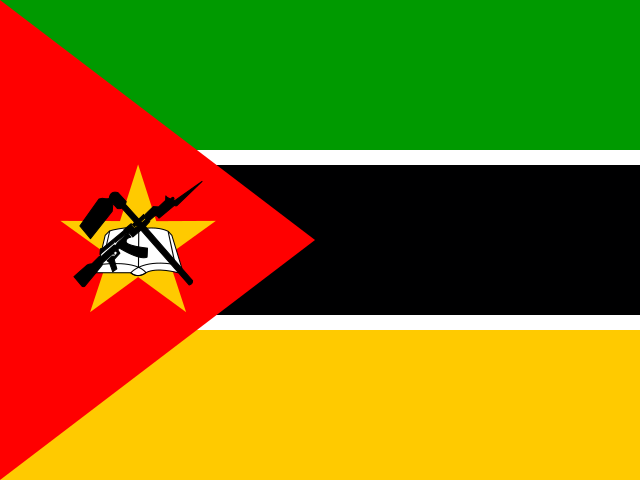
- The only country with an AK-47 on its flag
- Gorongosa park has been restored after war
- Has over 2,500 km of coastline
Key facts about Mozambique
- Government
- Presidential republic
- Religion
- Christian ~60%, Islam ~19%
- Founded / independence
- 1975 (from Portugal)
- Rich in
- Natural gas (LNG), coal, aluminium, rubies
- Languages
- Portuguese
Portuguese; Makhuwa, Tsonga, Sena, Swahili - Currency
- Mozambican metical (MT)
- People are called
- Mozambican
- Main cities
- Maputo, Matola, Beira, Nampula
Timeline of Mozambique
- 1498Vasco da Gama arrives
- 1505Portuguese rule
- 1975Independence
- 1992Civil war ends
- 2017Cabo Delgado insurgency
Places to see in Mozambique
- Bazaruto Archipelago
- Island of Mozambique
- Gorongosa National Park
- Maputo
Food and drink
Piri-piri chicken · matapa · prawns
Culture and famous for
Marrabenta music; Makonde carving
Popular sports
Football, athletics
Geography and climate
- Highest point
- Monte Binga, 2,436 m
- Rivers, lakes and seas
- Zambezi, Limpopo
- Climate
- Tropical
- Coastline
- Has a sea coast
- Population density
- 44 people per km²
Wars and conflicts
- Independence war 1964–74
- Civil War 1977–92
- Cabo Delgado insurgency 2017–present
Alliances and memberships
Political unions and regional organisations
African UnionSADCOrganisation of Islamic CooperationCommonwealth of Nations
Mozambique in depth
Detailed facts from the CIA World Factbook (public domain, latest edition).
Overview
- History in brief
- In the first half of the second millennium A.D., northern Mozambican port towns were frequented by traders from Somalia, Ethiopia, Egypt, Arabia, Persia, and India. The Portuguese were able to wrest much of the coastal trade from Arab Muslims in the centuries after 1500, and they set up their own colonies. Portugal did not relinquish Mozambique until 1975. Large-scale emigration, economic dependence on South Africa, a severe drought, and a prolonged civil war hindered the country's development until the mid-1990s.The ruling Front for the Liberation of Mozambique (FRELIMO) party formally abandoned Marxism in 1989, and a new constitution the following year provided for multiparty elections and a free-market economy. A UN-negotiated peace agreement between FRELIMO and rebel Mozambique National Resistance (RENAMO) forces ended the fighting in 1992. In 2004, Mozambique underwent a delicate transition as Joaquim CHISSANO stepped down after 18 years in office. His elected successor, Armando GUEBUZA, served two terms and then passed executive power to Filipe NYUSI in 2015. RENAMO’s residual armed forces intermittently engaged in a low-level insurgency after 2012, but a 2016 cease-fire eventually led to the two sides signing a comprehensive peace deal in 2019.Since 2017, violent extremists -- who an official ISIS media outlet recognized as ISIS's network in Mozambique for the first time in 2019 -- have been conducting attacks against civilians and security services in the northern province of Cabo Delgado. In 2021, Rwanda and the Southern African Development Community deployed forces to support Mozambique’s efforts to counter the extremist group.
Geography
- Location
- Southeastern Africa, bordering the Mozambique Channel, between South Africa and Tanzania
- Size compared
- slightly more than five times the size of Georgia; slightly less than twice the size of California
- Land borders
- Total: 4,783 kmBorder countries: Malawi 1498 km; South Africa 496 km; Eswatini 108 km; Tanzania 840 km; Zambia 439 km; Zimbabwe 1,402 km
- Coastline
- 2,470 km
- Climate
- tropical to subtropical
- Terrain
- mostly coastal lowlands, uplands in center, high plateaus in northwest, mountains in west
- Elevation
- Highest point: Monte Binga 2,436 mLowest point: Indian Ocean 0 mMean elevation: 345 m
- Natural resources
- coal, titanium, natural gas, hydropower, tantalum, graphite
- Major rivers
- Rio Zambeze (Zambezi) river mouth (shared with Zambia [s]), Angola, Namibia, Botswana, and Zimbabwe) - 2,740 km; Rio Limpopo river mouth (shared with South Africa [s], Botswana, and Zimbabwe) - 1,800 kmNote: [s] after country name indicates river source; [m] after country name indicates river mouth
- Major lakes
- Fresh water lake(s): Lake Malawi (shared with Malawi and Tanzania) - 22,490
- Natural hazards
- severe droughts; devastating cyclones and floods in central and southern provinces
- Notes
- the Zambezi River flows through the north-central and most fertile part of the country
- Environmental issues
- increased population migration to urban and coastal areas; desertification; soil erosion; deforestation; water pollution from artisanal mining; pollution of surface and coastal waters; wildlife preservation (elephant poaching for ivory)
People and society
- Population
- Total: 34,206,144 (2025 est.)Male: 16,880,529Female: 17,325,615
- Nationality
- Noun: Mozambican(s)Adjective: Mozambican
- Ethnic groups
- African 99% (Makhuwa, Tsonga, Lomwe, Sena, and others), Mestizo 0.8%, other (includes European, Indian, Pakistani, Chinese) 0.2% (2017 est.)
- Languages
- Makhuwa 26.1%, Portuguese (official) 16.6%, Tsonga 8.6%, Nyanja 8.1, Sena 7.1%, Lomwe 7.1%, Chuwabo 4.7%, Ndau 3.8%, Tswa 3.8%, other Mozambican languages 11.8%, other 0.5%, unspecified 1.8% (2017 est.)
- Religions
- Catholic 27.3%, Islam 19.1%, Pentecostal 16.7%, Saio/Zione 16.3%, no religion 13.5%, other 4.3%, Anglican 1.7%, unknown 1.2% (2017 est.)
- Median age
- Total: 17.4 years (2025 est.)Male: 16.7 yearsFemale: 17.9 years
- Population growth
- 2.53% (2025 est.)
- Life expectancy
- Total population: 58.3 years (2024 est.)Male: 57.1 yearsFemale: 59.6 years
- Children per woman
- 4.58 children born/woman (2025 est.)
- Urbanization
- Urban population: 38.8% of total population (2023)Rate of urbanization: 4.24% annual rate of change (2020-25 est.)
- Largest cities
- 1.852 million Matola, 1.163 million MAPUTO (capital), 969,000 Nampula (2023)
- Literacy
- Total population: 61.7% (2022 est.)Male: 74.1% (2022 est.)Female: 50.9% (2022 est.)
- Years in school
- Total: 10 years (2017 est.)Male: 11 years (2017 est.)Female: 10 years (2017 est.)
Government
- Official names
- Conventional long form: Republic of MozambiqueConventional short form: MozambiqueLocal long form: Republica de MocambiqueLocal short form: MocambiqueFormer: Portuguese East Africa, People's Republic of MozambiqueEtymology: named for an offshore island; the island was named after Mussa bin BIQUE (or Mussa Ibn MALIK), an influential Arab slave trader who set himself up as sultan on the island in the 15th century
- Government type
- presidential republic
- Capital
- Name: MaputoGeographic coordinates: 25 57 S, 32 35 ETime difference: UTC+2 (7 hours ahead of Washington, DC, during Standard Time)Etymology: named after the Maputo River, which drains into Maputo Bay south of the city; the river is said to be named after the son of Muagobe, a local chief in the 18th century
- Regions
- 10 provinces (provincias, singular - provincia), 1 city (cidade)*; Cabo Delgado, Gaza, Inhambane, Manica, Maputo, Cidade de Maputo*, Nampula, Niassa, Sofala, Tete, Zambezia
- Independence
- 25 June 1975 (from Portugal)
- National holiday
- Independence Day, 25 June (1975)
- Constitution
- History: previous 1975, 1990; latest adopted 16 November 2004, effective 21 December 2004Amendment process: proposed by the president of the republic or supported by at least one third of the Assembly of the Republic membership; passage of amendments affecting constitutional provisions, including the independence and sovereignty of the state, the republican form of government, basic rights and freedoms, and universal suffrage, requires at least a two-thirds majority vote by the Assembly and approval in a referendum; referenda not required for passage of other amendments
- Legal system
- mixed system of Portuguese civil law and customary law
- Voting age
- 18 years of age; universal
- Flag meaning
- Description: three equal horizontal bands of green (top), black, and yellow, with a red isosceles triangle based on the left side; the black band is edged in white; centered in the triangle is a five-pointed yellow star with a crossed black-and-white rifle and hoe, on top of an open white bookMeaning: green stands for the riches of the land, white for peace, black for the African continent, yellow for the country's minerals, and red for the fight for independence; the rifle stands for defense and vigilance, the hoe for agriculture, the open book for the importance of education, and the star for Marxism and internationalism
- National symbols
- rifle, hoe, and book
- National colours
- green, black, yellow, white, red
- National anthem
- Title: “Pátria Amada” (Lovely Fatherland)Lyrics/music: Salomão J. MANHICA/unkownHistory: adopted 2002; the new anthem reflects the new multi-party political system
- UNESCO World Heritage Sites
- Total World Heritage Sites: 1 (cultural)Selected World Heritage Site locales: Island of Mozambique
Economy
- Overview
- low-income East African economy; subsistence farming dominates labor force; return to growth led by agriculture and extractive industries; Islamist insurgency threatens natural gas projects in north; ongoing foreign debt restructuring and resolution under IMF Highly Indebted Poor Countries (HIPC) initiative
- GDP (PPP)
- $51.786 billion (2024 est.)
- GDP per person (PPP)
- $1,500 (2024 est.)
- GDP growth
- 1.9% (2024 est.)
- Inflation
- 4.1% (2024 est.)
- Unemployment
- 3.6% (2024 est.)
- Below poverty line
- 62.8% (2019 est.)
- Farm products
- cassava, maize, sugarcane, tomatoes, beans, potatoes, sweet potatoes, bananas, coconuts, onions (2023)
- Industries
- aluminum, petroleum products, chemicals (fertilizer, soap, paints), textiles, cement, glass, asbestos, tobacco, food, beverages
- Exports
- $9.358 billion (2024 est.)
- Main exports
- coal, natural gas, aluminum, gold, precious stones (2023)
- Export partners
- India 18%, China 13%, South Africa 9%, UAE 6%, Thailand 4% (2023)
- Main imports
- refined petroleum, chromium ore, iron alloys, iron ore, palm oil (2023)
- Import partners
- South Africa 34%, China 14%, India 13%, UAE 6%, Singapore 3% (2023)
- Money sent home from abroad
- 1.2% of GDP (2024 est.)
Energy, internet and transport
- Electricity access
- Electrification - total population: 33.2% (2022 est.)Electrification - urban areas: 79.4%Electrification - rural areas: 5%
- Electricity sources
- Fossil fuels: 16.3% of total installed capacity (2023 est.)Solar: 0.4% of total installed capacity (2023 est.)Hydroelectricity: 82.7% of total installed capacity (2023 est.)Biomass and waste: 0.6% of total installed capacity (2023 est.)
- Internet users
- Percent of population: 20% (2023 est.)
- Mobile phones
- Total subscriptions: 17.1 million (2024 est.)Subscriptions per 100 inhabitants: 50 (2024 est.)
- TV and radio
- 1 state-run TV station supplemented by a private TV station; Portuguese state TV's African service, RTP Africa, and Brazilian-owned TV Miramar are available; state-run radio provides nearly 100% territorial coverage and broadcasts in multiple languages; a number of privately owned and community-operated stations; transmissions of multiple international broadcasters are available (2019)
- Airports
- 92 (2025)
- Railways
- Total: 4,787 km (2014)Narrow gauge: 4,787 km (2014) 1.067-m gauge
- Merchant ships
- Total: 36 (2023)By type: general cargo 9, other 27
Military and space
- Armed forces
- Armed Forces for the Defense of Mozambique (Forcas Armadas de Defesa de Mocambique, FADM): Army, Mozambique Navy, Mozambique Air ForceMinistry of Interior: Mozambique National Police (PRM; includes the Rapid Intervention Unit, UIR), the National Criminal Investigation Service (SERNIC), Border Security Force; other security forces include the Presidential Guard and the Force for the Protection of High-Level Individuals (2025)
- Military spending
- 2% of GDP (2024 est.)
- Military service
- registration for military service is mandatory for all men and women at 18 years of age; 18-35 years of age for selective compulsory military service; 18 years of age for voluntary service for men and women; initial 60-month service obligation (2025)
Global issues
- Refugees and displaced people
- Refugees: 24,250 (2024 est.)IDPs: 718,154 (2024 est.)
Neighbouring countries
MalawiSouth AfricaEswatiniTanzaniaZambiaZimbabwe
- Phone code
- +258
- Internet domain
- .mz