Gabon
Gabonese Republic
Ruled by the Bongo family for 56 years until a 2023 coup. The coup leader was elected president in 2025.
See Gabon on the 3D globeTake a quiz
Population2.5 million
Area267,668 km²
CapitalLibreville
RegionMiddle Africa
Did you know?
- About 88% covered by rainforest
- Albert Schweitzer's hospital at Lambaréné won him the Nobel Peace Prize
- Has 13 national parks covering 11% of the land
Key facts about Gabon
- Government
- Presidential republic
- Religion
- Christian ~80%, Islam ~10%
- Founded / independence
- 1960 (from France)
- Rich in
- Oil, manganese, timber; 88% forest
- Languages
- French
French; Fang, Punu - Currency
- Central African CFA franc (Fr)
- People are called
- Gabonese
- Main cities
- Libreville, Port-Gentil, Franceville
Timeline of Gabon
- 1839French presence
- 1960Independence
- 1967Omar Bongo takes power
- 2023Coup
- 2025Coup leader elected
Places to see in Gabon
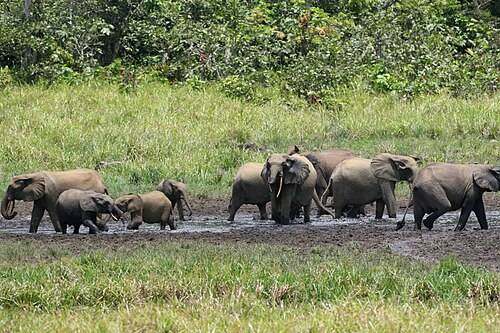
- Loango National Park (surfing hippos)
- Lopé reserve
- Libreville
- Ivindo falls
Food and drink
Poulet nyembwe (chicken in palm nut sauce)
Culture and famous for
Bwiti religion; Fang masks
Popular sports
Football
Geography and climate
- Highest point
- Mont Bengoué, 1,070 m
- Rivers, lakes and seas
- Ogooué River
- Climate
- Equatorial
- Coastline
- Has a sea coast
- Population density
- 9 people per km²
Wars and conflicts
- 2023 coup
Alliances and memberships
Political unions and regional organisations
African UnionOrganisation of Islamic CooperationCommonwealth of Nations
Economy and trade
Gabon in depth
Detailed facts from the CIA World Factbook (public domain, latest edition).
Overview
- History in brief
- Gabon, a sparsely populated country known for its dense rainforests and vast petroleum reserves, is one of the most prosperous and stable countries in central Africa. Approximately 40 ethnic groups are represented, the largest of which is the Fang, a group that covers the northern third of Gabon and expands north into Equatorial Guinea and Cameroon. From about the early 1300s, various kingdoms emerged in present-day Gabon and the surrounding area, including the Kingdoms of Loango and Orungu. Because most early Bantu languages spoken in these kingdoms did not have a written form, much of Gabon's early history was lost over time. Portuguese traders who arrived in the mid-1400s gave the area its name of Gabon. At that time, indigenous trade networks began to engage with European traders, exchanging goods such as ivory and wood. For a century beginning in the 1760s, trade came to focus mostly on enslaved people. While many groups in Gabon participated in the slave trade, the Fang were a notable exception. As the slave trade declined in the late 1800s, France colonized the country and directed a widespread extraction of Gabonese resources. Anti-colonial rhetoric by Gabon’s educated elites increased significantly in the early 1900s, but no widespread rebellion materialized. French decolonization after World War II led to the country’s independence in 1960.Within a year of independence, the government changed from a parliamentary to a presidential system, and Leon M’BA won the first presidential election in 1961. El Hadj Omar BONGO Ondimba was M’BA’s vice president and assumed the presidency after M’BA’s death in 1967. BONGO went on to dominate the country's political scene for four decades (1967-2009). In 1968, he declared Gabon a single-party state and created the still-dominant Parti Democratique Gabonais (PDG). In the early 1990s, he reintroduced a multiparty system under a new constitution in response to growing political opposition. He was reelected by wide margins in 1995, 1998, 2002, and 2005 against a divided opposition and amidst allegations of fraud. After BONGO's death in 2009, a new election brought his son, Ali BONGO Ondimba, to power, and he was reelected in 2016. He won a third term in the August 2023 election but was overthrown in a military coup a few days later. Gen. Brice OLIGUI Nguema led a military group called the Committee for the Transition and Restoration of Institutions that arrested BONGO, canceled the election results, and dissolved
Geography
- Location
- Central Africa, bordering the Atlantic Ocean at the Equator, between Republic of the Congo and Equatorial Guinea
- Size compared
- slightly smaller than Colorado
- Land borders
- Total: 3,261 kmBorder countries: Cameroon 349 km; Republic of the Congo 2,567 km; Equatorial Guinea 345 km
- Coastline
- 885 km
- Climate
- tropical; always hot, humid
- Terrain
- narrow coastal plain; hilly interior; savanna in east and south
- Elevation
- Highest point: Mont Bengoue 1,050 mLowest point: Atlantic Ocean 0 mMean elevation: 377 m
- Natural resources
- petroleum, natural gas, diamond, niobium, manganese, uranium, gold, timber, iron ore, hydropower
- Notes
- the country has maintained its pristine rain forest and rich biodiversity
- Environmental issues
- deforestation from logging; solid-waste disposal; water pollution from oil industry; wildlife poaching
People and society
- Population
- Total: 2,513,738 (2025 est.)Male: 1,299,085Female: 1,214,653
- Nationality
- Noun: Gabonese (singular and plural)Adjective: Gabonese
- Ethnic groups
- Fang 23.5%, Shira-Punu'Vii 20.6%, Nzabi-Duma 11.2%, Mbede-Teke 5.6%, Myene 4.4%, Kota-Kele 4.3%, Okande-Tsogho 1.6%, other 12.6%, foreigner 16.2% (2021 est.)
- Languages
- French (official), Fang, Myene, Nzebi, Bapounou/Eschira, Bandjabi
- Religions
- Protestant 46.4% (Revival Church 37%, other Protestant 9.4%), Roman Catholic 29.8%, other Christian 4%, Muslim 10.8%, traditional/animist 1.1%, other 0.9%, none 7% (2019-21 est.)
- Median age
- Total: 22.3 years (2025 est.)Male: 22.5 yearsFemale: 21.5 years
- Population growth
- 2.35% (2025 est.)
- Life expectancy
- Total population: 70.4 years (2024 est.)Male: 68.6 yearsFemale: 72.1 years
- Children per woman
- 3.16 children born/woman (2025 est.)
- Urbanization
- Urban population: 91% of total population (2023)Rate of urbanization: 2.27% annual rate of change (2020-25 est.)
- Largest cities
- 870,000 LIBREVILLE (capital) (2023)
- Literacy
- Total population: 88.9% (2021 est.)Male: 90.8% (2021 est.)Female: 87.1% (2021 est.)
Government
- Official names
- Conventional long form: Gabonese RepublicConventional short form: GabonLocal long form: République GabonaiseLocal short form: GabonEtymology: name originates from the Portuguese word gabão, meaning "cloak," possibly used by early explorers to describe the shape of the Komo River estuary
- Government type
- presidential republic
- Capital
- Name: LibrevilleGeographic coordinates: 0 23 N, 9 27 ETime difference: UTC+1 (6 hours ahead of Washington, DC, during Standard Time)Etymology: the city was founded in 1849 by freed slaves, and the name means "free town" in French
- Regions
- 9 provinces; Estuaire, Haut-Ogooue, Moyen-Ogooue, Ngounie, Nyanga, Ogooue-Ivindo, Ogooue-Lolo, Ogooue-Maritime, Woleu-Ntem
- Independence
- 17 August 1960 (from France)
- National holiday
- Independence Day, 17 August (1960)
- Constitution
- History: previous 1961, 1991; latest approved in November 2024 referendumAmendment process: proposed by the president of the republic, by the Council of Ministers, or by one third of either house of Parliament; passage requires Constitutional Court evaluation, at least two-thirds majority vote of two thirds of the Parliament membership convened in joint session, and approval in a referendum; constitutional articles on Gabon’s democratic form of government cannot be amended
- Legal system
- mixed system of French civil law and customary law
- Voting age
- 18 years of age; universal
- Flag meaning
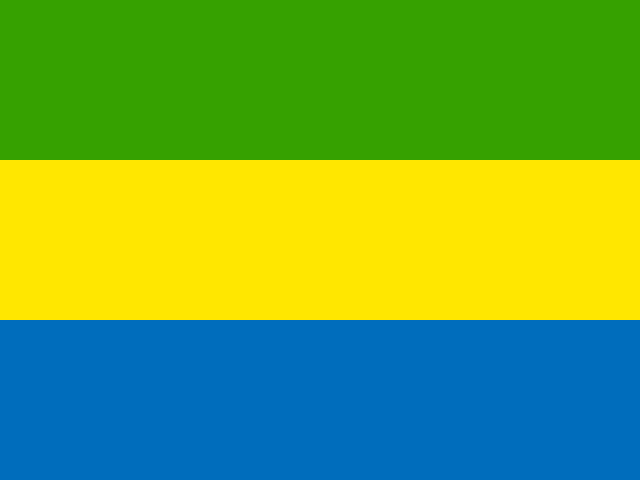
- Description: three equal horizontal bands of green (top), yellow, and blueMeaning: green stands for the country's forests and natural resources, gold for the equator and the sun, and blue for the sea
- National symbols
- black panther
- National colours
- green, yellow, blue
- National anthem
- Title: "La Concorde" (The Concorde)Lyrics/music: Georges Aleka DAMASHistory: adopted 1960
- UNESCO World Heritage Sites
- Total World Heritage Sites: 2 (1 natural, 1 mixed)Selected World Heritage Site locales: Ecosystem and Relict Cultural Landscape of Lopé-Okanda (m); Ivindo National Park (n)
Economy
- Overview
- natural-resource-rich, upper-middle-income, Central African economy; significant reliance on oil and mineral exports; highly urbanized population; high levels of poverty and unemployment; uncertainty on institutional and development reform progress following 2023 military coup
- GDP (PPP)
- $48.045 billion (2024 est.)
- GDP per person (PPP)
- $18,900 (2024 est.)
- GDP growth
- 3.4% (2024 est.)
- Inflation
- 1.2% (2024 est.)
- Unemployment
- 20.1% (2024 est.)
- Below poverty line
- 33.4% (2017 est.)
- Farm products
- oil palm fruit, plantains, cassava, sugarcane, yams, taro, vegetables, maize, groundnuts, game meat (2023)
- Industries
- petroleum extraction and refining; manganese, gold; chemicals, ship repair, food and beverages, textiles, lumbering and plywood, cement
- Exports
- $13.622 billion (2024 est.)
- Main exports
- crude petroleum, ships, manganese ore, refined petroleum, wood (2023)
- Export partners
- China 26%, Indonesia 8%, Spain 7%, Israel 6%, Congo, Republic of the 5% (2023)
- Main imports
- ships, refined petroleum, iron pipes, cars, packaged medicine (2023)
- Import partners
- France 14%, China 13%, S. Korea 13%, USA 7%, India 4% (2023)
- Money sent home from abroad
- 0.1% of GDP (2023 est.)
Energy, internet and transport
- Electricity access
- Electrification - total population: 93.5% (2022 est.)Electrification - urban areas: 98.5%Electrification - rural areas: 29%
- Electricity sources
- Fossil fuels: 51.9% of total installed capacity (2023 est.)Hydroelectricity: 47.7% of total installed capacity (2023 est.)Biomass and waste: 0.3% of total installed capacity (2023 est.)
- Internet users
- Percent of population: 72% (2023 est.)
- Mobile phones
- Total subscriptions: 3.18 million (2024 est.)Subscriptions per 100 inhabitants: 125 (2024 est.)
- TV and radio
- 2 state-run TV stations and 2 state-run radio stations; a few private radio and TV stations; transmissions of at least 2 international broadcasters are accessible; satellite service subscriptions are available
- Airports
- 42 (2025)
- Railways
- Total: 649 km (2014)Standard gauge: 649 km (2014) 1.435-m gauge
- Merchant ships
- Total: 87 (2023)By type: bulk carrier 1, general cargo 19, oil tanker 30, other 37
Military and space
- Armed forces
- Gabonese Armed Forces (Force Armées Gabonaise or FAG; aka National Defense and Security Forces of Gabon or des Forces Nationales de Défense et de Sécurité (FNDS) du Gabon): Army, Navy, Air Force, Light Aviation, Fire Brigade; Gabon National Gendarmerie (GENA); Republican Guard (GR); Military Health Service; Military Engineering (2025)
- Military spending
- 1.5% of GDP (2024 est.)
- Military service
- 18-24 years of age for voluntary military service; no conscription (2025)
- Space programme
- has a small space program focused on using data from remote sensing (RS) satellites for environmental and natural-resource management, mapping, land-use planning, maritime surveillance, and research; member of the African Space Agency; has relationships with Brazil, China, the ESA, individual ESA member states (particularly France), and the US, as well as African countries such as Kenya, Niger, Rwanda, and South Africa; shares RS satellite data with neighboring countries (2025)
- Space milestones
- 1986 - ESA established a ground station in Gabon2018 - completed mapping Gabon’s forests2019 - founding member of the Space Climate Observatory2021 - began acquisition process for first satellite in joint project with Japan, known as BIRDs2025 - became member of new African Space Agency
Global issues
- Refugees and displaced people
- Refugees: 261 (2024 est.)
Neighbouring countries
CameroonRepublic of the CongoEquatorial Guinea
- Phone code
- +241
- Internet domain
- .ga