Guinea-Bissau
Republic of Guinea-Bissau · Guiné-Bissau
Won independence in a guerrilla war led by Amílcar Cabral. Has had repeated coups, including one in November 2025.
See Guinea-Bissau on the 3D globeTake a quiz
Population2.2 million
Area36,125 km²
CapitalBissau
RegionWestern Africa
Did you know?
- Bijagós has saltwater hippos and sea turtles
- Cashews make up most exports
- Amílcar Cabral led the independence struggle
Key facts about Guinea-Bissau
- Government
- Military junta (coup Nov 2025)
- Religion
- Islam ~46%, Christian ~19%, traditional
- Founded / independence
- 1973/1974 (from Portugal)
- Rich in
- Cashews, fishing
- Languages
- Portuguese, Upper Guinea Creole
Portuguese; Guinea-Bissau Creole (Kriol), Balanta, Fula - Currency
- West African CFA franc (Fr)
- People are called
- Guinea-Bissauan
- Main cities
- Bissau, Bafatá, Gabú
Timeline of Guinea-Bissau
- 1446Portuguese arrive
- 1963Independence war
- 1974Independence
- 1998Civil war
- 2025Coup
Places to see in Guinea-Bissau
- Bijagós Islands
- Bissau old town
- Orango National Park (saltwater hippos)
Food and drink
Jollof rice · cashew fruit drinks · fish caldo
Culture and famous for
Bijagós matriarchal culture; gumbe music
Popular sports
Football
Geography and climate
- Highest point
- Unnamed point, about 300 m
- Rivers, lakes and seas
- Geba, Cacheu rivers
- Climate
- Tropical
- Coastline
- Has a sea coast
- Population density
- 61 people per km²
Wars and conflicts
- Independence war 1963–74
- civil war 1998–99
- many coups
Alliances and memberships
Political unions and regional organisations
African UnionECOWASOrganisation of Islamic Cooperation
Guinea-Bissau in depth
Detailed facts from the CIA World Factbook (public domain, latest edition).
Overview
- History in brief
- For much of its history, Guinea-Bissau was under the control of the Mali Empire and the Kaabu Kingdom. In the 16th century, Portugal began establishing trading posts along Guinea-Bissau’s shoreline. Initially, the Portuguese were restricted to the coastline and islands. However, the slave and gold trades were lucrative to local African leaders, and the Portuguese were slowly able to expand their power and influence inland. Starting in the 18th century, the Mali Empire and Kingdom of Kaabu slowly disintegrated into smaller local entities. By the 19th century, Portugal had fully incorporated Guinea-Bissau into its empire.Since gaining independence in 1974, Guinea-Bissau has experienced considerable political and military upheaval. In 1980, a military coup established General Joao Bernardo 'Nino' VIEIRA as president. VIEIRA's regime suppressed political opposition and purged political rivals. Several coup attempts through the 1980s and early 1990s failed to unseat him, but a military mutiny and civil war in 1999 led to VIEIRA's ouster. In 2000, a transitional government turned over power to opposition leader Kumba YALA. In 2003, a bloodless military coup overthrew YALA and installed businessman Henrique ROSA as interim president. In 2005, VIEIRA was reelected, pledging to pursue economic development and national reconciliation; he was assassinated in 2009. Malam Bacai SANHA was then elected president, but he passed away in 2012 from a long-term illness. A military coup blocked the second round of the election to replace him, but after mediation from the Economic Community of Western African States, a civilian transitional government assumed power. In 2014, Jose Mario VAZ was elected president in a free and fair election, and in 2019, he became the first president in Guinea-Bissau’s history to complete a full term. Umaro Sissoco EMBALO was elected president in 2019, but he did not take office until 2020 because of a prolonged challenge to the election results.
Geography
- Location
- Western Africa, bordering the North Atlantic Ocean, between Guinea and Senegal
- Size compared
- slightly less than three times the size of Connecticut
- Land borders
- Total: 762 kmBorder countries: Guinea 421 km; Senegal 341 km
- Coastline
- 350 km
- Climate
- tropical; generally hot and humid; monsoonal-type rainy season (June to November) with southwesterly winds; dry season (December to May) with northeasterly harmattan winds
- Terrain
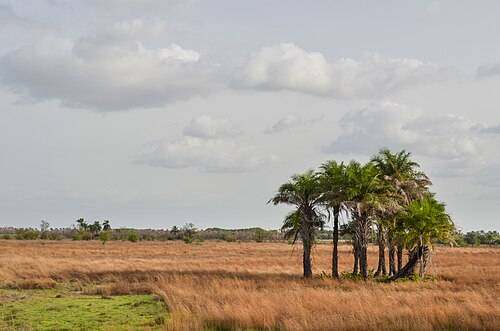
- mostly low-lying coastal plain with a deeply indented estuarine coastline rising to savanna in east; numerous off-shore islands including the Arquipelago Dos Bijagos consisting of 18 main islands and many small islets
- Elevation
- Highest point: Dongol Ronde 277 mLowest point: Atlantic Ocean 0 mMean elevation: 70 m
- Natural resources
- fish, timber, phosphates, bauxite, clay, granite, limestone, unexploited deposits of petroleum
- Natural hazards
- hot, dry, dusty harmattan haze may reduce visibility during dry season; brush fires
- Notes
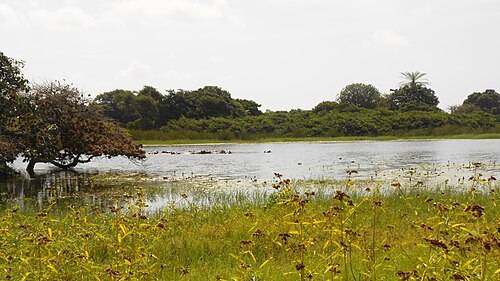
- this small country is swampy along its western coast and is low-lying inland
- Environmental issues
- deforestation (overharvesting of trees for timber and agricultural purposes); soil erosion; overgrazing; overfishing
People and society
- Population
- Total: 2,132,325 (2024 est.)Male: 1,042,910Female: 1,089,415
- Nationality
- Noun: Bissau-Guinean(s)Adjective: Bissau-Guinean
- Ethnic groups
- Balanta 30%, Fulani 30%, Manjaco 14%, Mandinga 13%, Papel 7%, unspecified smaller ethnic groups 6% (2015 est.)
- Languages
- Portuguese-based Creole, Portuguese (official; largely used as a second or third language), Pular (a Fula language), Mandingo
- Religions
- Muslim 46.1%, folk religions 30.6%, Christian 18.9%, other or unaffiliated 4.4% (2020 est.)
- Median age
- Total: 18.5 years (2025 est.)Male: 17.8 yearsFemale: 18.9 years
- Population growth
- 2.55% (2025 est.)
- Life expectancy
- Total population: 64.5 years (2024 est.)Male: 62.2 yearsFemale: 66.8 years
- Children per woman
- 4.59 children born/woman (2025 est.)
- Urbanization
- Urban population: 45.5% of total population (2023)Rate of urbanization: 3.22% annual rate of change (2020-25 est.)
- Largest cities
- 664,000 BISSAU (capital) (2023)
- Literacy
- Total population: 63.9% (2022 est.)Male: 77.3% (2022 est.)Female: 52.2% (2022 est.)
Government
- Official names
- Conventional long form: Republic of Guinea-BissauConventional short form: Guinea-BissauLocal long form: Republica da Guine-BissauLocal short form: Guine-BissauFormer: Portuguese GuineaEtymology: the country is partly named after the Guinea region of West Africa that lies along the Gulf of Guinea; the name itself is derived from the Tuareg word aginaw, meaning "black people;" Bissau, the name of the capital city, distinguishes the country from neighboring Guinea and is derived from the local Bijuga people
- Government type
- semi-presidential republic
- Capital
- Name: BissauGeographic coordinates: 11 51 N, 15 35 WTime difference: UTC 0 (5 hours ahead of Washington, DC, during Standard Time)Etymology: the name is derived from the local Bijuga people and is used to distinguish the country from neighboring Guinea
- Regions
- 9 regions (regioes, singular - regiao); Bafata, Biombo, Bissau, Bolama/Bijagos, Cacheu, Gabu, Oio, Quinara, Tombali
- Independence
- 24 September 1973 (declared); 10 September 1974 (from Portugal)
- National holiday
- Independence Day, 24 September (1973)
- Constitution
- History: promulgated 16 May 1984Amendment process: proposed by the National People’s Assembly if supported by at least one third of its members, by the Council of State (a presidential consultant body), or by the government; passage requires approval by at least two-thirds majority vote of the Assembly; constitutional articles on the republican and secular form of government and national sovereignty cannot be amended
- Legal system
- mixed system of civil law, which incorporated Portuguese law at independence; influenced by Economic Community of West African States (ECOWAS), West African Economic and Monetary Union (UEMOA), African Francophone Public Law, and customary law
- Voting age
- 18 years of age; universal
- Flag meaning
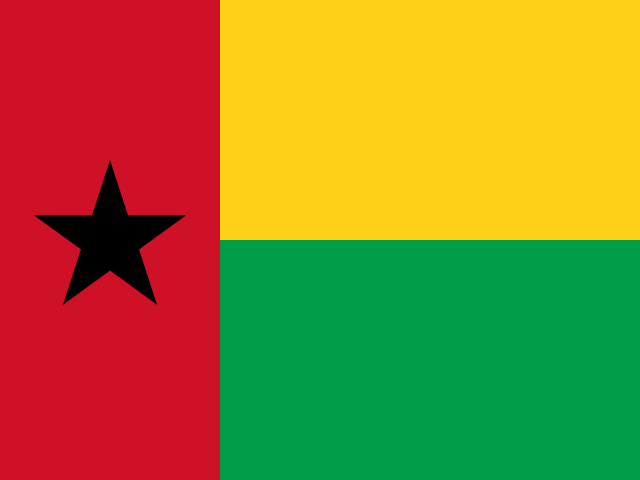
- Description: two equal horizontal bands of yellow (top) and green, with a vertical red band on the left side; a five-pointed black star is centered in the red bandMeaning: yellow stands for the sun, green for hope, red for blood shed during the struggle for independence; the black star stands for African unityHistory: uses the colors of the Pan-African movement; the Ghanaian flag heavily influenced the design
- National symbols
- black star
- National colours
- red, yellow, green, black
- National anthem
- Title: "Esta e a Nossa Patria Bem Amada" (This is Our Beloved Country)Lyrics/music: Amilcar Lopes CABRAL/XIAO HeHistory: adopted 1974; a delegation from Portuguese Guinea visited China in 1963 and heard music by XIAO He; Amilcar Lopes CABRAL, the leader of Guinea-Bissau's independence movement, asked the composer to create a piece that would inspire his people to fight for independence
- UNESCO World Heritage Sites
- Total World Heritage Sites: 1 (natural)Selected World Heritage Site locales: Coastal and Marine Ecosystems of the Bijagós Archipelago – Omatí Minhô (n)
Economy
- Overview
- extremely poor West African economy; ethnically diverse labor force; increasing government expenditures; slight inflation due to food supply disruptions; major cashew exporter; systemic banking instabilities and corruption; vulnerable to oil price shocks
- GDP (PPP)
- $5.912 billion (2024 est.)
- GDP per person (PPP)
- $2,700 (2024 est.)
- GDP growth
- 4.8% (2024 est.)
- Inflation
- 3.8% (2024 est.)
- Unemployment
- 2.7% (2024 est.)
- Below poverty line
- 50.5% (2021 est.)
- Farm products
- rice, groundnuts, cashews, root vegetables, oil palm fruit, plantains, cassava, coconuts, vegetables, sweet potatoes (2023)
- Industries
- agricultural products processing, beer, soft drinks
- Exports
- $284.5 million (2023 est.)
- Main exports
- coconuts/brazil nuts/cashews, fish, fish oil, processed crustaceans, malt extract (2023)
- Export partners
- India 66%, Chile 9%, Cote d'Ivoire 5%, Ghana 4%, Netherlands 3% (2023)
- Main imports
- refined petroleum, iron bars, rice, plastics, flavored water (2023)
- Import partners
- Senegal 28%, Portugal 24%, China 11%, Gambia, The 10%, Pakistan 4% (2023)
- Money sent home from abroad
- 9.8% of GDP (2023 est.)
Energy, internet and transport
- Electricity access
- Electrification - total population: 37.4% (2022 est.)Electrification - urban areas: 61%Electrification - rural areas: 15.8%
- Electricity sources
- Fossil fuels: 96.5% of total installed capacity (2023 est.)Solar: 3.5% of total installed capacity (2023 est.)
- Internet users
- Percent of population: 33% (2023 est.)
- Mobile phones
- Total subscriptions: 2.76 million (2023 est.)Subscriptions per 100 inhabitants: 126 (2022 est.)
- TV and radio
- 1 state-owned TV station, Televisao da Guine-Bissau (TGB) and a second station, Radio e Televisao de Portugal (RTP) Africa, operated by Portuguese public broadcaster (RTP); 1 state-owned radio station, several private radio stations, and some community radio stations; multiple international broadcasters are available (2019)
- Airports
- 7 (2025)
- Merchant ships
- Total: 20 (2023)By type: bulk carrier 3, general cargo 12, other 5
Military and space
- Armed forces
- People's Revolutionary Armed Force (Forcas Armadas Revolucionarias do Povo or FARP): Army, Navy, Air ForceMinistry of Internal Administration: National Guard (a gendarmerie force), Public Order Police, Border Police, Rapid Intervention Police, Maritime Police (2025)
- Military spending
- 1.2% of GDP (2024 est.)
- Military service
- 18-25 years of age for selective compulsory military service for men and women (Air Force service is voluntary) (2025)
Global issues
- Refugees and displaced people
- Refugees: 54 (2024 est.)
Neighbouring countries
- Phone code
- +245
- Internet domain
- .gw