Guinea
Republic of Guinea · Guinée
Part of the Mali Empire. Voted to reject France's offer in 1958 and became independent immediately; long authoritarian rule since.
See Guinea on the 3D globeTake a quiz
Population15 million
Area245,857 km²
CapitalConakry
RegionWestern Africa
Did you know?
- Called the "water tower of West Africa"
- Holds the world's largest bauxite reserves
- Simandou is one of the world's richest iron-ore deposits
Key facts about Guinea
- Government
- Military-led transition (coup 2021; elections 2025)
- Religion
- Sunni Islam ~85%, Christian ~8%
- Founded / independence
- 1958 (from France)
- Rich in
- Bauxite (largest reserves), iron ore (Simandou), gold
- Languages
- French
French; Pular, Maninka, Susu - Currency
- Guinean franc (Fr)
- People are called
- Guinean
- Main cities
- Conakry, Nzérékoré, Kankan, Kindia
Timeline of Guinea
- 1235Part of Mali Empire
- 1891French colony
- 1958Independence
- 1984Sékou Touré dies
- 2021Coup
Places to see in Guinea
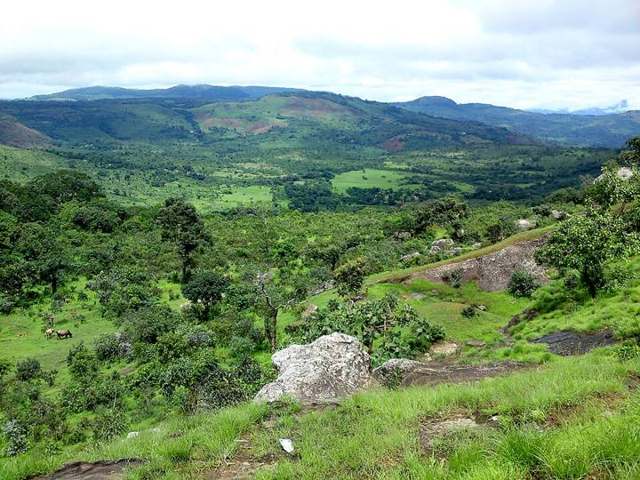
- Fouta Djallon highlands
- Îles de Los
- Mount Nimba reserve
- Conakry Grand Mosque
Food and drink
Poulet yassa · fou fou · leaf sauces
Culture and famous for
Kora and balafon music; birthplace of the "Water tower of West Africa"
Popular sports
Football
Geography and climate
- Highest point
- Mount Nimba, 1,752 m
- Rivers, lakes and seas
- Niger, Senegal and Gambia rivers rise here
- Climate
- Tropical
- Coastline
- Has a sea coast
- Population density
- 61 people per km²
Wars and conflicts
- Sierra Leone/Liberia spillover
- 2021 coup
Empires and states that once stood here
Alliances and memberships
Political unions and regional organisations
African UnionECOWASOrganisation of Islamic Cooperation
Guinea in depth
Detailed facts from the CIA World Factbook (public domain, latest edition).
Overview
- History in brief
- Guinea's deep Muslim heritage arrived via the neighboring Almoravid Empire in the 11th century. Following Almoravid decline, Guinea existed on the fringe of several African kingdoms, all competing for regional dominance. In the 13th century, the Mali Empire took control of Guinea and encouraged its already growing Muslim faith. After the fall of the West African empires, various smaller kingdoms controlled Guinea. In the 18th century, Fulani Muslims established an Islamic state in central Guinea that provided one of the earliest examples of a written constitution and alternating leadership. European traders first arrived in the 16th century, and the French secured colonial rule in the 19th century. In 1958, Guinea achieved independence from France. Sekou TOURE became Guinea’s first post-independence president; he established a dictatorial regime and ruled until his death in 1984, after which General Lansana CONTE staged a coup and seized the government. He too established an authoritarian regime and manipulated presidential elections until his death in 2008, when Captain Moussa Dadis CAMARA led a military coup, seized power, and suspended the constitution. In 2009, CAMARA was wounded in an assassination attempt and was exiled to Burkina Faso. In 2010 and 2013 respectively, the country held its first free and fair presidential and legislative elections. Alpha CONDE won the 2010 and 2015 presidential elections, and his first cabinet was the first all-civilian government in Guinean history. CONDE won a third term in 2020 after a constitutional change to term limits. In 2021, Col Mamady DOUMBOUYA led another successful military coup, establishing the National Committee for Reconciliation and Development (CNRD), suspending the constitution, and dissolving the government and the legislature. DOUMBOUYA was sworn in as transition president and appointed Mohamed BEAVOGUI as transition prime minister. The National Transition Council (CNT), which acts as the legislative body for the transition, was formed in 2022 and consists of appointed members representing a broad swath of Guinean society.
Geography
- Location
- Western Africa, bordering the North Atlantic Ocean, between Guinea-Bissau and Sierra Leone
- Size compared
- slightly smaller than Oregon; slightly larger than twice the size of Pennsylvania
- Land borders
- Total: 4,046 kmBorder countries: Cote d'Ivoire 816 km; Guinea-Bissau 421 km; Liberia 590 km; Mali 1062 km; Senegal 363 km; Sierra Leone 794 km
- Coastline
- 320 km
- Climate
- generally hot and humid; monsoonal-type rainy season (June to November) with southwesterly winds; dry season (December to May) with northeasterly harmattan winds
- Terrain
- generally flat coastal plain, hilly to mountainous interior
- Elevation
- Highest point: Mont Nimba 1,752 mLowest point: Atlantic Ocean 0 mMean elevation: 472 m
- Natural resources
- bauxite, iron ore, diamonds, gold, uranium, hydropower, fish, salt
- Major rivers
- Niger river source (shared with Mali, and Nigeria [m]) - 4,200 km; Gambie (Gambia) river source (shared with Senegal and The Gambia [m]) - 1,094 kmNote: [s] after country name indicates river source; [m] after country name indicates river mouth
- Natural hazards
- hot, dry, dusty harmattan haze may reduce visibility during dry season
- Notes
- the Niger and its important tributary, the Milo River, have their sources in the Guinean highlands
- Environmental issues
- deforestation; inadequate potable water; desertification; soil contamination and erosion; overfishing, overpopulation in forest region; poor mining practices; water pollution; improper waste disposal
People and society
- Population
- Total: 14,374,590 (2025 est.)Male: 7,179,661Female: 7,194,929
- Nationality
- Noun: Guinean(s)Adjective: Guinean
- Ethnic groups
- Fulani (Peuhl) 33.4%, Malinke 29.4%, Susu 21.2%, Guerze 7.8%, Kissi 6.2%, Toma 1.6%, other/foreign 0.4% (2018 est.)
- Languages
- French (official), Pular, Maninka, Susu, other native languages
- Religions
- Muslim 85.2%, Christian 13.4%, animist 0.2%, none 1.2% (2018 est.)
- Median age
- Total: 19.5 years (2025 est.)Male: 19.2 yearsFemale: 19.6 years
- Population growth
- 2.74% (2025 est.)
- Life expectancy
- Total population: 64.6 years (2024 est.)Male: 62.7 yearsFemale: 66.6 years
- Children per woman
- 4.75 children born/woman (2025 est.)
- Urbanization
- Urban population: 38.1% of total population (2023)Rate of urbanization: 3.64% annual rate of change (2020-25 est.)
- Largest cities
- 2.111 million CONAKRY (capital) (2023)
- Literacy
- Total population: 39.6% (2018 est.)Male: 54.4% (2018 est.)Female: 27.7% (2018 est.)
- Years in school
- Total: 9 years (2021 est.)Male: 9 years (2021 est.)Female: 8 years (2021 est.)
Government
- Official names
- Conventional long form: Republic of GuineaConventional short form: GuineaLocal long form: République de GuinéeLocal short form: GuinéeFormer: French GuineaEtymology: the country is named after the Guinea region of West Africa that lies along the Gulf of Guinea, but the name itself derives from the Tuareg word aginaw, meaning "black people"
- Government type
- presidential republic
- Capital
- Name: ConakryGeographic coordinates: 9 30 N, 13 42 WTime difference: UTC 0 (5 hours ahead of Washington, DC, during Standard Time)Etymology: the name derives from konakri, a Susu word meaning "over the water" and referring to the city's location on a peninsula; it was originally the name of a local village
- Regions
- 7 administrative regions (régions administratives, singular - région administrative) and 1 governorate (gouvenorat)*; Boke, Conakry*, Faranah, Kankan, Kindia, Labe, Mamou, N'Zerekore
- Independence
- 2 October 1958 (from France)
- National holiday
- Independence Day, 2 October (1958)
- Constitution
- History: previous 1958, 1990; 2010 and a referendum in 2020, which was suspended on 5 September 2021 via a coup d'état; on 27 September, the Transitional Charter was released, which supersedes the constitution until a new constitution is promulgated
- Legal system
- civil law system based on the French model
- Voting age
- 18 years of age; universal
- Flag meaning
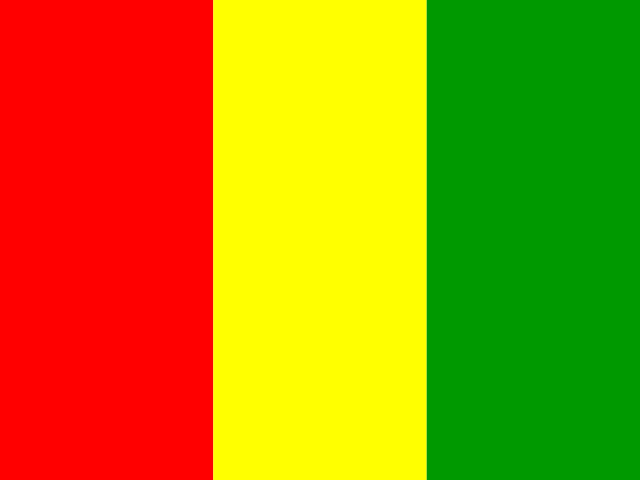
- Description: three equal vertical bands of red (left side), yellow, and greenMeaning: red stands for the people's sacrifice for liberation and work; yellow for the sun, the riches of the earth, and justice; green for the country's vegetation and unityHistory: uses the colors of the Pan-African movement
- National symbols
- elephant
- National colours
- red, yellow, green
- National anthem
- Title: "Liberté" (Liberty)Lyrics/music: unknown/Fodeba KEITAHistory: adopted 1958
- UNESCO World Heritage Sites
- Total World Heritage Sites: 1 (natural)Selected World Heritage Site locales: Mount Nimba Strict Nature Reserve
Economy
- Overview
- growing but primarily agrarian West African economy; major mining sector; improving fiscal and debt balances prior to COVID-19; economy increasingly vulnerable to climate change; slow infrastructure improvements; gender wealth and human capital gaps
- GDP (PPP)
- $59.439 billion (2024 est.)
- GDP per person (PPP)
- $4,000 (2024 est.)
- GDP growth
- 5.7% (2024 est.)
- Inflation
- 8.1% (2024 est.)
- Unemployment
- 5.3% (2024 est.)
- Below poverty line
- 43.7% (2018 est.)
- Farm products
- rice, cassava, maize, groundnuts, oil palm fruit, plantains, potatoes, fonio, yams, sweet potatoes (2023)
- Industries
- bauxite, gold, diamonds, iron ore; light manufacturing, agricultural processing
- Exports
- $12.008 billion (2023 est.)
- Main exports
- gold, aluminum ore, cocoa beans, crude petroleum, coconuts/brazil nuts/cashews (2023)
- Export partners
- UAE 50%, China 36%, India 8%, Switzerland 1%, Spain 1% (2023)
- Main imports
- refined petroleum, rice, garments, construction vehicles, cars (2023)
- Import partners
- China 39%, India 9%, Netherlands 7%, Belgium 6%, UAE 4% (2023)
- Money sent home from abroad
- 2.2% of GDP (2023 est.)
Energy, internet and transport
- Electricity access
- Electrification - total population: 47.7% (2022 est.)Electrification - urban areas: 91%Electrification - rural areas: 21.3%
- Electricity sources
- Fossil fuels: 25.3% of total installed capacity (2023 est.)Solar: 0.6% of total installed capacity (2023 est.)Hydroelectricity: 74.1% of total installed capacity (2023 est.)
- Internet users
- Percent of population: 27% (2023 est.)
- Mobile phones
- Total subscriptions: 15.3 million (2022 est.)Subscriptions per 100 inhabitants: 109 (2022 est.)
- TV and radio
- government maintains control over broadcast media; single state-run TV station; state-run radio also operates several stations in rural areas; a dozen private TV stations; many privately owned radio stations, nearly all in Conakry, and about a dozen community radio stations; foreign TV programming available via satellite and cable subscription services (2022)
- Airports
- 16 (2025)
- Railways
- Total: 1,086 km (2017)Standard gauge: 279 km (2017) 1.435-m gaugeNarrow gauge: 807 km (2017) 1.000-m gauge
- Merchant ships
- Total: 2 (2023)By type: other 2
Military and space
- Armed forces
- Guinean (or National) Armed Forces (Forces Armées Guinéennes): Army, Air Force, Navy, National GendarmerieMinistry of Security: National Police (2025)
- Military spending
- 2.1% of GDP (2024 est.)
- Military service
- 18 years of age for voluntary and selective conscripted service; 9-12 months of service (2025)
Global issues
- Refugees and displaced people
- Refugees: 2,343 (2024 est.)IDPs: 5,160 (2024 est.)
Neighbouring countries
Ivory CoastGuinea-BissauLiberiaMaliSenegalSierra Leone
- Phone code
- +224
- Internet domain
- .gn