Liechtenstein
Principality of Liechtenstein
Formed when the Liechtenstein princes bought two lordships, it became sovereign in 1806. Neutral and closely tied to Switzerland; the prince holds unusually strong powers.
See Liechtenstein on the 3D globeTake a quiz
Population40 thousand
Area160 km²
CapitalVaduz
RegionWestern Europe
Did you know?
- One of two doubly landlocked countries (with Uzbekistan)
- The world's largest producer of false teeth
- Has more registered companies than people
Key facts about Liechtenstein
- Government
- Constitutional monarchy
- Religion
- Catholic ~73%
- Founded / independence
- 1719 principality; 1806 sovereign
- Rich in
- Finance, precision manufacturing, dental products
- Languages
- German
German (Alemannic dialect) - Currency
- Swiss franc (Fr)
- People are called
- Liechtensteiner
- Main cities
- Vaduz, Schaan, Balzers
Timeline of Liechtenstein
- 1719Principality created
- 1806Sovereign state
- 1868Abolishes its army
- 1923Customs union with Switzerland
- 1990Joins UN
Places to see in Liechtenstein
- Vaduz Castle
- Kunstmuseum
- Gutenberg Castle
- Alpine hiking trails
Food and drink
Käsknöpfle (cheese dumplings) · Ribel
Culture and famous for
Collections of the princely family; false-teeth manufacturing
Popular sports
Skiing
Geography and climate
- Highest point
- Grauspitz, 2,599 m
- Rivers, lakes and seas
- Rhine (western border)
- Climate
- Alpine
- Coastline
- Landlocked
- Population density
- 250 people per km²
Wars and conflicts
- None
- no army since 1868
Alliances and memberships
Political unions and regional organisations
Economy and trade
Liechtenstein in depth
Detailed facts from the CIA World Factbook (public domain, latest edition).
Overview
- History in brief
- The Principality of Liechtenstein was established within the Holy Roman Empire in 1719. Occupied by both French and Russian troops during the Napoleonic Wars, it became a sovereign state in 1806 and joined the German Confederation in 1815. Liechtenstein became fully independent in 1866 when the Confederation dissolved. Until the end of World War I, it was closely tied to Austria, but the economic devastation caused by that conflict forced Liechtenstein to enter into a customs and monetary union with Switzerland. Since World War II (in which Liechtenstein remained neutral), the country's low taxes have spurred outstanding economic growth. In 2000, shortcomings in banking regulatory oversight resulted in concerns about the use of financial institutions for money laundering. However, Liechtenstein implemented anti-money laundering legislation and a Mutual Legal Assistance Treaty with the US that went into effect in 2003.
Geography
- Location
- Central Europe, between Austria and Switzerland
- Size compared
- about 0.9 times the size of Washington, D.C.
- Land borders
- Total: 75 kmBorder countries: Austria 34 km; Switzerland 41 km
- Coastline
- 0 km (doubly landlocked)
- Climate
- continental; cold, cloudy winters with frequent snow or rain; cool to moderately warm, cloudy, humid summers
- Terrain
- mostly mountainous (Alps) with Rhine Valley in western third
- Elevation
- Highest point: Vorder-Grauspitz 2,599 mLowest point: Ruggeller Riet 430 m
- Natural resources
- hydroelectric potential, arable land
- Natural hazards
- avalanches, landslides
- Notes
- along with Uzbekistan, one of only two doubly landlocked countries in the world; variety of microclimatic variations based on elevation
- Environmental issues
- some air pollution generated locally, some carried over from surrounding countries
People and society
- Population
- Total: 40,547 (2025 est.)Male: 20,215Female: 20,332
- Nationality
- Noun: Liechtensteiner(s)Adjective: Liechtenstein
- Ethnic groups
- Liechtensteiner 65.6%, Swiss 9.6%, Austrian 5.8%, German 4.5%, Italian 3.1%, other 11.4% (2021 est.)
- Languages
- German 91.5% (official, Alemannic is the main dialect), Italian 1.5%, Turkish 1.3%, Portuguese 1.1%, other 4.6% (2015 est.)Major-language sample(s): Das World Factbook, die unverzichtbare Quelle für grundlegende Informationen. (German)The World Factbook, the indispensable source for basic information.
- Religions
- Roman Catholic (official) 73.4%, Protestant Reformed 6.3%, Muslim 5.9%, Christian Orthodox 1.3%, Lutheran 1.2%, other Protestant 0.7%, other Christian 0.3%, other 0.8%, none 7%, unspecified 3.3% (2015 est.)
- Median age
- Total: 44.4 years (2025 est.)Male: 42.4 yearsFemale: 46.1 years
- Population growth
- 0.68% (2025 est.)
- Life expectancy
- Total population: 83 years (2024 est.)Male: 80.7 yearsFemale: 85.8 years
- Children per woman
- 1.69 children born/woman (2025 est.)
- Urbanization
- Urban population: 14.6% of total population (2023)Rate of urbanization: 1.15% annual rate of change (2020-25 est.)
- Largest cities
- 5,000 VADUZ (capital) (2018)
- Years in school
- Total: 15 years (2021 est.)Male: 16 years (2021 est.)Female: 14 years (2021 est.)
Government
- Official names
- Conventional long form: Principality of LiechtensteinConventional short form: LiechtensteinLocal long form: Fuerstentum LiechtensteinLocal short form: LiechtensteinEtymology: named after the Liechtenstein family that purchased and united the counties of Schellenburg and Vaduz in 1719; the family name was taken from its Austrian castle of the same name, which in German means "light stone"
- Government type
- constitutional monarchy
- Capital
- Name: VaduzGeographic coordinates: 47 08 N, 9 31 ETime difference: UTC+1 (6 hours ahead of Washington, DC, during Standard Time)Daylight saving time: +1hr, begins last Sunday in March; ends last Sunday in OctoberEtymology: may be a conflation from the Latin vallis (valley) and the Old German dutsch (German) to produce Valdutsch ("German valley"), which was simplified over time to Vaduz
- Regions
- 11 communes (Gemeinden, singular - Gemeinde); Balzers, Eschen, Gamprin, Mauren, Planken, Ruggell, Schaan, Schellenberg, Triesen, Triesenberg, Vaduz
- Independence
- 23 January 1719 (Principality of Liechtenstein established); 12 July 1806 (independence from the Holy Roman Empire); 24 August 1866 (independence from the German Confederation)
- National holiday
- National Day, 15 August (1940)
- Constitution
- History: previous 1862; latest adopted 5 October 1921Amendment process: proposed by Parliament, by the reigning prince (in the form of "Government" proposals), by petition of at least 1,500 qualified voters, or by at least four communes; passage requires unanimous approval of Parliament members in one sitting or three-quarters majority vote in two successive sittings; referendum required only if petitioned by at least 1,500 voters or by at least four communes; passage by referendum requires absolute majority of votes cast
- Legal system
- civil law system influenced by Swiss, Austrian, and German law
- Voting age
- 18 years of age; universal
- Flag meaning
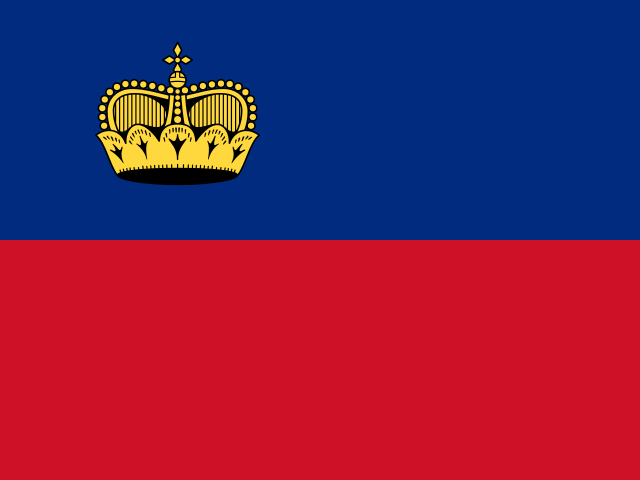
- Description: two equal horizontal bands of blue (top) and red, with a gold crown on the left side of the blue bandHistory: the colors may derive from the blue-and-red livery used in the principality's household in the 18th century; the prince's crown was added in 1937 to distinguish it from Haiti's flag
- National symbols
- princely hat (crown)
- National colours
- blue, red
- National anthem
- Title: "Oben am jungen Rhein" (High Above the Young Rhine)Lyrics/music: Jakob Joseph JAUCH/Josef FROMMELTHistory: adopted 1850, revised 1963; uses the tune of the United Kingdom's anthem, "God Save the King"
Economy
- Overview
- high-income European economy; Schengen Area participant; key European financial leader; integrated with Swiss economy and franc currency user; one of the highest GDP per capita countries; relies on US and Eurozone markets for exports
- GDP (PPP)
- $7.172 billion (2024 est.)
- GDP per person (PPP)
- $210,600 (2024 est.)
- Inflation
- 2.8% (2022 est.)
- Farm products
- wheat, barley, corn, potatoes; livestock, dairy products
- Industries
- electronics, metal manufacturing, dental products, ceramics, pharmaceuticals, food products, precision instruments, tourism, optical instruments
- Exports
- $3.217 billion (2015 est.)
- Main exports
- small specialty machinery, connectors for audio and video, parts for motor vehicles, dental products, hardware
- Main imports
- agricultural products, raw materials, energy products, machinery, metal goods, textiles, foodstuffs, motor vehicles
Energy, internet and transport
- Electricity access
- Electrification - total population: 100% (2022 est.)
- Internet users
- Percent of population: 97% (2023 est.)
- Mobile phones
- Total subscriptions: 51,400 (2024 est.)Subscriptions per 100 inhabitants: 129 (2024 est.)
- TV and radio
- relies on foreign terrestrial and satellite broadcasters for most broadcast media services; first Liechtenstein-based TV station established in 2008; Radio Liechtenstein operates multiple radio stations; a Swiss-based broadcaster operates one radio station
- Railways
- Total: 9 km (2018)Standard gauge: 9 km (2018) 1.435-m gauge (electrified)
- Merchant ships
- Total: 17 (2023)By type: bulk carrier 14, general cargo 1, other 2 (includes Switzerland)
Military and space
- Armed forces
- no regular military forces; National Police of the Principality of Liechtenstein (Landespolizei des Fürstentums Liechtenstein)
Global issues
- Refugees and displaced people
- Refugees: 875 (2024 est.)
Neighbouring countries
- Phone code
- +423
- Internet domain
- .li