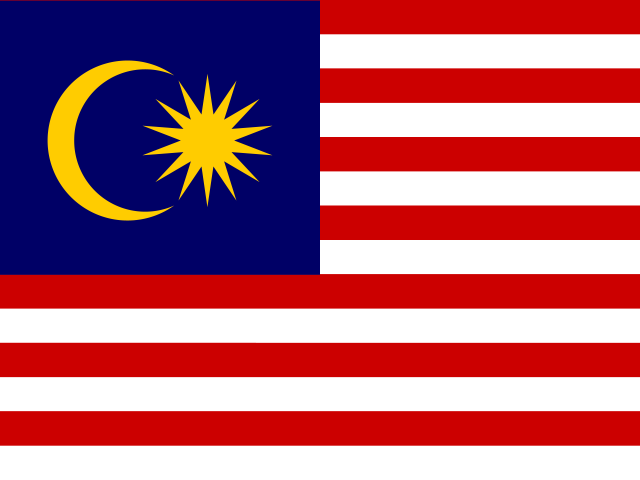
Malaysia
Malaysia · مليسيا
The Malacca Sultanate controlled the spice-trade strait in the 15th century. Ruled by Portugal, the Dutch and Britain; Singapore left the federation in 1965.
See Malaysia on the 3D globeTake a quiz
Population35 million
Area330,803 km²
CapitalKuala Lumpur
RegionSouth-Eastern Asia
Did you know?
- Petronas Towers were the world's tallest buildings from 1998 to 2004
- Home to the rafflesia, the world's largest flower
- Its rainforest is about 130 million years old
Key facts about Malaysia
- Government
- Federal parliamentary elective constitutional monarchy (king rotates among nine sultans)
- Religion
- Sunni Islam ~64%, Buddhist ~19%, Christian ~9%, Hindu ~6%
- Founded / independence
- 1957 (Malaya from UK); 1963 Malaysia
- Rich in
- Electronics and semiconductors, palm oil, oil and gas, rubber, tin
- Languages
- English, Malay
Malay; English, Chinese (Hokkien, Cantonese, Mandarin), Tamil, Iban - Currency
- Malaysian ringgit (RM)
- People are called
- Malaysian
- Main cities
- Kuala Lumpur, George Town, Johor Bahru, Ipoh, Kuching
Timeline of Malaysia
- 1400Malacca Sultanate
- 1511Portuguese take Malacca
- 1824British influence
- 1957Independence
- 1963Malaysia formed
- 1965Singapore leaves
Places to see in Malaysia
- Petronas Towers
- Batu Caves
- Langkawi
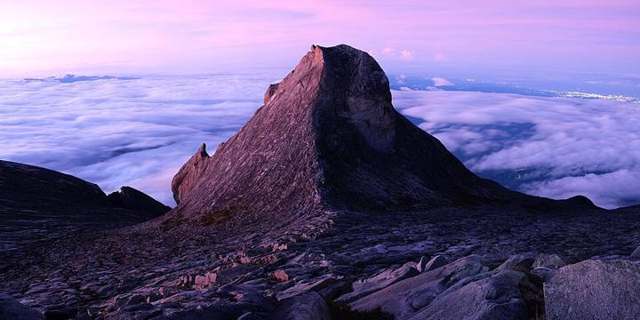
- Mount Kinabalu
- George Town, Penang
- Malacca
Food and drink
Nasi lemak · laksa · satay · roti canai · durian
Culture and famous for
Multicultural Malay, Chinese, Indian traditions; Formula 1 and MotoGP in Sepang
Popular sports
Badminton, football, sepak takraw
Geography and climate
- Highest point
- Mount Kinabalu, 4,095 m
- Rivers, lakes and seas
- Rajang, Kinabatangan
- Climate
- Tropical rainforest
- Coastline
- Has a sea coast
- Population density
- 106 people per km²
Wars and conflicts
- Malayan Emergency 1948–60
- Indonesia confrontation 1963–66
Empires and states that once stood here
Alliances and memberships
Political unions and regional organisations
BRICS (partner country)ASEANOrganisation of Islamic CooperationCommonwealth of Nations
Economy and trade
OPEC (OPEC+ partner (not a member))RCEPCPTPPAPEC
Malaysia in depth
Detailed facts from the CIA World Factbook (public domain, latest edition).
Overview
- History in brief
- Malaysia’s location has long made it an important cultural, economic, historical, social, and trade link between the islands of Southeast Asia and the mainland. Through the Strait of Malacca, which separates the Malay Peninsula from the archipelago, flowed maritime trade and with it influences from China, India, the Middle East, and the east coast of Africa. Prior to the 14th century, several powerful maritime empires existed in what is modern-day Malaysia, including the Srivijayan, which controlled much of the southern part of the peninsula between the 7th and 13th centuries, and the Majapahit Empire, which took control over most of the peninsula and the Malay Archipelago between the 13th and 14th centuries. The adoption of Islam between the 13th and 17th centuries also saw the rise of a number of powerful maritime states and sultanates on the Malay Peninsula and the island of Borneo, such as the port city of Malacca (Melaka), which at its height in the 15th century had a navy and hosted thousands of Chinese, Arab, Persian, and Indian merchants.The Portuguese in the 16th century and the Dutch in the 17th century were the first European colonial powers to establish themselves on the Malay Peninsula and in Southeast Asia. However, it was the British who ultimately secured hegemony across the territory and during the late 18th and 19th centuries established colonies and protectorates in the area that is now Malaysia. Japan occupied these holdings from 1942 to 1945. In 1948, the British-ruled territories on the Malay Peninsula (except Singapore) formed the Federation of Malaya, which became independent in 1957. Malaysia was formed in 1963 when the former British colonies of Singapore, as well as Sabah and Sarawak on the northern coast of Borneo, joined the Federation.A communist insurgency, confrontations with Indonesia, Philippine claims to Sabah, and Singapore's expulsion in 1965 marred the first several years of the country's independence. During the 22-year term of Prime Minister MAHATHIR Mohamad (1981-2003), Malaysia was successful in diversifying its economy from dependence on exports of raw materials to the development of manufacturing, services, and tourism. Former Prime Minister MAHATHIR and a newly formed coalition of opposition parties defeated Prime Minister Mohamed NAJIB bin Abdul Razak's United Malays National Organization (UMNO) in 2018, ending over 60 years of uninterrupted UMNO rule. From 2018-2022, Malaysia underwent considerable political
Geography
- Location
- Southeastern Asia, peninsula bordering Thailand and northern one-third of the island of Borneo, bordering Indonesia, Brunei, and the South China Sea, south of Vietnam
- Size compared
- slightly larger than New Mexico
- Land borders
- Total: 2,742 kmBorder countries: Brunei 266 km; Indonesia 1,881 km; Thailand 595 km
- Coastline
- 4,675 km (Peninsular Malaysia 2,068 km; East Malaysia 2,607 km)
- Climate
- tropical; annual southwest (April to October) and northeast (October to February) monsoons
- Terrain
- coastal plains rising to hills and mountains
- Elevation
- Highest point: Gunung Kinabalu 4,095 mLowest point: Indian Ocean 0 mMean elevation: 419 m
- Natural resources
- tin, petroleum, timber, copper, iron ore, natural gas, bauxite
- Natural hazards
- flooding; landslides; forest fires
- Notes
- strategic location along Strait of Malacca and southern South China Sea
- Environmental issues
- air pollution from industrial and vehicular emissions; water pollution from raw sewage; deforestation; smoke/haze from Indonesian forest fires; endangered species; coastal reclamation damaging mangroves and turtle nesting sites
People and society
- Population
- Total: 34,905,275 (2025 est.)Male: 17,833,074Female: 17,072,201
- Nationality
- Noun: Malaysian(s)Adjective: Malaysian
- Ethnic groups
- Bumiputera 63.8% (Malay 52.8% and indigenous peoples, including Orang Asli, Dayak, Anak Negeri, 11%), Chinese 20.6%, Indian 6%, other 0.6%, non-citizens 9% (2023 est.)
- Languages
- Bahasa Malaysia (official), English, Chinese (Cantonese, Mandarin, Hokkien, Hakka, Hainan, Foochow), Tamil, Telugu, Malayalam, Panjabi, ThaiMajor-language sample(s): Buku Fakta Dunia, sumber yang diperlukan untuk maklumat asas. (Bahasa Malaysia)The World Factbook, the indispensable source for basic information.
- Religions
- Muslim (official) 63.5%, Buddhist 18.7%, Christian 9.1%, Hindu 6.1%, other (Confucianism, Taoism, other traditional Chinese religions) 0.9%, none/unspecified 1.8% (2020 est.)
- Median age
- Total: 32.2 years (2025 est.)Male: 31.7 yearsFemale: 31.9 years
- Population growth
- 0.97% (2025 est.)
- Life expectancy
- Total population: 76.6 years (2024 est.)Male: 75 yearsFemale: 78.4 years
- Children per woman
- 1.73 children born/woman (2025 est.)
- Urbanization
- Urban population: 78.7% of total population (2023)Rate of urbanization: 1.87% annual rate of change (2020-25 est.)
- Largest cities
- 8.622 million KUALA LUMPUR (capital), 1.086 million Johor Bahru, 857,000 Ipoh (2023)
- Literacy
- Total population: 95.8% (2022 est.)Male: 96.8% (2022 est.)Female: 94.7% (2022 est.)
- Years in school
- Total: 12 years (2023 est.)Male: 11 years (2023 est.)Female: 12 years (2023 est.)
Government
- Official names
- Conventional long form: noneConventional short form: MalaysiaLocal long form: noneLocal short form: MalaysiaFormer: British Malaya, Malayan Union, Federation of MalayaEtymology: devised in the early 19th century by British geographers; the suffix -sia was added to the name of the Malay people to form a classical-style name; the name Malay may come from the Tamil word malai, meaning "mountain"
- Government type
- federal parliamentary constitutional monarchy
- Capital
- Name: Kuala LumpurGeographic coordinates: 3 10 N, 101 42 ETime difference: UTC+8 (13 hours ahead of Washington, DC, during Standard Time)Etymology: the name means "muddy river junction," referring to the city's location on the confluence of the Kelang and Gombak rivers; it comes from the Malay words kuala (river junction or estuary) and lumpur (mud)
- Regions
- 13 states (negeri-negeri, singular - negeri); Johor, Kedah, Kelantan, Melaka, Negeri Sembilan, Pahang, Perak, Perlis, Pulau Pinang, Sabah, Sarawak, Selangor, Terengganu; and 1 federal territory (Wilayah Persekutuan) with 3 components, Kuala Lumpur, Labuan, and Putrajaya
- Independence
- 31 August 1957 (from the UK)
- National holiday
- Independence Day (or Merdeka Day), 31 August (1957) (independence of Malaya); Malaysia Day, 16 September (1963) (formation of Malaysia)
- Constitution
- History: previous 1948; latest drafted 21 February 1957, effective 27 August 1957Amendment process: proposed as a bill by Parliament; passage requires at least two-thirds majority vote by the Parliament membership in the bill’s second and third readings; a number of constitutional sections are excluded from amendment or repeal
- Legal system
- mixed system of English common law, Islamic law (sharia), and customary law; the Federal Court can review legislative acts at the request of the supreme head of the federation
- Voting age
- 18 years of age; universal
- Flag meaning
- Description: 14 equal horizontal stripes of red alternating with white; a dark blue rectangle in the upper-left corner has a yellow crescent and a 14-pointed yellow starMeaning: the flag is often called Jalur Gemilang (Stripes of Glory); the 14 stripes stand for the equal status of the 13 member states and the federal government; the points on the star represent the unity among these entities; the crescent is a traditional symbol of Islam; blue symbolizes the unity of the Malay people, and yellow is the royal color
- National symbols
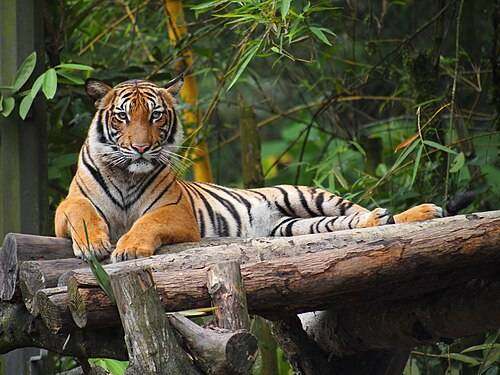
- tiger, hibiscus
- National colours
- gold, black
- National anthem
- Title: "Negaraku" (My Country)Lyrics/music: collective, led by Tunku ABDUL RAHMAN/Pierre Jean DE BERANGERHistory: adopted 1957; full version only performed in the king's presence, the shorter version performed for the queen and lesser officials
- UNESCO World Heritage Sites
- Total World Heritage Sites: 6 (4 cultural, 2 natural)Selected World Heritage Site locales: Gunung Mulu National Park (n); Kinabalu Park (n); Melaka and George Town, Historic Cities of the Straits of Melaka (c); Archaeological Heritage of the Lenggong Valley (c); The Archaeological Heritage of Niah National Park’s Caves Complex (c); Forest Research Institute Malaysia Forest Park Selangor (c)
Economy
- Overview
- upper middle-income Southeast Asian economy; implementing key anticorruption policies; major electronics, oil, and chemicals exporter; trade sector employs over 40% of jobs; key economic equity initiative; high labor productivity
- GDP (PPP)
- $1.212 trillion (2024 est.)
- GDP per person (PPP)
- $34,100 (2024 est.)
- GDP growth
- 5.1% (2024 est.)
- Inflation
- 1.8% (2024 est.)
- Unemployment
- 3.9% (2024 est.)
- Below poverty line
- 6.2% (2021 est.)
- Farm products
- oil palm fruit, rice, chicken, eggs, tropical fruits, coconuts, vegetables, pineapples, rubber, bananas (2023)
- Industries
- Peninsular Malaysia - rubber and oil palm processing and manufacturing, petroleum and natural gas, light manufacturing, pharmaceuticals, medical technology, electronics and semiconductors, timber processing; Sabah - logging, petroleum and natural gas production; Sarawak - agriculture processing, petroleum and natural gas production, logging
- Exports
- $301.789 billion (2024 est.)
- Main exports
- integrated circuits, refined petroleum, crude petroleum, natural gas, palm oil (2023)
- Export partners
- China 21%, Singapore 12%, USA 12%, Japan 5%, Hong Kong 5% (2023)
- Main imports
- integrated circuits, refined petroleum, crude petroleum, coal, broadcasting equipment (2023)
- Import partners
- China 24%, Singapore 11%, USA 7%, Japan 5%, Taiwan 5% (2023)
- Money sent home from abroad
- 0.4% of GDP (2024 est.)
Energy, internet and transport
- Electricity access
- Electrification - total population: 100% (2022 est.)
- Electricity sources
- Fossil fuels: 81.9% of total installed capacity (2023 est.)Solar: 1.1% of total installed capacity (2023 est.)Hydroelectricity: 16.3% of total installed capacity (2023 est.)Biomass and waste: 0.6% of total installed capacity (2023 est.)
- Internet users
- Percent of population: 98% (2023 est.)
- Mobile phones
- Total subscriptions: 49.7 million (2024 est.)Subscriptions per 100 inhabitants: 140 (2024 est.)
- TV and radio
- state-owned TV broadcaster operates 2 TV networks with relays; the leading private commercial media group operates 4 TV stations with numerous relays; satellite TV subscription service is available; state-owned radio broadcaster operates multiple national networks, as well as regional and local stations; many private commercial radio broadcasters and some subscription satellite radio services are available; about 55 radio stations overall (2019)
- Airports
- 100 (2025)
- Railways
- Total: 1,851 km (2014)Standard gauge: 59 km (2014) 1.435-m gauge (59 km electrified)Narrow gauge: 1,792 km (2014) 1.000-m gauge (339 km electrified)
- Merchant ships
- Total: 1,750 (2023)By type: bulk carrier 14, container ship 35, general cargo 169, oil tanker 148, other 1,384
Military and space
- Armed forces
- Malaysian Armed Forces (Angkatan Tentera Malaysia, ATM): Malaysian Army, Royal Malaysian Navy, Royal Malaysian Air ForceMinistry of Home Affairs: Royal Malaysia Police (RMP or Polis Diraja Malaysia, PDRM), Malaysian Maritime Enforcement Agency (MMEA; aka Malaysian Coast Guard) (2025)
- Military spending
- 1% of GDP (2024 est.)
- Military service
- 17 years 6 months of age for voluntary military service for men and women (younger with parental consent and proof of age); mandatory retirement age 60; no conscription (2025)
- Space programme
- has a national space policy and program focused on the areas of remote sensing (RS), navigational services, and telecommunications to support domestic economic sectors; seeks to promote a domestic space industry; acquires, manufactures, and operates satellites; conducts research in RS capabilities and space sciences such as astronomy, atmospherics, space environment, and weather; has an astronaut training exchange program with Russia and works with a variety of foreign space agencies and industries, including those of the ESA, individual ESA member states, India, Japan, Russia, South Korea, the UK, and the US (2025)
- Space milestones
- 1996 - first of a series of domestically produced commercial communications satellites (MEASAT) launched on European rocket2000 - first multipurpose (remote sensing/RS, communications, scientific) microsatellite (TiungSat-1) produced with technology and training from the UK and launched by Russia2007 - first Malaysian astronaut (trained in Russia) to space on International Space Station2009 - first RS satellite (RazakSat) built with assistance from South Korea and launched by US2011 - completed construction of a satellite assembly, integration, and testing facility2025 - first commercial high-resolution RS satellite (UzmaSat-1) launched by US; signed US-led Artemis Accords
Global issues
- Refugees and displaced people
- Refugees: 191,343 (2024 est.)Stateless persons: 120,857 (2024 est.)
Neighbouring countries
- Phone code
- +60
- Internet domain
- .my