Moldova
Republic of Moldova
Eastern half of the medieval Principality of Moldavia, annexed by Russia in 1812 as Bessarabia. A Soviet republic after WWII; Transnistria broke away in 1992. EU candidate since 2022.
See Moldova on the 3D globeTake a quiz
Population2.4 million
Area33,846 km²
CapitalChișinău
RegionEastern Europe
Did you know?
- Mileștii Mici holds a Guinness record with about 2 million bottles
- Among Europe's least visited countries
- Half its exports once went to the EU
Key facts about Moldova
- Government
- Parliamentary republic
- Religion
- Eastern Orthodox ~90%
- Founded / independence
- 1991 (from USSR)
- Rich in
- Wine, agriculture, IT
- Languages
- Moldavian
Romanian (Moldovan); Russian, Gagauz, Ukrainian - Currency
- Moldovan leu (L)
- People are called
- Moldovan
- Main cities
- Chișinău, Bălți, Tiraspol, Cahul
Timeline of Moldova
- 1359Principality of Moldavia
- 1812Russia annexes Bessarabia
- 1918Joins Romania
- 1940Soviet annexation
- 1991Independence
- 1992Transnistria war
- 2022EU candidate
Places to see in Moldova
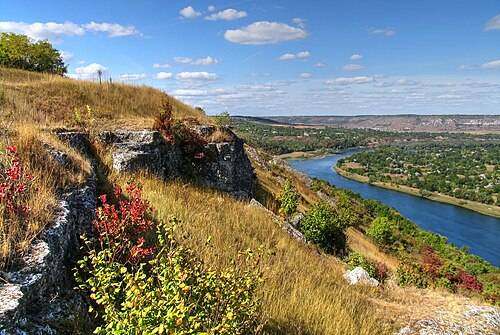
- Orheiul Vechi cave monastery
- Mileștii Mici wine cellars
- Chișinău
- Soroca Fortress
Food and drink
Mămăligă (maize porridge) · plăcintă · sarmale · wine
Culture and famous for
Wine: Mileștii Mici has the world's largest wine collection
Popular sports
Football, wrestling
Geography and climate
- Highest point
- Bălănești Hill, 430 m
- Rivers, lakes and seas
- Dniester, Prut
- Climate
- Continental
- Coastline
- Landlocked
- Population density
- 71 people per km²
Wars and conflicts
- Transnistria War 1992 (frozen conflict, Russian troops remain)
Alliances and memberships
Political unions and regional organisations
EU candidate countriesCouncil of EuropeCommonwealth of Independent States (in the process of leaving)
Moldova in depth
Detailed facts from the CIA World Factbook (public domain, latest edition).
Overview
- History in brief
- A large portion of present-day Moldovan territory became a province of the Russian Empire in 1812 and then unified with Romania in 1918 in the aftermath of World War I. This territory was then incorporated into the Soviet Union at the close of World War II. Although Moldova has been independent from the Soviet Union since 1991, Russian forces have remained on Moldovan territory east of the Nistru River in the breakaway region of Transnistria. Years of Communist Party rule in Moldova from 2001 to 2009 ultimately ended with election-related violent protests and a rerun of parliamentary elections in 2009. A series of pro-Europe ruling coalitions governed Moldova from 2010 to 2019, but pro-Russia candidate Igor DODON won the presidency in 2016, and his Socialist Party of the Republic of Moldova won a plurality in the legislative election in 2019. Pro-EU reformist candidate Maia SANDU defeated DODON in his reelection bid in 2020, and SANDU's Party of Action and Solidarity won a parliamentary majority in an early legislative election in 2021. Prime Minister Natalia GAVRILITA and her cabinet took office in 2021. In early 2023, Moldova's parliament confirmed a new cabinet led by Prime Minister Dorin RECEAN, which retained the majority of the former ministers.
Geography
- Location
- Eastern Europe, northeast of Romania
- Size compared
- slightly larger than Maryland
- Land borders
- Total: 1,885 kmBorder countries: Romania 683 km; Ukraine 1202 km
- Coastline
- 0 km (landlocked)
- Climate
- moderate winters, warm summers
- Terrain
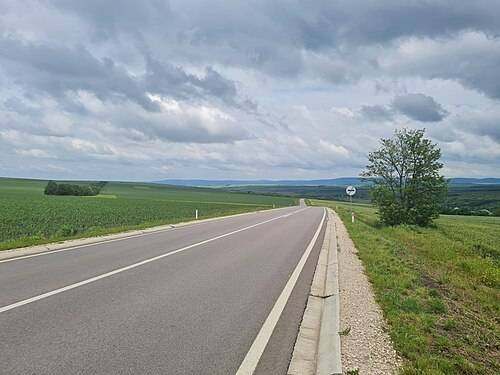
- rolling steppe, gradual slope south to Black Sea
- Elevation
- Highest point: Dealul Balanesti 430 mLowest point: Dniester (Nistru) 2 mMean elevation: 139 m
- Natural resources
- lignite, phosphorites, gypsum, limestone, arable land
- Major rivers
- Dunărea (Danube) (shared with Germany [s], Austria, Slovakia, Hungary, Croatia, Serbia, Bulgaria, Ukraine, and Romania [m]) - 2,888 km; Nistru (Dniester) (shared with Ukraine [s/m]) - 1,411 kmNote: [s] after country name indicates river source; [m] after country name indicates river mouth
- Natural hazards
- landslides
- Notes
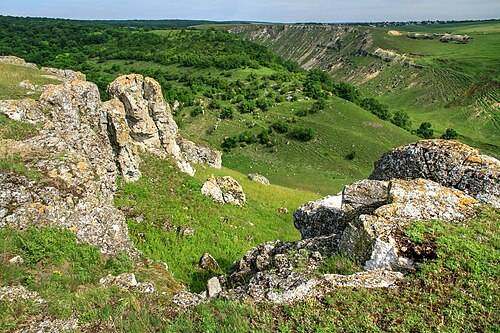
- landlocked; has many types of sedimentary rocks and minerals, including sand, gravel, gypsum, and limestone
- Environmental issues
- soil and water pollution from heavy use of agricultural chemicals; extensive soil erosion and declining soil fertility from farming methods
People and society
- Population
- Total: 3,578,930 (2025 est.)Male: 1,687,496Female: 1,891,434
- Nationality
- Noun: Moldovan(s)Adjective: Moldovan
- Ethnic groups
- Moldovan 75.1%, Romanian 7%, Ukrainian 6.6%, Gagauz 4.6%, Russian 4.1%, Bulgarian 1.9%, other 0.8% (2014 est.)
- Languages
- Moldovan/Romanian 80.2% (official) (56.7% Moldovan; 23.5% Romanian), Russian 9.7%, Gagauz 4.2% (a Turkish language), Ukrainian 3.9%, Bulgarian 1.5%, Romani 0.3%, other 0.2% (2014)Major-language sample(s): Cartea informativa a lumii, sursa indispensabila pentru informatii de baza. (Moldovan/Romanian)The World Factbook, the indispensable source for basic information.
- Religions
- Orthodox 90.1%, other Christian 2.6%, other 0.1%, agnostic <0.1%, atheist 0.2%, unspecified 6.9% (2014 est.)
- Median age
- Total: 40.4 years (2025 est.)Male: 38.6 yearsFemale: 41.3 years
- Population growth
- -0.57% (2025 est.)
- Life expectancy
- Total population: 70.1 years (2024 est.)Male: 66.1 yearsFemale: 74.4 years
- Children per woman
- 1.27 children born/woman (2025 est.)
- Urbanization
- Urban population: 43.4% of total population (2023)Rate of urbanization: 0.09% annual rate of change (2020-25 est.)
- Largest cities
- 488,000 CHISINAU (capital) (2023)
- Years in school
- Total: 15 years (2023 est.)Male: 15 years (2023 est.)Female: 15 years (2023 est.)
Government
- Official names
- Conventional long form: Republic of MoldovaConventional short form: MoldovaLocal long form: Republica MoldovaLocal short form: MoldovaFormer: Moldavian Soviet Socialist Republic, Moldovan Soviet Socialist RepublicEtymology: named for the Moldova River in neighboring eastern Romania; the river's name probably comes from the Indoeuropean root word mel, meaning "dark" or "black"
- Government type
- parliamentary republic
- Capital
- Name: Chisinau in Romanian (Kishinev in Russian)Geographic coordinates: 47 00 N, 28 51 ETime difference: UTC+2 (7 hours ahead of Washington, DC, during Standard Time)Daylight saving time: +1hr, begins last Sunday in March; ends last Sunday in OctoberEtymology: origin unclear but may derive from the Old Moldovan word kishineu ("spring" or "artesian well")
- Regions
- 32 districts (raioane, singular - raion), 3 municipalities (municipii, singular - municipiul), 1 autonomous territorial unit (unitatea teritoriala autonoma), and 1 territorial unit (unitatea teritoriala)Districts: Anenii Noi, Basarabeasca, Briceni, Cahul, Cantemir, Calarasi, Causeni, Cimislia, Criuleni, Donduseni, Drochia, Dubasari, Edinet, Falesti, Floresti, Glodeni, Hincesti, Ialoveni, Leova, Nisporeni, Ocnita, Orhei, Rezina, Riscani, Singerei, Soldanesti, Soroca, Stefan Voda, Straseni, Taraclia, Telenesti, UngheniMunicipalities: Balti, Bender, ChisinauAutonomous territorial unit: GagauziaTerritorial unit: Stinga Nistrului (Transnistria)
- Independence
- 27 August 1991 (from the Soviet Union)
- National holiday
- Independence Day, 27 August (1991)
- Constitution
- History: previous 1978; latest adopted 29 July 1994, effective 27 August 1994Amendment process: proposed by voter petition (at least 200,000 eligible voters), by at least one third of Parliament members, or by the government; passage requires two-thirds majority vote of Parliament within one year of initial proposal; revisions to constitutional articles on sovereignty, independence, and neutrality require majority vote by referendum; articles on fundamental rights and freedoms cannot be amended
- Legal system
- civil law system with Germanic law influences; Constitutional Court reviews legislative acts
- Voting age
- 18 years of age; universal
- Flag meaning
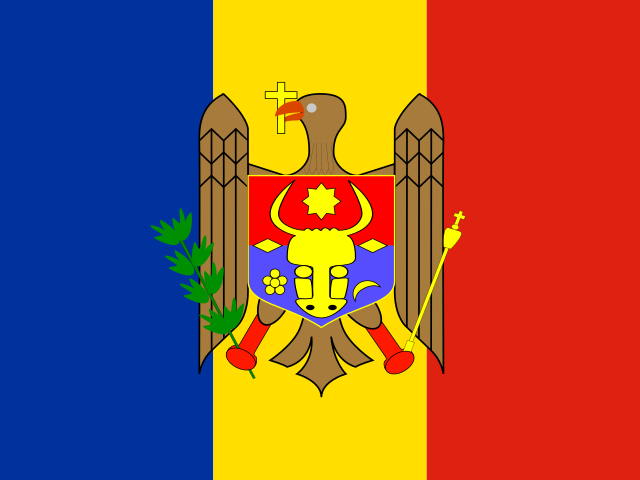
- Description: three equal vertical bands of Prussian blue (left side), chrome yellow, and vermilion red; the Moldavan coat of arms in the center is a dark gold Roman eagle outlined in black, with a red beak and talons; the eagle carries a yellow cross in its beak, a green olive branch in its right talons, and a yellow scepter in its left talons; on the eagle's breast is a red-and-blue shield divided horizontally, with a stylized aurochs head, star, rose, and crescent in black and outlined yellow; the reverse of the flag displays a mirror image of the coat of armsHistory: replaced the communist flag in 1990; the coat of arms is based on traditional designs
- National symbols
- aurochs (type of wild cattle)
- National colours
- blue, yellow, red
- National anthem
- Title: "Limba noastra" (Our Tongue)Lyrics/music: Alexei MATEEVICI/Alexandru CRISTEAHistory: adopted 1994; originally a 12-verse poem, but only stanzas 1, 2, 5, 9, and 12 are included in the anthem
- UNESCO World Heritage Sites
- Total World Heritage Sites: 1 (cultural)Selected World Heritage Site locales: Struve Geodetic Arc
Economy
- Overview
- upper middle-income Eastern European economy; sustained growth reversed by COVID-19; significant remittances; Russian energy and regional dependence; agricultural exporter; declining workforce due to emigration and low fertility
- GDP (PPP)
- $39.342 billion (2024 est.)
- GDP per person (PPP)
- $16,500 (2024 est.)
- GDP growth
- 0.1% (2024 est.)
- Inflation
- 4.7% (2024 est.)
- Unemployment
- 1.5% (2024 est.)
- Below poverty line
- 31.1% (2022 est.)
- Farm products
- wheat, maize, sunflower seeds, grapes, apples, sugar beets, barley, milk, rapeseed, potatoes (2023)
- Industries
- sugar processing, vegetable oil, food processing, agricultural machinery; foundry equipment, refrigerators and freezers, washing machines; hosiery, shoes, textiles
- Exports
- $5.717 billion (2024 est.)
- Main exports
- insulated wire, garments, refined petroleum, seed oils, wheat (2023)
- Export partners
- Romania 31%, Ukraine 13%, Italy 6%, Germany 6%, Czechia 4% (2023)
- Main imports
- refined petroleum, natural gas, cars, packaged medicine, plastic products (2023)
- Import partners
- Romania 16%, Ukraine 13%, China 11%, Turkey 8%, Germany 7% (2023)
- Money sent home from abroad
- 10.5% of GDP (2024 est.)
Energy, internet and transport
- Electricity access
- Electrification - total population: 100% (2022 est.)
- Electricity sources
- Fossil fuels: 88% of total installed capacity (2023 est.)Solar: 1.7% of total installed capacity (2023 est.)Wind: 3.8% of total installed capacity (2023 est.)Hydroelectricity: 6.3% of total installed capacity (2023 est.)Biomass and waste: 0.2% of total installed capacity (2023 est.)
- Internet users
- Percent of population: 80% (2023 est.)
- Mobile phones
- Total subscriptions: 3.64 million (2024 est.)Subscriptions per 100 inhabitants: 120 (2024 est.)
- TV and radio
- state-owned national radio-TV broadcaster operates 1 TV and 1 radio station; total of nearly 70 terrestrial TV channels and about 50 radio stations; Russian and Romanian channels are available (2019)
- Airports
- 10 (2025)
- Railways
- Total: 1,171 km (2014)Standard gauge: 14 km (2014) 1.435-m gaugeBroad gauge: 1,157 km (2014) 1.520-m gauge
- Merchant ships
- Total: 75 (2023)By type: bulk carrier 1, container ship 1, general cargo 44, oil tanker 7, other 22
Military and space
- Armed forces
- Armed Forces of the Republic of Moldova (Forțele Armate ale Republicii Moldova): National Army (comprised of Land Forces, Air Force)Ministry of Internal Affairs: General Inspectorate of Police (GPI), Border Police Department, Carabinieri Troops Department (2025)
- Military spending
- 0.6% of GDP (2024 est.)
- Military service
- 18-27 years of age for compulsory or voluntary military service; male registration required at age 16; 12-month service obligation; conscientious objectors can perform non-military service in public institutions for a longer period (up to 24 months) (2025)
Global issues
- Refugees and displaced people
- Refugees: 136,845 (2024 est.)IDPs: 6 (2024 est.)Stateless persons: 3,164 (2024 est.)
Neighbouring countries
- Phone code
- +373
- Internet domain
- .md