Romania
Romania · România
Roman Dacia became the principalities of Wallachia, Moldavia and Transylvania. Unified in 1859–1918; Ceaușescu's harsh communist regime fell in a violent 1989 revolution. EU member since 2007.
See Romania on the 3D globeTake a quiz
Population19 million
Area238,391 km²
CapitalBucharest
RegionSoutheast Europe
Did you know?
- The Palace of the Parliament is one of the heaviest buildings in the world
- Nadia Comăneci scored the first perfect 10 in Olympic gymnastics (1976)
- Has Europe's largest population of brown bears outside Russia
Key facts about Romania
- Government
- Semi-presidential republic
- Religion
- Romanian Orthodox ~85%
- Founded / independence
- 1859 union; 1878 independence
- Rich in
- Oil and gas, IT, cars (Dacia), agriculture
- Languages
- Romanian
Romanian (Latin-based); Hungarian, Romani, German minorities - Currency
- Romanian leu (lei)
- People are called
- Romanian
- Main cities
- Bucharest, Cluj-Napoca, Timișoara, Iași, Constanța
Timeline of Romania
- 106Roman conquest of Dacia
- 1859Union of principalities
- 1878Independence
- 1918Great Union
- 1947Communist rule
- 1989Revolution
- 2007Joins EU
Places to see in Romania
- Bran Castle
- Peleș Castle
- Transylvania's Saxon towns
- Danube Delta
- painted monasteries of Bucovina
- Palace of the Parliament
Food and drink
Sarmale (cabbage rolls) · mămăligă · mici · papanași
Culture and famous for
Legend of Dracula; folk crafts; sculptor Brâncuși
Popular sports
Football, gymnastics (Nadia Comăneci), tennis
Geography and climate
- Highest point
- Moldoveanu, 2,544 m
- Rivers, lakes and seas
- Danube and its delta
- Climate
- Continental
- Coastline
- Has a sea coast
- Population density
- 80 people per km²
Wars and conflicts
- Roman conquest of Dacia
- Ottoman wars
- WWI
- WWII
- 1989 revolution
Empires and states that once stood here
Alliances and memberships
Military and security
Political unions and regional organisations
European UnionCouncil of Europe
Economy and trade
Romania in depth
Detailed facts from the CIA World Factbook (public domain, latest edition).
Overview
- History in brief
- The principalities of Wallachia and Moldavia -- for centuries under the control of the Turkish Ottoman Empire -- secured their autonomy through the Treaty of Paris in 1856. They were de facto linked in 1859 and formally united in 1862 under the new name of Romania. The country joined the Allied Powers in World War I and subsequently acquired new territories -- most notably Transylvania -- that more than doubled its size. In 1940, Romania allied with the Axis powers and participated in the 1941 German invasion of the USSR. Three years later, overrun by the Soviets, Romania signed an armistice. The post-war Soviet occupation led to the formation of a communist "people's republic" in 1947 and the abdication of the king. The decades-long rule of dictator Nicolae CEAUSESCU, who took power in 1965, and his Securitate police state became increasingly oppressive and draconian through the 1980s. CEAUSESCU was overthrown and executed in late 1989. Former communists dominated the government until 1996 when they were swept from power. Romania joined NATO in 2004, the EU in 2007, and the Schengen Area for air and sea travel in 2024.
Geography
- Location
- Southeastern Europe, bordering the Black Sea, between Bulgaria and Ukraine
- Size compared
- twice the size of Pennsylvania; slightly smaller than Oregon
- Land borders
- Total: 2,844 kmBorder countries: Bulgaria 605 km; Hungary 424 km; Moldova 683 km; Serbia 531 km; Ukraine 601 km
- Coastline
- 225 km
- Climate
- temperate; cold, cloudy winters with frequent snow and fog; sunny summers with frequent showers and thunderstorms
- Terrain
- central Transylvanian Basin is separated from the Moldavian Plateau on the east by the Eastern Carpathian Mountains and separated from the Walachian Plain on the south by the Transylvanian Alps
- Elevation
- Highest point: Moldoveanu 2,544 mLowest point: Black Sea 0 mMean elevation: 414 m
- Natural resources
- petroleum (reserves declining), timber, natural gas, coal, iron ore, salt, arable land, hydropower
- Major rivers
- Dunărea (Danube) river mouth (shared with Germany [s], Austria, Slovakia, Hungary, Croatia, Serbia, Bulgaria, Moldova, and Ukraine) - 2,888 kmNote: [s] after country name indicates river source; [m] after country name indicates river mouth
- Natural hazards
- earthquakes, most severe in south and southwest; geologic structure and climate promote landslides
- Notes
- controls the most easily traversable land route between the Balkans, Moldova, and Ukraine; the Carpathian Mountains dominate the center of the country, and the Danube River forms much of the southern boundary with Serbia and Bulgaria
- Environmental issues
- soil erosion, degradation, and desertification; water pollution; air pollution in south from industrial effluents; contamination of Danube delta wetlands
People and society
- Population
- Total: 18,148,155 (2024 est.)Male: 8,747,795Female: 9,400,360
- Nationality
- Noun: Romanian(s)Adjective: Romanian
- Ethnic groups
- Romanian 89.3%, Hungarian 6%, Romani 3.4%, Ukrainian 0.3%, German 0.1%, other 0.9% (2021 est.)
- Languages
- Romanian (official) 91.6%, Hungarian 6.3%, Romani 1.2%, other 0.7% (2021 est.)Major-language sample(s): Cartea informativa a lumii, sursa indispensabila pentru informatii de baza. (Romanian)The World Factbook, the indispensable source for basic information.
- Religions
- Romanian Orthodox 85.3%, Roman Catholic 4.5%, Reformed 3%, Pentecostal 2.5%, other 4.7% (2021 est.)
- Median age
- Total: 45.8 years (2025 est.)Male: 44 yearsFemale: 46.9 years
- Population growth
- -0.86% (2025 est.)
- Life expectancy
- Total population: 76.9 years (2024 est.)Male: 73.4 yearsFemale: 80.5 years
- Children per woman
- 1.63 children born/woman (2025 est.)
- Urbanization
- Urban population: 54.7% of total population (2023)Rate of urbanization: -0.15% annual rate of change (2020-25 est.)
- Largest cities
- 1.776 million BUCHAREST (capital) (2023)
- Literacy
- Total population: 99.2% (2021 est.)Male: 99% (2021 est.)Female: 99.3% (2021 est.)
- Years in school
- Total: 14 years (2023 est.)Male: 13 years (2023 est.)Female: 14 years (2023 est.)
Government
- Official names
- Conventional long form: noneConventional short form: RomaniaLocal long form: noneLocal short form: RomaniaFormer: Kingdom of Romania, Romanian People's Republic, Socialist Republic of RomaniaEtymology: the name derives from the Latin Romani, meaning "people from Rome;" the area was an outpost of the Roman Empire in the 2nd century A.D., and the current name was adopted when Moldavia and Wallachia merged in 1861
- Government type
- semi-presidential republic
- Capital
- Name: BucharestGeographic coordinates: 44 26 N, 26 06 ETime difference: UTC+2 (7 hours ahead of Washington, DC, during Standard Time)Daylight saving time: +1hr, begins last Sunday in March; ends last Sunday in OctoberEtymology: the name is said to come from a shepherd named Bucur who is reputed to have founded the town in 1457, but a settlement probably already existed on the site; the name may come from the personal name of an early landowner
- Regions
- 41 counties (judete, singular - judet) and 1 municipality* (municipiu); Alba, Arad, Arges, Bacau, Bihor, Bistrita-Nasaud, Botosani, Braila, Brasov, Bucuresti (Bucharest)*, Buzau, Calarasi, Caras-Severin, Cluj, Constanta, Covasna, Dambovita, Dolj, Galati, Gorj, Giurgiu, Harghita, Hunedoara, Ialomita, Iasi, Ilfov, Maramures, Mehedinti, Mures, Neamt, Olt, Prahova, Salaj, Satu Mare, Sibiu, Suceava, Teleorman, Timis, Tulcea, Vaslui, Valcea, Vrancea
- Independence
- 9 May 1877 (independence proclaimed from the Ottoman Empire; 13 July 1878 (independence recognized by the Treaty of Berlin); 26 March 1881 (kingdom proclaimed); 30 December 1947 (republic proclaimed)
- National holiday
- Unification Day (unification of Romania and Transylvania), 1 December (1918)
- Constitution
- History: several previous; latest adopted 21 November 1991, approved by referendum and effective 8 December 1991Amendment process: initiated by the president of Romania through a proposal by the government, by at least one fourth of deputies or senators in Parliament, or by petition of eligible voters representing at least half of Romania’s counties; passage requires at least two-thirds majority vote by both chambers or – if mediation is required - by three-fourths majority vote in a joint session, followed by approval in a referendum; articles, including those on national sovereignty, form of government, political pluralism, and fundamental rights and freedoms cannot be amended
- Legal system
- civil law system
- Voting age
- 18 years of age; universal
- Flag meaning
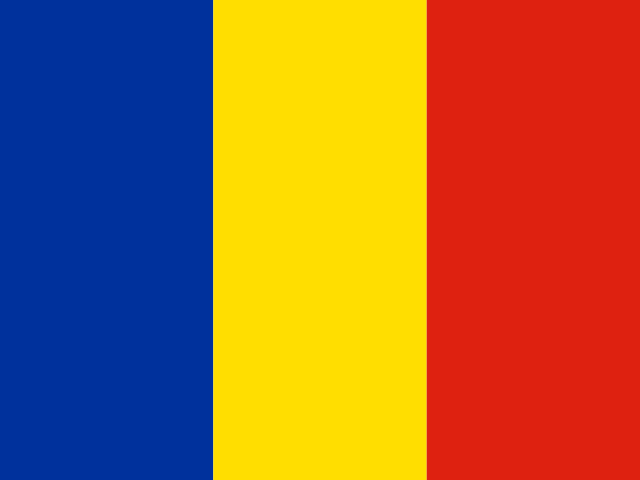
- Description: three equal vertical bands of blue (left side), yellow, and redMeaning: the colors come from the principalities of Walachia (red and yellow) and Moldavia (red and blue), which united in 1862 to form RomaniaHistory: modeled on the French flag; the national coat of arms that used to be centered on the yellow band has been removed
- National symbols
- golden eagle
- National colours
- blue, yellow, red
- National anthem
- Title: "Desteapta-te romane!" (Wake up, Romanian!)Lyrics/music: Andrei MURESIANU/Anton PANNHistory: adopted 1990; the anthem was written during the 1848 Revolution
- UNESCO World Heritage Sites
- Total World Heritage Sites: 11 (9 cultural, 2 natural)Selected World Heritage Site locales: Danube Delta (n); Churches of Moldavia (c); Monastery of Horezu (c); Villages with Fortified Churches in Transylvania (c); Dacian Fortresses of the Orastie Mountains (c); Historic Center of Sighişoara (c); Wooden Churches of Maramureş (c); Ancient and Primeval Beech Forests of the Carpathians and Other Regions of Europe (n); Roșia Montană Mining Landscape (c); Brâncuși Monumental Ensemble of Târgu Jiu (c); Frontiers of the Roman Empire – Dacia (c)
Economy
- Overview
- high-income, EU-member economy; euro membership delayed over macroeconomic indicators; persistent inflation, but consumption and EU-funded investments driving recovery; skilled labor shortage; high public debt and budget deficit; challenges include fiscal sustainability and political instability
- GDP (PPP)
- $774.376 billion (2024 est.)
- GDP per person (PPP)
- $40,600 (2024 est.)
- GDP growth
- 0.8% (2024 est.)
- Inflation
- 5.7% (2024 est.)
- Unemployment
- 5.4% (2024 est.)
- Below poverty line
- 21.1% (2022 est.)
- Farm products
- wheat, maize, milk, sunflower seeds, barley, rapeseed, potatoes, grapes, plums, apples (2023)
- Industries
- electric machinery and equipment, auto assembly, textiles and footwear, light machinery, metallurgy, chemicals, food processing, petroleum refining, mining, timber, construction materials
- Exports
- $136.253 billion (2024 est.)
- Main exports
- cars, vehicle parts/accessories, insulated wire, garments, wheat (2023)
- Export partners
- Germany 19%, Italy 10%, France 6%, UK 5%, Hungary 4% (2023)
- Main imports
- vehicle parts/accessories, packaged medicine, cars, crude petroleum, plastic products (2023)
- Import partners
- Germany 19%, Italy 8%, Hungary 6%, Poland 6%, China 6% (2023)
- Money sent home from abroad
- 2.5% of GDP (2024 est.)
Energy, internet and transport
- Electricity access
- Electrification - total population: 100% (2022 est.)
- Electricity sources
- Fossil fuels: 32.2% of total installed capacity (2023 est.)Nuclear: 18% of total installed capacity (2023 est.)Solar: 3.9% of total installed capacity (2023 est.)Wind: 13% of total installed capacity (2023 est.)Hydroelectricity: 32.5% of total installed capacity (2023 est.)Biomass and waste: 0.4% of total installed capacity (2023 est.)
- Internet users
- Percent of population: 89% (2023 est.)
- Mobile phones
- Total subscriptions: 23.2 million (2022 est.)Subscriptions per 100 inhabitants: 118 (2022 est.)
- TV and radio
- a mixture of public and private TV stations; 7 public (2 national, 5 regional) and 187 private TV stations using terrestrial broadcasting, plus 11 public and 86 private TV stations using satellite broadcasting; state-owned public radio broadcaster operates 4 national networks, as well as regional and local stations; 502 private radio stations using terrestrial broadcasting, and 26 using satellite broadcasting
- Airports
- 103 (2025)
- Railways
- Total: 10,628 km (2020) 4,030 km electrified
- Merchant ships
- Total: 127 (2023)By type: general cargo 9, oil tanker 7, other 111
Military and space
- Armed forces
- Romanian Armed Forces (Forțele Armate Române or Armata Română): Romanian Land Forces, Romanian Naval Forces, Romanian Air ForceMinistry of Internal Affairs: Romanian Police, Romanian Gendarmerie, Romanian Border Police (2025)
- Military spending
- 2.3% of GDP (2025 est.)
- Military service
- typically 18-35 years of age for voluntary service for men and women; compulsory service ended in 2007 (2025)
- Space programme
- develops and produces a range of capabilities and technologies, including satellites, satellite launch vehicles, remote sensing, human space flight, navigation, and telecommunications; program is integrated into the ESA; participates in EU and international space programs; works with a variety of foreign space agencies and commercial space entities, including those of Azerbaijan, China, Japan, Russia, and the US; also works bilaterally with ESA member states, particularly Bulgaria, France, Germany, Hungary, Italy; has an active space-industry sector with over 50 entities (2025)
- Space milestones
- 1967-1968 - began participating in Soviet Intercosmos program and established the Romanian Commission for Space Activities to coordinate national space activities1981 - first Romanian in space on Soviet spacecraft2010 - domestically developed commercial rocket launched to an altitude of 40,000 m (24.9 mi)2012 - first domestically produced scientific/experimental microsatellite (Goliat) launched (failed to operate)2022 - joined US-led Artemis Accords for space exploration2023 - digital amateur-radio-repeater microsatellite (ROM-2) launched on US commercial rocket
Global issues
- Refugees and displaced people
- Refugees: 184,991 (2024 est.)Stateless persons: 297 (2024 est.)
Neighbouring countries
BulgariaHungaryMoldovaSerbiaUkraine
- Phone code
- +40
- Internet domain
- .ro