Mongolia
Mongolia · Монгол улс
Genghis Khan's empire of 1206 became the largest contiguous empire in history. Ruled by Qing China, then a Soviet satellite until 1990; now a democracy.
See Mongolia on the 3D globeTake a quiz
Population3.5 million
Area1,564,110 km²
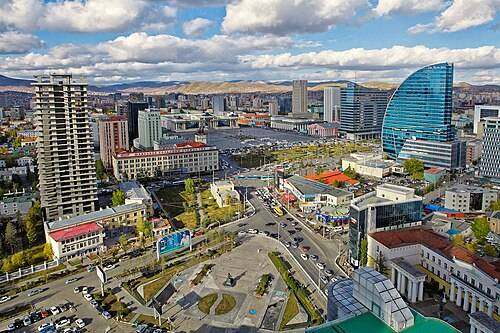
CapitalUlan Bator
RegionEastern Asia
Did you know?
- The world's least densely populated country
- The first dinosaur eggs known to science were found here
- Has more horses than people
Key facts about Mongolia
- Government
- Semi-presidential republic
- Religion
- Buddhism ~52%, unaffiliated ~40%, shamanism
- Founded / independence
- 1911/1921 (from China)
- Rich in
- Copper, coal, gold, cashmere, livestock
- Languages
- Mongolian
Mongolian (Khalkha); Kazakh in the west; Cyrillic and traditional script - Currency
- Mongolian tögrög (₮)
- People are called
- Mongolian
- Main cities
- Ulaanbaatar, Erdenet, Darkhan
Timeline of Mongolia
- 1206Genghis Khan
- 1368Mongols leave China
- 1691Qing rule
- 1911Independence
- 1924Mongolian People's Republic
- 1990Democratic revolution
Places to see in Mongolia
- Gobi Desert
- Genghis Khan Equestrian Statue
- Erdene Zuu Monastery
- Khövsgöl Lake
- Flaming Cliffs (dinosaur fossils)
Food and drink
Buuz (dumplings) · khuushuur · airag (fermented mare's milk)
Culture and famous for
Nomadic gers (yurts); throat singing; Naadam festival
Popular sports
Wrestling, archery, horse racing (Naadam)
Geography and climate
- Highest point
- Khüiten Peak, 4,374 m
- Rivers, lakes and seas
- Khövsgöl lake; Selenge River
- Climate
- Extreme continental; Ulaanbaatar is the coldest capital
- Coastline
- Landlocked
- Population density
- 2 people per km²
Wars and conflicts
- Mongol conquests 13th century
- Khalkhin Gol 1939
Empires and states that once stood here
Xiongnu 209 BC–91 ADGöktürk Khaganate 552–744Uyghur Khaganate 744–840
Alliances and memberships
Military and security
Shanghai Cooperation Organisation (observer)
Mongolia in depth
Detailed facts from the CIA World Factbook (public domain, latest edition).
Overview
- History in brief
- The peoples of Mongolia have a long history under a number of nomadic empires dating back to the Xiongnu in the 4th century B.C., and the name Mongol goes back to at least the 11th century A.D. The most famous Mongol, TEMÜÜJIN (aka Genghis Khan), emerged as the ruler of all Mongols in the early 1200s. By the time of his death in 1227, he had created through conquest a Mongol Empire that extended across much of Eurasia. His descendants, including ÖGÖDEI and KHUBILAI (aka Kublai Khan), continued to conquer Eastern Europe, the Middle East, and the rest of China, where KHUBILAI established the Yuan Dynasty in the 1270s. The Mongols attempted to invade Japan and Java before their empire broke apart in the 14th century. In the 17th century, Mongolia fell under the rule of the Manchus of the Chinese Qing Dynasty. After Manchu rule collapsed in 1911, Mongolia declared independence, finally winning it in 1921 with help from the Soviet Union. Mongolia became a socialist state (the Mongolian People’s Republic) in 1924. Until the collapse of the Soviet Union in 1989, Mongolia was a Soviet satellite state and relied heavily on economic, military, and political assistance from Moscow. The period was also marked by purges, political repression, economic stagnation, and tensions with China.Mongolia peacefully transitioned to an independent democracy in 1990. In 1992, it adopted a new constitution and established a free-market economy. Since the country's transition, it has conducted a series of successful presidential and legislative elections. Throughout the period, the ex-communist Mongolian People's Revolutionary Party -- which took the name Mongolian People’s Party (MPP) in 2010 -- has competed for political power with the Democratic Party and several other smaller parties. For most of its democratic history, Mongolia has had a divided government, with the presidency and the parliamentary majority held by different parties but that changed in 2021, when the MPP won the presidency after having secured a supermajority in parliament in 2020. Mongolia’s June 2021 presidential election delivered a decisive victory for MPP candidate Ukhnaagiin KHURELSUKH.Mongolia maintains close cultural, political, and military ties with Russia, while China is its largest economic partner. Mongolia’s foreign relations are focused on preserving its autonomy by balancing relations with China and Russia, as well as its other major partners, Japan, South Korea, and the US.
Geography
- Location
- Northern Asia, between China and Russia
- Size compared
- slightly smaller than Alaska; more than twice the size of Texas
- Land borders
- Total: 8,082 kmBorder countries: China 4,630 km; Russia 3,452 km
- Coastline
- 0 km (landlocked)
- Climate
- desert; continental (large daily and seasonal temperature ranges)
- Terrain
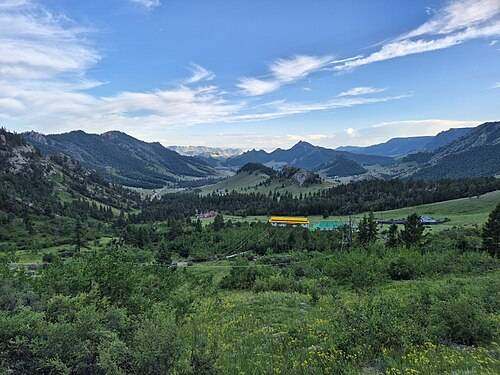
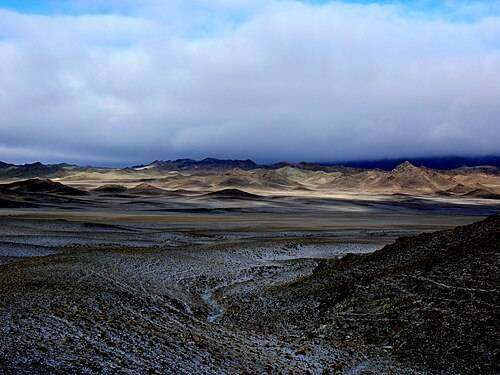
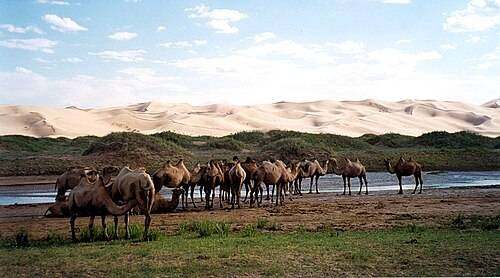
- vast semidesert and desert plains, grassy steppe, mountains in west and southwest; Gobi Desert in south-central
- Elevation
- Highest point: Nayramadlin Orgil (Khuiten Peak) 4,374 mLowest point: Hoh Nuur 560 mMean elevation: 1,528 m
- Natural resources
- oil, coal, copper, molybdenum, tungsten, phosphates, tin, nickel, zinc, fluorspar, gold, silver, iron
- Major rivers
- Amur (shared with China [s] and Russia [m]) - 4,444 kmNote: [s] after country name indicates river source; [m] after country name indicates river mouth
- Major lakes
- Fresh water lake(s): Hovsgol Nuur - 2,620 sq km; Har Us Nuur - 1,760 sq km;Salt water lake(s): Uvs Nuur - 3,350 sq km; Hyargas Nuur - 1,360 sq km
- Natural hazards
- dust storms; grassland and forest fires; drought; "zud," which is harsh winter conditions
- Notes
- landlocked; strategic location between China and Russia
- Environmental issues
- limited natural freshwater resources in some areas; air pollution from coal-burning power plants and lax regulations in Ulaanbaatar; soil erosion from deforestation and overgrazing; water pollution; desertification; effects from mining
People and society
- Population
- Total: 3,281,676 (2024 est.)Male: 1,595,596Female: 1,686,080
- Nationality
- Noun: Mongolian(s)Adjective: Mongolian
- Ethnic groups
- Khalkh 83.8%, Kazak 3.8%, Durvud 2.6%, Bayad 2%, Buriad 1.4%, Zakhchin 1.2%, Dariganga 1.1%, other 4.1% (2020 est.)
- Languages
- Mongolian 90% (official, Khalkha dialect is predominant), Turkic, Russian (1999)Major-language sample(s): Дэлхийн баримтат ном, үндсэн мэдээллийн зайлшгүй эх сурвалж. (Mongolian)The World Factbook, the indispensable source for basic information.
- Religions
- Buddhist 51.8%, no religion 40.6%, Muslim 3.2%, Shaman 2.5%, Christian 1.3%, Other 0.6% (2020 est.)
- Median age
- Total: 28.8 years (2025 est.)Male: 30.1 yearsFemale: 32.8 years
- Population growth
- 1.08% (2025 est.)
- Life expectancy
- Total population: 71.9 years (2024 est.)Male: 67.8 yearsFemale: 76.3 years
- Children per woman
- 2.6 children born/woman (2025 est.)
- Urbanization
- Urban population: 69.1% of total population (2023)Rate of urbanization: 1.4% annual rate of change (2020-25 est.)
- Largest cities
- 1.673 million ULAANBAATAR (capital) (2023)
- Literacy
- Total population: 98.6% (2023 est.)Male: 98.3% (2023 est.)Female: 98.9% (2023 est.)
- Years in school
- Total: 14 years (2023 est.)Male: 13 years (2023 est.)Female: 14 years (2023 est.)
Government
- Official names
- Conventional long form: noneConventional short form: MongoliaLocal long form: noneLocal short form: Mongol UlsFormer: Outer Mongolia, Mongolian People's RepublicEtymology: name comes from the Mongol people, whose name derives from the Mongol root word mengu or mongu, meaning "brave" or "unconquered;" the Mongolian name Mongol Uls translates as "Mongol State"
- Government type
- semi-presidential republic
- Capital
- Name: UlaanbaatarGeographic coordinates: 47 55 N, 106 55 ETime difference: UTC+8 (13 hours ahead of Washington, DC, during Standard Time)Daylight saving time: +1hr, begins last Saturday in March; ends last Saturday in SeptemberTime zone note: Mongolia has two time zones - Ulaanbaatar Time (8 hours in advance of UTC) and Hovd Time (7 hours in advance of UTC)Etymology: the name means "red hero" in Mongolian and honors national hero Damdin SUKHBAATAR, leader of the partisan army that, with Soviet help, liberated Mongolia from Chinese occupation in the early 1920s
- Regions
- 21 provinces (aymguud, singular - aymag) and 1 municipality* (hot); Arhangay, Bayanhongor, Bayan-Olgiy, Bulgan, Darhan-Uul, Dornod, Dornogovi, Dundgovi, Dzavhan (Zavkhan), Govi-Altay, Govisumber, Hentiy, Hovd, Hovsgol, Omnogovi, Orhon, Ovorhangay, Selenge, Suhbaatar, Tov, Ulaanbaatar*, Uvs
- Independence
- 29 December 1911 (independence declared from China; in actuality, autonomy attained); 11 July 1921 (from China)
- National holiday
- Naadam (games) holiday, 11-15 July; Constitution Day, 26 November (1924)
- Constitution
- History: several previous; latest adopted 13 January 1992, effective 12 February 1992Amendment process: proposed by the State Great Hural, by the president of the republic, by the government, or by petition submitted to the State Great Hural by the Constitutional Court; conducting referenda on proposed amendments requires at least two-thirds majority vote of the State Great Hural; passage of amendments by the State Great Hural requires at least three-quarters majority vote; passage by referendum requires majority participation of qualified voters and a majority of votes
- Legal system
- civil law system influenced by Soviet and Romano-Germanic systems; constitution ambiguous on judicial review of legislative acts
- Voting age
- 18 years of age; universal
- Flag meaning
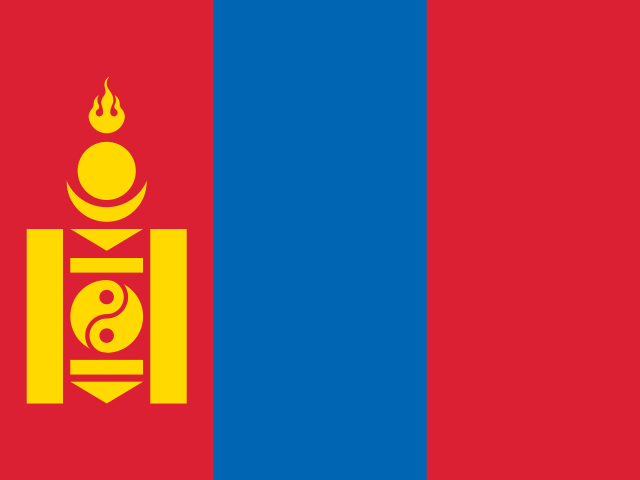
- Description: three equal vertical bands of red (left side), blue, and red; centered on the left-side red band is the national emblem in yellow, the soyombo, which is an abstract representation of fire, sun, moon, earth, water, and the yin-yang symbolMeaning: blue stands for the sky, and red for progress and prosperity
- National symbols
- Soyombo character (from the Soyombo writing system)
- National colours
- red, blue, yellow
- National anthem
- Title: "Mongol ulsyn toriin duulal" (National Anthem of Mongolia)Lyrics/music: Tsendiin DAMDINSUREN/Bilegiin DAMDINSUREN and Luvsanjamts MURJORJHistory: music adopted 1950, lyrics adopted 2006; lyrics altered on numerous occasions
- UNESCO World Heritage Sites
- Total World Heritage Sites: 6 (4 cultural, 2 natural)Selected World Heritage Site locales: Uvs Nuur Basin (n); Orkhon Valley Cultural Landscape (c); Petroglyphic Complexes of the Mongolian Altai (c); Great Burkhan Khaldun Mountain and surrounding sacred landscape (c); Landscapes of Dauria (n); Deer Stone Monuments and Related Bronze Age Sites (c)
Economy
- Overview
- lower middle-income East Asian economy; large human capital improvements over last 3 decades; agricultural and natural resource rich; export and consumption-led growth; high inflation due to supply bottlenecks and increased food and energy prices; currency depreciation
- GDP (PPP)
- $59.221 billion (2024 est.)
- GDP per person (PPP)
- $16,800 (2024 est.)
- GDP growth
- 4.9% (2024 est.)
- Inflation
- 6.8% (2024 est.)
- Unemployment
- 5.5% (2024 est.)
- Below poverty line
- 27.1% (2022 est.)
- Farm products
- milk, wheat, lamb/mutton, potatoes, beef, carrots/turnips, goat milk, goat meat, bison milk, horse meat (2023)
- Industries
- construction and construction materials; mining (coal, copper, molybdenum, fluorspar, tin, tungsten, gold); oil; food and beverages; processing of animal products, cashmere and natural fiber manufacturing
- Exports
- $15.501 billion (2023 est.)
- Main exports
- coal, copper ore, gold, iron ore, crude petroleum (2023)
- Export partners
- China 92%, Switzerland 6%, Italy 1%, Thailand 0%, Japan 0% (2023)
- Main imports
- cars, trucks, trailers, tractors, construction vehicles (2023)
- Import partners
- China 57%, Japan 13%, Germany 3%, Singapore 3%, USA 3% (2023)
- Money sent home from abroad
- 2.2% of GDP (2023 est.)
Energy, internet and transport
- Electricity access
- Electrification - total population: 100% (2022 est.)
- Electricity sources
- Fossil fuels: 90.4% of total installed capacity (2023 est.)Solar: 2.4% of total installed capacity (2023 est.)Wind: 6.4% of total installed capacity (2023 est.)Hydroelectricity: 0.8% of total installed capacity (2023 est.)
- Internet users
- Percent of population: 83% (2023 est.)
- Mobile phones
- Total subscriptions: 4.84 million (2023 est.)Subscriptions per 100 inhabitants: 142 (2022 est.)
- TV and radio
- state-run radio and TV provider is now a public-service provider; also available are 68 radio and 160 TV stations, including multi-channel satellite and cable TV providers; transmissions of multiple international broadcasters are available (2019)
- Airports
- 37 (2025)
- Railways
- Total: 1,815 km (2017)Broad gauge: 1,815 km (2017) 1.520-m gauge
- Merchant ships
- Total: 318 (2023)By type: bulk carrier 8, container ship 8, general cargo 151, oil tanker 58, other 93
Military and space
- Armed forces
- Mongolian Armed Forces (MAF): Land Force, Air Force, Cyber Security Forces, Special Forces, Construction-Engineering Forces (2025)
- Military spending
- 0.7% of GDP (2024 est.)
- Military service
- 18-25 years of age for voluntary service for men and women; initial service 24 months; compulsory service for men at 18; service obligation is 12 months in the military or police, which can be extended to 15 months under special circumstances; compulsory service can be exchanged for a 24‐month stint in the civil service or a cash payment determined by the Mongolian Government; after conscription, soldiers can contract into military service for up to 4 years (2025)
Global issues
- Refugees and displaced people
- Refugees: 26 (2024 est.)IDPs: 22 (2024 est.)Stateless persons: 17 (2024 est.)
Neighbouring countries
- Phone code
- +976
- Internet domain
- .mn