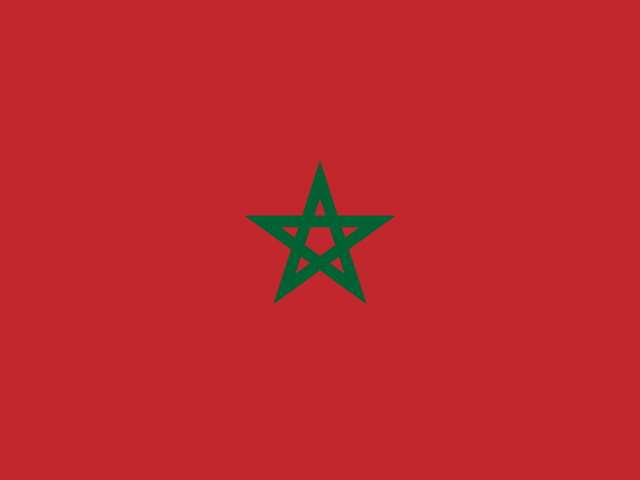
Morocco
Kingdom of Morocco · المغرب · ⵍⵎⴰⵖⵔⵉⴱ
Ruled by Berber and Arab dynasties for over a thousand years; the Alaouite dynasty since 1631. French and Spanish protectorate 1912–56.
See Morocco on the 3D globeTake a quiz
Population38 million
Area446,550 km²
CapitalRabat
RegionNorthern Africa
Did you know?
- Fes has the world's oldest continuously operating university (al-Qarawiyyin, 859)
- First African team to reach a World Cup semi-final (2022)
- Co-hosting the 2030 World Cup
Key facts about Morocco
- Government
- Constitutional monarchy
- Religion
- Sunni Islam ~99%
- Founded / independence
- 788 (Idrisid); 1956 independence
- Rich in
- Phosphates (70% of reserves), cars, tourism
- Languages
- Arabic, Berber
Arabic (Darija), Berber (Tamazight, Tashelhit, Tarifit); French - Currency
- Moroccan dirham (د.م.)
- People are called
- Moroccan
- Main cities
- Casablanca, Rabat, Fez, Marrakesh, Tangier
Timeline of Morocco
- 788Idrisid dynasty
- 859University of al-Qarawiyyin
- 1912French and Spanish protectorate
- 1956Independence
- 1975Green March
Places to see in Morocco
- Jemaa el-Fnaa, Marrakesh
- Fes medina
- Chefchaouen blue city
- Hassan II Mosque
- Sahara at Merzouga
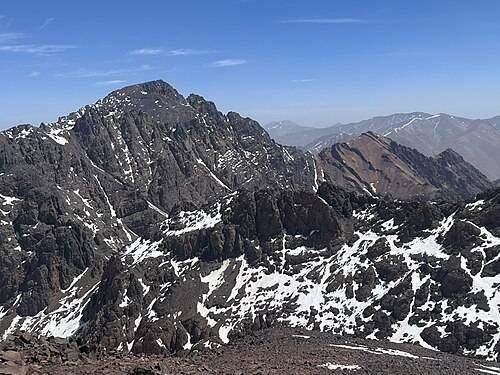
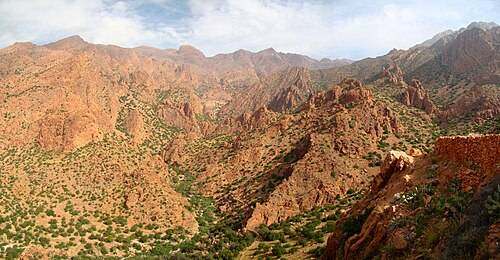
- Atlas Mountains
Food and drink
Tagine · couscous · pastilla · mint tea · harira
Culture and famous for
Riads; zellige tiles; Berber carpets; Gnawa music
Popular sports
Football (2022 World Cup semi-finalist)
Geography and climate
- Highest point
- Toubkal, 4,167 m
- Rivers, lakes and seas
- Moulouya, Draa
- Climate
- Mediterranean to desert
- Coastline
- Has a sea coast
- Population density
- 85 people per km²
Wars and conflicts
- Rif War 1921–26
- Western Sahara conflict 1975–present
Alliances and memberships
Political unions and regional organisations
African UnionArab LeagueOrganisation of Islamic Cooperation
Morocco in depth
Detailed facts from the CIA World Factbook (public domain, latest edition).
Overview
- History in brief
- In 788, about a century after the Arab conquest of North Africa, a series of Muslim dynasties began to rule in Morocco. In the 16th century, the Sa'adi monarchy, particularly under Ahmad al-MANSUR (1578-1603), repelled foreign invaders and inaugurated a golden age. The Alaouite Dynasty, to which the current Moroccan royal family belongs, dates from the 17th century. In 1860, Spain occupied northern Morocco and ushered in a half-century of trade rivalry among European powers that saw Morocco's sovereignty steadily erode; in 1912, the French imposed a protectorate over the country. A protracted independence struggle with France ended successfully in 1956. The internationalized city of Tangier and most Spanish possessions were turned over to the new country that same year. Sultan MOHAMMED V, the current monarch's grandfather, organized the new state as a constitutional monarchy and in 1957 assumed the title of king.Since Spain's 1976 withdrawal from Western Sahara, Morocco has extended its de facto administrative control to roughly 75% of this territory; however, the UN does not recognize Morocco as the administering power for Western Sahara. The UN since 1991 has monitored a cease-fire, which broke down in late 2020, between Morocco and the Polisario Front -- an organization advocating the territory’s independence -- and restarted negotiations over the status of the territory in 2018. In 2020, the US recognized Morocco's sovereignty over all of Western Sahara. In 2011, King MOHAMMED VI responded to the spread of pro-democracy protests in the North Africa region by implementing a reform program that included a new constitution, passed by popular referendum, under which some new powers were extended to parliament and the prime minister, but ultimate authority remains in the hands of the monarch. Later that year, the Justice and Development Party (PJD) -- a moderate Islamist democratic party -- won the largest number of seats in parliamentary elections, becoming the first Islamist party to lead the Moroccan Government. In 2015, Morocco held its first direct elections for regional councils, which was one of the reforms included in the 2011 constitution. The PJD again won the largest number of seats in nationwide parliamentary elections in 2016, but it lost its plurality to the probusiness National Rally of Independents (RNI) in 2021. In 2020, Morocco signed a normalization agreement with Israel, similar to those that Bahrain, the United Arab Emirates, and Sudan
Geography
- Location
- Northern Africa, bordering the North Atlantic Ocean and the Mediterranean Sea, between Algeria and Mauritania
- Size compared
- slightly larger than twice the size of California
- Land borders
- Total: 3,523.5 kmBorder countries: Algeria 1,941 km; Mauritania 1,564 km; Spain (Ceuta) 8 km and Spain (Melilla) 10.5 km
- Coastline
- 2,945 km
- Climate
- Mediterranean in the north, becoming more extreme in the interior; in the south, hot, dry desert; rain is rare; cold offshore air currents produce fog and heavy dew
- Terrain
- mountainous northern coast (Rif Mountains) and interior (Atlas Mountains) bordered by large plateaus with intermontane valleys, and fertile coastal plains; the south is mostly low, flat desert with large areas of rocky or sandy surfaces
- Elevation
- Highest point: Jebel Toubkal 4,165 mLowest point: Sebkha Tah -59 mMean elevation: 909 m
- Natural resources
- phosphates, iron ore, manganese, lead, zinc, fish, salt
- Major rivers
- Draa - 1,100 km
- Natural hazards
- in the north, the mountains are geologically unstable and subject to earthquakes; periodic droughts; windstorms; flash floods; landslides; in the south, a hot, dry, dust/sand-laden sirocco wind can occur during winter and spring; widespread harmattan haze exists 60% of time, often severely restricting visibility
- Notes
- strategic location along Strait of Gibraltar; the only African nation to have both Atlantic and Mediterranean coastlines; the waters off the Atlantic coast are particularly rich fishing areas
- Environmental issues
- In the north: land degradation and desertification, with soil erosion from farming, overgrazing, and vegetation removal; water and soil pollution from industrial-waste dumping; in the south: desertification; overgrazing; sparse water
People and society
- Population
- Total: 37,387,585 (2024 est.)Male: 18,664,263Female: 18,723,322
- Nationality
- Noun: Moroccan(s)Adjective: Moroccan
- Ethnic groups
- Arab-Amazigh 99%, other 1%
- Languages
- Arabic (official), Tamazight languages (Tamazight (official), Tachelhit, Tarifit), French (often the language of business, government, and diplomacy)Major-language sample(s): كتاب ديال لحقائق متاع العالم، احسن مصدر متاع المعلومات الأساسية (Arabic)The World Factbook, the indispensable source for basic information.
- Religions
- Muslim 99% (official; virtually all Sunni, <0.1% Shia), other 1% (includes Christian, Jewish, and Baha'i); note - Jewish about 3,000-3,500 (2020 est.)
- Median age
- Total: 30.9 years (2025 est.)Male: 30.1 yearsFemale: 31 years
- Population growth
- 0.81% (2025 est.)
- Life expectancy
- Total population: 74.2 years (2024 est.)Male: 72.5 yearsFemale: 76 years
- Children per woman
- 2.24 children born/woman (2025 est.)
- Urbanization
- Urban population: 65.1% of total population (2023)Rate of urbanization: 1.88% annual rate of change (2020-25 est.)
- Largest cities
- 3.893 million Casablanca, 1.959 million RABAT (capital), 1.290 million Fes, 1.314 million Tangier, 1.050 million Marrakech, 979,000 Agadir (2023)
- Years in school
- Total: 15 years (2023 est.)Male: 15 years (2023 est.)Female: 15 years (2023 est.)
Government
- Official names
- Conventional long form: Kingdom of MoroccoConventional short form: MoroccoLocal long form: Al Mamlakah al MaghribiyahLocal short form: Al MaghribFormer: French Protectorate in Morocco, Spanish Protectorate in Morocco, Ifni, Spanish Sahara, Western SaharaEtymology: the English name of Morocco derives from, respectively, the Spanish and Portuguese names Marruecos and Marrocos, which stem from Marrakesh, the Latin name for the former capital of ancient Morocco; the Arabic name, Al Maghrib, translates as "The West"
- Government type
- parliamentary constitutional monarchy
- Capital
- Name: RabatGeographic coordinates: 34 01 N, 6 49 WTime difference: UTC+1 (6 hours ahead of Washington, DC, during Standard Time)Etymology: derives from the Arabic name Ribat el-Fath, from the words ribat (fortified monastery) and fath (conquest); the third Almohad sultan, Abu Yusuf Yaqub al-Manṣur, gave the name to a fort on the site in the 12th century
- Regions
- 12 regions; Beni Mellal-Khenifra, Casablanca-Settat, Dakhla-Oued Ed-Dahab, Draa-Tafilalet, Fes-Meknes, Guelmim-Oued Noun, Laayoune-Sakia El Hamra, Marrakech-Safi, Oriental, Rabat-Sale-Kenitra, Souss-Massa, Tanger-Tetouan-Al Hoceima
- Independence
- 2 March 1956 (from France)
- National holiday
- Throne Day (accession of King MOHAMMED VI to the throne), 30 July (1999)
- Constitution
- History: several previous; latest drafted 17 June 2011, approved by referendum 1 July 2011Amendment process: proposed by the king, by the prime minister, or by members in either chamber of Parliament; passage requires at least two-thirds majority vote by both chambers and approval in a referendum; the king can opt to submit self-initiated proposals directly to a referendum
- Legal system
- mixed system of civil law based on French civil law and Islamic (sharia) law; Constitutional Court reviews legislative acts
- Voting age
- 18 years of age; universal
- Flag meaning
- Description: red with a green pentacle (five-pointed linear star) known as Sulayman's (Solomon's) seal in the center of the flagMeaning: red and green are traditional colors in Arab flags, although the use of red is more commonly associated with the Arab states of the Persian Gulf; the pentacle represents the five pillars of Islam and the association between God and the nationHistory: the design dates to 1912
- National symbols
- pentacle symbol, lion
- National colours
- red, green
- National anthem
- Title: "Hymne Cherifien" (Hymn of the Sharif)Lyrics/music: Ali Squalli HOUSSAINI/Leo MORGANHistory: music adopted 1956, lyrics adopted 1970
- UNESCO World Heritage Sites
- Total World Heritage Sites: 9 (all cultural)Selected World Heritage Site locales: Medina of Fez; Medina of Marrakesh; Ksar of Ait-Ben-Haddou; Historic City of Meknes; Archaeological Site of Volubilis; Medina of Tétouan (formerly known as Titawin); Medina of Essaouira (formerly Mogador); Portuguese City of Mazagan (El Jadida); Historic and Modern Rabat
Economy
- Overview
- lower middle-income North African economy; ongoing recovery from recent drought and earthquake; rebounding via tourism, manufacturing, and raw materials processing; significant trade and investment with EU; reform programs include fiscal rebalancing, state enterprise governance and private sector investments
- GDP (PPP)
- $350.594 billion (2024 est.)
- GDP per person (PPP)
- $9,100 (2024 est.)
- GDP growth
- 3.2% (2024 est.)
- Inflation
- 1% (2024 est.)
- Unemployment
- 9% (2024 est.)
- Below poverty line
- 3.9% (2022 est.)
- Farm products
- wheat, milk, potatoes, sugar beets, tomatoes, barley, olives, apples, tangerines/mandarins, onions (2023)
- Industries
- automotive parts, phosphate mining and processing, aerospace, food processing, leather goods, textiles, construction, energy, tourism
- Exports
- $61.746 billion (2023 est.)
- Main exports
- fertilizers, cars, garments, insulated wire, tomatoes (2023)
- Export partners
- Spain 20%, France 17%, Germany 6%, UK 5%, Italy 4% (2023)
- Main imports
- refined petroleum, cars, vehicle parts/accessories, natural gas, coal (2023)
- Import partners
- Spain 16%, China 11%, France 10%, USA 9%, Turkey 5% (2023)
- Money sent home from abroad
- 8.1% of GDP (2023 est.)
Energy, internet and transport
- Electricity access
- Electrification - total population: 100% (2022 est.)
- Electricity sources
- Fossil fuels: 78.6% of total installed capacity (2023 est.)Solar: 5% of total installed capacity (2023 est.)Wind: 15.5% of total installed capacity (2023 est.)Hydroelectricity: 0.9% of total installed capacity (2023 est.)Biomass and waste: 0.1% of total installed capacity (2023 est.)
- Internet users
- Percent of population: 91% (2023 est.)
- Mobile phones
- Total subscriptions: 55.9 million (2023 est.)Subscriptions per 100 inhabitants: 137 (2021 est.)
- TV and radio
- 2 TV broadcast networks with state-run Radio-Television Marocaine (RTM) operating one network and the state partially owning the other; foreign TV is available via satellite dish; 3 radio broadcast networks, with RTM operating one; the state-owned network includes 10 regional radio channels in addition to its national service (2019)
- Airports
- 48 (2025)
- Railways
- Total: 2,067 km (2014)Standard gauge: 2,067 km (2014) 1.435-m gauge (1,022 km electrified)
- Merchant ships
- Total: 94 (2023)By type: container ship 6, general cargo 5, oil tanker 2, other 81
Military and space
- Armed forces
- Royal Moroccan Armed Forces (FAR): Royal Moroccan Army (includes the Moroccan Royal Guard), Royal Moroccan Navy (includes Coast Guard, marines), Royal Moroccan Air Force, Moroccan Royal Guard, Royal Moroccan GendarmerieMinistry of Interior: General Directorate for National Security (DGSN; aka National Police), Auxiliary Forces (2025)
- Military spending
- 4% of GDP (2024 est.)
- Military service
- 19-25 years of age for 12-month compulsory and voluntary military service for men and women (2025)
Global issues
- Refugees and displaced people
- Refugees: 18,848 (2024 est.)IDPs: 256 (2024 est.)
Neighbouring countries
- Phone code
- +212
- Internet domain
- .ma