Netherlands
Kingdom of the Netherlands · Nederland
Revolted against Spain in 1568 and built a 17th-century golden age with a global trading empire. About a quarter of the country lies below sea level, protected by dikes. A founding EU member.
See Netherlands on the 3D globeTake a quiz
Population18 million
Area41,850 km²
CapitalAmsterdam
RegionWestern Europe
Did you know?
- There are more bicycles than people
- About a quarter lies below sea level
- Dutch are the tallest people in the world on average
Key facts about Netherlands
- Government
- Parliamentary constitutional monarchy
- Religion
- Unaffiliated ~55%, Catholic ~18%, Protestant ~13%, Islam ~5%
- Founded / independence
- 1581 (from Spain)
- Rich in
- Port of Rotterdam, agriculture exports, chip machines (ASML), natural gas
- Languages
- Dutch
Dutch (Hollandic, Brabantian, Limburgish, Low Saxon), West Frisian in Friesland - Currency
- Euro (€)
- People are called
- Dutch
- Main cities
- Amsterdam, Rotterdam, The Hague, Utrecht, Eindhoven
Timeline of Netherlands
- 1581Independence from Spain
- 1602Dutch East India Company
- 1648Recognised at Westphalia
- 1815Kingdom
- 1940German occupation
- 1957Founds EEC
- 2001First to legalise same-sex marriage
Places to see in Netherlands
- Rijksmuseum
- Anne Frank House
- Keukenhof tulips
- Kinderdijk windmills
- Amsterdam canals
- Delta Works
Food and drink
Stroopwafels · herring · Gouda and Edam cheese · bitterballen
Culture and famous for
Painters Rembrandt, Vermeer, van Gogh; tulips; bicycles
Popular sports
Football, speed skating, cycling
Geography and climate
- Highest point
- Mount Scenery (Saba), 887 m; Vaalserberg on the mainland, 322 m
- Rivers, lakes and seas
- Rhine, Meuse delta
- Climate
- Mild maritime
- Coastline
- Has a sea coast
- Population density
- 430 people per km²
Wars and conflicts
- Eighty Years' War
- Anglo-Dutch Wars
- WWII occupation
- Indonesian independence war
Alliances and memberships
Military and security
Political unions and regional organisations
European UnionEurozoneCouncil of EuropeBenelux Union
Economy and trade
Netherlands in depth
Detailed facts from the CIA World Factbook (public domain, latest edition).
Overview
- History in brief
- The Dutch United Provinces declared their independence from Spain in 1581; during the 17th century, they became a leading seafaring and commercial power, with settlements and colonies around the world. After 18 years of French domination, the Netherlands regained its independence in 1813. In 1830, Belgium seceded and formed a separate kingdom. The Netherlands remained neutral in World War I but suffered German invasion and occupation in World War II. A modern, industrialized nation, the Netherlands is also a large exporter of agricultural products. The country was a founding member of NATO and the EEC (now the EU) and participated in the introduction of the euro in 1999. In 2010, the former Netherlands Antilles was dissolved and the three smallest islands -- Bonaire, Sint Eustatius, and Saba -- became special municipalities in the Netherlands administrative structure. The larger islands of Sint Maarten and Curacao joined the Netherlands and Aruba as constituent countries forming the Kingdom of the Netherlands. In 2018, the Sint Eustatius island council (governing body) was dissolved and replaced by a government commissioner to restore the integrity of public administration. According to the Dutch Government, the intervention will be as "short as possible and as long as needed."
Geography
- Location
- Western Europe, bordering the North Sea, between Belgium and Germany
- Size compared
- slightly less than twice the size of New Jersey
- Land borders
- Total: 1,053 kmBorder countries: Belgium 478 km; Germany 575 km
- Coastline
- 451 km
- Climate
- temperate; marine; cool summers and mild winters
- Terrain
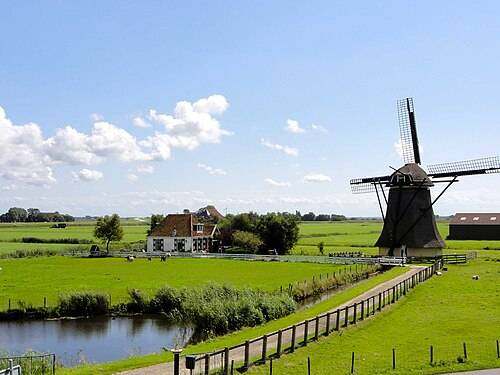
- mostly coastal lowland and reclaimed land (polders); some hills in southeast
- Elevation
- Highest point: Mount Scenery (on the island of Saba in the Caribbean, now considered an integral part of the Netherlands following the dissolution of the Netherlands Antilles) 862 mLowest point: Zuidplaspolder -7 mMean elevation: 30 m
- Natural resources
- natural gas, petroleum, peat, limestone, salt, sand and gravel, arable land
- Major rivers
- Rijn (Rhine) river mouth (shared with Switzerland [s], Germany, and France) - 1,233 kmNote: [s] after country name indicates river source; [m] after country name indicates river mouth
- Natural hazards
- floodingVolcanism: Mount Scenery (887 m), located on the island of Saba in the Caribbean, last erupted in 1640; Round Hill (601 m), a dormant volcano also known as "The Quill," is located on the island of St. Eustatius in the Caribbean; these islands are at the northern end of the volcanic island arc of the Lesser Antilles that extends south to Grenada
- Notes
- located at mouths of three major European rivers (Rhine (Rijn), Meuse (Maas), and Scheldt (Schelde)); about a quarter of the country lies below sea level and only about half of the land exceeds one meter above sea level
- Environmental issues
- water pollution, including industrial and agricultural chemicals in rivers; air pollution from vehicles and refining activities
People and society
- Population
- Total: 17,833,885 (2025 est.)Male: 8,874,366Female: 8,959,519
- Nationality
- Noun: Dutchman(men), Dutchwoman(women)Adjective: Dutch
- Ethnic groups
- Dutch 75.4%, EU (excluding Dutch) 6.4%, Turkish 2.4%, Moroccan 2.4%, Surinamese 2.1%, Indonesian 2%, other 9.3% (2021 est.)
- Languages
- Dutch (official), Frisian (official in Fryslan province)Major-language sample(s): Het Wereld Feitenboek, een onmisbare bron van informatie. (Dutch)The World Factbook, the indispensable source for basic information.
- Religions
- Roman Catholic 20.1%, Protestant 14.8% (includes Dutch Reformed, Protestant Church of The Netherlands, Calvinist), Muslim 5%, other 5.9% (includes Hindu, Buddhist, Jewish), none 54.1% (2019 est.)
- Median age
- Total: 42.2 years (2025 est.)Male: 40.9 yearsFemale: 43.5 years
- Population growth
- 0.3% (2025 est.)
- Life expectancy
- Total population: 81.9 years (2024 est.)Male: 80.3 yearsFemale: 83.5 years
- Children per woman
- 1.62 children born/woman (2025 est.)
- Urbanization
- Urban population: 93.2% of total population (2023)Rate of urbanization: 0.59% annual rate of change (2020-25 est.)
- Largest cities
- 1.174 million AMSTERDAM (capital), 1.018 million Rotterdam (2023)
- Years in school
- Total: 19 years (2021 est.)Male: 18 years (2021 est.)Female: 19 years (2021 est.)
Government
- Official names
- Conventional long form: Kingdom of the NetherlandsConventional short form: NetherlandsLocal long form: Koninkrijk der NederlandenLocal short form: NederlandAbbreviation: NLEtymology: the English name is derived from the country's Dutch name, which means "the lowlands" and describes the geographic area; only about half the Netherlands is more than 1 meter (3.3 ft) above sea level
- Government type
- parliamentary constitutional monarchy; part of the Kingdom of the Netherlands
- Capital
- Name: AmsterdamGeographic coordinates: 52 21 N, 4 55 ETime difference: UTC+1 (6 hours ahead of Washington, DC, during Standard Time)Daylight saving time: +1hr, begins last Sunday in March; ends last Sunday in OctoberTime zone note: time descriptions apply to the continental Netherlands only, for the constituent countries in the Caribbean, the time difference is UTC-4Etymology: the name is derived from the Dutch name of the local river, the Amstel, and the Dutch word dam, which has the same meaning in English; the river name is said to derive from the Germanic words ama (current) and stelle (place)
- Regions
- 12 provinces (provincies, singular - provincie), 3 public entities* (openbare lichamen, singular - openbaar lichaam (Dutch); entidatnan publiko, singular - entidat publiko (Papiamento)); Bonaire*, Drenthe, Flevoland, Fryslan (Friesland), Gelderland, Groningen, Limburg, Noord-Brabant (North Brabant), Noord-Holland (North Holland), Overijssel, Saba*, Sint Eustatius*, Utrecht, Zeeland (Zealand), Zuid-Holland (South Holland)
- Independence
- 26 July 1581
- National holiday
- King's Day (birthday of King WILLEM-ALEXANDER), 27 April (1967)
- Constitution
- History: many previous to adoption of the "Basic Law of the Kingdom of the Netherlands" on 24 August 1815; revised 8 times, the latest in 1983Amendment process: proposed as an Act of Parliament by or on behalf of the king or by the Second Chamber of the States General; the Second Chamber is dissolved after its first reading of the Act; passage requires a second reading by both the First Chamber and the newly elected Second Chamber, followed by at least two-thirds majority vote of both chambers, and ratification by the king
- Legal system
- civil law system based on the French system; constitution does not permit judicial review of acts of the States General
- Voting age
- 18 years of age; universal
- Flag meaning
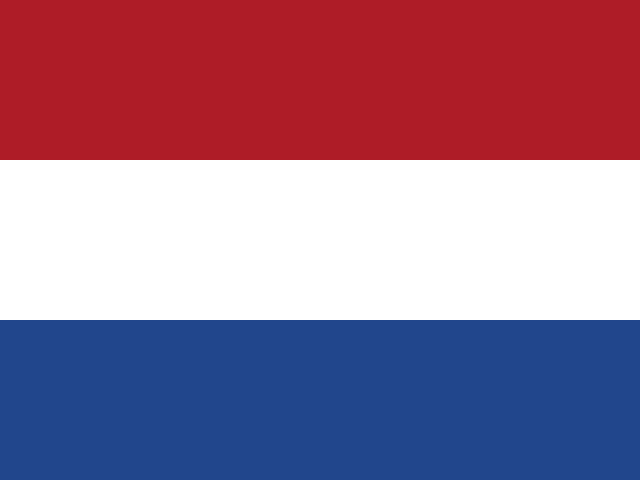
- Description: three equal horizontal bands of bright red (top), white, and cobalt blueHistory: the colors come from WILLIAM I, Prince of Orange; originally the upper band was orange, but the dye would turn red over time, so red was eventually made the permanent color
- National symbols
- lion, daisy
- National colours
- orange
- National anthem
- Title: "Het Wilhelmus" (The William)Lyrics/music: Philips VAN MARNIX van Sint Aldegonde (presumed)/unknownHistory: adopted 1932, in use since the 17th century
- UNESCO World Heritage Sites
- Total World Heritage Sites: 13 (12 cultural, 1 natural)Selected World Heritage Site locales: Schokland and Surroundings (c); Dutch Water Defense Lines (c); Van Nellefabriek (c); Mill Network at Kinderdijk-Elshout (c); Droogmakerij de Beemster (Beemster Polder) (c); Rietveld Schröderhuis (Rietveld Schröder House) (c); Wadden Sea (n); Seventeenth Century Canal Ring Area of Amsterdam inside the Singelgracht (c); Colonies of Benevolence (c); Frontiers of the Roman Empire - The Lower German Limes (c)
Economy
- Overview
- high-income, core EU- and eurozone-member economy; strong services, logistics, and tech sectors; strongly trade-oriented with heightened risks from global tensions; declining inflation aided by easing energy prices and wage growth; rising but manageable deficits and public debt; strong ratings for innovation, competitiveness, and business climate
- GDP (PPP)
- $1.276 trillion (2024 est.)
- GDP per person (PPP)
- $70,900 (2024 est.)
- GDP growth
- 1% (2024 est.)
- Inflation
- 3.3% (2024 est.)
- Unemployment
- 3.6% (2024 est.)
- Below poverty line
- 14.5% (2021 est.)
- Farm products
- milk, sugar beets, potatoes, onions, pork, wheat, chicken, tomatoes, carrots/turnips, beef (2023)
- Industries
- agroindustries, metal and engineering products, electrical machinery and equipment, chemicals, petroleum, construction, microelectronics, fishing
- Exports
- $1.032 trillion (2024 est.)
- Main exports
- refined petroleum, vaccines, machinery, crude petroleum, broadcasting equipment (2023)
- Export partners
- Germany 16%, Belgium 15%, France 11%, Italy 6%, USA 6% (2023)
- Main imports
- crude petroleum, refined petroleum, broadcasting equipment, cars, natural gas (2023)
- Import partners
- Germany 16%, Belgium 10%, China 10%, USA 10%, UK 5% (2023)
- Money sent home from abroad
- 0.4% of GDP (2024 est.)
Energy, internet and transport
- Electricity access
- Electrification - total population: 100% (2022 est.)
- Electricity sources
- Fossil fuels: 46.8% of total installed capacity (2023 est.)Nuclear: 3.2% of total installed capacity (2023 est.)Solar: 17.2% of total installed capacity (2023 est.)Wind: 24.6% of total installed capacity (2023 est.)Hydroelectricity: 0.1% of total installed capacity (2023 est.)Biomass and waste: 8.2% of total installed capacity (2023 est.)
- Internet users
- Percent of population: 97% (2023 est.)
- Mobile phones
- Total subscriptions: 23.4 million (2024 est.)Subscriptions per 100 inhabitants: 129 (2024 est.)
- TV and radio
- more than 90% of households are connected to cable or satellite TV systems with a wide range of domestic and foreign channels; public service broadcast system includes multiple broadcasters, 3 with a national reach and the remainder in regional and local markets; 2 nationwide commercial TV companies, each with 3 or more stations, and many commercial TV stations in regional and local markets; nearly 600 radio stations with a mix of public and private stations
- Airports
- 44 (2025)
- Railways
- Total: 3,055 km (2020) 2,310 km electrified
- Merchant ships
- Total: 1,187 (2023)By type: bulk carrier 11, container ship 36, general cargo 521, oil tanker 27, other 592
Military and space
- Armed forces
- Netherlands (Dutch) Armed Forces (Nederlandse Krijgsmacht): Royal Netherlands Army, Royal Netherlands Navy (includes Marine Corps), Royal Netherlands Air Force, Royal Netherlands Marechaussee (Military Constabulary) (2025)
- Military spending
- 2.5% of GDP (2025 est.)
- Military service
- 17 years of age for voluntary service for men and women; the military is an all-volunteer force; conscription remains in place, but the requirement to show up for compulsory military service was suspended in 1997 (2025)
- Space programme
- has a national space program focused on developing advanced space technologies and services based on satellite data; builds and operates a range of satellites, including communications and remote sensing (RS); researches and develops technologies related to astrophysics, atmospheric measuring instruments, planetary/exoplanetary research, propulsion systems, RS, robotics, and telecommunications; founding member of the ESA and active in the EU space community; hosts the ESA's main research and technology center; participates in building European satellite launch vehicles and a range of other European space programs, such as Copernicus Earth observation and the Galileo global navigation satellite system; participates in international programs, including the International Space Station and the Square Kilometer Array project; works with other foreign space agencies and industries, including those of Japan and the US; has a robust commercial space sector (2025)
- Space milestones
- 1960s - established space program1974-1983 - developed advanced astronomical observatory satellites jointly with US, including the Astronomical Netherlands Satellite and the Infrared Astronomical Satellite1985 - first Dutch citizen in space on the US Space Shuttle2023 - signed US-led Artemis Accords for space and lunar exploration2025 - launched the first of four planned synthetic aperture radar (SAR) remote sensing satellites
Global issues
- Refugees and displaced people
- Refugees: 310,239 (2024 est.)Stateless persons: 4,428 (2024 est.)
- Drug trade
- USG identification: major precursor-chemical producer (2025)
Neighbouring countries
- Phone code
- +31
- Internet domain
- .nl