Belgium
Kingdom of Belgium · Belgien · Belgique · België
Rich medieval trading towns of Flanders came under Burgundy, Spain, Austria, France and the Netherlands before independence in 1830. King Leopold II's brutal private rule of the Congo is a dark chapter. Today a federation of Flanders, Wallonia and Brussels.
See Belgium on the 3D globeTake a quiz
Population11.8 million
Area30,528 km²
CapitalBrussels
RegionWestern Europe
Did you know?
- Fries may have originated here, not France
- Voting is compulsory
- Antwerp handles most of the world's rough diamonds
Key facts about Belgium
- Government
- Federal parliamentary constitutional monarchy
- Religion
- Roman Catholic ~50%, Islam ~7%, unaffiliated ~30%
- Founded / independence
- 1830 (from Netherlands)
- Rich in
- Chemicals, diamonds (Antwerp), ports, EU and NATO headquarters
- Languages
- German, French, Dutch
Dutch (Flemish dialects: West Flemish, Brabantian, Limburgish), French (Walloon, Picard), German in the east - Currency
- Euro (€)
- People are called
- Belgian
- Main cities
- Brussels, Antwerp, Ghent, Charleroi, Liège, Bruges
Timeline of Belgium
- 1830Belgian Revolution and independence
- 1885Leopold II takes Congo
- 1914German invasion
- 1940Occupied again
- 1958Brussels hosts the world fair and EU institutions
- 1993Becomes a federal state
Places to see in Belgium
- Grand-Place, Brussels
- Atomium
- medieval Bruges
- Ghent's Gravensteen
- battlefield of Waterloo
Food and drink
Moules-frites · Belgian waffles · chocolate · over 1,500 beers
Culture and famous for
Comics (Tintin, the Smurfs); surrealist painter Magritte; Flemish masters Rubens and van Eyck; Art Nouveau
Popular sports
Cycling, football, tennis
Geography and climate
- Highest point
- Signal de Botrange, 694 m
- Rivers, lakes and seas
- Scheldt, Meuse
- Climate
- Mild maritime
- Coastline
- Has a sea coast
- Population density
- 387 people per km²
Wars and conflicts
- Belgian Revolution 1830
- WWI and WWII (occupied both times)
- Congo colonial wars
Alliances and memberships
Military and security
Political unions and regional organisations
European UnionEurozoneCouncil of EuropeBenelux Union
Economy and trade
Belgium in depth
Detailed facts from the CIA World Factbook (public domain, latest edition).
Overview
- History in brief
- Belgium became independent from the Netherlands in 1830; it was occupied by Germany during World Wars I and II. The country prospered as a modern, technologically advanced European state and member of NATO and the EU. In recent years, longstanding tensions between the Dutch-speaking Flemish of the north and the French-speaking Walloons of the south have led to constitutional amendments granting these regions formal recognition and autonomy. The capital city of Brussels is home to numerous international organizations, including the EU and NATO.
Geography
- Location
- Western Europe, bordering the North Sea, between France and the Netherlands
- Size compared
- about the size of Maryland
- Land borders
- Total: 1,297 kmBorder countries: France 556 km; Germany 133 km; Luxembourg 130 km; Netherlands 478 km
- Coastline
- 66.5 km
- Climate
- temperate; mild winters, cool summers; rainy, humid, cloudy
- Terrain
- flat coastal plains in northwest, central rolling hills, rugged mountains of Ardennes Forest in southeast
- Elevation
- Highest point: Botrange 694 mLowest point: North Sea 0 mMean elevation: 181 m
- Natural resources
- construction materials, silica sand, carbonates, arable land
- Natural hazards
- flooding is a threat along rivers and in areas of reclaimed coastal land, protected from the sea by concrete dikes
- Notes
- crossroads of Western Europe; most West European capitals are within 1,000 km of Brussels, the seat of both the EU and NATO
- Environmental issues
- urbanization; possible risks from industry and intensive farming; air and water pollution
People and society
- Population
- Total: 11,960,170 (2025 est.)Male: 5,907,498Female: 6,052,672
- Nationality
- Noun: Belgian(s)Adjective: Belgian
- Ethnic groups
- Belgian 75.2%, Italian 4.1%, Moroccan 3.7%, French 2.4%, Turkish 2%, Dutch 2%, other 10.6% (2012 est.)
- Languages
- Dutch (official) 60%, French (official) 40%, German (official) less than 1%Major-language sample(s): Het Wereld Feitenboek, een onmisbare bron van informatie. (Dutch)The World Factbook, une source indispensable d'informations de base. (French)The World Factbook, the indispensable source for basic information.
- Religions
- Roman Catholic 57.1%, Protestant 2.3%, other Christian, 2.8%, Muslim 6.8%, other 1.7%, atheist 9.1%, nonbeliever/agnostic 20.2% (2018 est.)
- Median age
- Total: 42.4 years (2025 est.)Male: 40.8 yearsFemale: 43.1 years
- Population growth
- 0.45% (2025 est.)
- Life expectancy
- Total population: 82.3 years (2024 est.)Male: 79.7 yearsFemale: 85 years
- Children per woman
- 1.46 children born/woman (2025 est.)
- Urbanization
- Urban population: 98.2% of total population (2023)Rate of urbanization: 0.38% annual rate of change (2020-25 est.)
- Largest cities
- 2.122 million BRUSSELS (capital), 1.057 million Antwerp (2023)
- Years in school
- Total: 19 years (2022 est.)Male: 18 years (2022 est.)Female: 20 years (2022 est.)
Government
- Official names
- Conventional long form: Kingdom of BelgiumConventional short form: BelgiumLocal long form: Royaume de Belgique (French)/Koninkrijk Belgie (Dutch)/Koenigreich Belgien (German)Local short form: Belgique/Belgie/BelgienEtymology: the name derives from the Belgae, an ancient Celtic tribal confederation that inhabited an area between the English Channel and the west bank of the Rhine in the first centuries B.C.
- Government type
- federal parliamentary democracy under a constitutional monarchy
- Capital
- Name: BrusselsGeographic coordinates: 50 84 N, 4 35 ETime difference: UTC+1 (6 hours ahead of Washington, DC, during Standard Time)Daylight saving time: +1hr, begins last Sunday in March; ends last Sunday in OctoberEtymology: the name is of Germanic origin, from broca (marsh) and sali (room or building)
- Regions
- 3 regions (French: régions, singular - région; Dutch: gewesten, singular - gewest); Brussels-Capital Region, also known as Brussels Hoofdstedelijk Gewest (Dutch), Région de Bruxelles-Capitale (French long form), Bruxelles-Capitale (French short form); Flemish Region (Flanders), also known as Vlaams Gewest (Dutch long form), Vlaanderen (Dutch short form), Région Flamande (French long form), Flandre (French short form); Walloon Region (Wallonia), also known as Région Wallonne (French long form), Wallonie (French short form), Waals Gewest (Dutch long form), Wallonie (Dutch short form)
- Independence
- 4 October 1830 (a provisional government declared independence from the Netherlands); 21 July 1831 (King LEOPOLD I ascended to the throne)
- National holiday
- Belgian National Day (ascension to the throne of King LEOPOLD I), 21 July (1831)
- Constitution
- History: drafted 25 November 1830, approved 7 February 1831, entered into force 26 July 1831, revised 14 July 1993 (creating a federal state)Amendment process: "revisions" proposed as declarations by the federal government in accord with the king or by Parliament followed by dissolution of Parliament and new elections; adoption requires two-thirds majority vote of a two-thirds quorum in both houses of the next elected Parliament
- Legal system
- civil law system based on the French Civil Code; judicial review of legislative acts
- Voting age
- 18 years of age; universal and compulsory
- Flag meaning
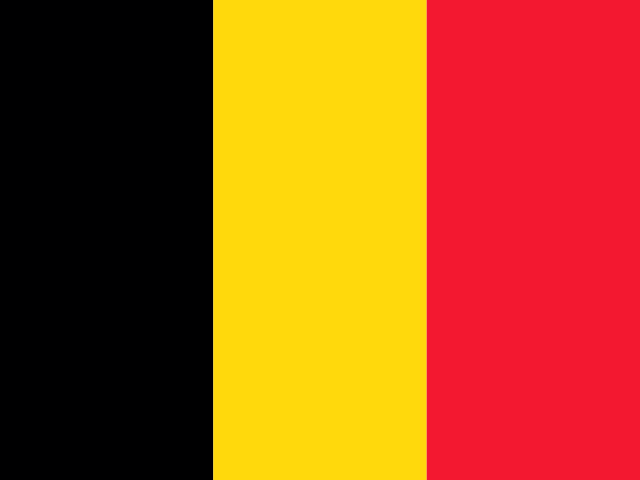
- Description: three equal vertical bands of black (left side), yellow, and redHistory: the vertical design was based on the flag of France; the colors are from the arms of the duchy of Brabant (yellow lion with red claws and tongue on a black field)
- National symbols
- golden rampant lion
- National colours
- red, black, yellow
- National anthem
- Title: "La Brabançonne" (The Song of Brabant)Lyrics/music: Louis-Alexandre DECHET [French] and Victor CEULEMANS [Dutch]/Francois VAN CAMPENHOUTHistory: adopted 1830; according to legend Louis-Alexandre DECHET, an actor at the theater where the revolution against the Netherlands began, wrote the lyrics with a group of young people in a Brussels cafe
- UNESCO World Heritage Sites
- Total World Heritage Sites: 16 (15 cultural, 1 natural)Selected World Heritage Site locales: Belfries of Belgium (c); Historic Brugge (c); The Grand Place, Brussels (c); Major Town Houses of Victor Horta (c); Notre-Dame Cathedral, Tournai (c); Spa, Liege (c); Primeval Beech Forests - Sonian Wood (n); Stoclet Palace (c)
Economy
- Overview
- high-income, core EU and eurozone economy; slow growth with weakened domestic consumption and export demand; high public debt and structural deficits linked to social spending; aging workforce with weak productivity growth and participation rates
- GDP (PPP)
- $749.229 billion (2024 est.)
- GDP per person (PPP)
- $63,100 (2024 est.)
- GDP growth
- 1% (2024 est.)
- Inflation
- 3.1% (2024 est.)
- Unemployment
- 5.5% (2024 est.)
- Below poverty line
- 12.3% (2022 est.)
- Farm products
- sugar beets, milk, potatoes, wheat, pork, lettuce, maize, chicken, barley, pears (2023)
- Industries
- engineering and metal products, motor vehicle assembly, transportation equipment, scientific instruments, processed food and beverages, chemicals, pharmaceuticals, base metals, textiles, glass, petroleum
- Exports
- $525.458 billion (2024 est.)
- Main exports
- refined petroleum, natural gas, vaccines, cars, packaged medicine (2023)
- Export partners
- France 20%, Netherlands 15%, Germany 14%, Italy 6%, USA 5% (2023)
- Main imports
- cars, natural gas, vaccines, packaged medicine, crude petroleum (2023)
- Import partners
- Netherlands 20%, Germany 13%, France 11%, USA 7%, Ireland 4% (2023)
- Money sent home from abroad
- 2.3% of GDP (2024 est.)
Energy, internet and transport
- Electricity access
- Electrification - total population: 100% (2022 est.)
- Electricity sources
- Fossil fuels: 24.1% of total installed capacity (2023 est.)Nuclear: 40.4% of total installed capacity (2023 est.)Solar: 9.4% of total installed capacity (2023 est.)Wind: 20% of total installed capacity (2023 est.)Hydroelectricity: -0.1% of total installed capacity (2023 est.) note: Belgium has negative net hydroelectric power generation based on losses from use of pumped storage hydropowerBiomass and waste: 6.2% of total installed capacity (2023 est.)
- Internet users
- Percent of population: 95% (2023 est.)
- Mobile phones
- Total subscriptions: 12.2 million (2024 est.)Subscriptions per 100 inhabitants: 104 (2024 est.)
- TV and radio
- a segmented market with the three major linguistic communities (Flemish-, French-, and German-speaking) each responsible for their own broadcast media; multiple TV channels exist for each community; over 90% of households are connected to cable and can access TV broadcasts from neighboring countries; each community has a public radio network coexisting with private broadcasters
- Airports
- 48 (2025)
- Railways
- Total: 3,602 km (2020) 3,160 km electrified
- Merchant ships
- Total: 198 (2023)By type: bulk carrier 17, container ship 2, general cargo 16, oil tanker 21, other 142
Military and space
- Armed forces
- Belgian Armed Forces (Defensie or La Défense): Land Component, Marine (Naval) Component, Air Component, Medical Component, Cyber Command (2025)
- Military spending
- 2% of GDP (2025 est.)
- Military service
- 18 years of age for voluntary military service for men and women; maximum age varies by position; conscription abolished in 1995 (2025)
- Space programme
- builds satellites, particularly research/science/technology and remote sensing platforms; researches, develops, and produces a wide variety of space technologies, including telecommunications, optics, robotics, scientific instruments, and space launch vehicle components; founding member of the ESA and participates in a variety of ESA and EU projects, such as Space Surveillance and Tracking, Copernicus Earth observation, and Galileo global navigation satellite system; hosts the European Space Security and Education Center (established 1968); participates in international astronomy efforts, particularly through the European Southern Observatory (ESO); has worked with a variety of foreign space agencies and commercial entities outside Europe, including those of Argentina, China, India, Russia, South Africa, UAE, Vietnam, and the US (2025)
- Space milestones
- 1986 - joined first European Earth Observation program; founding member of European Organization for the Exploitation of Meteorological Satellites1992 - first Belgian astronaut in space on the US Space Shuttle2001 - first remote sensing satellite (PROBA-1) launched by India2024 - signed US-led Artemis Accords outlining best practices for space exploration
Global issues
- Refugees and displaced people
- Refugees: 236,689 (2024 est.)Stateless persons: 849 (2024 est.)
- Drug trade
- USG identification: major precursor-chemical producer (2025)
Neighbouring countries
FranceGermanyLuxembourgNetherlands
- Phone code
- +32
- Internet domain
- .be