Honduras
Republic of Honduras
The original "banana republic" dominated by US fruit companies. Maya city of Copán.
See Honduras on the 3D globeTake a quiz
Population10.8 million
Area112,492 km²
CapitalTegucigalpa
RegionCentral America
Did you know?
- Copán has some of the finest Maya sculpture
- Bay Islands sit on the Mesoamerican Barrier Reef
- The term "banana republic" was coined about it
Key facts about Honduras
- Government
- Presidential republic
- Religion
- Evangelical ~48%, Catholic ~34%
- Founded / independence
- 1821 (from Spain)
- Rich in
- Coffee, bananas, textiles, shrimp
- Languages
- Spanish
Spanish; Garifuna, Miskito - Currency
- Honduran lempira (L)
- People are called
- Honduran
- Main cities
- Tegucigalpa, San Pedro Sula, La Ceiba
Timeline of Honduras
- 1502Columbus arrives
- 1821Independence
- 1969Football War
- 1998Hurricane Mitch
- 2009Coup
Places to see in Honduras
- Copán ruins
- Roatán and Bay Islands
- Pico Bonito
- Lake Yojoa
Food and drink
Baleadas · plato típico · sopa de caracol
Culture and famous for
Garifuna culture (UNESCO)
Popular sports
Football
Geography and climate
- Highest point
- Cerro Las Minas, 2,870 m
- Rivers, lakes and seas
- Ulúa, Patuca
- Climate
- Tropical
- Coastline
- Has a sea coast
- Population density
- 96 people per km²
Wars and conflicts
- Football War 1969
- 2009 coup
Empires and states that once stood here
Federal Republic of Central America 1823–1841
Alliances and memberships
Military and security
Political unions and regional organisations
Central American Integration SystemCELACOrganization of American States
Honduras in depth
Detailed facts from the CIA World Factbook (public domain, latest edition).
Overview
- History in brief
- Once part of Spain's vast empire in the New World, Honduras became an independent nation in 1821. After two and a half decades of mostly military rule, a freely elected civilian government came to power in 1982. During the 1980s, Honduras proved a haven for anti-Sandinista contras fighting the Marxist Nicaraguan Government and an ally to Salvadoran Government forces fighting leftist guerrillas. Hurricane Mitch devastated the country in 1998, killing about 5,600 people and causing approximately $2 billion in damage. Since then, the economy has slowly rebounded, despite COVID-19 and severe storm-related setbacks in 2020 and 2021.
Geography
- Location
- Central America, bordering the Caribbean Sea, between Guatemala and Nicaragua and bordering the Gulf of Fonseca (North Pacific Ocean), between El Salvador and Nicaragua
- Size compared
- slightly larger than Tennessee
- Land borders
- Total: 1,575 kmBorder countries: Guatemala 244 km; El Salvador 391 km; Nicaragua 940 km
- Coastline
- 823 km (Caribbean Sea 669 km; Gulf of Fonseca 163 km)
- Climate
- subtropical in lowlands, temperate in mountains
- Terrain
- mostly mountains in interior, narrow coastal plains
- Elevation
- Highest point: Cerro Las Minas 2,870 mLowest point: Caribbean Sea 0 mMean elevation: 684 m
- Natural resources
- timber, gold, silver, copper, lead, zinc, iron ore, antimony, coal, fish, hydropower
- Major lakes
- Salt water lake(s): Laguna de Caratasca - 1,110 sq km
- Natural hazards
- frequent, but generally mild, earthquakes; extremely susceptible to damaging hurricanes and floods along the Caribbean coast
- Notes
- has only a short Pacific coast but a long Caribbean shoreline, including the virtually uninhabited eastern Mosquito Coast
- Environmental issues
- deforestation from logging and agricultural clearing; land degradation and soil erosion from overdevelopment and improper land use practices; mining activities polluting Lago de Yojoa (the country's largest source of fresh water) and other rivers and streams
People and society
- Population
- Total: 9,529,188 (2024 est.)Male: 4,591,247Female: 4,937,941
- Nationality
- Noun: Honduran(s)Adjective: Honduran
- Ethnic groups
- Mestizo (mixed Indigenous and European) 90%, Indigenous 7%, African descent 2%, White 1%
- Languages
- Spanish (official), Amerindian dialectsMajor-language sample(s): La Libreta Informativa del Mundo, la fuente indispensable de información básica. (Spanish)The World Factbook, the indispensable source for basic information.
- Religions
- Evangelical 55%, Roman Catholic 33.4%, none 10.1%, unspecified 1.5% (2023 est.)
- Median age
- Total: 26.1 years (2025 est.)Male: 24.8 yearsFemale: 26.6 years
- Population growth
- 1.28% (2025 est.)
- Life expectancy
- Total population: 73.1 years (2024 est.)Male: 69.6 yearsFemale: 76.8 years
- Children per woman
- 2.29 children born/woman (2025 est.)
- Urbanization
- Urban population: 60.2% of total population (2023)Rate of urbanization: 2.48% annual rate of change (2020-25 est.)
- Largest cities
- 1.568 million TEGUCIGALPA (capital), 982,000 San Pedro Sula (2023)
- Literacy
- Total population: 88.2% (2024 est.)Male: 87.6% (2024 est.)Female: 88.8% (2024 est.)
- Years in school
- Total: 10 years (2019 est.)Male: 9 years (2019 est.)Female: 10 years (2019 est.)
Government
- Official names
- Conventional long form: Republic of HondurasConventional short form: HondurasLocal long form: República de HondurasLocal short form: HondurasEtymology: the name means "depths" in Spanish and refers to the deep anchorage in the northern Bay of Trujillo
- Government type
- presidential republic
- Capital
- Name: TegucigalpaGeographic coordinates: 14 06 N, 87 13 WTime difference: UTC-6 (1 hour behind Washington, DC during Standard Time)Etymology: the name is a Nahuatl word meaning "silver mountain," probably referring to nearby silver mines
- Regions
- 18 departments (departamentos, singular - departamento); Atlántida, Choluteca, Colon, Comayagua, Copan, Cortes, El Paraiso, Francisco Morazán, Gracias a Dios, Intibucá, Islas de la Bahia, La Paz, Lempira, Ocotepeque, Olancho, Santa Barbara, Valle, Yoro
- Independence
- 15 September 1821 (from Spain)
- National holiday
- Independence Day, 15 September (1821)
- Constitution
- History: several previous; latest approved 11 January 1982, effective 20 January 1982Amendment process: proposed by the National Congress with at least two-thirds majority vote of the membership; passage requires at least two-thirds majority vote of Congress in its next annual session; constitutional articles, such as the form of government, national sovereignty, the presidential term, and the procedure for amending the constitution, cannot be amended
- Legal system
- civil law system
- Voting age
- 18 years of age; universal and compulsory
- Flag meaning
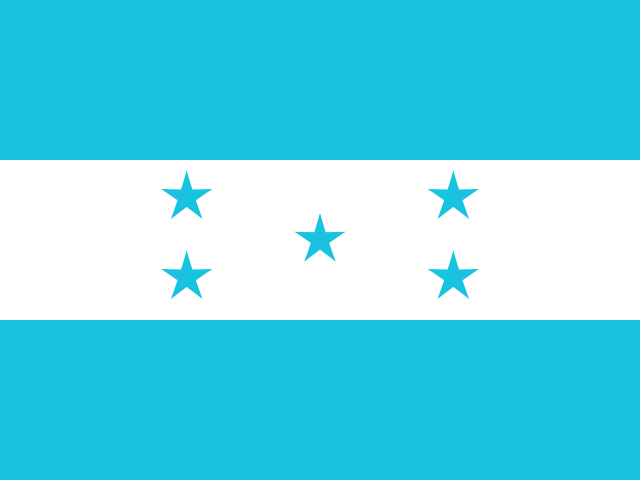
- Description: three equal horizontal bands of cerulean blue (top), white, and cerulean blue, with five five-pointed cerulean stars arranged in an "X" pattern and centered in the white bandMeaning: the stars represent the members of the former Federal Republic of Central America: Costa Rica, El Salvador, Guatemala, Honduras, and Nicaragua; blue stands for the Pacific Ocean and the Caribbean Sea, and white for the land and the people's peace and prosperity
- National symbols
- scarlet macaw, white-tailed deer
- National colours
- blue, white
- National anthem
- Title: "Himno Nacional de Honduras" (National Anthem of Honduras)Lyrics/music: Augusto Constancio COELLO/Carlos HARTLINGHistory: adopted 1915; the anthem's seven verses chronicle Honduran history; on official occasions, only the chorus and last verse are sung
- UNESCO World Heritage Sites
- Total World Heritage Sites: 2 (1 cultural, 1 natural)Selected World Heritage Site locales: Maya Site of Copan (c); Río Plátano Biosphere Reserve (n)
Economy
- Overview
- second-fastest-growing Central American economy; COVID-19 and two hurricanes crippled activity; high poverty and inequality; declining-but-still-high violent crime disruption; systemic corruption; coffee and banana exporter; enormous remittances
- GDP (PPP)
- $71.297 billion (2024 est.)
- GDP per person (PPP)
- $6,600 (2024 est.)
- GDP growth
- 3.6% (2024 est.)
- Inflation
- 4.6% (2024 est.)
- Unemployment
- 6.1% (2024 est.)
- Below poverty line
- 64.1% (2023 est.)
- Farm products
- sugarcane, oil palm fruit, maize, milk, bananas, coffee, cantaloupes/melons, oranges, chicken, beans (2023)
- Industries
- sugar processing, coffee, woven and knit apparel, wood products, cigars
- Exports
- $9.352 billion (2024 est.)
- Main exports
- garments, coffee, insulated wire, palm oil, shellfish (2023)
- Export partners
- USA 49%, Nicaragua 8%, El Salvador 7%, Guatemala 5%, Mexico 5% (2023)
- Main imports
- refined petroleum, cotton yarn, garments, trucks, packaged medicine (2023)
- Import partners
- USA 36%, China 14%, Guatemala 8%, Mexico 6%, El Salvador 6% (2023)
- Money sent home from abroad
- 25.7% of GDP (2024 est.)
Energy, internet and transport
- Electricity access
- Electrification - total population: 94.4% (2022 est.)Electrification - urban areas: 100%Electrification - rural areas: 86.8%
- Electricity sources
- Fossil fuels: 38.4% of total installed capacity (2023 est.)Solar: 8.9% of total installed capacity (2023 est.)Wind: 5.9% of total installed capacity (2023 est.)Hydroelectricity: 33.2% of total installed capacity (2023 est.)Geothermal: 3% of total installed capacity (2023 est.)Biomass and waste: 10.7% of total installed capacity (2023 est.)
- Internet users
- Percent of population: 58% (2023 est.)
- Mobile phones
- Total subscriptions: 7.92 million (2023 est.)Subscriptions per 100 inhabitants: 76 (2022 est.)
- TV and radio
- multiple privately owned terrestrial TV networks, supplemented by multiple cable TV networks; Radio Honduras is the state-owned radio network; roughly 300 privately owned radio stations (2019)
- Airports
- 129 (2025)
- Railways
- Total: 699 km (2014)Narrow gauge: 164 km (2014) 1.067-m gauge
- Merchant ships
- Total: 489 (2023)By type: general cargo 233, oil tanker 82, other 174
Military and space
- Armed forces
- Honduran Armed Forces (Fuerzas Armadas de Honduras, FFAA): Army (Ejercito), Honduran Naval Force (Fuerza Naval Hondurena, FNH; includes marines), Honduran Air Force (Fuerza Aerea Hondurena, FAH), Honduran Military Police of Public Order (Policía Militar del Orden Público or PMOP) (2025)
- Military spending
- 1.5% of GDP (2024 est.)
- Military service
- 18-22 years of age for voluntary military service for men and women; 24–36 month service obligation; no conscription (2026)
Global issues
- Refugees and displaced people
- Refugees: 341 (2024 est.)IDPs: 100,637 (2024 est.)
- Drug trade
- USG identification: major illicit drug-producing and/or drug-transit countrymajor precursor-chemical producer (2025)
Neighbouring countries
- Phone code
- +504
- Internet domain
- .hn