Colombia
Republic of Colombia
Part of Gran Colombia under Bolívar. Decades of civil conflict ended in a 2016 FARC peace deal, but armed groups remain.
See Colombia on the 3D globeTake a quiz

Population53 million
Area1,141,748 km²
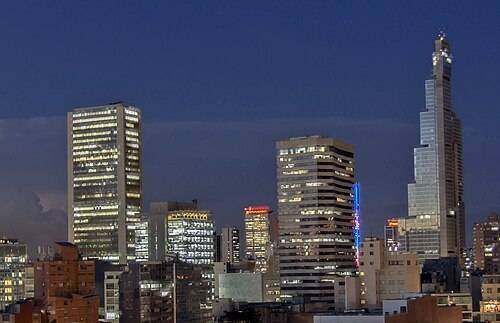
CapitalBogotá
RegionSouth America
Did you know?
- Has the most bird species of any country
- Produces about 70% of the world's emeralds
- The only South American country with Caribbean and Pacific coasts
Key facts about Colombia
- Government
- Presidential republic
- Religion
- Catholic ~70%, Evangelical ~15%
- Founded / independence
- 1810/1819 (from Spain)
- Rich in
- Coffee, oil, coal, emeralds, flowers
- Languages
- Spanish
Spanish (Paisa, Costeño, Rolo accents); 65 Indigenous languages, Palenquero creole - Currency
- Colombian peso ($)
- People are called
- Colombian
- Main cities
- Bogotá, Medellín, Cali, Barranquilla, Cartagena
Timeline of Colombia
- 1538Bogotá founded
- 1819Independence
- 1903Panama secedes
- 1948La Violencia
- 1993Escobar killed
- 2016FARC peace deal
Places to see in Colombia
- Cartagena old town
- Caño Cristales "river of five colours"
- Coffee Region
- Ciudad Perdida
- Tayrona National Park
- Medellín
Food and drink
Bandeja paisa · arepas · ajiaco · empanadas
Culture and famous for
Writer Gabriel García Márquez; singer Shakira; cumbia and vallenato; emeralds
Popular sports
Football, cycling
Geography and climate
- Highest point
- Pico Cristóbal Colón, about 5,730 m
- Rivers, lakes and seas
- Magdalena, Amazon tributaries
- Climate
- Tropical; cooler highlands
- Coastline
- Has a sea coast
- Population density
- 46 people per km²
Wars and conflicts
- Thousand Days' War
- La Violencia 1948–58
- FARC conflict 1964–2016
- ongoing guerrilla and cartel violence
Alliances and memberships
Military and security
Political unions and regional organisations
CELACOrganization of American States
Economy and trade
OECDPacific AllianceAndean Community
Colombia in depth
Detailed facts from the CIA World Factbook (public domain, latest edition).
Overview
- History in brief
- Colombia was one of three countries that emerged after the dissolution of Gran Colombia in 1830 -- the others are Ecuador and Venezuela. A decades-long conflict among government forces, paramilitaries, and antigovernment insurgent groups heavily funded by the drug trade -- principally the Revolutionary Armed Forces of Colombia (FARC) -- escalated during the 1990s. In the wake of the paramilitary demobilization in the 2000s, new criminal groups arose that included some former paramilitaries. After four years of formal peace negotiations, the Colombian Government signed a final accord with the FARC in 2016 that called for its members to demobilize, disarm, and reincorporate into society and politics. The accord also committed the Colombian Government to create three new institutions to form a 'comprehensive system for truth, justice, reparation, and non-repetition,' including a truth commission, a special unit to coordinate the search for those who disappeared during the conflict, and a 'Special Jurisdiction for Peace' to administer justice for conflict-related crimes. Despite decades of internal conflict and drug-trade-related security challenges, Colombia maintains relatively strong and independent democratic institutions characterized by peaceful, transparent elections and the protection of civil liberties.
Geography
- Location
- Northern South America, bordering the Caribbean Sea, between Panama and Venezuela, and bordering the North Pacific Ocean, between Ecuador and Panama
- Size compared
- slightly less than twice the size of Texas
- Land borders
- Total: 6,672 kmBorder countries: Brazil 1,790 km; Ecuador 708 km; Panama 339 km; Peru 1,494 km; Venezuela 2,341 km
- Coastline
- 3,208 km (Caribbean Sea 1,760 km, North Pacific Ocean 1,448 km)
- Climate
- tropical along coast and eastern plains; cooler in highlands
- Terrain
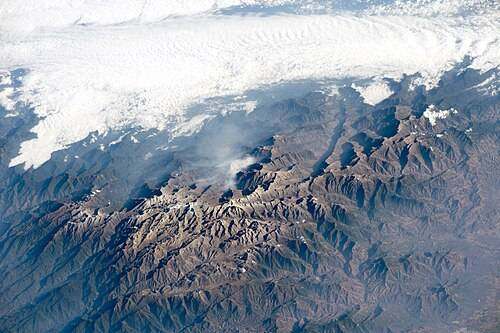
- flat coastal lowlands, central highlands, high Andes Mountains, eastern lowland plains (Llanos)
- Elevation
- Highest point: Pico Cristobal Colon 5,730 mLowest point: Pacific Ocean 0 mMean elevation: 593 m
- Natural resources
- petroleum, natural gas, coal, iron ore, nickel, gold, copper, emeralds, hydropower
- Major rivers
- Rio Negro river source (shared with Venezuela and Brazil [m]) - 2,250 km; Orinoco (shared with Venezuela [s]) - 2,101 kmNote: [s] after country name indicates river source; [m] after country name indicates river mouth
- Natural hazards
- highlands subject to volcanic eruptions; occasional earthquakes; periodic droughtsVolcanism: Galeras (4,276 m) is one of Colombia's most active volcanoes; it has been deemed a Decade Volcano by the International Association of Volcanology and Chemistry of the Earth's Interior, worthy of study due to its explosive history and close proximity to human populations; Nevado del Ruiz (5,321 m), 129 km (80 mi) west of Bogota, erupted in 1985, producing lahars (mudflows) that killed 23,000 people; the volcano last erupted in 1991; after 500 years of dormancy, Nevado del Huila reawakened in 2007 and has experienced frequent eruptions since then; other historically active volcanoes include Cumbal, Dona Juana, Nevado del Tolima, and Purace
- Notes
- only South American country with coastlines on both the North Pacific Ocean and Caribbean Sea
- Environmental issues
- deforestation from timber exploitation in the Amazon and the Chocó region; soil erosion; soil and water pollution from overuse of pesticides; air pollution, especially in Bogota, from vehicle emissions
People and society
- Population
- Total: 49,842,298 (2025 est.)Male: 24,320,959Female: 25,521,339
- Nationality
- Noun: Colombian(s)Adjective: Colombian
- Ethnic groups
- Mestizo and White 87.6%, Afro-Colombian (includes Mulatto, Raizal, and Palenquero) 6.8%, Indigenous 4.3%, unspecified 1.4% (2018 est.)
- Languages
- Spanish (official) 98.9%, indigenous 1%, Portuguese 0.1%; 65 indigenous languages exist (2023 est.)Major-language sample(s): La Libreta Informativa del Mundo, la fuente indispensable de información básica. (Spanish)The World Factbook, the indispensable source for basic information.
- Religions
- Roman Catholic 63.6%, Protestant 17.2% (Evangelical 16.7%, Adventist 0.3%, other Protestant 0.2%), Jehovah's Witness 0.6%, Church of Jesus Christ 0.1%, other 0.3%, believer, 0.2%. agnostic 1%, atheist 1%, none 14.2%, unspecified 1.8% (2023 est.)
- Median age
- Total: 33.1 years (2025 est.)Male: 31.5 yearsFemale: 34 years
- Population growth
- 0.54% (2025 est.)
- Life expectancy
- Total population: 74.9 years (2024 est.)Male: 71.3 yearsFemale: 78.7 years
- Children per woman
- 1.94 children born/woman (2025 est.)
- Urbanization
- Urban population: 82.4% of total population (2023)Rate of urbanization: 1.01% annual rate of change (2020-25 est.)
- Largest cities
- 11.508 million BOGOTA (capital), 4.102 million Medellin, 2.864 million Cali, 2.349 million Barranquilla, 1.381 million Bucaramanga, 1.088 million Cartagena (2023)
- Literacy
- Total population: 95.3% (2024 est.)Male: 95% (2024 est.)Female: 95.7% (2024 est.)
- Years in school
- Total: 14 years (2022 est.)Male: 14 years (2022 est.)Female: 15 years (2022 est.)
Government
- Official names
- Conventional long form: Republic of ColombiaConventional short form: ColombiaLocal long form: República de ColombiaLocal short form: ColombiaEtymology: named after explorer Christopher COLUMBUS
- Government type
- presidential republic
- Capital
- Name: BogotáGeographic coordinates: 4 36 N, 74 05 WTime difference: UTC-5 (same time as Washington, DC, during Standard Time)Etymology: originally named Santa Fe de Bacatá in 1538, after the Chibcha people's nearby settlement of Bacatá; the name was later corrupted to Bogotá
- Regions
- 32 departments (departamentos, singular - departamento) and 1 capital district* (distrito capital); Amazonas, Antioquia, Arauca, Atlántico, Bogota*, Bolivar, Boyacá, Caldas, Caquetá, Casanare, Cauca, Cesar, Choco, Cordoba, Cundinamarca, Guainía, Guaviare, Huila, La Guajira, Magdalena, Meta, Nariño, Norte de Santander, Putumayo, Quindío, Risaralda, Archipiélago de San Andres, Providencia y Santa Catalina (colloquially San Andres y Providencia), Santander, Sucre, Tolima, Valle del Cauca, Vaupes, Vichada
- Independence
- 20 July 1810 (from Spain)
- National holiday
- Independence Day, 20 July (1810)
- Constitution
- History: several previous; latest promulgated 4 July 1991Amendment process: proposed by the government, by Congress, by a constituent assembly, or by public petition; passage requires a majority vote by Congress in each of two consecutive sessions; passage of amendments to constitutional articles on citizen rights, guarantees, and duties also require approval in a referendum by over one half of voters and participation of over one fourth of citizens registered to vote
- Legal system
- civil law system influenced by the Spanish and French civil codes
- Voting age
- 18 years of age; universal
- Flag meaning
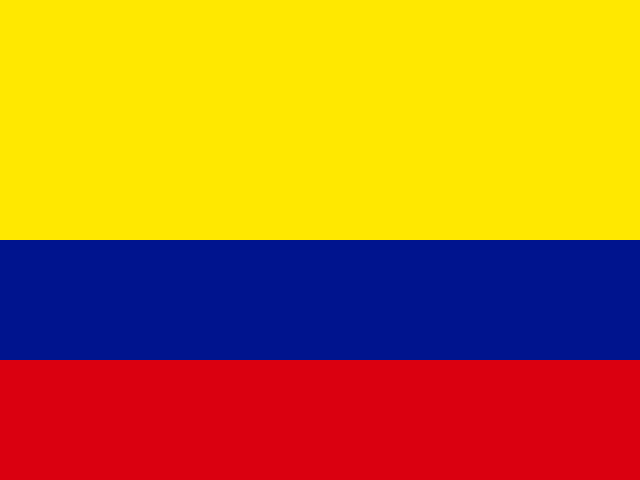
- Description: three horizontal bands of yellow (top, double-width), blue, and redMeaning: various interpretations of the colors exist; one has yellow for the gold in Colombia's land, blue for the sea, and red for the blood spilled in attaining freedom; another describes them as representing sovereignty and justice (yellow), loyalty and vigilance (blue), and valor and generosity (red); another has the colors standing for liberty, equality, and fraternity
- National symbols
- Andean condor
- National colours
- yellow, blue, red
- National anthem
- Title: "Himno Nacional de la Republica de Colombia" (National Anthem of the Republic of Colombia)Lyrics/music: Rafael NUNEZ/Oreste SINDICIHistory: adopted 1920; the anthem comes from an inspirational poem written by President Rafael NUNEZ; the anthem always starts with the chorus
- UNESCO World Heritage Sites
- Total World Heritage Sites: 9 (6 cultural, 2 natural, 1 mixed)Selected World Heritage Site locales: Chiribiquete National Park (m); Coffee Cultural Landscape of Colombia (c); Historic Center of Santa Cruz de Mompox (c); Los Katíos National Park (n); Malpelo Fauna and Flora Sanctuary (n); Tierradentro National Archeological Park (c); San Agustín Archaeological Park (c); Colonial Cartagena (c); Qhapaq Ñan/Andean Road System (c)
Economy
- Overview
- prior to COVID-19, one of the most consistent growth economies; declining poverty; large stimulus package has mitigated economic fallout, but delayed key infrastructure investments; successful inflation management; sound flexible exchange rate regime; domestic economy suffers from lack of trade integration and infrastructure
- GDP (PPP)
- $978.592 billion (2024 est.)
- GDP per person (PPP)
- $18,500 (2024 est.)
- GDP growth
- 1.7% (2024 est.)
- Inflation
- 6.6% (2024 est.)
- Unemployment
- 9.7% (2024 est.)
- Below poverty line
- 33% (2023 est.)
- Farm products
- sugarcane, oil palm fruit, milk, rice, plantains, potatoes, bananas, maize, chicken, avocados (2023)
- Industries
- textiles, food processing, oil, clothing and footwear, beverages, chemicals, cement; gold, coal, emeralds
- Exports
- $68.866 billion (2024 est.)
- Main exports
- crude petroleum, coal, gold, coffee, refined petroleum (2023)
- Export partners
- USA 27%, Panama 9%, India 5%, China 5%, Netherlands 4% (2023)
- Main imports
- refined petroleum, cars, broadcasting equipment, aircraft, packaged medicine (2023)
- Import partners
- USA 26%, China 22%, Brazil 6%, Mexico 5%, Germany 4% (2023)
- Money sent home from abroad
- 2.8% of GDP (2024 est.)
Energy, internet and transport
- Electricity access
- Electrification - total population: 100% (2022 est.)
- Electricity sources
- Fossil fuels: 34% of total installed capacity (2023 est.)Solar: 1.3% of total installed capacity (2023 est.)Wind: 0.1% of total installed capacity (2023 est.)Hydroelectricity: 62.1% of total installed capacity (2023 est.)Biomass and waste: 2.5% of total installed capacity (2023 est.)
- Internet users
- Percent of population: 77% (2023 est.)
- Mobile phones
- Total subscriptions: 92.1 million (2024 est.)Subscriptions per 100 inhabitants: 174 (2024 est.)
- TV and radio
- combination of state-owned and privately owned broadcast media provide service; more than 500 radio stations and many national, regional, and local TV stations (2019)
- Airports
- 661 (2025)
- Railways
- Total: 2,141 km (2019)Standard gauge: 150 km (2019) 1.435-m gaugeNarrow gauge: 1,991 km (2019) 0.914-m gauge
- Merchant ships
- Total: 153 (2023)By type: general cargo 28, oil tanker 13, other 112
Military and space
- Armed forces
- Military Forces of Colombia (Fuerzas Militares de Colombia): National Army (Ejercito Nacional), Colombian Aerospace Force (Fuerza Aeroespacial Colombiana, FAC), Colombian Navy (Armada de Colombia; includes Coast Guard); National Police of Colombia (Policia Nacional de Colombia, PNC) (2025)
- Military spending
- 3.4% of GDP (2024 est.)
- Military service
- 18-24 years of age for compulsory (men) and voluntary (men and women) military (and police) service; conscript service obligation is 18 months or 12 months for those with a college degree; conscripted soldiers reportedly include regular soldiers (conscripts without a high school degree), drafted high school graduates (bachilleres), and rural (campesino) soldiers who serve in their home regions (2025)
- Space programme
- has a small program focused on acquiring satellites, particularly remote sensing (RS) satellites; operates satellites and produces nanosatellites; researches other space technologies, including astronautics, satellite navigation, and telecommunications; works with a variety of foreign space agencies or commercial space industries, including those of Denmark, India, Russia, Sweden, the US, and some members of the Latin American and Caribbean Space Agency (2025)
- Space milestones
- 2007 - first domestically produced technology-demonstration/remote-sensing (RS) nanosatellite (Libertad I) launched by Russia2014 - second experimental RS nanosatellite (UAPSAT) launched by US2018 - first RS satellite (FACSAT-1) for military use purchased from Denmark and launched by India2022 - signed US-led Artemis Accords for space exploration2023 - second RS satellite (FACSAT-2 or Chibiriquete) launched by US
Global issues
- Refugees and displaced people
- Refugees: 30,611 (2024 est.)IDPs: 7,264,767 (2024 est.)Stateless persons: 5 (2024 est.)
- Drug trade
- USG identification: major illicit drug-producing and/or drug-transit countrymajor precursor-chemical producer (2025)
Neighbouring countries
BrazilEcuadorPanamaPeruVenezuela
- Phone code
- +57
- Internet domain
- .co