Sierra Leone
Republic of Sierra Leone
Freetown was founded for freed slaves in 1792. A civil war known for blood diamonds and child soldiers ended in 2002.
See Sierra Leone on the 3D globeTake a quiz
Population8.6 million
Area71,740 km²
CapitalFreetown
RegionWestern Africa
Did you know?
- Freetown was founded for freed slaves
- Has one of the world's largest natural harbours
- Recovered from the 2014–16 Ebola epidemic
Key facts about Sierra Leone
- Government
- Presidential republic
- Religion
- Islam ~78%, Christian ~21%
- Founded / independence
- 1961 (from UK)
- Rich in
- Diamonds, iron ore, rutile
- Languages
- English
English; Krio, Mende, Temne - Currency
- Sierra Leonean leone (Le)
- People are called
- Sierra Leonean
- Main cities
- Freetown, Bo, Kenema, Makeni
Timeline of Sierra Leone
- 1462Portuguese name it "Lion Mountains"
- 1792Freetown founded
- 1961Independence
- 1991Civil war
- 2002Peace
Places to see in Sierra Leone
- Tiwai Island
- Bunce Island
- Freetown Peninsula beaches
- Outamba-Kilimi park
Food and drink
Cassava leaves · groundnut stew · jollof
Culture and famous for
Krio culture; Freetown's Cotton Tree (fell 2023)
Popular sports
Football
Geography and climate
- Highest point
- Mount Bintumani, 1,945 m
- Rivers, lakes and seas
- Rokel, Sewa rivers
- Climate
- Tropical
- Coastline
- Has a sea coast
- Population density
- 120 people per km²
Wars and conflicts
- Civil War 1991–2002 (blood diamonds)
Alliances and memberships
Political unions and regional organisations
African UnionECOWASOrganisation of Islamic CooperationCommonwealth of Nations
Sierra Leone in depth
Detailed facts from the CIA World Factbook (public domain, latest edition).
Overview
- History in brief
- Continuously populated for at least 2,500 years, the area now known as Sierra Leone is covered with dense jungle that allowed the region to remain relatively protected from invading West African empires. Traders introduced Sierra Leone to Islam, which occupies a central role in Sierra Leonean culture and history. In the 17th century, the British set up a trading post near present-day Freetown. The trade originally involved timber and ivory but later expanded to enslaved people. In 1787, after the American Revolution, Sierra Leone became a destination for Black British loyalists from the new United States. When Britain abolished the slave trade in 1807, British ships delivered thousands of liberated Africans to Sierra Leone. During the 19th century, the colony gradually expanded inland. In 1961, Sierra Leone became independent of the UK. Sierra Leone held free and fair elections in 1962 and 1967, but Siaka STEVENS -- Sierra Leone’s second prime minister -- quickly reverted to authoritarian tendencies, outlawing most political parties and ruling from 1967 to 1985. In 1991, Sierra Leonean soldiers launched a civil war against STEVENS’ ruling party. The war caused tens of thousands of deaths and displaced more than 2 million people (about one third of the population). In 1998, a Nigerian-led West African coalition military force intervened, installing Tejan KABBAH -- who was originally elected in 1996 -- as prime minister. In 2002, KABBAH officially announced the end of the war. Since 1998, Sierra Leone has conducted democratic elections dominated by the two main political parties, the Sierra Leone People’s Party (SLPP) and the All People’s Congress (APC) party. In 2018, Julius Maada BIO of the Sierra Leone People’s Party won the presidential election that saw a high voter turnout despite some allegations of voter intimidation. BIO won again in June 2023, although irregularities were noted that called into question the integrity of the results. In October 2023, the Government of Sierra Leone and the main opposition party, the All People’s Congress, signed the Agreement for National Unity to boost cooperation between political parties and begin the process of reforming the country’s electoral system.
Geography
- Location
- Western Africa, bordering the North Atlantic Ocean, between Guinea and Liberia
- Size compared
- slightly smaller than South Carolina
- Land borders
- Total: 1,093 kmBorder countries: Guinea 794 km; Liberia 299 km
- Coastline
- 402 km
- Climate
- tropical; hot, humid; summer rainy season (May to December); winter dry season (December to April)
- Terrain
- coastal belt of mangrove swamps, wooded hill country, upland plateau, mountains in east
- Elevation
- Highest point: Loma Mansa (Bintimani) 1,948 mLowest point: Atlantic Ocean 0 mMean elevation: 279 m
- Natural resources
- diamonds, titanium ore, bauxite, iron ore, gold, chromite
- Natural hazards
- dry, sand-laden harmattan winds blow from the Sahara (December to February); sandstorms, dust storms
- Notes
- rainfall along the coast can reach 495 cm (195 in) a year, making it one of the wettest places along coastal western Africa
- Environmental issues
- overharvesting of timber, expansion of cattle grazing, and slash-and-burn agriculture resulting in deforestation, soil exhaustion, and flooding; loss of biodiversity; air pollution; water pollution; overfishing
People and society
- Population
- Total: 9,331,203 (2025 est.)Male: 4,620,638Female: 4,710,565
- Nationality
- Noun: Sierra Leonean(s)Adjective: Sierra Leonean
- Ethnic groups
- Temne 35.4%, Mende 30.8%, Limba 8.8%, Kono 4.3%, Korankoh 4%, Fullah 3.8%, Mandingo 2.8%, Loko 2%, Sherbro 1.9%, Creole 1.2% (descendants of freed Jamaican slaves who were settled in the Freetown area in the late-18th century; also known as Krio), other 5% (2019 est.)
- Languages
- English (official, regular use limited to literate minority), Mende (principal vernacular in the south), Temne (principal vernacular in the north), Krio (English-based Creole, spoken by the descendants of freed Jamaican slaves; a first language for 10% of the population but understood by 95%)
- Religions
- Muslim 77.1%, Christian 22.9% (2019 est.)
- Median age
- Total: 19.7 years (2025 est.)Male: 19 yearsFemale: 19.9 years
- Population growth
- 2.24% (2025 est.)
- Life expectancy
- Total population: 59.4 years (2024 est.)Male: 57.8 yearsFemale: 61 years
- Children per woman
- 3.52 children born/woman (2025 est.)
- Urbanization
- Urban population: 44.3% of total population (2023)Rate of urbanization: 3.02% annual rate of change (2020-25 est.)
- Largest cities
- 1.309 million FREETOWN (capital) (2023)
- Literacy
- Total population: 43.6% (2019 est.)Male: 54.6% (2019 est.)Female: 33.9% (2019 est.)
Government
- Official names
- Conventional long form: Republic of Sierra LeoneConventional short form: Sierra LeoneLocal long form: Republic of Sierra LeoneLocal short form: Sierra LeoneEtymology: Portuguese explorer Pedro de SINTRA is usually credited with naming the country "Serra da Leao" (Lion Mountains) in 1462, but Venetian explorer Alvise CA' DA MOSTO recorded the name as "Serre-Lionne" in 1457, referring to the rumbling of thunder over the mountains
- Government type
- presidential republic
- Capital
- Name: FreetownGeographic coordinates: 8 29 N, 13 14 WTime difference: UTC 0 (5 hours ahead of Washington, DC, during Standard Time)Etymology: the name described the original settlement in 1781, which served as a haven for free-born and freed African Americans
- Regions
- 4 provinces and 1 area*; Eastern, Northern, North Western, Southern, Western*
- Independence
- 27 April 1961 (from the UK)
- National holiday
- Independence Day, 27 April (1961)
- Constitution
- History: several previous; latest effective 1 October 1991Amendment process: proposed by Parliament; passage of amendments requires at least two-thirds majority vote of Parliament in two successive readings and assent of the president of the republic; passage of amendments affecting fundamental rights and freedoms and many other constitutional sections also requires approval in a referendum with participation of at least one half of qualified voters and at least two thirds of votes cast
- Legal system
- mixed system of English common law and customary law
- Voting age
- 18 years of age; universal
- Flag meaning
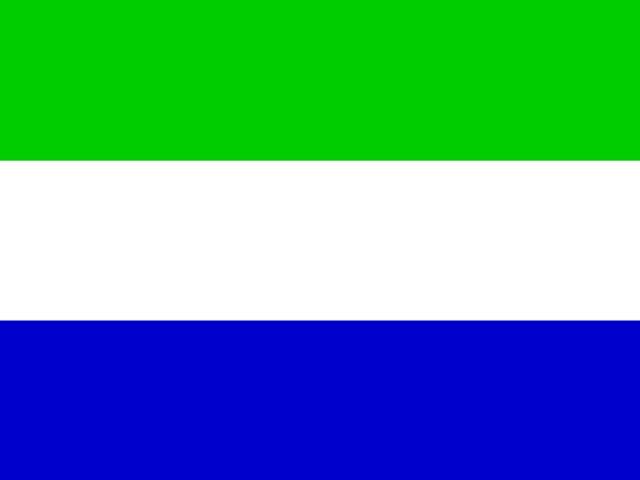
- Description: three equal horizontal bands of light green (top), white, and light blueMeaning: green stands for agriculture, mountains, and natural resources; white for unity and justice; and blue for the sea and the natural harbor in Freetown
- National symbols
- lion
- National colours
- green, white, blue
- National anthem
- Title: "High We Exalt Thee, Realm of the Free"Lyrics/music: Clifford Nelson FYLE/John Joseph AKAHistory: adopted 1961
- UNESCO World Heritage Sites
- Total World Heritage Sites: 1 (natural)Selected World Heritage Site locales: Gola-Tiwai Complex (n)
Economy
- Overview
- low-income West African economy; primarily subsistent agriculture; key iron and diamond mining activities suspended; slow recovery from 1990s civil war; systemic corruption; high-risk debt; high youth unemployment; natural resource rich
- GDP (PPP)
- $26.728 billion (2024 est.)
- GDP per person (PPP)
- $3,100 (2024 est.)
- GDP growth
- 4% (2024 est.)
- Inflation
- 28.6% (2024 est.)
- Unemployment
- 3.2% (2024 est.)
- Below poverty line
- 56.8% (2018 est.)
- Farm products
- cassava, rice, oil palm fruit, vegetables, sweet potatoes, milk, citrus fruits, fruits, groundnuts, sugarcane (2023)
- Industries
- diamond mining; iron ore, rutile and bauxite mining; small-scale manufacturing (beverages, textiles, footwear)
- Exports
- $1.382 billion (2023 est.)
- Main exports
- iron ore, titanium ore, diamonds, aluminum ore, cocoa beans (2023)
- Export partners
- China 67%, India 6%, Belgium 5%, Netherlands 4%, Ireland 3% (2023)
- Main imports
- rice, plastic products, packaged medicine, cement, cars (2023)
- Import partners
- China 32%, India 15%, UAE 5%, USA 5%, Turkey 5% (2023)
- Money sent home from abroad
- 4.6% of GDP (2023 est.)
Energy, internet and transport
- Electricity access
- Electrification - total population: 29.4% (2022 est.)Electrification - urban areas: 55.3%Electrification - rural areas: 5%
- Electricity sources
- Fossil fuels: 3.4% of total installed capacity (2023 est.)Solar: 9.8% of total installed capacity (2023 est.)Hydroelectricity: 84.4% of total installed capacity (2023 est.)Biomass and waste: 2.3% of total installed capacity (2023 est.)
- Internet users
- Percent of population: 21% (2023 est.)
- Mobile phones
- Total subscriptions: 8.93 million (2022 est.)Subscriptions per 100 inhabitants: 108 (2022 est.)
- TV and radio
- 1 state-owned TV station; 3 private TV stations; 1 pay-TV service; 1 state-owned national radio station; about 24 private radio stations; transmissions of several international broadcasters available (2019)
- Airports
- 8 (2025)
- Merchant ships
- Total: 584 (2023)By type: bulk carrier 33, container ship 8, general cargo 320, oil tanker 97, other 126
Military and space
- Armed forces
- Republic of Sierra Leone Armed Forces (RSLAF): organized as a Joint Force Command with land, air, and maritime componentsMinistry of Internal Affairs: Sierra Leone Police (2025)
- Military spending
- 0.5% of GDP (2024 est.)
- Military service
- 18-25 for voluntary military service for men and women; no conscription (2025)
Neighbouring countries
- Phone code
- +232
- Internet domain
- .sl