Liberia
Republic of Liberia
Founded by freed American slaves; Africa's first republic. Two civil wars under Charles Taylor and others devastated it.
See Liberia on the 3D globeTake a quiz
Population5.6 million
Area111,369 km²
CapitalMonrovia
RegionWestern Africa
Did you know?
- Africa's oldest republic
- Elected Africa's first female president (2005)
- Ballon d'Or winner George Weah later became president
Key facts about Liberia
- Government
- Presidential republic
- Religion
- Christian ~85%, Islam ~12%
- Founded / independence
- 1847
- Rich in
- Iron ore, rubber, gold, ship registry
- Languages
- English
English; Liberian Kreyol, Kpelle, Bassa - Currency
- Liberian dollar ($)
- People are called
- Liberian
- Main cities
- Monrovia, Gbarnga, Buchanan
Timeline of Liberia
- 1822Settlement of freed slaves
- 1847Independence
- 1980Coup
- 1989Civil war
- 2003Peace
- 2005Ellen Johnson Sirleaf elected
Places to see in Liberia
- Sapo National Park
- Providence Island
- Robertsport surfing
- Monrovia
Food and drink
Jollof rice · palm butter soup · fufu
Culture and famous for
Founded by freed American slaves; flag modelled on the US flag
Popular sports
Football (George Weah)
Geography and climate
- Highest point
- Mount Wuteve, 1,440 m
- Rivers, lakes and seas
- St Paul, Cavalla rivers
- Climate
- Tropical
- Coastline
- Has a sea coast
- Population density
- 50 people per km²
Wars and conflicts
- Civil wars 1989–2003 (about 250,000 dead)
Alliances and memberships
Political unions and regional organisations
Liberia in depth
Detailed facts from the CIA World Factbook (public domain, latest edition).
Overview
- History in brief
- With 28 ethnic groups and languages, Liberia is one of the most ethnically diverse countries in the world. For hundreds of years, the Mali and Songhai Empires claimed most of Liberia. Beginning in the 15th century, European traders began establishing outposts along the Liberian coast. Unlike its neighbors, however, Liberia did not fall under European colonial rule. In the early 19th century, the US began sending freed enslaved people and other people of color to Liberia to establish settlements. In 1847, these settlers declared independence from the US, writing their own constitution and establishing Africa’s first republic. Early in Liberia’s history, tensions arose between the Americo-Liberian settlers and the indigenous population. In 1980, Samuel DOE, who was from the indigenous population, led a military coup and ushered in a decade of authoritarian rule. In 1989, Charles TAYLOR launched a rebellion that led to a prolonged civil war in which DOE was killed. A period of relative peace in 1997 permitted an election that brought TAYLOR to power. In 2000, fighting resumed. A 2003 peace agreement ended the war and prompted TAYLOR’s resignation. He was later convicted by the UN-backed Special Court for Sierra Leone in The Hague for his involvement in Sierra Leone's civil war.In 2005, Ellen JOHNSON SIRLEAF became president after two years of transitional governments; she was the first female head of state in Africa. In 2011, JOHNSON SIRLEAF won reelection but struggled to rebuild Liberia's economy -- particularly after the 2014-15 Ebola epidemic -- and to reconcile a nation still recovering from 14 years of fighting. In 2017, former soccer star George WEAH won the presidential runoff election, marking the first successful transfer of power from one democratically elected government to another since the end of Liberia’s civil wars. Like his predecessor, WEAH struggled to improve the country’s economy. In 2023, former Vice President Joseph BOAKAI was elected president, edging out WEAH by a thin margin, the first time since 1927 that an incumbent was not re-elected after one term.
Geography
- Location
- Western Africa, bordering the North Atlantic Ocean, between Cote d'Ivoire and Sierra Leone
- Size compared
- slightly larger than Virginia
- Land borders
- Total: 1,667 kmBorder countries: Guinea 590 km; Cote d'Ivoire 778 km; Sierra Leone 299 km
- Coastline
- 579 km
- Climate
- tropical; hot, humid; dry winters with hot days and cool to cold nights; wet, cloudy summers with frequent heavy showers
- Terrain
- mostly flat to rolling coastal plains rising to rolling plateau and low mountains in northeast
- Elevation
- Highest point: Mount Wuteve 1,447 mLowest point: Atlantic Ocean 0 mMean elevation: 243 m
- Natural resources
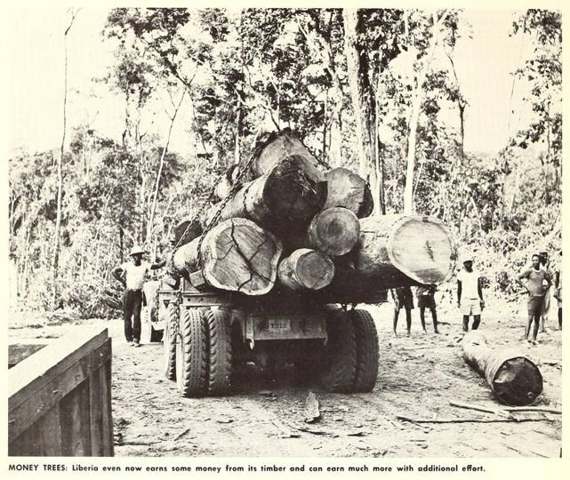
- iron ore, timber, diamonds, gold, hydropower
- Natural hazards
- dust-laden harmattan winds blow from the Sahara (December to March)
- Notes
- facing the Atlantic Ocean, the coastline is characterized by lagoons, mangrove swamps, and river-deposited sandbars; the inland grassy plateau supports limited agriculture
- Environmental issues
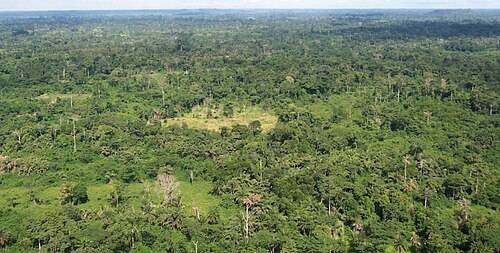
- tropical rainforest deforestation; soil erosion; loss of biodiversity; hunting of endangered species for bushmeat; pollution of coastal waters from oil residue and raw sewage; pollution of rivers from industrial run-off; burning and dumping of household waste
People and society
- Population
- Total: 5,563,541 (2025 est.)Male: 2,774,006Female: 2,789,535
- Nationality
- Noun: Liberian(s)Adjective: Liberian
- Ethnic groups
- Kpelle 20.2%, Bassa 13.6%, Grebo 9.9%, Gio 7.9%, Mano 7.2%, Kru 5.5%, Lorma 4.8%, Krahn 4.5%, Kissi, 4.3%, Mandingo 4.2%, Vai 3.8%, Gola 3.8%, Gbandi 2.9%, Mende 1.7%, Sapo 1%, Belle 0.7%, Dey 0.3%, other Liberian ethnic group 0.4%, other African 3%, non-African 0.2% (2022 est.)
- Languages
- English 20% (official) and 27 indigenous languages, including Liberian English variants
- Religions
- Christian 84.9%, Muslim 12%, Traditional 0.5%, other 0.1%, none 2.6% (2022 est.)
- Median age
- Total: 20.1 years (2025 est.)Male: 19.8 yearsFemale: 20 years
- Population growth
- 2.27% (2025 est.)
- Life expectancy
- Total population: 61.6 years (2024 est.)Male: 59.9 yearsFemale: 63.3 years
- Children per woman
- 3.84 children born/woman (2025 est.)
- Urbanization
- Urban population: 53.6% of total population (2023)Rate of urbanization: 3.41% annual rate of change (2015-20 est.)
- Largest cities
- 1.678 million MONROVIA (capital) (2023)
Government
- Official names
- Conventional long form: Republic of LiberiaConventional short form: LiberiaEtymology: name derives from the Latin word liber, meaning "free;" so named because the nation was created as a homeland for liberated African-American slaves
- Government type
- presidential republic
- Capital
- Name: MonroviaGeographic coordinates: 6 18 N, 10 48 WTime difference: UTC 0 (5 hours ahead of Washington, DC, during Standard Time)Etymology: named after James MONROE (1758-1831), the fifth president of the United States and supporter of Liberia's colonization by freed slaves
- Regions
- 15 counties; Bomi, Bong, Gbarpolu, Grand Bassa, Grand Cape Mount, Grand Gedeh, Grand Kru, Lofa, Margibi, Maryland, Montserrado, Nimba, River Cess, River Gee, Sinoe
- Independence
- 26 July 1847
- National holiday
- Independence Day, 26 July (1847)
- Constitution
- History: previous 1847 (at independence); latest drafted 19 October 1983, revision adopted by referendum 3 July 1984, effective 6 January 1986Amendment process: proposed by agreement of at least two thirds of both National Assembly houses or by petition of at least 10,000 citizens; passage requires at least two-thirds majority approval of both houses and approval in a referendum by at least two-thirds majority of registered voters
- Legal system
- mixed system of common law, based on Anglo-American law and customary law
- Voting age
- 18 years of age; universal
- Flag meaning
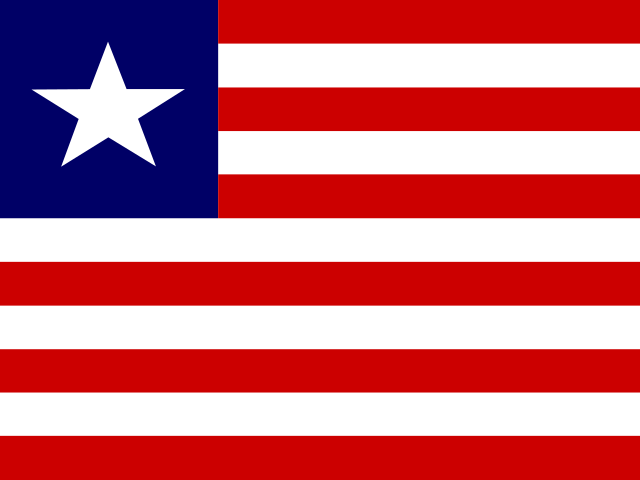
- Description: 11 equal horizontal stripes of red alternating with white; a five-pointed white star sits on a blue square in the upper-left cornerMeaning: the stripes stand for the signatories of the Liberian Declaration of Independence, the blue square for the African mainland, and the star for the freedom granted to ex-slaves; the blue stands for liberty, justice, and fidelity; the white for purity, cleanliness, and guilelessness; the red for steadfastness, valor, and fervor
- National symbols
- white star
- National colours
- red, white, blue
- National anthem
- Title: "All Hail, Liberia, Hail!"Lyrics/music: Daniel Bashiel WARNER/Olmstead LUCAHistory: lyrics adopted 1847, music adopted 1860; the anthem's author later became the third president of Liberia
Economy
- Overview
- low-income West African economy; food scarcity, especially in rural areas; high poverty and inflation; bad recession prior to COVID-19 due to Ebola crisis; growing government debt; longest continuously operated rubber plantation; large informal economy
- GDP (PPP)
- $9.308 billion (2024 est.)
- GDP per person (PPP)
- $1,700 (2024 est.)
- GDP growth
- 4.8% (2024 est.)
- Inflation
- 10.1% (2023 est.)
- Unemployment
- 2.9% (2024 est.)
- Below poverty line
- 50.9% (2016 est.)
- Farm products
- cassava, sugarcane, rice, oil palm fruit, bananas, rubber, vegetables, plantains, taro, maize (2023)
- Industries
- mining (iron ore and gold), rubber processing, palm oil processing, diamonds
- Exports
- $1.22 billion (2022 est.)
- Main exports
- gold, ships, iron ore, rubber, refined petroleum (2023)
- Export partners
- Switzerland 30%, UK 13%, France 8%, Germany 7%, Lebanon 4% (2023)
- Main imports
- ships, refined petroleum, rice, trucks, centrifuges (2023)
- Import partners
- China 48%, Japan 21%, Germany 8%, Brazil 3%, Cote d'Ivoire 3% (2023)
- Money sent home from abroad
- 18.2% of GDP (2023 est.)
Energy, internet and transport
- Electricity access
- Electrification - total population: 31.8% (2022 est.)Electrification - urban areas: 53.7%Electrification - rural areas: 14.9%
- Electricity sources
- Fossil fuels: 66.1% of total installed capacity (2023 est.)Solar: 1.3% of total installed capacity (2023 est.)Hydroelectricity: 32.4% of total installed capacity (2023 est.)Biomass and waste: 0.3% of total installed capacity (2023 est.)
- Internet users
- Percent of population: 24% (2023 est.)
- Mobile phones
- Total subscriptions: 1.72 million (2022 est.)Subscriptions per 100 inhabitants: 32 (2022 est.)
- TV and radio
- 8 private and 1 state-owned TV station; satellite TV service available; 1 state-owned radio station; about 20 independent radio stations broadcasting in Monrovia, with about 80 more local stations operating in other areas; transmissions of 4 international broadcasters are available (2019)
- Airports
- 19 (2025)
- Railways
- Total: 429 km (2008)Standard gauge: 345 km (2008) 1.435-m gaugeNarrow gauge: 84 km (2008) 1.067-m gauge
- Merchant ships
- Total: 4,821 (2023)By type: bulk carrier 1,895, container ship 1,013, general cargo 170, oil tanker 1,038, other 705
Military and space
- Armed forces
- Armed Forces of Liberia (AFL): Army, Liberian Coast GuardMinistry of Justice: Liberia National Police, Liberia Drug Enforcement Agency (2025)
- Military spending
- 0.7% of GDP (2024 est.)
- Military service
- 18 years of age for men and women for voluntary military service (2025)
Global issues
- Refugees and displaced people
- Refugees: 1,854 (2024 est.)
Neighbouring countries
- Phone code
- +231
- Internet domain
- .lr