Somalia
Federal Republic of Somalia · الصومال · Soomaaliya
The ancient Land of Punt. Siad Barre's regime fell in 1991; the state collapsed. Somaliland in the north has been self-governing since 1991.
See Somalia on the 3D globeTake a quiz
Population19 million
Area637,657 km²
CapitalMogadishu
RegionEastern Africa
Did you know?
- Has Africa's longest mainland coastline
- Known as a "nation of poets"
- Laas Geel rock art is about 5,000 years old
Key facts about Somalia
- Government
- Federal parliamentary republic (fragile)
- Religion
- Sunni Islam ~99%
- Founded / independence
- 1960 (union of British and Italian Somaliland)
- Rich in
- Livestock, bananas, remittances
- Languages
- Arabic, Somali
Somali (Maay and Maxaa dialects) and Arabic - Currency
- Somali shilling (Sh)
- People are called
- Somali
- Main cities
- Mogadishu, Hargeisa, Bosaso, Kismayo
Timeline of Somalia
- 1500 BCLand of Punt
- 1884British and Italian colonies
- 1960Independence
- 1969Siad Barre coup
- 1991State collapse
Places to see in Somalia
- Laas Geel cave paintings
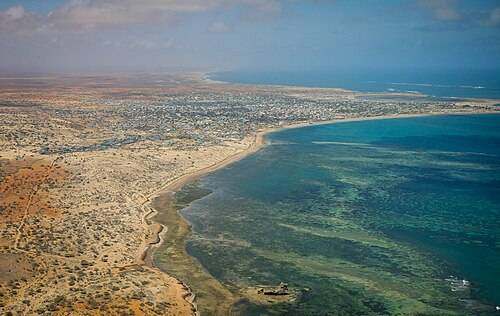
- Mogadishu Lido beach
- Berbera
- Hargeisa
Food and drink
Canjeero (pancake) · bariis iskukaris (spiced rice) · camel milk
Culture and famous for
Oral poetry ("nation of poets"); Somali clans
Popular sports
Football, athletics
Geography and climate
- Highest point
- Shimbiris, 2,416 m
- Rivers, lakes and seas
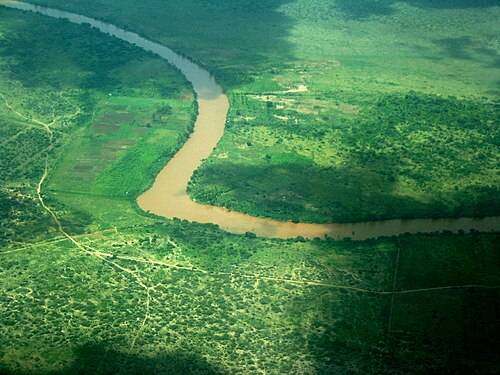
- Juba, Shebelle
- Climate
- Arid
- Coastline
- Has a sea coast
- Population density
- 30 people per km²
Wars and conflicts
- Ogaden War 1977–78
- Civil War 1991–present
- al-Shabaab insurgency
Alliances and memberships
Political unions and regional organisations
African UnionEast African CommunityArab LeagueOrganisation of Islamic Cooperation
Somalia in depth
Detailed facts from the CIA World Factbook (public domain, latest edition).
Overview
- History in brief
- Between A.D. 800 and 1100, immigrant Muslim Arabs and Persians set up coastal trading posts along the Gulf of Aden and the Indian Ocean, solidifying present-day Somalia’s close trading relationship with the Arab Peninsula. In the late 19th century, Britain, France, and Italy established colonies in the Somali Peninsula that lasted until 1960, when British Somaliland gained independence and joined with Italian Somaliland to form the Republic of Somalia.The country functioned as a parliamentary democracy until 1969, when General Mohamed SIAD Barre took control in a coup, beginning a 22-year socialist dictatorship. In an effort to centralize power, SIAD called for the eradication of the clan, the key cultural and social organizing principle in Somali society. Resistance to SIAD’s socialist leadership, which was causing a rapid deterioration of the country, prompted allied clan militias to overthrow SIAD in 1991, resulting in state collapse. Subsequent fighting between rival clans for resources and territory overwhelmed the country, causing a manmade famine and prompting international intervention. Beginning in 1993, the UN spearheaded an international humanitarian mission, but the international community largely withdrew by 1995 after an incident that became known as Black Hawk Down, in which two US military helicopters were shot down in Mogadishu. The fighting and subsequent siege and rescue resulted in 21 deaths and 82 wounded among the international forces.International peace conferences in the 2000s resulted in a number of transitional governments that operated outside Somalia. Left largely to themselves, Somalis in the country established alternative governance structures; some areas formed their own administrations, such as Somaliland and Puntland, while others developed localized institutions. Many local populations turned to sharia courts, an Islamic judicial system that implements religious law. Several of these courts came together in 2006 to form the Islamic Courts Union (ICU). The ICU established order in many areas of central and southern Somalia, including Mogadishu, but was forced out when Ethiopia intervened militarily in 2006 on behalf of the Somali Transitional Federal Government (TFG). As the TFG settled in the capital, the ICU fled to rural areas or left Somalia altogether, but the organization reemerged less than a year later as the Islamic insurgent and terrorist movement al-Shabaab, which is still active today.In 2007, the African Un
Geography
- Location
- Eastern Africa, bordering the Gulf of Aden and the Indian Ocean, east of Ethiopia
- Size compared
- almost five times the size of Alabama; slightly smaller than Texas
- Land borders
- Total: 2,385 kmBorder countries: Djibouti 61 km; Ethiopia 1,640 km; Kenya 684 km
- Coastline
- 3,025 km
- Climate
- principally desert; northeast monsoon (December to February), moderate temperatures in north and hot in south; southwest monsoon (May to October), torrid in the north and hot in the south, irregular rainfall, hot and humid periods (tangambili) between monsoons
- Terrain
- mostly flat to undulating plateau rising to hills in north
- Elevation
- Highest point: Mount Shimbiris 2,460 mLowest point: Indian Ocean 0 mMean elevation: 410 m
- Natural resources
- uranium and largely unexploited reserves of iron ore, tin, gypsum, bauxite, copper, salt, natural gas, likely oil reserves
- Natural hazards
- recurring droughts; frequent dust storms over eastern plains in summer; floods during rainy season
- Notes
- strategic location on Horn of Africa along southern approaches to Bab el Mandeb and route through Red Sea and Suez Canal
- Environmental issues
- water scarcity; contaminated water; improper waste disposal; deforestation; land degradation; overgrazing; soil erosion; desertification
People and society
- Population
- Total: 20,324,160 (2025 est.)Male: 10,170,863Female: 10,153,297
- Nationality
- Noun: Somali(s)Adjective: Somali
- Ethnic groups
- predominantly Somali with lesser numbers of Arabs, Bantus, and others
- Languages
- Somali (official), Arabic (official), Italian, EnglishMajor-language sample(s): Buugga Xaqiiqda Aduunka, waa laga maarmaanka macluumaadka assasiga. (Somali)The World Factbook, the indispensable source for basic information.
- Religions
- Muslim 99.9% (Sunni Muslim 98.1%, Shia Muslim 1.2%, Islamic schismatic 0.6%), ethnic religionist 0.1% (2020 est.)
- Median age
- Total: 15.7 years (2025 est.)Male: 19.3 yearsFemale: 18.9 years
- Population growth
- 3.32% (2025 est.)
- Life expectancy
- Total population: 56.5 years (2024 est.)Male: 54.1 yearsFemale: 59 years
- Children per woman
- 6.38 children born/woman (2025 est.)
- Urbanization
- Urban population: 47.9% of total population (2023)Rate of urbanization: 4.2% annual rate of change (2020-25 est.)
- Largest cities
- 2.610 million MOGADISHU (capital), 1.127 million Hargeysa (2023)
- Literacy
- Total population: 54.1% (2022 est.)Male: 64.5% (2022 est.)Female: 43.9% (2022 est.)
Government
- Official names
- Conventional long form: Federal Republic of SomaliaConventional short form: SomaliaLocal long form: Jamhuuriyadda Federaalka Soomaaliya (Somali)/ Jumhuriyat as Sumal al Fidiraliyah (Arabic)Local short form: Soomaaliya (Somali)/ As Sumal (Arabic)Former: British Somaliland, Italian Somaliland, Somali Republic, Somali Democratic RepublicEtymology: the name means "Land of the Somali," a local ethnic group; the origin of the group's name is unclear but may come from 1) a Cushitic word meaning "dark," 2) the local phrase soo mal, meaning "go and milk" (referring to offering guests milk), 3) the name of a local chief, or 4) the Arabic zamla, meaning "cattle"
- Government type
- federal parliamentary republic
- Capital
- Name: MogadishuGeographic coordinates: 2 04 N, 45 20 ETime difference: UTC+3 (8 hours ahead of Washington, DC, during Standard Time)Etymology: the name is probably derived from the Arabic word mukaddas, meaning "holy"
- Regions
- 18 regions (gobollo, singular - gobol); Awdal, Bakool, Banaadir, Bari, Bay, Galguduud, Gedo, Hiiraan, Jubbada Dhexe (Middle Jubba), Jubbada Hoose (Lower Jubba), Mudug, Nugaal, Sanaag, Shabeellaha Dhexe (Middle Shabeelle), Shabeellaha Hoose (Lower Shabeelle), Sool, Togdheer, Woqooyi Galbeed
- Independence
- 1 July 1960 (from a merger of British Somaliland, which became independent from the UK on 26 June 1960, and Italian Somaliland, which became independent from the Italian-administered UN trusteeship on 1 July 1960 to form the Somali Republic)
- National holiday
- Foundation of the Somali Republic, 1 July (1960); note - 26 June (1960) in Somaliland
- Constitution
- History: previous 1961, 1979; latest drafted 12 June 2012, adopted 1 August 2012Amendment process: proposed by the federal government, by members of the state governments, the Federal Parliament, or by public petition; proposals require review by a joint committee of Parliament with inclusion of public comments and state legislatures’ comments; passage requires at least two-thirds majority vote in both houses of Parliament and approval by a majority of votes cast in a referendum; constitutional clauses on Islamic principles, the federal system, human rights and freedoms, powers and authorities of the government branches, and inclusion of women in national institutions cannot be amended
- Legal system
- mixed system of civil law, Islamic (sharia) law, and customary law (referred to as Xeer)
- Voting age
- 18 years of age; universal suffrage starting with 24 June 2024 local elections
- Flag meaning
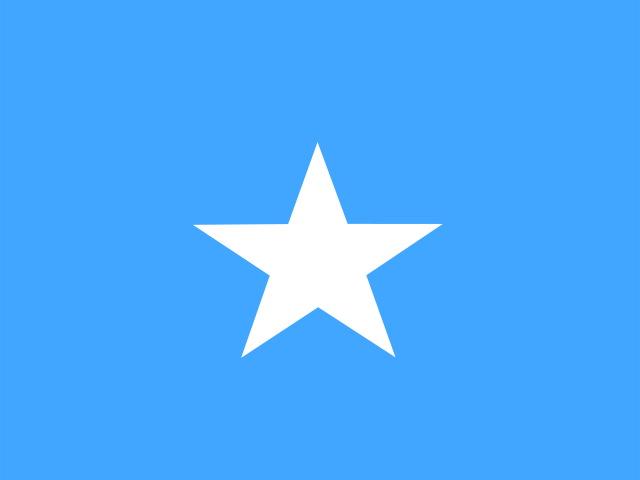
- Description: light blue with a large white five-pointed star in the centerMeaning: the blue field was originally influenced by the UN flag but today is said to represent the sky and the Indian Ocean; the five points of the star represent the regions in the horn of Africa where Somali people live: the former British Somaliland and Italian Somaliland (which together make up Somalia), Djibouti, Ogaden (Ethiopia), and the Northeast Province (Kenya)
- National symbols
- leopard
- National colours
- blue, white
- National anthem
- Title: "Qolobaa Calankeed" (Every Nation Has Its Own Flag)Lyrics/music: Abdullahi QARSHEHistory: adopted 2012
Economy
- Overview
- low-income African Horn economy; 30 years of war and instability crippled economic potential; high remittances for basic survival; new fiscal federalism approach; cleared some unsustainable debt; environmentally fragile; digitally driven urbanization efforts
- GDP (PPP)
- $26.77 billion (2024 est.)
- GDP per person (PPP)
- $1,400 (2024 est.)
- GDP growth
- 4% (2024 est.)
- Inflation
- 6.8% (2022 est.)
- Unemployment
- 18.9% (2024 est.)
- Below poverty line
- 54.4% (2022 est.)
- Farm products
- camel milk, milk, goat milk, sheep milk, sugarcane, fruits, sorghum, cassava, vegetables, maize (2023)
- Industries
- light industries, including sugar refining, textiles, wireless communication
- Exports
- $2.424 billion (2024 est.)
- Main exports
- sheep and goats, gold, postage stamps/documents, other animals, cattle (2023)
- Export partners
- UAE 35%, Saudi Arabia 27%, Oman 18%, Djibouti 8%, India 3% (2023)
- Main imports
- raw sugar, tobacco, broadcasting equipment, rice, milk (2023)
- Import partners
- UAE 29%, China 19%, India 15%, Turkey 8%, Oman 5% (2023)
- Money sent home from abroad
- 15.8% of GDP (2023 est.)
Energy, internet and transport
- Electricity access
- Electrification - total population: 48.9% (2022 est.)Electrification - urban areas: 76.7%Electrification - rural areas: 30.6%
- Electricity sources
- Fossil fuels: 82.5% of total installed capacity (2023 est.)Solar: 16% of total installed capacity (2023 est.)Wind: 1.5% of total installed capacity (2023 est.)
- Internet users
- Percent of population: 28% (2022 est.)
- Mobile phones
- Total subscriptions: 9.91 million (2023 est.)Subscriptions per 100 inhabitants: 54 (2023 est.)
- TV and radio
- 2 private TV stations rebroadcast Al-Jazeera and CNN; 1 state-operated TV station and 1 private TV station; state-operated Radio Mogadishu; 1 SW and roughly 10 private FM radio stations in Mogadishu; several radio stations in central and southern regions; transmissions of at least 2 international broadcasters available (2019)
- Airports
- 40 (2025)
- Merchant ships
- Total: 4 (2023)By type: general cargo 1, other 3
Military and space
- Armed forces
- Somali Armed Forces (SAF; aka Somali Defense Force): Somali National Army (SNA; aka Land Forces), Somali Navy, Somali Air ForceMinistry of Internal Security: Somali National Police (SNP, includes Coast Guard, commando unit) (2025)
- Military spending
- 6% of GDP (2021 est.)
- Military service
- 18-22 for voluntary military service for men and women in the Somali Armed Forces; compulsory service is reportedly authorized, but not currently utilized (2025)
Global issues
- Refugees and displaced people
- Refugees: 41,763 (2024 est.)IDPs: 3,869,345 (2024 est.)
Neighbouring countries
- Phone code
- +252
- Internet domain
- .so