Ethiopia
Federal Democratic Republic of Ethiopia · ኢትዮጵያ
Home of Lucy and the Kingdom of Aksum, one of the earliest Christian states. Defeated Italy in 1896 and was briefly occupied 1936–41. The Tigray war killed hundreds of thousands. Africa's second most populous country.
See Ethiopia on the 3D globeTake a quiz
Population132 million
Area1,104,300 km²
CapitalAddis Ababa
RegionEastern Africa
Did you know?
- Uses a calendar about 7–8 years behind the Gregorian
- Coffee was first discovered here
- Abebe Bikila won the 1960 Olympic marathon barefoot
Key facts about Ethiopia
- Government
- Federal parliamentary republic
- Religion
- Orthodox Christian ~43%, Islam ~34%, Protestant ~19%
- Founded / independence
- c. 980 BC (Aksum tradition); never colonised
- Rich in
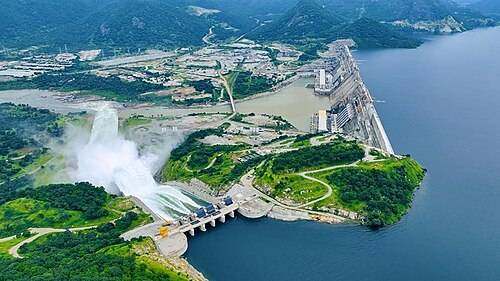
- Coffee (origin), agriculture, Grand Renaissance Dam hydropower, aviation
- Languages
- Amharic
Amharic; Oromo, Tigrinya, Somali, Sidama; over 80 languages - Currency
- Ethiopian birr (Br)
- People are called
- Ethiopian
- Main cities
- Addis Ababa, Dire Dawa, Mekelle, Gondar, Bahir Dar
Timeline of Ethiopia
- 100Kingdom of Aksum
- 1896Victory at Adwa
- 1936Italian occupation
- 1974Monarchy overthrown
- 1991Derg falls
- 2020Tigray war
- 2025Grand Ethiopian Renaissance Dam inaugurated
Places to see in Ethiopia
- Rock-hewn churches of Lalibela
- Simien Mountains
- Aksum obelisks
- Gondar castles
- Danakil Depression
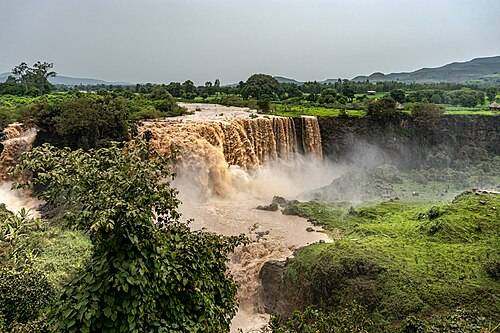
- Blue Nile Falls
Food and drink
Injera with wot · doro wat · kitfo · coffee ceremony
Culture and famous for
Birthplace of coffee; own calendar and alphabet (Ge'ez); "Lucy" fossil
Popular sports
Long-distance running (Bikila, Gebrselassie), football
Geography and climate
- Highest point
- Ras Dashen, 4,550 m
- Rivers, lakes and seas
- Blue Nile (from Lake Tana); Awash
- Climate
- Highland temperate; hot lowlands
- Coastline
- Landlocked
- Population density
- 120 people per km²
Wars and conflicts
- Battle of Adwa 1896
- Italian occupation 1936–41
- Derg terror
- Tigray war 2020–22
- Amhara Fano insurgency
Empires and states that once stood here
Kingdom of Aksum c. 100–940 AD
Alliances and memberships
Political unions and regional organisations
Ethiopia in depth
Detailed facts from the CIA World Factbook (public domain, latest edition).
Overview
- History in brief
- The area that is modern-day Ethiopia is rich in cultural and religious diversity with more than 80 ethnic groups. The oldest hominid yet found comes from Ethiopia, and Ethiopia was the second country to officially adopt Christianity in the 4th century A.D. A series of monarchies ruled the area that is now Ethiopia from 980 B.C. to 1855, when the Amhara kingdoms of northern Ethiopia united in an empire under Tewodros II. Many Ethiopians still speak reverently about the Battle of Adwa in 1896, when they defeated Italian forces and won their freedom from colonial rule.Emperor Haile SELASSIE became an internationally renowned figure in 1935, when he unsuccessfully appealed to the League of Nations to prevent Italy from occupying Ethiopia from 1936 to 1941. SELASSIE survived an attempted coup in 1960, annexed modern-day Eritrea in 1962, and played a leading role in establishing the Organization of African Unity in 1963. However, in 1974, a military junta called the Derg deposed him and established a socialist state. Torn by bloody coups, uprisings, drought, and massive displacement, the Derg regime was toppled in 1991 by a coalition of opposing forces, the Ethiopian People's Revolutionary Democratic Front (EPRDF). The EPRDF became an ethno-federalist political coalition that ruled Ethiopia from 1991 until its dissolution in 2019. Ethiopia adopted its constitution in 1994 and held its first multiparty elections in 1995.A two-and-a-half-year border war with Eritrea in the late 1990s ended with a peace treaty in 2000. Ethiopia subsequently rejected the 2007 Eritrea-Ethiopia Boundary Commission demarcation. This resulted in more than a decade of a tense “no peace, no war” stalemate between the two countries. In 2012, longtime Prime Minister MELES Zenawi died in office and was replaced by his Deputy Prime Minister HAILEMARIAM Desalegn, marking the first peaceful transition of power in decades. Following a wave of popular dissent and anti-government protest that began in 2015, HAILEMARIAM resigned in 2018, and ABIY Ahmed Ali took office the same year as Ethiopia's first ethnic Oromo prime minister. In 2018, ABIY promoted a rapprochement between Ethiopia and Eritrea that was marked with a peace agreement and a reopening of their shared border. In 2019, Ethiopia's nearly 30-year ethnic-based ruling coalition, the EPRDF, merged into a single unity party called the Prosperity Party; however, the lead coalition party, the Tigray People’s Liberation Front (TPLF), decline
Geography
- Location
- Eastern Africa, west of Somalia
- Size compared
- slightly less than twice the size of Texas
- Land borders
- Total: 5,925 kmBorder countries: Djibouti 342 km; Eritrea 1,033 km; Kenya 867 km; Somalia 1,640 km; South Sudan 1,299 km; Sudan 744 km
- Coastline
- 0 km (landlocked)
- Climate
- tropical monsoon with wide topographic-induced variation
- Terrain
- high plateau with central mountain range divided by Great Rift Valley
- Elevation
- Highest point: Ras Dejen 4,550 mLowest point: Danakil Depression -125 mMean elevation: 1,330 m
- Natural resources
- small reserves of gold, platinum, copper, potash, natural gas, hydropower
- Major rivers
- Blue Nile river source (shared with Sudan [m]) - 1,600 kmNote: [s] after country name indicates river source; [m] after country name indicates river mouth
- Major lakes
- Fresh water lake(s): Lake Tana - 3,600 sq km; Abaya Hayk - 1,160 sq km; Ch'amo Hayk - 550 sq kmSalt water lake(s): Lake Turkana (shared with Kenya) - 6,400 sq km; Abhe Bid Hayk/Abhe Bad (shared with Djibouti) - 780 sq km;
- Natural hazards
- geologically active Great Rift Valley susceptible to earthquakes, volcanic eruptions; frequent droughtsVolcanism: volcanic activity in the Great Rift Valley; Erta Ale (613 m) is the country's most active volcano; Dabbahu became active in 2005, forcing evacuations; other historically active volcanoes include Alayta, Dalaffilla, Dallol, Dama Ali, Fentale, Kone, Manda Hararo, and Manda-Inakir
- Notes
- the most populous landlocked country in the world; the Blue Nile, the chief headstream of the Nile by water volume, rises in T'ana Hayk (Lake Tana) in northwest Ethiopia
- Environmental issues
- deforestation; overgrazing; soil erosion; desertification; loss of biodiversity; water shortages in some areas from water-intensive farming and poor management; industrial pollution and pesticides contribute to air, water, and soil pollution
People and society
- Population
- Total: 121,372,632 (2025 est.)Male: 60,461,406Female: 60,911,226
- Nationality
- Noun: Ethiopian(s)Adjective: Ethiopian
- Ethnic groups
- Oromo 35.8%, Amhara 24.1%, Somali 7.2%, Tigray 5.7%, Sidama 4.1%, Guragie 2.6%, Welaita 2.3%, Afar 2.2%, Silte 1.3%, Kefficho 1.2%, other 13.5% (2022 est.)
- Languages
- Oromo (official regional working language) 33.8%, Amharic (official national language) 29.3%, Somali (official regional working language) 6.2%, Tigrigna (Tigrinya) (official regional working language) 5.9%, Sidamo 4%, Wolaytta 2.2%, Gurage 2%, Afar (official regional working language) 1.7%, Hadiyya 1.7%, Gamo 1.5%, Gedeo 1.3%, Opuuo 1.2%, Kafa 1.1%, other 8.1%, English (2007 est.)Major-language sample(s): Kitaaba Addunyaa Waan Qabataamaatiif - Kan Madda Odeeffannoo bu’uraawaatiif baay’ee barbaachisaa ta’e. (Oromo)የአለም እውነታ መጽሐፍ፣ ለመሠረታዊ መረጃ እጅግ አስፈላጊ የሆነ ምንጭ። (Amharic)The World Factbook, the indispensable source for basic information.
- Religions
- Ethiopian Orthodox 43.8%, Muslim 31.3%, Protestant 22.8%, Catholic 0.7%, traditional 0.6%, other 0.8% (2016 est.)
- Median age
- Total: 20.6 years (2025 est.)Male: 20.2 yearsFemale: 20.7 years
- Population growth
- 2.34% (2025 est.)
- Life expectancy
- Total population: 67.7 years (2024 est.)Male: 65.4 yearsFemale: 70 years
- Children per woman
- 3.77 children born/woman (2025 est.)
- Urbanization
- Urban population: 23.2% of total population (2023)Rate of urbanization: 4.4% annual rate of change (2020-25 est.)
- Largest cities
- 5.461 million ADDIS ABABA (capital) (2023)
- Literacy
- Total population: 60.5% (2022 est.)Male: 71% (2022 est.)Female: 50% (2022 est.)
Government
- Official names
- Conventional long form: Federal Democratic Republic of EthiopiaConventional short form: EthiopiaLocal long form: YeItyop'iya Federalawi Demokrasiyawi RipeblikLocal short form: Ityop'iyaFormer: Abyssinia, Italian East AfricaAbbreviation: FDREEtymology: the country name derives from the ancient Greek word used to describe the inhabitants, aithiops, meaning "burnt appearance"
- Government type
- federal parliamentary republic
- Capital
- Name: Addis AbabaGeographic coordinates: 9 02 N, 38 42 ETime difference: UTC+3 (8 hours ahead of Washington, DC, during Standard Time)Etymology: the name in Amharic means "new flower;" Empress TAITU gave the name to the new capital city in 1887
- Regions
- 12 ethnically based regional states (kililoch, singular - kilil) and 2 chartered cities* (astedader akabibiwach, singular - astedader akabibi); Adis Abeba* (Addis Ababa), Afar, Amara (Amhara), Binshangul Gumuz, Dire Dawa*, Gambela Hizboch (Gambela), Hareri Hizb (Harari), Oromia, Sidama, Sumale, Tigray, YeDebub Biheroch Bihereseboch na Hizboch (Southern Nations, Nationalities and Peoples), YeDebub M'irab Ityop'iya Hizboch (Southwest Ethiopia Peoples), Southern Ethiopia Peoples
- Independence
- oldest independent country in Africa and one of the oldest in the world, at least 2,000 years; may be traced to the Aksumite Kingdom, which appeared in the first century B.C.
- National holiday
- Derg Downfall Day (defeat of MENGISTU regime), 28 May (1991)
- Constitution
- History: several previous; latest drafted June 1994, adopted 8 December 1994, entered into force 21 August 1995Amendment process: proposals submitted for discussion require two-thirds majority approval in either house of Parliament or majority approval of one-third of the State Councils; passage of amendments other than constitutional articles on fundamental rights and freedoms and the initiation and amendment of the constitution requires two-thirds majority vote in a joint session of Parliament and majority vote by two thirds of the State Councils; passage of amendments affecting rights and freedoms and amendment procedures requires two-thirds majority vote in each house of Parliament and majority vote by all the State Councils
- Legal system
- civil law system
- Voting age
- 18 years of age; universal
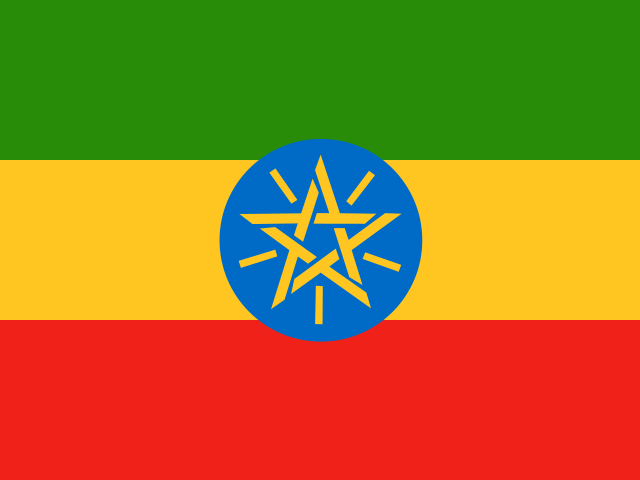
- Flag meaning
- Description: three equal horizontal bands of green (top), yellow, and red, with a light blue disk centered on the three bands; on the disk is a yellow pentagram with single yellow rays emanating from the angles between the pointsMeaning: green stands for hope and the land's fertility, yellow for justice and harmony, and red for sacrifice and heroism; the blue of the disk symbolizes peace, and the pentagram represents the Ethiopian people's unity and equalityHistory: the emblem in the center of the current flag was added in 1996
- National symbols
- Abyssinian lion (traditional), yellow pentagram with five rays of light on a blue field (promoted by government)
- National colours
- green, yellow, red
- National anthem
- Title: "Whedefit Gesgeshi Woud Enat Ethiopia" (March Forward, Dear Mother Ethiopia)Lyrics/music: DEREJE Melaku Mengesha/SOLOMON LuluHistory: adopted 1992
- UNESCO World Heritage Sites
- Total World Heritage Sites: 12 (10 cultural, 2 natural)Selected World Heritage Site locales: Rock-Hewn Churches, Lalibela (c); Simien National Park (n); Fasil Ghebbi, Gondar Region (c); Aksum (c); Lower Valley of the Awash (c); Lower Valley of the Omo (c); Tiya (c); Harar Jugol, the Fortified Historic Town (c); Konso Cultural Landscape (c); Gedeo Cultural Landscape (c); Bale Mountains National Park (n); Melka Kunture and Balchit: Archaeological and Palaeontological Sites in the Highland Area of Ethiopia (c)
Economy
- Overview
- low-income, fast-growing Horn of Africa economy; widespread poverty and food insecurity worsened by conflict and environmental factors; landlocked with tensions over seaport access; development aid supporting reforms to boost private-sector growth and financial stability; challenge of creating jobs for growing labor force
- GDP (PPP)
- $380.895 billion (2024 est.)
- GDP per person (PPP)
- $2,900 (2024 est.)
- GDP growth
- 7.3% (2024 est.)
- Inflation
- 21% (2024 est.)
- Unemployment
- 3.4% (2024 est.)
- Below poverty line
- 23.5% (2015 est.)
- Farm products
- maize, cereals, wheat, milk, sorghum, barley, taro, beans, sweet potatoes, potatoes (2023)
- Industries
- food processing, beverages, textiles, leather, garments, chemicals, metals processing, cement
- Exports
- $10.865 billion (2023 est.)
- Main exports
- coffee, garments, dried legumes, cut flowers, oil seeds (2023)
- Export partners
- USA 12%, China 10%, UAE 8%, Saudi Arabia 8%, Netherlands 5% (2023)
- Main imports
- refined petroleum, fertilizers, plastics, raw sugar, cars (2023)
- Import partners
- China 26%, Djibouti 16%, India 7%, Kuwait 7%, Saudi Arabia 6% (2023)
- Money sent home from abroad
- 0.33% of GDP (2023 est.)
Energy, internet and transport
- Electricity access
- Electrification - total population: 55% (2022 est.)Electrification - urban areas: 94%Electrification - rural areas: 43%
- Electricity sources
- Solar: 0.2% of total installed capacity (2023 est.)Wind: 3.1% of total installed capacity (2023 est.)Hydroelectricity: 96.5% of total installed capacity (2023 est.)Geothermal: 0.2% of total installed capacity (2023 est.)
- Internet users
- Percent of population: 17% (2021 est.)
- Mobile phones
- Total subscriptions: 85.9 million (2024 est.)Subscriptions per 100 inhabitants: 65 (2024 est.)
- TV and radio
- 10 public/state broadcasters; 9 public/state radio stations; 13 commercial FM radio stations; 18 commercial TV stations; 45 community radio stations; 5 community TV stations (2023)
- Airports
- 58 (2025)
- Railways
- Total: 659 km (2017) (Ethiopian segment of the 756 km Addis Ababa-Djibouti railroad)Standard gauge: 659 km (2017) 1.435-m gauge
- Merchant ships
- Total: 12 (2023)By type: general cargo 10, oil tanker 2
Military and space
- Armed forces
- Ethiopian National Defense Force (ENDF; aka Federal Defense Force of Ethiopia, FDRE): Army, Air Force, Naval Force, Defense Cyber Main Directorate (2025)
- Military spending
- 0.7% of GDP (2024 est.)
- Military service
- 18-22 years of age for voluntary military service; 24-month service obligation; no compulsory military service, but the military can conduct callups when necessary and compliance is compulsory (2025)
- Space programme
- focuses on acquiring and operating satellites, as well as conducting research; jointly builds satellites with foreign partners, and operates and exploits remote sensing (RS) satellites; developing the ability to manufacture satellites and their payloads; involved in astronomy and the construction of space observatories; works with a variety of countries, including China, France, India, Russia, and multiple African countries, particularly Kenya, Rwanda, Sudan, Tanzania, and Uganda; shares RS data with neighboring countries (2025)
- Space milestones
- 2015 - established Entoto Observatory and Space Science Research Center2019 - first remote sensing (RS) satellite (Ethiopia RS Satellite or ETRSS-1) built and launched by China2020 - second RS satellite (ET-SMART-RSS) built with assistance from and launched by China; began construction of satellite manufacturing, assembly, integration, and testing facility2021 - established a multi-mission ground control station for RS satellites2024 - declared second satellite ground station operational2025 - announced plans to launch third RS satellite (ETRSS-02) in partnership with China in 2026
Global issues
- Refugees and displaced people
- Refugees: 1,071,881 (2024 est.)IDPs: 3,134,600 (2024 est.)
Neighbouring countries
DjiboutiEritreaKenyaSomaliaSouth SudanSudan
- Phone code
- +251
- Internet domain
- .et