Kenya
Republic of Kenya
Swahili coastal city-states traded across the Indian Ocean. British colonial rule faced the Mau Mau uprising. Now East Africa's largest economy.
See Kenya on the 3D globeTake a quiz
Ongoing: Haiti gang war
Population57 million
Area580,367 km²
CapitalNairobi
RegionEastern Africa
Did you know?
- Hosts the Great Migration of over a million wildebeest
- Eliud Kipchoge ran the first sub-2-hour marathon (unofficial, 2019)
- Fossils of early humans found at Lake Turkana
Key facts about Kenya
- Government
- Presidential republic
- Religion
- Christian ~85%, Islam ~11%
- Founded / independence
- 1963 (from UK)
- Rich in
- Tea, flowers, tourism (safaris), tech (M-Pesa), athletics
- Languages
- English, Swahili
Swahili and English; Kikuyu, Luhya, Luo, Kalenjin; Sheng slang - Currency
- Kenyan shilling (Sh)
- People are called
- Kenyan
- Main cities
- Nairobi, Mombasa, Kisumu, Nakuru, Eldoret
Timeline of Kenya
- 1498Vasco da Gama at Malindi
- 1895British protectorate
- 1952Mau Mau uprising
- 1963Independence
- 2010New constitution
Places to see in Kenya
- Maasai Mara
- Mount Kenya
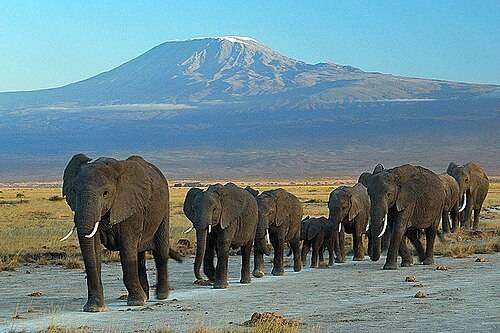
- Amboseli (view of Kilimanjaro)
- Lamu old town
- Diani Beach
- Great Rift Valley
Food and drink
Ugali · nyama choma · sukuma wiki · chapati
Culture and famous for
Maasai culture; M-Pesa mobile money; Swahili coast
Popular sports
Long-distance running (Kipchoge), rugby sevens
Geography and climate
- Highest point
- Mount Kenya, 5,199 m
- Rivers, lakes and seas
- Lake Victoria; Lake Turkana; Tana River
- Climate
- Tropical; cool highlands
- Coastline
- Has a sea coast
- Population density
- 98 people per km²
Wars and conflicts
- Mau Mau uprising 1952–60
- 2007–08 election violence
- al-Shabaab attacks
Alliances and memberships
Political unions and regional organisations
African UnionEast African CommunityCommonwealth of Nations
Kenya in depth
Detailed facts from the CIA World Factbook (public domain, latest edition).
Overview
- History in brief
- Trade centers such as Mombasa have existed along the Kenyan and Tanzanian coastlines, known as the Land of Zanj, since at least the 2nd century. These centers traded with the outside world, including China, India, Indonesia, the Middle East, North Africa, and Persia. By around the 9th century, the mix of Africans, Arabs, and Persians who lived and traded there became known as Swahili ("people of the coast") with a distinct language (KiSwahili) and culture. The Portuguese arrived in the 1490s and, using Mombasa as a base, sought to monopolize trade in the Indian Ocean. The Portuguese were pushed out in the late 1600s by the combined forces of Oman and Pate, an island off the coast. In 1890, Germany and the UK divided up the region, with the UK taking the north and the Germans the south, including present-day Tanzania, Burundi, and Rwanda. In 1895, the British established the East Africa Protectorate, which in 1920 was converted into a colony, and named Kenya after its highest mountain. Numerous political disputes between the colony and the UK led to the violent Mau Mau Uprising, which began in 1952, and the eventual declaration of independence in 1963. Jomo KENYATTA, the founding president and an icon of the liberation struggle, led Kenya from independence in 1963 until his death in 1978, when Vice President Daniel Arap MOI took power in a constitutional succession. The country was a de facto one-party state from 1969 until 1982, after which time the ruling Kenya African National Union (KANU) changed the constitution to make itself the sole legal political party. MOI gave in to internal and external pressure for political liberalization in 1991, but the ethnically fractured opposition failed to dislodge KANU from power in elections in 1992 and 1997, which were marred by violence and fraud. MOI stepped down in 2002 after fair and peaceful elections. Mwai KIBAKI, running as the candidate of the multiethnic, united opposition group, the National Rainbow Coalition (NARC), defeated KANU candidate Uhuru KENYATTA, the son of the founding president, and assumed the presidency following a campaign centered on an anticorruption platform.Opposition candidate Raila ODINGA challenged KIBAKI's reelection in 2007 on the grounds of widespread vote rigging, leading to two months of ethnic violence that caused more than 1,100 deaths and displaced hundreds of thousands. African Union-sponsored mediation resulted in a power-sharing accord that brought ODINGA into the governme
Geography
- Location
- Eastern Africa, bordering the Indian Ocean, between Somalia and Tanzania
- Size compared
- five times the size of Ohio; slightly more than twice the size of Nevada
- Land borders
- Total: 3,457 kmBorder countries: Ethiopia 867 km; Somalia 684 km; South Sudan 317 km; Tanzania 775 km; Uganda 814 km
- Coastline
- 536 km
- Climate
- varies from tropical along coast to arid in interior
- Terrain
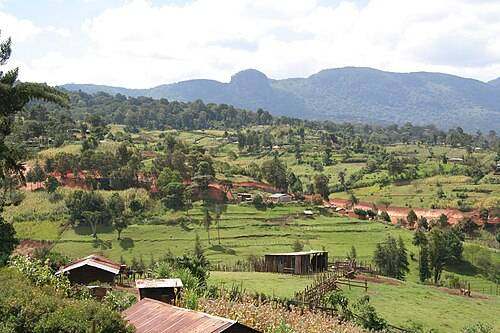
- low plains rise to central highlands bisected by Great Rift Valley; fertile plateau in west
- Elevation
- Highest point: Mount Kenya 5,199 mLowest point: Indian Ocean 0 mMean elevation: 762 m
- Natural resources
- limestone, soda ash, salt, gemstones, fluorspar, zinc, diatomite, gypsum, wildlife, hydropower
- Major lakes
- Fresh water lake(s): Lake Victoria (shared with Tanzania and Uganda) - 62,940 sq kmSalt water lake(s): Lake Turkana (shared with Ethiopia) - 6,400 sq km
- Natural hazards
- recurring drought; flooding during rainy seasonsVolcanism: limited volcanic activity; the Barrier (1,032 m) last erupted in 1921; South Island is the only other historically active volcano
- Notes
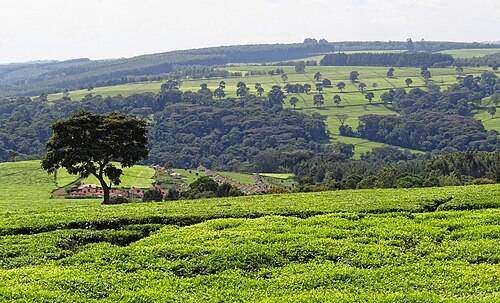
- the Kenyan Highlands comprise one of the most successful agricultural production regions in Africa; glaciers are found on Mount Kenya, Africa's second-highest peak; unique physiography supports abundant and varied wildlife of scientific and economic value; Lake Victoria, the world's largest tropical lake and the second-largest freshwater lake, is shared among three countries: Kenya, Tanzania, and Uganda
- Environmental issues
- water pollution from urban and industrial wastes and from use of pesticides and fertilizers; flooding; water-hyacinth infestation in Lake Victoria; deforestation; soil erosion; desertification; poaching
People and society
- Population
- Total: 55,751,717 (2025 est.)Male: 27,857,519Female: 27,894,198
- Nationality
- Noun: Kenyan(s)Adjective: Kenyan
- Ethnic groups
- Kikuyu 17.1%, Luhya 14.3%, Kalenjin 13.4%, Luo 10.7%, Kamba 9.8%, Somali 5.8%, Kisii 5.7%, Mijikenda 5.2%, Meru 4.2%, Maasai 2.5%, Turkana 2.1%, non-Kenyan 1%, other 8.2% (2019 est.)
- Languages
- English (official), Kiswahili (official), numerous indigenous languagesMajor-language sample(s): The World Factbook, the indispensable source for basic information. (English)The World Factbook, Chanzo cha Lazima Kuhusu Habari ya Msingi. (Kiswahili)
- Religions
- Christian 85.5% (Protestant 33.4%, Catholic 20.6%, Evangelical 20.4%, African Instituted Churches 7%, other Christian 4.1%), Muslim 10.9%, other 1.8%, none 1.6%, don't know/no answer 0.2% (2019 est.)
- Median age
- Total: 21.5 years (2025 est.)Male: 21.1 yearsFemale: 21.4 years
- Population growth
- 2.15% (2025 est.)
- Life expectancy
- Total population: 70.4 years (2024 est.)Male: 68.6 yearsFemale: 72.2 years
- Children per woman
- 3.09 children born/woman (2025 est.)
- Urbanization
- Urban population: 29.5% of total population (2023)Rate of urbanization: 4.09% annual rate of change (2020-25 est.)
- Largest cities
- 5.325 million NAIROBI (capital), 1.440 million Mombassa (2023)
Government
- Official names
- Conventional long form: Republic of KenyaConventional short form: KenyaLocal long form: Republic of Kenya (English)/ Jamhuri ya Kenya (Swahili)Local short form: KenyaFormer: British East AfricaEtymology: named for Mount Kenya; the mountain's name may derive from the Kikuyu word kere nyaga, or "white mountain"
- Government type
- presidential republic
- Capital
- Name: NairobiGeographic coordinates: 1 17 S, 36 49 ETime difference: UTC+3 (8 hours ahead of Washington, DC, during Standard Time)Etymology: the name derives from the Maasai expression meaning "cool waters," which was used to refer to a local water hole, Enkare Nairobi
- Regions
- 47 counties; Baringo, Bomet, Bungoma, Busia, Elgeyo/Marakwet, Embu, Garissa, Homa Bay, Isiolo, Kajiado, Kakamega, Kericho, Kiambu, Kilifi, Kirinyaga, Kisii, Kisumu, Kitui, Kwale, Laikipia, Lamu, Machakos, Makueni, Mandera, Marsabit, Meru, Migori, Mombasa, Murang'a, Nairobi City, Nakuru, Nandi, Narok, Nyamira, Nyandarua, Nyeri, Samburu, Siaya, Taita/Taveta, Tana River, Tharaka-Nithi, Trans Nzoia, Turkana, Uasin Gishu, Vihiga, Wajir, West Pokot
- Independence
- 12 December 1963 (from the UK)
- National holiday
- Jamhuri Day (Independence Day), 12 December (1963)
- Constitution
- History: current constitution passed by referendum on 4 August 2010Amendment process: amendments can be proposed by either house of Parliament or by petition of at least one million eligible voters; passage of amendments by Parliament requires approval by at least two-thirds majority vote of both houses in each of two readings, approval in a referendum by majority of votes cast by at least 20% of eligible voters in at least one half of Kenya’s counties, and approval by the president; passage of amendments introduced by petition requires approval by a majority of county assemblies, approval by majority vote of both houses, and approval by the president
- Legal system
- mixed system of English common law, Islamic law, and customary law; Supreme Court reviews laws
- Voting age
- 18 years of age; universal
- Flag meaning
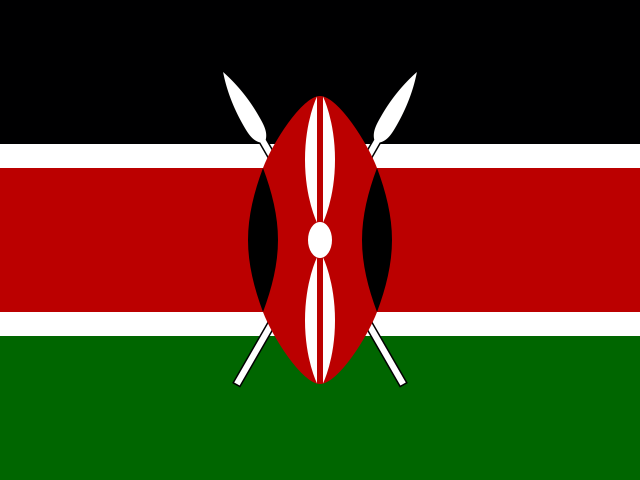
- Description: three equal horizontal bands of black (top), red, and green; the red band is edged in white; a large Maasai warrior's shield covering crossed spears is at the centerMeaning: black stands for the majority population, red for the blood shed in the struggle for freedom, green for natural wealth, and white for peace; the shield and crossed spears symbolize the defense of freedom
- National symbols
- lion
- National colours
- black, red, green, white
- National anthem
- Title: "Ee Mungu Nguvu Yetu" (O God of All Creation)Lyrics/music: Graham HYSLOP, Thomas KALUME, Peter KIBUKOSYA, Washington OMONDI, and George W. SENOGA-ZAKE/traditional, adapted by Graham HYSLOP, Thomas KALUME, Peter KIBUKOSYA, Washington OMONDI, and George W. SENOGA-ZAKEHistory: adopted 1963; based on a traditional Kenyan folk song
- UNESCO World Heritage Sites
- Total World Heritage Sites: 8(5 cultural, 3 natural)Selected World Heritage Site locales: Lake Turkana National Parks (n); Mount Kenya National Park/Natural Forest (n); Lamu Old Town (c); Sacred Mijikenda Kaya Forests (c); Fort Jesus, Mombasa (c); Kenya Lake System in the Great Rift Valley (n); Thimlich Ohinga Archaeological Site (c); The Historic Town and Archaeological Site of Gedi (c)
Economy
- Overview
- fast growing, third largest Sub-Saharan economy; strong agriculture sector with emerging services and tourism industries; IMF program to address current account and debt service challenges; business-friendly policies foster infrastructure investment, digital innovation and public-private partnerships; vulnerable to climate change-induced droughts
- GDP (PPP)
- $328.632 billion (2024 est.)
- GDP per person (PPP)
- $5,800 (2024 est.)
- GDP growth
- 4.5% (2024 est.)
- Inflation
- 4.5% (2024 est.)
- Unemployment
- 5.5% (2024 est.)
- Below poverty line
- 38.6% (2021 est.)
- Farm products
- sugarcane, milk, maize, bananas, tea, potatoes, cassava, cabbages, camel milk, mangoes/guavas (2023)
- Industries
- agriculture, transportation, services, manufacturing, construction, telecommunications, tourism, retail
- Exports
- $12.626 billion (2023 est.)
- Main exports
- tea, cut flowers, garments, gold, tropical fruits (2023)
- Export partners
- Uganda 10%, USA 10%, UAE 8%, Netherlands 8%, Pakistan 6% (2023)
- Main imports
- refined petroleum, palm oil, wheat, plastics, garments (2023)
- Import partners
- China 22%, UAE 14%, India 10%, Saudi Arabia 5%, Malaysia 4% (2023)
- Money sent home from abroad
- 3.9% of GDP (2023 est.)
Energy, internet and transport
- Electricity access
- Electrification - total population: 76% (2022 est.)Electrification - urban areas: 98%Electrification - rural areas: 65.6%
- Electricity sources
- Fossil fuels: 10.2% of total installed capacity (2023 est.)Solar: 4.5% of total installed capacity (2023 est.)Wind: 15.7% of total installed capacity (2023 est.)Hydroelectricity: 20.9% of total installed capacity (2023 est.)Geothermal: 47.2% of total installed capacity (2023 est.)Biomass and waste: 1.6% of total installed capacity (2023 est.)
- Internet users
- Percent of population: 35% (2023 est.)
- Mobile phones
- Total subscriptions: 71.4 million (2024 est.)Subscriptions per 100 inhabitants: 126 (2024 est.)
- TV and radio
- about a half-dozen large, privately owned media companies with TV and radio stations, as well as a state-owned TV broadcaster, provide service nationwide; satellite and cable TV subscription services available; state-owned radio broadcaster operates 2 national radio channels and provides regional and local radio services in multiple languages; many private radio stations broadcast nationally, with over 100 private and non-profit regional stations broadcasting in local languages; TV transmissions of all major international broadcasters available, mostly via paid subscriptions (2019)
- Airports
- 368 (2025)
- Railways
- Total: 3,819 km (2018)Standard gauge: 485 km (2018) 1.435-m gaugeNarrow gauge: 3,334 km (2018) 1.000-m gauge
- Merchant ships
- Total: 26 (2023)By type: oil tanker 4, other 22
Military and space
- Armed forces
- Kenya Defense Forces (KDF): Kenya Army, Kenya Navy, Kenya Air ForceMinistry of Interior: National Police Service, Kenya Coast Guard (2025)
- Military spending
- 1.1% of GDP (2024 est.)
- Military service
- 18-26 years of age for voluntary service for men and women (under 18 with parental consent; upper limit 30 years of age for specialists, tradesmen, or women with a diploma; 39 years of age for chaplains/imams); 7-9 year service obligations (2026)
- Space programme
- has a national space strategy focused on acquiring and applying space technologies for agriculture, communications, disaster and resource management, security, urban planning, and weather monitoring; jointly develops and builds nanosatellites with foreign partners; operates satellites; researching and developing satellite payloads and imagery data analysis capabilities; has cooperated on space issues with China, Japan, India, Italy, and the US, as well as a variety of African partners; member of the African Space Agency (2025)
- Space milestones
- 1970 - first satellite (US-made Uhura) launched from Kenya2008 - established country's first satellite ground station2018 - first remote-sensing (RS)/technology-demonstrator cube nanosatellite (1KUNS-PF) produced jointly with Japan and Italy and deployed from the International Space Station2023 - first domestically designed RS satellite (TAIFA-1) built by Bulgaria and launched by US
Global issues
- Refugees and displaced people
- Refugees: 823,904 (2024 est.)IDPs: 284,886 (2024 est.)Stateless persons: 9,800 (2024 est.)
Neighbouring countries
EthiopiaSomaliaSouth SudanTanzaniaUganda
- Phone code
- +254
- Internet domain
- .ke