Suriname
Republic of Suriname
Dutch colony traded for New York in 1667. Elected its first woman president in 2025.
See Suriname on the 3D globeTake a quiz
Population640 thousand
Area163,820 km²
CapitalParamaribo
RegionSouth America
Did you know?
- About 93% forest — the most forested country
- Was traded by Britain for New York in 1667
- Smallest country in South America
Key facts about Suriname
- Government
- Presidential republic
- Religion
- Christian ~52%, Hindu ~18%, Islam ~14%
- Founded / independence
- 1975 (from Netherlands)
- Rich in
- Gold, oil, bauxite, timber
- Languages
- Dutch
Dutch; Sranan Tongo, Sarnami Hindustani, Javanese - Currency
- Surinamese dollar ($)
- People are called
- Surinamer
- Main cities
- Paramaribo, Lelydorp
Timeline of Suriname
- 1667Dutch rule
- 1863Slavery abolished
- 1975Independence
- 1980Coup
- 2025First woman president
Places to see in Suriname
- Paramaribo historic centre
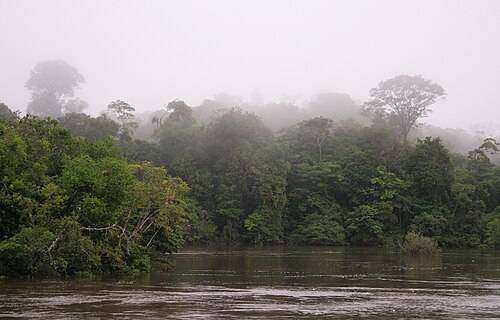
- Central Suriname Nature Reserve
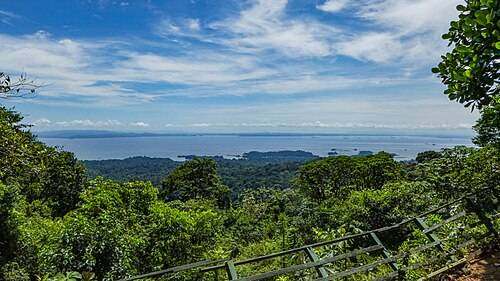
- Brownsberg
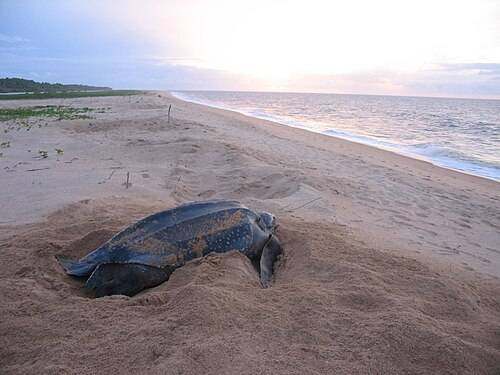
- Galibi turtle beaches
Food and drink
Pom · roti · nasi goreng
Culture and famous for
Mosque and synagogue side by side in Paramaribo; Maroon culture
Popular sports
Football
Geography and climate
- Highest point
- Julianatop, 1,286 m
- Rivers, lakes and seas
- Suriname, Marowijne
- Climate
- Tropical
- Coastline
- Has a sea coast
- Population density
- 4 people per km²
Wars and conflicts
- Interior War 1986–92
Empires and states that once stood here
Alliances and memberships
Political unions and regional organisations
Organisation of Islamic CooperationCARICOMCELACOrganization of American States
Suriname in depth
Detailed facts from the CIA World Factbook (public domain, latest edition).
Overview
- History in brief
- The Spaniards first explored Suriname in the 16th century, and the English then settled it in the mid-17th century. Suriname became a Dutch colony in 1667. With the abolition of African slavery in 1863, workers were brought in from India and Java. The Netherlands granted the colony independence in 1975. Five years later, the civilian government was replaced by a military regime that soon declared Suriname a socialist republic. It continued to exert control through a succession of nominally civilian administrations until 1987, when international pressure finally forced a democratic election. In 1990, the military overthrew the civilian leadership, but a democratically elected government -- a four-party coalition -- returned to power in 1991. The coalition expanded to eight parties in 2005 and ruled until 2010, when voters returned former military leader Desire BOUTERSE and his opposition coalition to power. President BOUTERSE ran unopposed in 2015 and was reelected. Opposition parties campaigned hard against BOUTERSE in the run-up to the 2020 elections, and a multi-party coalition led by Chandrikapersad SANTOKHI’s VHP and Ronnie Brunswijk’s ABOP was installed.
Geography
- Location
- Northern South America, bordering the North Atlantic Ocean, between French Guiana and Guyana
- Size compared
- slightly larger than Georgia
- Land borders
- Total: 1,907 kmBorder countries: Brazil 515 km; French Guiana 556 km; Guyana 836 km
- Coastline
- 386 km
- Climate
- tropical; moderated by trade winds
- Terrain
- mostly rolling hills; narrow coastal plain with swamps
- Elevation
- Highest point: Juliana Top 1,230 mLowest point: unnamed location in the coastal plain -2 mMean elevation: 246 m
- Natural resources
- timber, hydropower, fish, kaolin, shrimp, bauxite, gold, and small amounts of nickel, copper, platinum, iron ore
- Natural hazards
- flooding
- Notes
- smallest independent country on the South American continent; mostly tropical rainforest; great diversity of flora and fauna; relatively small population, mostly along the coast
- Environmental issues
- deforestation; pollution of inland waterways from small-scale mining activities
People and society
- Population
- Total: 653,605 (2025 est.)Male: 323,747Female: 329,858
- Nationality
- Noun: Surinamer(s)Adjective: Surinamese
- Ethnic groups
- Hindustani (also known locally as "East Indians"; their ancestors emigrated from northern India in the latter part of the 19th century) 27.4%, Maroon (their African ancestors were brought to the country in the 17th and 18th centuries as slaves and escaped to the interior) 21.7%, Creole (mixed White and Black) 15.7%, Javanese 13.7%, mixed 13.4%, other 7.6%, unspecified 0.6% (2012 est.)
- Languages
- Dutch (official), English (widely spoken), Sranang Tongo (Surinamese, sometimes called Taki-Taki, is the native language of Creoles and much of the younger population), Caribbean Hindustani (a dialect of Hindi), JavaneseMajor-language sample(s): Het Wereld Feitenboek, een omnisbare bron van informatie. (Dutch)The World Factbook, the indispensable source for basic information. (English)
- Religions
- Protestant 23.6% (includes Evangelical 11.2%, Moravian 11.2%, Reformed 0.7%, Lutheran 0.5%), Hindu 22.3%, Roman Catholic 21.6%, Muslim 13.8%, other Christian 3.2%, Winti 1.8%, Jehovah's Witness 1.2%, other 1.7%, none 7.5%, unspecified 3.2% (2012 est.)
- Median age
- Total: 32.3 years (2025 est.)Male: 31 yearsFemale: 32.9 years
- Population growth
- 1.04% (2025 est.)
- Life expectancy
- Total population: 72.7 years (2024 est.)Male: 69 yearsFemale: 76.7 years
- Children per woman
- 1.87 children born/woman (2025 est.)
- Urbanization
- Urban population: 66.4% of total population (2023)Rate of urbanization: 0.88% annual rate of change (2020-25 est.)
- Largest cities
- 239,000 PARAMARIBO (capital) (2018)
- Years in school
- Total: 11 years (2021 est.)Male: 10 years (2021 est.)Female: 11 years (2021 est.)
Government
- Official names
- Conventional long form: Republic of SurinameConventional short form: SurinameLocal long form: Republiek SurinameLocal short form: SurinameFormer: Netherlands Guiana, Dutch GuianaEtymology: name may derive from the Surinen people who inhabited the area at the time of European contact
- Government type
- presidential republic
- Capital
- Name: ParamariboGeographic coordinates: 5 50 N, 55 10 WTime difference: UTC-3 (2 hours ahead of Washington, DC, during Standard Time)Etymology: the name comes from the Guaraní words para (water or river) and maribo (inhabitants)
- Regions
- 10 districts (distrikten, singular - distrikt); Brokopondo, Commewijne, Coronie, Marowijne, Nickerie, Para, Paramaribo, Saramacca, Sipaliwini, Wanica
- Independence
- 25 November 1975 (from the Netherlands)
- National holiday
- Independence Day, 25 November (1975)
- Constitution
- History: previous 1975; latest ratified 30 September 1987, effective 30 October 1987Amendment process: proposed by the National Assembly; passage requires at least two-thirds majority vote of the total membership
- Legal system
- civil law system influenced by Dutch civil law
- Voting age
- 18 years of age; universal
- Flag meaning
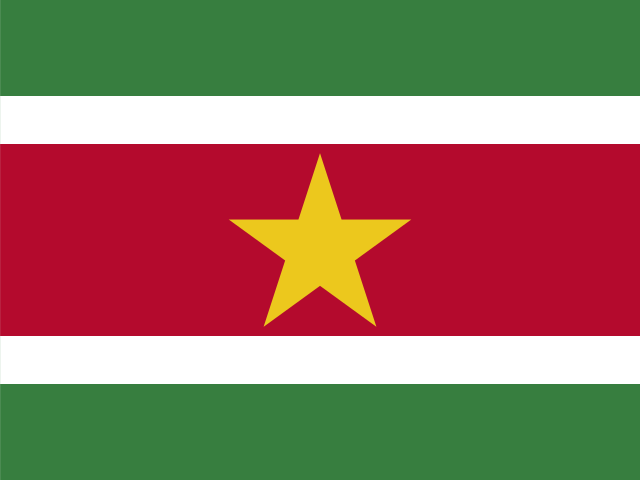
- Description: five horizontal bands of green (top, double-width), white, red (quadruple-width), white, and green (double-width); a five-pointed yellow star is centered on the red bandMeaning: red stands for progress and love, green for hope and fertility, and white for peace, justice, and freedom; the star represents the unity of ethnic groups
- National symbols
- royal palm, faya lobi (flower)
- National colours
- green, white, red, yellow
- National anthem
- Title: "God zij met ons Suriname!" (God Be With Our Suriname)Lyrics/music: Cornelis Atses HOEKSTRA and Henry DE ZIEL/Johannes Corstianus DE PUYHistory: adopted 1959; originally adapted from a Sunday-school song written in 1893; contains lyrics in both Dutch and Sranang Tongo
- UNESCO World Heritage Sites
- Total World Heritage Sites: 3 (2 cultural, 1 natural)Selected World Heritage Site locales: Central Suriname Nature Reserve (n); Historic Inner City of Paramaribo (c); Jodensavanne Archaeological Site: Jodensavanne Settlement and Cassipora Creek Cemetery (c)
Economy
- Overview
- upper middle-income South American economy; new floating currency regime; key aluminum goods, gold, and hydrocarbon exporter; new IMF plan for economic recovery and fiscal sustainability; controversial hardwood industry
- GDP (PPP)
- $12.316 billion (2024 est.)
- GDP per person (PPP)
- $19,400 (2024 est.)
- GDP growth
- 2.8% (2024 est.)
- Inflation
- 16.2% (2024 est.)
- Unemployment
- 7.4% (2024 est.)
- Farm products
- rice, sugarcane, oranges, vegetables, chicken, cassava, plantains, pineapples, eggs, citrus fruits (2023)
- Industries
- gold mining, oil, lumber, food processing, fishing
- Exports
- $2.793 billion (2024 est.)
- Main exports
- gold, fish, refined petroleum, wood, tobacco (2023)
- Export partners
- Switzerland 49%, UAE 28%, Guyana 5%, USA 4%, France 3% (2023)
- Main imports
- refined petroleum, ships, excavation machinery, trucks, tobacco (2023)
- Import partners
- USA 22%, China 12%, Netherlands 11%, Trinidad & Tobago 9%, Guyana 8% (2023)
- Money sent home from abroad
- 3.4% of GDP (2024 est.)
Energy, internet and transport
- Electricity access
- Electrification - total population: 99% (2022 est.)Electrification - urban areas: 100%Electrification - rural areas: 98%
- Electricity sources
- Fossil fuels: 57.1% of total installed capacity (2023 est.)Solar: 0.6% of total installed capacity (2023 est.)Hydroelectricity: 42% of total installed capacity (2023 est.)Biomass and waste: 0.3% of total installed capacity (2023 est.)
- Internet users
- Percent of population: 78% (2023 est.)
- Mobile phones
- Total subscriptions: 902,000 (2024 est.)Subscriptions per 100 inhabitants: 142 (2024 est.)
- TV and radio
- 2 state-owned TV stations; 1 state-owned radio station; multiple private radio and TV stations (2019)
- Airports
- 55 (2025)
- Merchant ships
- Total: 13 (2023)By type: general cargo 5, oil tanker 3, other 5
Military and space
- Armed forces
- Suriname National Army (Nationaal Leger or NL); Army (Landmacht), Navy (Marine); Air Force (Luchtmacht), Military Police (Korps Militaire Politie)Ministry of Justice and Police: Suriname Police Force (Korps Politie Suriname or KPS) (2026)
- Military spending
- 1.2% of GDP (2019 est.)
- Military service
- 18-28 years of age for voluntary military service for men and women; no conscription (2025)
Global issues
- Refugees and displaced people
- Refugees: 3,241 (2024 est.)
Neighbouring countries
- Phone code
- +597
- Internet domain
- .sr