Brazil
Federative Republic of Brazil · Brasil
Portugal's largest colony; it received more enslaved Africans than any other country. Independent as an empire in 1822, a republic since 1889. Hosted COP30 in Belém in 2025.
See Brazil on the 3D globeTake a quiz
Population213 million
Area8,515,767 km²
CapitalBrasília
RegionSouth America
Did you know?
- Has won the most men's World Cups (5)
- Contains about 60% of the Amazon rainforest
- The world's largest coffee producer for over 150 years
Key facts about Brazil
- Government
- Federal presidential republic
- Religion
- Catholic ~50%, Evangelical ~31%
- Founded / independence
- 1822 (from Portugal)
- Rich in
- Soy, coffee, beef, iron ore, oil, Amazon rainforest, aircraft (Embraer)
- Languages
- Portuguese
Portuguese (Brazilian: Carioca, Paulista, Nordestino accents); about 270 Indigenous languages - Currency
- Brazilian real (R$)
- People are called
- Brazilian
- Main cities
- São Paulo, Rio de Janeiro, Brasília, Salvador, Fortaleza, Belo Horizonte
Timeline of Brazil
- 1500Portuguese arrive
- 1822Independence
- 1888Slavery abolished
- 1889Republic
- 1960Brasília becomes capital
- 1985Democracy returns
- 2025Hosts COP30
Places to see in Brazil
- Christ the Redeemer
- Iguazú Falls
- Amazon rainforest
- Copacabana
- Pantanal
- Salvador's Pelourinho
- Brasília's architecture
Food and drink
Feijoada · pão de queijo · churrasco · açaí · brigadeiro
Culture and famous for
Carnival; samba and bossa nova; capoeira
Popular sports
Football (5 World Cups; Pelé), volleyball, Formula 1
Geography and climate
- Highest point
- Pico da Neblina, 2,995 m
- Rivers, lakes and seas
- Amazon (largest river by volume), Paraná, São Francisco
- Climate
- Tropical
- Coastline
- Has a sea coast
- Population density
- 25 people per km²
Wars and conflicts
- Paraguayan War 1864–70
- WWII (sent troops)
- military dictatorship 1964–85
Alliances and memberships
Military and security
Political unions and regional organisations
BRICSCELACOrganization of American States
Economy and trade
Brazil in depth
Detailed facts from the CIA World Factbook (public domain, latest edition).
Overview
- History in brief
- After more than three centuries under Portuguese rule, Brazil gained its independence in 1822, maintaining a monarchical system of government until the abolition of slavery in 1888 and the subsequent proclamation of a republic by the military in 1889. Brazilian coffee exporters politically dominated the country until populist leader Getúlio VARGAS rose to power in 1930. VARGAS governed through various versions of democratic and authoritarian regimes from 1930 to 1945. Democratic rule returned in 1945 -- including a democratically elected VARGAS administration from 1951 to 1954 -- and lasted until 1964, when the military overthrew President João GOULART. The military regime censored journalists and repressed and tortured dissidents in the late 1960s and early 1970s. The dictatorship lasted until 1985, when the military regime peacefully ceded power to civilian rulers, and the Brazilian Congress passed its current constitution in 1988.By far the largest and most populous country in South America, Brazil continues to pursue industrial and agricultural growth and development of its interior. Having successfully weathered a period of global financial difficulty in the late 20th century, Brazil was soon seen as one of the world's strongest emerging markets and a contributor to global growth under President Luiz Inácio LULA da Silva (2003-2010). The awarding of the 2014 FIFA World Cup and 2016 Summer Olympic Games -- the first ever to be held in South America -- to Brazil was symbolic of the country's rise. However, from about 2013 to 2016, Brazil was plagued by a sagging economy, high unemployment, and high inflation, only emerging from recession in 2017. Congress removed then-President Dilma ROUSSEFF (2011-2016) from office in 2016 for having committed impeachable acts against Brazil's budgetary laws, and her vice president, Michel TEMER, served the remainder of her second term. A money-laundering investigation, Operation Lava Jato, uncovered a vast corruption scheme and prosecutors charged several high-profile Brazilian politicians with crimes. Former President LULA was convicted of accepting bribes and served jail time (2018-19), although his conviction was overturned in 2021. LULA's revival became complete in 2022 when he narrowly defeated incumbent Jair BOLSONARO (2019-2022) in the presidential election. Positioning Brazil as an independent global leader on climate change and promoting sustainable development, LULA took on the 2024 G20 presidency, balancin
Geography
- Location
- Eastern South America, bordering the Atlantic Ocean
- Size compared
- slightly smaller than the US
- Land borders
- Total: 16,145 kmBorder countries: Argentina 1,263 km; Bolivia 3,403 km; Colombia 1,790 km; French Guiana 649 km; Guyana 1,308 km; Paraguay 1,371 km; Peru 2,659 km; Suriname 515 km; Uruguay 1,050 km; Venezuela 2,137 km
- Coastline
- 7,491 km
- Climate
- mostly tropical, but temperate in south
- Terrain
- mostly flat to rolling lowlands in north; some plains, hills, mountains, and narrow coastal belt
- Elevation
- Highest point: Pico da Neblina 2,994 mLowest point: Atlantic Ocean 0 mMean elevation: 320 m
- Natural resources
- alumina, bauxite, beryllium, gold, iron ore, manganese, nickel, niobium, phosphates, platinum, tantalum, tin, rare earth elements, uranium, petroleum, hydropower, timber
- Major rivers
- Amazon river mouth (shared with Peru [s]) - 6,400 km; Río de la Plata/Paraná river source (shared with Paraguay, Argentina, and Uruguay [m]) - 4,880 km; Tocantins - 3,650 km; São Francisco - 3,180 km; Paraguay river source (shared with Argentina and Paraguay [m]) - 2,549 km; Rio Negro river mouth (shared with Colombia [s] and Venezuela) - 2,250 km; Uruguay river source (shared with Argentina and Uruguay [m]) - 1,610 kmNote: [s] after country name indicates river source; [m] after country name indicates river mouth
- Major lakes
- Fresh water lake(s): Lagoa dos Patos - 10,140 sq kmSalt water lake(s): Lagoa Mirim (shared with Uruguay) - 2,970 sq km
- Natural hazards
- recurring droughts in northeast; floods and occasional frost in south
- Notes
- Note 1: largest country in South America and in the Southern Hemisphere; shares common boundaries with every South American country except Chile and Ecuador; most of the Pantanal, the world's largest tropical wetland, extends through the west central part of the country; shares Iguaçu Falls (Iguazú Falls), the world's largest waterfalls system, with ArgentinaNote 2: Rocas Atoll, located off the northeast coast of Brazil, is the only atoll in the South Atlantic
- Environmental issues
- deforestation in Amazon Basin; illegal wildlife trade; illegal poaching; air and water pollution in Rio de Janeiro, Sao Paulo, and other large cities; land degradation and water pollution from mining; wetland degradation; oil spills
People and society
- Population
- Total: 221,359,387 (2025 est.)Male: 108,753,532Female: 112,605,855
- Nationality
- Noun: Brazilian(s)Adjective: Brazilian
- Ethnic groups
- mixed 45.3%, White 43.5%, Black 10.2%, Indigenous 0.6%, Asian 0.4% (2022 est.)
- Languages
- Portuguese (official and most widely spoken language); less common languages include Spanish (border areas and schools), German, Italian, Japanese, English, and many minor Amerindian languagesMajor-language sample(s): O Livro de Fatos Mundiais, a fonte indispensável para informação básica. (Brazilian Portuguese)The World Factbook, the indispensable source for basic information.
- Religions
- Roman Catholic 56.8%, Evangelical 26.9%, none 9.3%, other 4%, Spirtism (Espírita) 1.8%, unspecified 1.4%, Umbanda and Candomblé 1.1%, Indigenous religions .06%, undeclared 0.2% (2022)
- Median age
- Total: 35.4 years (2025 est.)Male: 34 yearsFemale: 36.1 years
- Population growth
- 0.58% (2025 est.)
- Life expectancy
- Total population: 76.3 years (2024 est.)Male: 72.6 yearsFemale: 80.1 years
- Children per woman
- 1.73 children born/woman (2025 est.)
- Urbanization
- Urban population: 87.8% of total population (2023)Rate of urbanization: 0.87% annual rate of change (2020-25 est.)
- Largest cities
- 22.620 million São Paulo, 13.728 million Rio de Janeiro, 6.248 million Belo Horizonte, 4.873 million BRASÍLIA (capital), 4.264 million Recife, 4.212 million Porto Alegre (2023)
- Literacy
- Total population: 94.8% (2024 est.)Male: 94.5% (2024 est.)Female: 95.1% (2024 est.)
- Years in school
- Total: 16 years (2022 est.)Male: 15 years (2022 est.)Female: 17 years (2022 est.)
Government
- Official names
- Conventional long form: Federative Republic of BrazilConventional short form: BrazilLocal long form: República Federativa do BrasilLocal short form: BrasilEtymology: the country name derives from the brazil tree that used to grow plentifully along the coast of Brazil and that was used to produce a deep red dye
- Government type
- federal presidential republic
- Capital
- Name: BrasíliaGeographic coordinates: 15 47 S, 47 55 WTime difference: UTC-3 (2 hours ahead of Washington, DC, during Standard Time)Time zone note: Brazil has four time zones, including one for the Fernando de Noronha IslandsEtymology: the name is the Latinized form of the country name, bestowed on the new capital of Brazil in 1960; previous Brazilian capitals were Salvador (1549-1763) and Rio de Janeiro (1763 to 1960)
- Regions
- 26 states (estados, singular - estado) and 1 federal district* (distrito federal); Acre, Alagoas, Amapa, Amazonas, Bahia, Ceara, Distrito Federal*, Espirito Santo, Goias, Maranhao, Mato Grosso, Mato Grosso do Sul, Minas Gerais, Para, Paraiba, Parana, Pernambuco, Piaui, Rio de Janeiro, Rio Grande do Norte, Rio Grande do Sul, Rondônia, Roraima, Santa Catarina, São Paulo, Sergipe, Tocantins
- Independence
- 7 September 1822 (from Portugal)
- National holiday
- Independence Day, 7 September (1822)
- Constitution
- History: several previous; latest ratified 5 October 1988Amendment process: proposed by at least one third of either house of the National Congress, by the president of the republic, or by simple majority vote by more than half of the state legislative assemblies; passage requires at least three-fifths majority vote by both houses in each of two readings; constitutional provisions affecting the federal form of government, separation of powers, suffrage, or individual rights and guarantees cannot be amended
- Legal system
- civil law
- Voting age
- voluntary between 16 to 18 years of age, over 70, and if illiterate; compulsory between 18 to 70 years of age
- Flag meaning
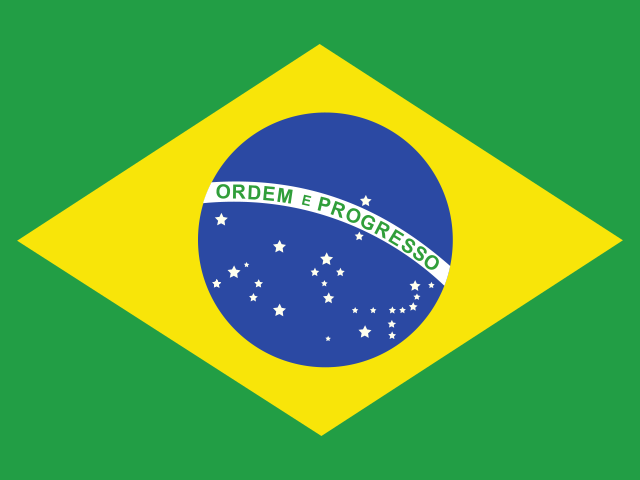
- Description: green with a large yellow diamond in the center, showing a blue celestial globe with 27 five-pointed white stars; the globe has a white equatorial band with the motto ORDEM E PROGRESSO (Order and Progress)Meaning: green stands for the country's forests, and yellow for its mineral wealth, with the diamond representing the country's shape; the blue globe and stars depict the sky over Rio de Janeiro on the morning of 15 November 1889, the day the Republic of Brazil was declared; the number of stars has risen with the creation of new states, from 21 to 27 (one for each state and the Federal District)History: the flag was inspired by the former Empire of Brazil's flag (1822-1889)
- National symbols
- Southern Cross constellation
- National colours
- green, yellow, blue
- National anthem
- Title: "Hino Nacional Brasileiro" (Brazilian National Anthem)Lyrics/music: Joaquim Osorio Duque ESTRADA/Francisco Manoel DA SILVAHistory: music adopted 1890, lyrics adopted 1922; the anthem's music, composed in 1822, was used unofficially for many years
- UNESCO World Heritage Sites
- Total World Heritage Sites: 24 (15 cultural, 9 natural, 1 mixed)Selected World Heritage Site locales: Brasilia (c); Historic Salvador de Bahia (c); Historic Ouro Preto (c); Historic Center of the Town of Olinda (c); Iguaçu National Park (n); Jesuit Missions of the Guaranis (c); Rio de Janeiro: Carioca Landscapes (c); Central Amazon Conservation Complex (n); Atlantic Forest South-East Reserves (n); Historic Center of Salvador de Bahia (c); Sanctuary of Bom Jesus do Congonhas (c ); Brasilia (c ); Serra da Capivara National Park (c ); Historic Center of Sao Luis( c); Discovery Coast Atlantic Forest Reserves (n); Historic Center of the Town of Diamantina (c ); Pantanal Conservation Area (n); Brazilian Atlantic Islands: Fernando de Noronha and Atol das Rocas Reserves (n); Cerrado Protected Areas: Chapada dos Veadeiros and Emas National Parks (n); Historic Centre of the Town of Goiás (c); São Francisco Square in the Town of São Cristóvão (c ); Rio de Janeiro: Carioca Landscapes between the Mountain and the Sea (c ); Pampulha Modern Ensemble (c ); Valongo Wharf Archaeological Site (c ); Paraty and Ilha Grande – Culture and Biodiversity (m); Sítio Roberto Burle Marx (c ); Lençóis Maranhenses National Park (n);Peruaçu River Canyon (n)
Economy
- Overview
- upper-middle-income, largest Latin American economy; Mercosur, BRICS, G20 member and OECD accession candidate; growth driven by strong domestic consumption; monetary tightening helping curb inflation rate; high inequality in income and access to health and education
- GDP (PPP)
- $4.165 trillion (2024 est.)
- GDP per person (PPP)
- $19,600 (2024 est.)
- GDP growth
- 3.4% (2024 est.)
- Inflation
- 4.4% (2024 est.)
- Unemployment
- 7.7% (2024 est.)
- Below poverty line
- 4.2% (2016 est.)
- Farm products
- sugarcane, soybeans, maize, milk, cassava, oranges, chicken, beef, rice, wheat (2023)
- Industries
- textiles, shoes, chemicals, cement, lumber, iron ore, tin, steel, aircraft, motor vehicles and parts, other machinery and equipment
- Exports
- $388.333 billion (2024 est.)
- Main exports
- soybeans, crude petroleum, iron ore, raw sugar, corn (2023)
- Export partners
- China 30%, USA 10%, Argentina 5%, Netherlands 3%, Chile 2% (2023)
- Main imports
- refined petroleum, fertilizers, crude petroleum, vehicle parts/accessories, gas turbines (2023)
- Import partners
- China 23%, USA 16%, Germany 5%, Argentina 5%, Russia 4% (2023)
- Money sent home from abroad
- 0.2% of GDP (2024 est.)
Energy, internet and transport
- Electricity access
- Electrification - total population: 100% (2022 est.)Electrification - urban areas: 100%Electrification - rural areas: 97.3%
- Electricity sources
- Fossil fuels: 8.9% of total installed capacity (2023 est.)Nuclear: 2.1% of total installed capacity (2023 est.)Solar: 6.9% of total installed capacity (2023 est.)Wind: 13.5% of total installed capacity (2023 est.)Hydroelectricity: 60.2% of total installed capacity (2023 est.)Biomass and waste: 8.3% of total installed capacity (2023 est.)
- Internet users
- Percent of population: 84% (2023 est.)
- Mobile phones
- Total subscriptions: 216 million (2024 est.)Subscriptions per 100 inhabitants: 102 (2024 est.)
- TV and radio
- state-run Radiobras operates a radio and a TV network; more than 1,000 radio stations and more than 100 TV channels operating, mostly privately owned; private media ownership highly concentrated (2022)
- Airports
- 5,297 (2025)
- Railways
- Total: 29,849.9 km (2014)Standard gauge: 194 km (2014) 1.435-m gaugeNarrow gauge: 23,341.6 km (2014) 1.000-m gauge (24 km electrified)Broad gauge: 5,822.3 km (2014) 1.600-m gauge (498.3 km electrified)Dual gauge: 492 km (2014) 1.600-1.000-m gauge
- Merchant ships
- Total: 888 (2023)By type: bulk carrier 13, container ship 20, general cargo 38, oil tanker 27, other 790
Military and space
- Armed forces
- Brazilian Armed Forces (Forças Armadas Brasileiras): Brazilian Army (Exercito Brasileiro, EB), Brazilian Navy (Marinha do Brasil; includes Naval Aviation (Aviacao Naval Brasileira) and Marine Corps (Corpo de Fuzileiros Navais)), Brazilian Air Force (Forca Aerea Brasileira) (2025)
- Military spending
- 1.1% of GDP (2024 est.)
- Military service
- 18-45 years of age for compulsory military service for men (only 5-10% of those inducted are required to serve); compulsory service obligation is generally 12 months; 17-45 (18 for women) years of age for voluntary service (2025)
- Space programme
- develops, builds, operates, and tracks satellites, including communications, remote sensing (RS), multi-mission, navigational, and scientific/testing/research; satellites are launched by foreign partners, but Brazil has a long-standing sounding (research) rocket and satellite launch vehicle (SLV) program and rocket launch facilities; cooperates with a variety of foreign space agencies and commercial entities, including those of Argentina, Canada, the ESA, individual ESA member states (particularly France and Germany), India, Japan, Russia, South Africa, South Korea, Ukraine, and the US; has a state-controlled communications company that operates Brazil’s communications satellites and a growing commercial space sector (2025)
- Space milestones
- 1960s - established a national space program under the Air Force1984 - began satellite launch vehicle (SLV) program (Veículo Lançador de Satélites or VLS-1)1985 - first communications satellite jointly produced with Canada and launched on European SLV1993 - first domestically built experimental communications satellite (Satélite de Coleta de Dados, SCD-1) launched by US2004 - launched a sounding rocket into sub-orbital space, but the subsequent catastrophic failure of a VLS-1 during a test launch led to scaling back the program2006 - first Brazilian astronaut to the International Space Station on a Russian rocket2008 - began work on a 3-stage microsatellite launch vehicle (Veículo Lançador de Microssatélite or VLM-1) in partnership with Germany2021 - first independently produced remote sensing (RS) satellite (Amazonia-1) launched by India; signed US-led Artemis Accords on space exploration cooperation and signed cooperation agreements with the space agencies of China, India, Russia, and South Africa for the joint development of an RS satellite constellation2022 - successfully launched suborbital rocket more than 225 km (140 miles) in height
Global issues
- Refugees and displaced people
- Refugees: 331,097 (2024 est.)IDPs: 19,043 (2024 est.)Stateless persons: 27 (2024 est.)
- Drug trade
- USG identification: major precursor-chemical producer (2025)
Neighbouring countries
ArgentinaBoliviaColombiaGuyanaParaguayPeruSurinameUruguayVenezuela
- Phone code
- +55
- Internet domain
- .br