Guyana
Co-operative Republic of Guyana
Dutch then British colony; the only English-speaking country in South America. Huge offshore oil finds since 2015.
See Guyana on the 3D globeTake a quiz
Population830 thousand
Area214,969 km²
CapitalGeorgetown
RegionSouth America
Did you know?
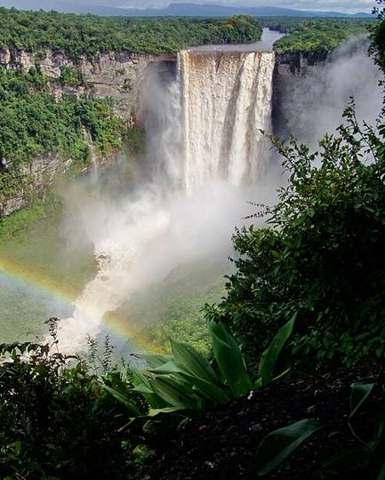
- Kaieteur Falls is one of the world's most powerful single-drop waterfalls
- About 85% forest
- Its economy grew fastest in the world after oil finds
Key facts about Guyana
- Government
- Presidential republic
- Religion
- Christian ~63%, Hindu ~25%, Islam ~7%
- Founded / independence
- 1966 (from UK)
- Rich in
- Oil (fastest-growing economy since 2020), gold, bauxite, rice
- Languages
- English
English; Guyanese Creole, Hindi, Indigenous languages - Currency
- Guyanese dollar ($)
- People are called
- Guyanese
- Main cities
- Georgetown, Linden, New Amsterdam
Timeline of Guyana
- 1616Dutch settlements
- 1814British rule
- 1966Independence
- 2015Oil discovered
Places to see in Guyana
- Kaieteur Falls
- Iwokrama rainforest
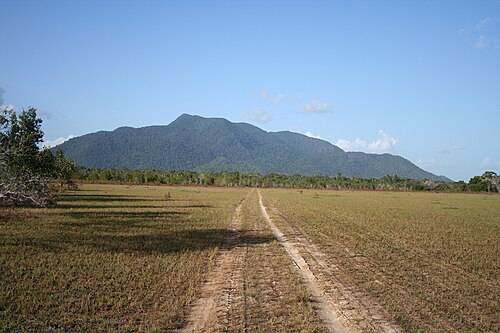
- Rupununi savannah
- Georgetown's St George's Cathedral
Food and drink
Pepperpot · cook-up rice · roti
Culture and famous for
Mashramani festival
Popular sports
Cricket
Geography and climate
- Highest point
- Mount Roraima, 2,810 m
- Rivers, lakes and seas
- Essequibo, Demerara
- Climate
- Tropical
- Coastline
- Has a sea coast
- Population density
- 4 people per km²
Wars and conflicts
- Venezuelan claim to Essequibo
Alliances and memberships
Political unions and regional organisations
Organisation of Islamic CooperationCARICOMCELACOrganization of American StatesCommonwealth of Nations
Guyana in depth
Detailed facts from the CIA World Factbook (public domain, latest edition).
Overview
- History in brief
- Originally a Dutch colony in the 17th century, by 1815 Guyana had become a British possession. The abolition of slavery led to former slaves settling urban areas and indentured servants being imported from India to work the sugar plantations. The resulting ethnocultural divide has persisted and has led to turbulent politics. Guyana achieved independence from the UK in 1966, and since then primarily socialist-oriented governments have ruled the country.In 1992, Cheddi JAGAN was elected president in what is considered the country's first free and fair election since independence. After his death five years later, his wife, Janet JAGAN, became president but resigned in 1999 due to poor health. Her successor, Bharrat JAGDEO, was elected in 2001 and again in 2006. Donald RAMOTAR won in 2011, but early elections held in 2015 resulted in the first change in governing party, and David GRANGER took office. After a 2018 no-confidence vote against the GRANGER government, the administration ignored a constitutional requirement to hold elections and remained in place until the 2020 elections, when Irfaan ALI became president.The discovery of massive offshore oil reserves in 2015 has been Guyana's primary economic and political focus, with many hoping the reserves will transform one of the poorest countries in the region. Guyana is the only English-speaking country in South America and shares cultural and historical bonds with the Anglophone Caribbean.
Geography
- Location
- Northern South America, bordering the North Atlantic Ocean, between Suriname and Venezuela
- Size compared
- slightly smaller than Idaho; almost twice the size of Tennessee
- Land borders
- Total: 2,933 kmBorder countries: Brazil 1,308 km; Suriname 836 km; Venezuela 789 km
- Coastline
- 459 km
- Climate
- tropical; hot, humid, moderated by northeast trade winds; two rainy seasons (May to August, November to January)
- Terrain
- mostly rolling highlands; low coastal plain; savanna in south
- Elevation
- Highest point: Laberintos del Norte on Mount Roraima 2,775 mLowest point: Atlantic Ocean 0 mMean elevation: 207 m
- Natural resources
- bauxite, gold, diamonds, hardwood timber, shrimp, fish
- Natural hazards
- flash flood threat during rainy seasons
- Notes
- the third-smallest country in South America after Suriname and Uruguay; contains some of the largest unspoiled rainforests on the continent
- Environmental issues
- water pollution from sewage and agricultural/industrial chemicals; deforestation
People and society
- Population
- Total: 794,099 (2024 est.)Male: 405,244Female: 388,855
- Nationality
- Noun: Guyanese (singular and plural)Adjective: Guyanese
- Ethnic groups
- East Indian 39.8%, African descent 29.3%, mixed 19.9%, Indigenous 10.5%, other 0.5% (includes Portuguese, Chinese, White) (2012 est.)
- Languages
- English (official), Guyanese Creole, Amerindian languages (including Caribbean and Arawak languages), Indian languages (including Caribbean Hindustani, a dialect of Hindi), Chinese (2014 est.)
- Religions
- Protestant 34.8% (Pentecostal 22.8%, Seventh Day Adventist 5.4%, Anglican 5.2%, Methodist 1.4%), Hindu 24.8%, other Christian 20.8%, Roman Catholic 7.1%, Muslim 6.8%, Jehovah's Witness 1.3%, Rastafarian 0.5%, other 0.9%, none 3.1% (2012 est.)
- Median age
- Total: 28.7 years (2025 est.)Male: 28.2 yearsFemale: 28.4 years
- Population growth
- 0.35% (2025 est.)
- Life expectancy
- Total population: 72.4 years (2024 est.)Male: 70.6 yearsFemale: 74.3 years
- Children per woman
- 2.04 children born/woman (2025 est.)
- Urbanization
- Urban population: 27.2% of total population (2023)Rate of urbanization: 1.01% annual rate of change (2020-25 est.)
- Largest cities
- 110,000 GEORGETOWN (capital) (2018)
- Literacy
- Total population: 85.6% (2020 est.)Male: 84.2% (2020 est.)Female: 86.9% (2020 est.)
Government
- Official names
- Conventional long form: Cooperative Republic of GuyanaConventional short form: GuyanaFormer: British GuianaEtymology: the name is derived from Guiana, the original name for the region that included British Guiana, Dutch Guiana, and French Guiana; the name Guiana may be derived from a local term meaning "Land of Water" (referring to the area's multitude of rivers and streams)
- Government type
- parliamentary republic
- Capital
- Name: GeorgetownGeographic coordinates: 6 48 N, 58 09 WTime difference: UTC-4 (1 hour ahead of Washington, DC, during Standard Time)Etymology: the British founded the town in 1781 and named it in honor of King GEORGE III (1738-1820)
- Regions
- 10 regions; Barima-Waini, Cuyuni-Mazaruni, Demerara-Mahaica, East Berbice-Corentyne, Essequibo Islands-West Demerara, Mahaica-Berbice, Pomeroon-Supenaam, Potaro-Siparuni, Upper Demerara-Berbice, Upper Takutu-Upper Essequibo
- Independence
- 26 May 1966 (from the UK)
- National holiday
- Republic Day, 23 February (1970)
- Constitution
- History: several previous; latest promulgated 6 October 1980Amendment process: proposed by the National Assembly; passage of amendments affecting constitutional articles, such as national sovereignty, government structure and powers, and constitutional amendment procedures, requires approval by the Assembly membership, approval in a referendum, and assent of the president; other amendments only require Assembly approval
- Legal system
- common law system, based on the English model, with some Roman-Dutch civil law influence
- Voting age
- 18 years of age; universal
- Flag meaning
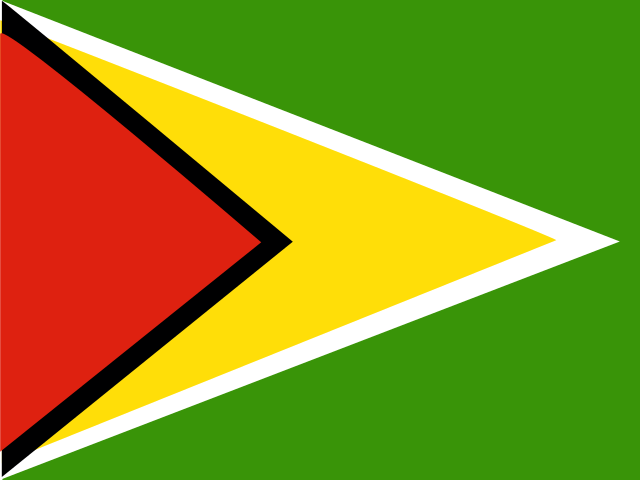
- Description: green with a red isosceles triangle (based on the left side) on top of a long yellow arrowhead shape that extends to the opposite side of the flag; a narrow black border sits between the red and yellow, and a narrow white border between the yellow and greenMeaning: green stands for forest and foliage, yellow for mineral resources and a bright future, white for the rivers, red for zeal and the people's sacrifice, and black for perseverance
- National symbols
- Canje pheasant (hoatzin), jaguar, Victoria Regia water lily
- National colours
- red, yellow, green, black, white
- National anthem
- Title: "Dear Land of Guyana, of Rivers and Plains"Lyrics/music: Archibald Leonard LUKERL/Robert Cyril Gladstone POTTERHistory: adopted 1966
Economy
- Overview
- small, hydrocarbon-driven South American export economy; major forest coverage being leveraged in carbon credit offsets to encourage preservation; strengthening financial sector; large bauxite and gold resources
- GDP (PPP)
- $58.423 billion (2024 est.)
- GDP per person (PPP)
- $70,300 (2024 est.)
- GDP growth
- 43.4% (2024 est.)
- Inflation
- 2.9% (2024 est.)
- Unemployment
- 10.2% (2024 est.)
- Farm products
- rice, sugarcane, plantains, cassava, papayas, pumpkins/squash, chicken, milk, ginger, eggplants (2023)
- Industries
- bauxite, sugar, rice milling, timber, textiles, gold mining
- Exports
- $13.739 billion (2023 est.)
- Main exports
- crude petroleum, railway cargo containers, gold, ships, rice (2023)
- Export partners
- USA 20%, Trinidad & Tobago 11%, Netherlands 10%, Singapore 10%, Germany 7% (2023)
- Main imports
- refined petroleum, ships, construction vehicles, excavation machinery, cars (2023)
- Import partners
- USA 28%, China 13%, Trinidad & Tobago 11%, Brazil 5%, Bahamas, The 4% (2023)
- Money sent home from abroad
- 3.2% of GDP (2023 est.)
Energy, internet and transport
- Electricity access
- Electrification - total population: 93% (2022 est.)Electrification - urban areas: 98%Electrification - rural areas: 91.6%
- Electricity sources
- Fossil fuels: 92.9% of total installed capacity (2023 est.)Solar: 1.3% of total installed capacity (2023 est.)Hydroelectricity: 0.3% of total installed capacity (2023 est.)Biomass and waste: 5.4% of total installed capacity (2023 est.)
- Internet users
- Percent of population: 82% (2023 est.)
- Mobile phones
- Total subscriptions: 856,000 (2021 est.)Subscriptions per 100 inhabitants: 106 (2021 est.)
- TV and radio
- government-dominated broadcast media; the National Communications Network (NCN) TV is state-owned; a few private TV stations relay satellite services; the state owns and operates 2 radio stations broadcasting on multiple frequencies; government limits on licensing of new private radio stations has constrained competition
- Airports
- 55 (2025)
- Merchant ships
- Total: 80 (2023)By type: general cargo 45, oil tanker 10, other 25
Military and space
- Armed forces
- the Guyana Defense Force (GDF) is a unified force with ground, air, and coast guard components, as well as the Guyana National Reserve (2026)
- Military spending
- 0.9% of GDP (2024 est.)
- Military service
- 18 years of age or older for voluntary military service; no conscription (2026)
Global issues
- Refugees and displaced people
- Refugees: 79 (2024 est.)
Neighbouring countries
- Phone code
- +592
- Internet domain
- .gy