Sweden
Kingdom of Sweden · Sverige
A great power in the 17th century controlling much of the Baltic. Has not fought a war since 1814. Joined NATO in 2024 after Russia's invasion of Ukraine.
See Sweden on the 3D globeTake a quiz

Population10.6 million
Area450,295 km²
CapitalStockholm
RegionNorthern Europe
Did you know?
- Has a law giving everyone the right to roam in nature
- About 97,500 lakes
- The Nobel Prizes are awarded in Stockholm
Key facts about Sweden
- Government
- Parliamentary constitutional monarchy
- Religion
- Church of Sweden ~52%, many unaffiliated
- Founded / independence
- c. 1000; Vasa kingdom 1523
- Rich in
- Iron ore, timber, cars, telecom (Ericsson), music and gaming
- Languages
- Swedish
Swedish with many dialects (Scanian, Gotlandic, Dalecarlian); Finnish, Sámi, Meänkieli - Currency
- Swedish krona (kr)
- People are called
- Swedish
- Main cities
- Stockholm, Gothenburg, Malmö, Uppsala
Timeline of Sweden
- 1523Gustav Vasa king
- 1611Great power era
- 1809Loses Finland
- 1814Last war
- 1905Norway leaves union
- 1995Joins EU
- 2024Joins NATO
Places to see in Sweden
- Stockholm's Gamla Stan
- Vasa Museum
- Icehotel
- Drottningholm Palace
- Gothenburg archipelago
Food and drink
Meatballs · gravlax · cinnamon buns · surströmming
Culture and famous for
IKEA; ABBA; Volvo; Spotify; Nobel Prizes; Astrid Lindgren
Popular sports
Ice hockey, football, skiing
Geography and climate
- Highest point
- Kebnekaise, about 2,100 m
- Rivers, lakes and seas
- Göta älv; Vänern (EU's largest lake)
- Climate
- Temperate south, subarctic north
- Coastline
- Has a sea coast
- Population density
- 24 people per km²
Wars and conflicts
- Thirty Years' War
- Great Northern War
- neutral since 1814
Empires and states that once stood here
Alliances and memberships
Military and security
Political unions and regional organisations
European UnionCouncil of EuropeNordic Council
Economy and trade
Sweden in depth
Detailed facts from the CIA World Factbook (public domain, latest edition).
Overview
- History in brief
- A military power during the 17th century, Sweden maintained a policy of military non-alignment until it applied to join NATO in 2022. Sweden has not participated in any war for two centuries. Stockholm preserved an armed neutrality in both World Wars. Since then, Sweden has pursued a successful economic formula consisting of a capitalist system intermixed with substantial welfare elements. Sweden joined the EU in 1995, but the public rejected the introduction of the euro in a 2003 referendum. The share of Sweden’s population born abroad increased from 11.3% in 2000 to 20% in 2022.
Geography
- Location
- Northern Europe, bordering the Baltic Sea, Gulf of Bothnia, Kattegat, and Skagerrak, between Finland and Norway
- Size compared
- almost three times the size of Georgia; slightly larger than California
- Land borders
- Total: 2,211 kmBorder countries: Finland 545 km; Norway 1,666 km
- Coastline
- 3,218 km
- Climate
- temperate in south with cold, cloudy winters and cool, partly cloudy summers; subarctic in north
- Terrain
- mostly flat or gently rolling lowlands; mountains in west
- Elevation
- Highest point: Kebnekaise South 2,100 mLowest point: reclaimed bay of Lake Hammarsjon, near Kristianstad -2.4 mMean elevation: 320 m
- Natural resources
- iron ore, copper, lead, zinc, gold, silver, tungsten, uranium, arsenic, feldspar, timber, hydropower
- Major lakes
- Fresh water lake(s): Vanern - 5,580 sq km; Vattern - 1,910 sq km; Malaren - 1,140 sq km
- Natural hazards
- ice floes in the surrounding waters, especially in the Gulf of Bothnia, can interfere with maritime traffic
- Notes
- strategic location along Danish Straits linking Baltic and North Seas; Sweden has almost 100,000 lakes, the largest of which, Vanern, is the third-largest in Europe
- Environmental issues
- marine pollution (Baltic Sea and North Sea); acid rain damage to soil and lakes; air pollution; poor timber-harvesting practices
People and society
- Population
- Total: 10,643,745 (2025 est.)Male: 5,360,755Female: 5,282,990
- Nationality
- Noun: Swede(s)Adjective: Swedish
- Ethnic groups
- Swedish 79.6%, Syrian 1.9%, Iraqi 1.4%, Finnish 1.3%, other 15.8% (2022 est.)
- Languages
- Swedish (official)Major-language sample(s): The World Factbook, den obestridliga källan för grundläggande information. (Swedish)The World Factbook, the indispensable source for basic information.
- Religions
- Church of Sweden (Lutheran) 53.9%, other (includes Roman Catholic, Orthodox, Baptist, Muslim, Jewish, and Buddhist) 8.9%, none or unspecified 37.2% (2021 est.)
- Median age
- Total: 41.2 years (2025 est.)Male: 40.1 yearsFemale: 42.1 years
- Population growth
- 0.51% (2025 est.)
- Life expectancy
- Total population: 82.9 years (2024 est.)Male: 81.2 yearsFemale: 84.7 years
- Children per woman
- 1.66 children born/woman (2025 est.)
- Urbanization
- Urban population: 88.7% of total population (2023)Rate of urbanization: 0.89% annual rate of change (2020-25 est.)
- Largest cities
- 1.700 million STOCKHOLM (capital) (2023)
- Years in school
- Total: 19 years (2023 est.)Male: 17 years (2023 est.)Female: 20 years (2023 est.)
Government
- Official names
- Conventional long form: Kingdom of SwedenConventional short form: SwedenLocal long form: Konungariket SverigeLocal short form: SverigeEtymology: name derives from the North Germanic Svea tribe that inhabited central Sweden; the tribe's name probably comes from the Old German word sweba, meaning "independent;" the local form of the country's name, Sverige, means "kingdom of the Svea"
- Government type
- parliamentary constitutional monarchy
- Capital
- Name: StockholmGeographic coordinates: 59 20 N, 18 03 ETime difference: UTC+1 (6 hours ahead of Washington, DC, during Standard Time)Daylight saving time: +1hr, begins last Sunday in March; ends last Sunday in OctoberEtymology: the name of the city probably comes from the Swedish words stak (bay) or stock (stake or pole) and holm (island); it was built in the mid-13th century on the site of a fishing village, so the name may refer to building over earlier foundations
- Regions
- 21 counties (lan, singular and plural); Blekinge, Dalarna, Gavleborg, Gotland, Halland, Jamtland, Jonkoping, Kalmar, Kronoberg, Norrbotten, Orebro, Ostergotland, Skane, Sodermanland, Stockholm, Uppsala, Varmland, Vasterbotten, Vasternorrland, Vastmanland, Vastra Gotaland
- Independence
- 6 June 1523 (Gustav VASA elected king of Sweden, marking the abolishment of the Kalmar Union of Denmark, Norway, and Sweden)
- National holiday
- National Day, 6 June (1983)
- Constitution
- History: Sweden has four fundamental laws which together make up the Constitution: The Instrument of Government (several previous; latest 1974); The Act of Succession (enacted 1810; changed in 1937 and 1980); The Freedom of the Press Act (many previous; latest in 1949); The Fundamental Law on Freedom of Expression (adopted 1991)Amendment process: proposed by Parliament; passage requires simple majority vote in two consecutive parliamentary terms with an intervening general election; passage also requires approval by simple majority vote in a referendum if Parliament approves a motion for a referendum by one third of its members; the results of such a referendum are only binding if a majority vote against the proposal
- Legal system
- civil law system influenced by Roman-Germanic law and customary law
- Voting age
- 18 years of age; universal
- Flag meaning
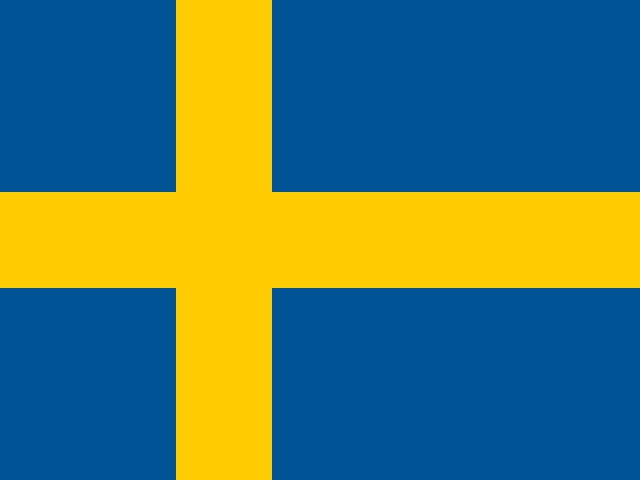
- Description: blue with a golden yellow cross extending to the edges of the flag; the cross is shifted to the left side in the style of the Dannebrog (Danish flag)Meaning: the colors come from the Swedish coat of arms
- National symbols
- three crowns, lion
- National colours
- blue, yellow
- National anthem
- Title: "Kungssangen" (Royal Song)Lyrics/music: Carl Wilhelm August Strandberg/Otto LindbladHistory: adopted 1844 as the royal anthem, but also used as the national anthem until 1893; only the first verse is sung if the monarch is present
- UNESCO World Heritage Sites
- Total World Heritage Sites: 15 (13 cultural, 1 natural, 1 mixed)Selected World Heritage Site locales: Royal Domain of Drottningholm (c); Laponian Area (m); High Coast/Kvarken Archipelago (n); Birka and Hovgården (c); Hanseatic Town of Visby (c); Church Town of Gammelstad, Luleå (c); Naval Port of Karlskrona (c); Rock Carvings in Tanum (c); Engelsberg Ironworks (c); Mining Area of the Great Copper Mountain in Falun (c)
Economy
- Overview
- high-income, largest Nordic economy; EU member but does not use the euro; export-oriented, led by automotive, electronics, machinery, and pharmaceuticals; highly ranked for competitiveness, R&D investments and governance; recovery, with falling inflation and real wage growth balanced by risks from trade uncertainty
- GDP (PPP)
- $668.628 billion (2024 est.)
- GDP per person (PPP)
- $63,300 (2024 est.)
- GDP growth
- 1% (2024 est.)
- Inflation
- 2.8% (2024 est.)
- Unemployment
- 8.6% (2024 est.)
- Below poverty line
- 16.1% (2022 est.)
- Farm products
- milk, wheat, sugar beets, barley, potatoes, oats, rapeseed, pork, chicken, beef (2023)
- Industries
- iron and steel, precision equipment (bearings, radio and telephone parts, armaments), wood pulp and paper products, processed foods, motor vehicles
- Exports
- $338.852 billion (2024 est.)
- Main exports
- cars, refined petroleum, packaged medicine, paper, vehicle parts/accessories (2023)
- Export partners
- Germany 10%, USA 10%, Denmark 8%, Norway 6%, Netherlands 5% (2023)
- Main imports
- cars, crude petroleum, refined petroleum, vehicle parts/accessories, garments (2023)
- Import partners
- Germany 17%, Netherlands 10%, Norway 9%, Denmark 6%, China 6% (2023)
- Money sent home from abroad
- 0.8% of GDP (2024 est.)
Energy, internet and transport
- Electricity access
- Electrification - total population: 100% (2022 est.)
- Electricity sources
- Fossil fuels: 0.5% of total installed capacity (2023 est.)Nuclear: 28.6% of total installed capacity (2023 est.)Solar: 1.9% of total installed capacity (2023 est.)Wind: 21% of total installed capacity (2023 est.)Hydroelectricity: 40.2% of total installed capacity (2023 est.)Biomass and waste: 7.8% of total installed capacity (2023 est.)
- Internet users
- Percent of population: 96% (2023 est.)
- Mobile phones
- Total subscriptions: 14.9 million (2024 est.)Subscriptions per 100 inhabitants: 141 (2024 est.)
- TV and radio
- publicly owned TV broadcaster has 2 terrestrial networks plus regional stations; multiple privately owned TV broadcasters operating nationally, regionally, and locally; about 50 local TV stations; widespread access to pan-Nordic and international broadcasters through multi-channel cable and satellite TV; publicly owned radio broadcaster has 3 national stations and a network of 25 regional channels; roughly 100 privately owned local radio stations, with some consolidating into near-national networks; an estimated 900 community and neighborhood radio stations broadcast intermittently
- Airports
- 206 (2025)
- Railways
- Total: 10,910 km (2020) 8,184 km electrifiedNarrow gauge: 65 km
- Merchant ships
- Total: 361 (2023)By type: general cargo 44, oil tanker 18, other 299
Military and space
- Armed forces
- Swedish Armed Forces (Försvarsmakten): Army, Navy, Air Force, Home Guard (202)
- Military spending
- 2.5% of GDP (2025 est.)
- Military service
- 18 years of age for voluntary and selective conscripted service for men and women; conscript service obligation typically 9-15 months depending on the branch of service and position, with a reserve commitment up to age 45 (2026)
- Space programme
- aims to have one of Europe's leading space programs; produces and operates satellites; builds and launches sounding rockets; involved in the research, development, production, and operations of a variety of other space-related areas, including astronomy, atmospheric monitoring, geographic information systems, infrared imaging, meteorology, propulsion systems, remote sensing, satellite subsystems, spacecraft systems and structures, research, and telecommunications; member of the ESA and program is integrated into its framework; works extensively with foreign space agencies, in particular through the ESA and EU and their member states, as well as with the US; participates in programs such as Europe's Copernicus Earth observation and the Galileo global navigation satellite system, France's Pleiades project, and the Square Kilometer Array Project; has a large commercial space industry, including state-owned enterprises (2025)
- Space milestones
- 1950s - space program initiated with the establishment of a space observatory and the Swedish Space Research Committee1961 - launched first sounding rocket1986 - first scientific satellite (Viking) launched on European rocket1989 - first communications satellite (Tele-X) launched on European rocket2006 - first astronaut into space on US Space Shuttle2019 - established a space data lab for artificial intelligence-based analysis of imagery data2024 - signed US-led Artemis Accords for space and lunar exploration; launched first military communications satellite (GNA-3); adopted its first defense and security space strategy
Global issues
- Refugees and displaced people
- Refugees: 168,519 (2024 est.)Stateless persons: 6,835 (2024 est.)
Neighbouring countries
- Phone code
- +46
- Internet domain
- .se