Norway
Kingdom of Norway · Noreg · Norge · Norgga
Viking kingdom unified around 872, later in union with Denmark (1380–1814) and Sweden (until 1905). North Sea oil, found in 1969, made it one of the richest countries. Not in the EU.
See Norway on the 3D globeTake a quiz
Population5.6 million
Area323,802 km²
CapitalOslo
RegionNorthern Europe
Did you know?
- Has won the most Winter Olympic medals of any country
- Introduced salmon sushi to Japan in the 1980s
- Most new cars sold are electric
Key facts about Norway
- Government
- Parliamentary constitutional monarchy
- Religion
- Lutheran (Church of Norway) ~63%
- Founded / independence
- 872 unification; 1905 (from Sweden)
- Rich in
- Oil and gas, the world's largest sovereign wealth fund, fishing and salmon, hydropower
- Languages
- Norwegian Nynorsk, Norwegian Bokmål, Sami
Norwegian with two written forms (Bokmål, Nynorsk) and many spoken dialects; Sámi languages - Currency
- Norwegian krone (kr)
- People are called
- Norwegian
- Main cities
- Oslo, Bergen, Trondheim, Stavanger
Timeline of Norway
- 872Unification
- 1380Union with Denmark
- 1814Constitution; union with Sweden
- 1905Independence
- 1940German occupation
- 1969Oil discovered
- 1994Votes no to EU
Places to see in Norway
- Geirangerfjord
- Preikestolen (Pulpit Rock)
- Lofoten
- Bergen's Bryggen
- Northern lights in Tromsø
- Svalbard
Food and drink
Salmon · brunost (brown cheese) · fårikål (lamb and cabbage) · lutefisk
Culture and famous for
Vikings; painter Munch (The Scream); playwright Ibsen; Nobel Peace Prize awarded in Oslo
Popular sports
Cross-country skiing, biathlon, football
Geography and climate
- Highest point
- Galdhøpiggen, 2,469 m
- Rivers, lakes and seas
- Fjords; Glomma river
- Climate
- Mild coast, cold interior
- Coastline
- Has a sea coast
- Population density
- 17 people per km²
Wars and conflicts
- Viking expeditions
- WWII German occupation
Empires and states that once stood here
Alliances and memberships
Military and security
Political unions and regional organisations
Council of EuropeNordic Council
Economy and trade
Norway in depth
Detailed facts from the CIA World Factbook (public domain, latest edition).
Overview
- History in brief
- Two centuries of Viking raids into Europe tapered off after King Olav TRYGGVASON adopted Christianity in 994; conversion of the Norwegian kingdom occurred over the next several decades. In 1397, Norway was absorbed into a union with Denmark that lasted more than four centuries. In 1814, Norwegians resisted the cession of their country to Sweden and adopted a new constitution. Sweden then invaded Norway but agreed to let Norway keep its constitution in return for accepting the union under a Swedish king. Rising nationalism throughout the 19th century led to a 1905 referendum granting Norway independence. Norway remained neutral in World War I and proclaimed its neutrality at the outset of World War II, but Nazi Germany nonetheless occupied the country for five years (1940-45). In 1949, Norway abandoned neutrality and became a member of NATO. Discovery of oil and gas in adjacent waters in the late 1960s boosted Norway's economic fortunes. In referenda held in 1972 and 1994, Norway rejected joining the EU. Key domestic issues include immigration and integration of ethnic minorities, maintaining the country's extensive social safety net with an aging population, and preserving economic competitiveness.
Geography
- Location
- Northern Europe, bordering the North Sea and the North Atlantic Ocean, west of Sweden
- Size compared
- slightly larger than twice the size of Georgia; slightly larger than New Mexico
- Land borders
- Total: 2,566 kmBorder countries: Finland 709 km; Sweden 1,666 km; Russia 191 km
- Coastline
- 25,148 km
- Climate
- temperate along coast, modified by North Atlantic Current; colder interior with increased precipitation and colder summers; rainy year-round on west coast
- Terrain
- glaciated; mostly high plateaus and rugged mountains broken by fertile valleys; small, scattered plains; coastline deeply indented by fjords; arctic tundra in north
- Elevation
- Highest point: Galdhopiggen 2,469 mLowest point: Norwegian Sea 0 mMean elevation: 460 m
- Natural resources
- petroleum, natural gas, iron ore, copper, lead, zinc, titanium, pyrites, nickel, fish, timber, hydropower
- Natural hazards
- rockslides, avalanchesVolcanism: Beerenberg (2,227 m) on Jan Mayen Island in the Norwegian Sea is the country's only active volcano
- Notes
- about two-thirds mountains; some 50,000 islands off its much-indented coastline; strategic location adjacent to sea lanes and air routes in North Atlantic; one of the most rugged and longest coastlines in the world
- Environmental issues
- water pollution; acid rain damaging forests and affecting lakes and fish stocks; air pollution from vehicle emissions
People and society
- Population
- Total: 5,509,733 (2024 est.)Male: 2,780,972Female: 2,728,761
- Nationality
- Noun: Norwegian(s)Adjective: Norwegian
- Ethnic groups
- Norwegian 81.5% (includes about 60,000 Sami), other European 8.9%, other 9.6% (2021 est.)
- Languages
- Bokmal Norwegian (official), Nynorsk Norwegian (official), small Sami- and Finnish-speaking minoritiesMajor-language sample(s): Verdens Faktabok, den essensielle kilden for grunnleggende informasjon. (Norwegian)The World Factbook, the indispensable source for basic information.
- Religions
- Church of Norway (Evangelical Lutheran - official) 67.5%, Muslim 3.1%, Roman Catholic 3.1%, other Christian 3.8%, other 2.6%, unspecified 19.9% (2021 est.)
- Median age
- Total: 41 years (2025 est.)Male: 40.1 yearsFemale: 41.5 years
- Population growth
- 0.57% (2025 est.)
- Life expectancy
- Total population: 82.9 years (2024 est.)Male: 81.3 yearsFemale: 84.6 years
- Children per woman
- 1.58 children born/woman (2025 est.)
- Urbanization
- Urban population: 84% of total population (2023)Rate of urbanization: 1.32% annual rate of change (2020-25 est.)
- Largest cities
- 1.086 million OSLO (capital) (2023)
- Years in school
- Total: 19 years (2023 est.)Male: 18 years (2023 est.)Female: 20 years (2023 est.)
Government
- Official names
- Conventional long form: Kingdom of NorwayConventional short form: NorwayLocal long form: Kongeriket NorgeLocal short form: NorgeEtymology: derives from the Old Norse words norre and vegr, meaning "northern way," and refers to the long coastline of western Norway
- Government type
- parliamentary constitutional monarchy
- Capital
- Name: OsloGeographic coordinates: 59 55 N, 10 45 ETime difference: UTC+1 (6 hours ahead of Washington, DC, during Standard Time)Daylight saving time: +1hr, begins last Sunday in March; ends last Sunday in OctoberEtymology: the name may derive from the Old Norwegian word os, meaning "estuary" and referring to the city's location on a fjord; alternatively, the name may come from As, a Scandinavian god, and Lo, a nearby river
- Regions
- 12 counties (fylker, singular - fylke); Agder, Innlandet, More og Romsdal, Nordland, Oslo, Rogaland, Romsdal, Troms og Finnmark, Trondelag, Vestfold og Telemark, Vestland, Viken (2024)
- Independence
- 7 June 1905 (union with Sweden declared dissolved); 26 October 1905 (Sweden agreed to the repeal of the union); notable earlier dates: ca. 872 (traditional unification of Norwegian kingdoms by HARALD Fairhair); 1397 (Kalmar Union of Denmark, Norway, and Sweden); 1524 (Denmark-Norway); 17 May 1814 (Norwegian constitution adopted); 4 November 1814 (Sweden-Norway union confirmed)
- National holiday
- Constitution Day, 17 May (1814)
- Constitution
- History: drafted spring 1814, adopted 16 May 1814, signed by Constituent Assembly 17 May 1814Amendment process: proposals submitted by members of Parliament or by the government within the first three years of Parliament's four-year term; passage requires two-thirds majority vote of a two-thirds quorum in the next elected Parliament
- Legal system
- mixed system of civil, common, and customary law; Supreme Court can advise on legislative acts
- Voting age
- 18 years of age; universal
- Flag meaning
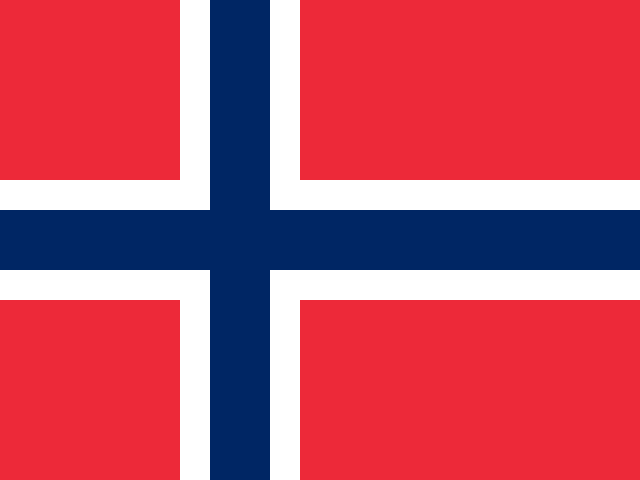
- Description: red with a blue cross outlined in white that extends to the edges of the flag; the the cross is shifted to the left side in the style of the Dannebrog (Danish flag)Meaning: the colors represent Norway's past political unions with Denmark (red and white) and Sweden (blue)
- National symbols
- lion
- National colours
- red, white, blue
- National anthem
- Title: "Kongesangen" (Song of the King)Lyrics/music: Gustav JENSENHistory: royal anthem; uses the tune of "God Save the King," the United Kingdom's anthem
- UNESCO World Heritage Sites
- Total World Heritage Sites: 8 (7 cultural, 1 natural)Selected World Heritage Site locales: Bryggen (c); Urnes Stave Church (c); Røros Mining Town and the Circumference (c); Rock Art of Alta (c); Vegaøyan – The Vega Archipelago (c); Struve Geodetic Arc (c); West Norwegian Fjords – Geirangerfjord and Nærøyfjord (n); Rjukan-Notodden Industrial Heritage Site (c)
Economy
- Overview
- high-income, non-EU economy with trade links via European Economic Area (EEA); key role in European energy security as leader in oil, gas, and electricity exports; major fishing, forestry, and oil(?) extraction industries; oil sovereign fund supports generous welfare system; low unemployment; inflation moderating but remains above target level
- GDP (PPP)
- $507.68 billion (2024 est.)
- GDP per person (PPP)
- $91,100 (2024 est.)
- GDP growth
- 2.1% (2024 est.)
- Inflation
- 3.1% (2024 est.)
- Unemployment
- 4% (2024 est.)
- Below poverty line
- 12.2% (2021 est.)
- Farm products
- milk, barley, potatoes, oats, wheat, pork, chicken, beef, eggs, carrots/turnips (2023)
- Industries
- petroleum and gas, shipping, fishing, aquaculture, food processing, shipbuilding, pulp and paper products, metals, chemicals, timber, mining, textiles
- Exports
- $229.205 billion (2024 est.)
- Main exports
- natural gas, crude petroleum, fish, refined petroleum, aluminum (2023)
- Export partners
- Germany 18%, UK 17%, Sweden 9%, Denmark 7%, Netherlands 6% (2023)
- Main imports
- cars, refined petroleum, ships, nickel, garments (2023)
- Import partners
- Sweden 11%, Germany 11%, China 11%, USA 7%, Netherlands 5% (2023)
- Money sent home from abroad
- 0.1% of GDP (2024 est.)
Energy, internet and transport
- Electricity access
- Electrification - total population: 100% (2022 est.)
- Electricity sources
- Fossil fuels: 1.2% of total installed capacity (2023 est.)Solar: 0.2% of total installed capacity (2023 est.)Wind: 9.2% of total installed capacity (2023 est.)Hydroelectricity: 89.1% of total installed capacity (2023 est.)Biomass and waste: 0.2% of total installed capacity (2023 est.)
- Internet users
- Percent of population: 99% (2023 est.)
- Mobile phones
- Total subscriptions: 6.09 million (2022 est.)Subscriptions per 100 inhabitants: 111 (2022 est.)
- TV and radio
- state-owned public radio and TV broadcaster operates 3 nationwide TV stations, 3 nationwide radio stations, and 16 regional radio stations; roughly a dozen privately owned TV stations broadcast nationally, and another 25 locally; nearly 75% of households have access to multi-channel cable or satellite TV; 2 privately owned radio stations broadcast nationwide, with another 240 local stations; Norway was the first country to phase out FM radio in favor of Digital Audio Broadcasting (DAB) (2019)
- Airports
- 146 (2025)
- Railways
- Total: 3,848 km (2020) 2,482 km electrified
- Merchant ships
- Total: 1,720 (2022)By type: bulk carrier 109, container ship 1, general cargo 274, oil tanker 95, other 1,241
Military and space
- Armed forces
- Norwegian Armed Forces (Forsvaret or "the Defense"): Norwegian Army (Haeren), Royal Norwegian Navy (Kongelige Norske Sjoeforsvaret; includes Coastal Rangers and Coast Guard (Kystvakt)), Royal Norwegian Air Force (Kongelige Norske Luftforsvaret), Home Guard (Heimevernet, HV) (2025)
- Military spending
- 3.4% of GDP (2025 est.)
- Military service
- 17 (men) or 18 (women) for voluntary military service; all Norwegian citizens 19-44 are subject to selective compulsory military service; 19-month service obligation for those selected (12 months plus 4-5 refresher training periods) (2025)
- Space programme
- jointly designs and builds satellites with foreign partners, including communications, remote sensing (RS), scientific, and navigational/positional satellites; develops and launches sounding rockets; researches and produces a range of other space-related technologies, including satellite/space launch vehicle (SLV) and space station components, telescopes, and robotics; conducts solar and telecommunications research; member of the ESA; participates in international programs such as the International Space Station; hosts training on the island of Svalbard for Mars landing missions; cooperates with a variety of foreign space agencies and industries, including those of Canada, ESA/EU member states, Japan, Russia, and the US; has an active and advanced private-sector space industry that works with domestic and foreign space programs (2025)
- Space milestones
- 1962 - launched first research rocket1992 - began operating first communications satellite (THOR-1)2010 - built first satellite (AISSat-1) to monitor from polar orbit Automatic Identification Signals from ships (launched by India)2017 - launched two microsatellites (NorSat-1 and -2) to track commercial sea vessels2025 - signed US-led Artemis Accords for space and lunar exploration
Global issues
- Refugees and displaced people
- Refugees: 129,894 (2024 est.)Stateless persons: 1,621 (2024 est.)
Neighbouring countries
- Phone code
- +47
- Internet domain
- .no