Finland
Republic of Finland · Suomi
Part of Sweden for about 600 years, then a Russian grand duchy from 1809. Declared independence in 1917 and defended it against the USSR in WWII. Joined the EU in 1995 and NATO in 2023.
See Finland on the 3D globeTake a quiz
Population5.6 million
Area338,424 km²
CapitalHelsinki
RegionNorthern Europe
Did you know?
- Ranked the world's happiest country several years in a row
- Has world championships in wife-carrying and mobile-phone throwing
- About 75% of the land is forest
Key facts about Finland
- Government
- Parliamentary republic
- Religion
- Lutheran ~63%, unaffiliated ~33%
- Founded / independence
- 1917 (from Russia)
- Rich in
- Forests and paper, technology (Nokia), metals, education
- Languages
- Finnish, Swedish
Finnish (Savonian, Tavastian, Ostrobothnian dialects), Swedish, Sámi languages - Currency
- Euro (€)
- People are called
- Finnish
- Main cities
- Helsinki, Espoo, Tampere, Vantaa, Oulu, Turku
Timeline of Finland
- 1155Swedish crusades begin
- 1809Becomes Russian grand duchy
- 1906First in Europe to give women full voting rights
- 1917Independence
- 1939Winter War
- 1995Joins EU
- 2023Joins NATO
Places to see in Finland
- Helsinki Cathedral
- Suomenlinna fortress
- Lapland and Santa Claus Village
- Lakeland
- Turku Castle
Food and drink
Karelian pies · salmon soup · reindeer stew · rye bread
Culture and famous for
Saunas (about 3 million for 5.6 million people); Nokia; Angry Birds; architect Alvar Aalto; composer Sibelius
Popular sports
Ice hockey, Formula 1, skiing
Geography and climate
- Highest point
- Halti, 1,324 m
- Rivers, lakes and seas
- About 188,000 lakes
- Climate
- Cold winters, mild summers; midnight sun in the north
- Coastline
- Has a sea coast
- Population density
- 17 people per km²
Wars and conflicts
- Finnish Civil War 1918
- Winter War 1939–40
- Continuation War 1941–44
Alliances and memberships
Military and security
Political unions and regional organisations
European UnionEurozoneCouncil of EuropeNordic Council
Economy and trade
Finland in depth
Detailed facts from the CIA World Factbook (public domain, latest edition).
Overview
- History in brief
- Finland was a province and then a grand duchy under Sweden from the 12th to the 19th centuries and an autonomous grand duchy of Russia after 1809. It gained complete independence in 1917. During World War II, Finland successfully defended its independence through cooperation with Germany and resisted subsequent invasions by the Soviet Union, albeit with some loss of territory. During the next half-century, Finland transformed from a farm/forest economy to a diversified modern industrial economy; per-capita income is among the highest in Western Europe. A member of the EU since 1995, Finland was the only Nordic state to join the euro single currency at its initiation in January 1999. In the 21st century, the key features of Finland's modern welfare state are high-quality education, promotion of equality, and a national social welfare system, although the system is currently facing the challenges of an aging population and the fluctuations of an export-driven economy. Following Russia's invasion of Ukraine in 2022, Finland opted to join NATO; it became the organization's 31st member in April 2023.
Geography
- Location
- Northern Europe, bordering the Baltic Sea, Gulf of Bothnia, and Gulf of Finland, between Sweden and Russia
- Size compared
- slightly more than two times the size of Georgia; slightly smaller than Montana
- Land borders
- Total: 2,563 kmBorder countries: Norway 709 km; Sweden 545 km; Russia 1,309 km
- Coastline
- 1,250 km
- Climate
- cold temperate; potentially subarctic but comparatively mild because of moderating influence of the North Atlantic Current, Baltic Sea, and more than 60,000 lakes
- Terrain
- mostly low, flat to rolling plains interspersed with lakes and low hills
- Elevation
- Highest point: Halti (alternatively Haltia, Haltitunturi, Haltiatunturi) 1,328 mLowest point: Baltic Sea 0 mMean elevation: 164 m
- Natural resources
- timber, iron ore, copper, lead, zinc, chromite, nickel, gold, silver, limestone
- Major lakes
- Fresh water lake(s): Saimaa - 1,760 sq km; Paijanne - 1,090 sq km; Inarijarvi - 1,000 sq km; Oulujarvi - 900 sq km; Pielinen - 850 sq km
- Natural hazards
- severe winters in the north
- Notes
- long boundary with Russia; Helsinki is northernmost national capital on European continent; population concentrated on small southwestern coastal plain
- Environmental issues
- limited air pollution in urban centers; some water pollution from industrial wastes, agricultural chemicals; habitat loss threatens wildlife populations
People and society
- Population
- Total: 5,550,449 (2025 est.)Male: 2,750,057Female: 2,800,392
- Nationality
- Noun: Finn(s)Adjective: Finnish
- Ethnic groups
- Finnish, Swedish, Russian, Estonian, Romani, Sami
- Languages
- Finnish (official) 85.9%, Swedish (official) 5.2%, Russian 1.7%, other 7.2% (2022 est.)Major-language sample(s): World Factbook, korvaamaton perustietolähde. (Finnish)The World Factbook, the indispensable source for basic information.
- Religions
- Lutheran 66.6%, Greek Orthodox 1.1%, other 1.7%, none 30.6% (2022 est.)
- Median age
- Total: 44 years (2025 est.)Male: 41.8 yearsFemale: 44.9 years
- Population growth
- 0.02% (2025 est.)
- Life expectancy
- Total population: 82.2 years (2024 est.)Male: 79.3 yearsFemale: 85.2 years
- Children per woman
- 1.28 children born/woman (2025 est.)
- Urbanization
- Urban population: 85.8% of total population (2023)Rate of urbanization: 0.42% annual rate of change (2020-25 est.)
- Largest cities
- 1.338 million HELSINKI (capital) (2023)
- Years in school
- Total: 20 years (2023 est.)Male: 18 years (2023 est.)Female: 21 years (2023 est.)
Government
- Official names
- Conventional long form: Republic of FinlandConventional short form: FinlandLocal long form: Suomen tasavalta (Finnish)/ Republiken Finland (Swedish)Local short form: Suomi (Finnish)/ Finland (Swedish)Etymology: name derives from the Finns, an ethnic group in northeastern Europe; their name comes from the Germanic word finna, meaning "fish scale;" the local name, Suomi, may come from two local words: suo, meaning "marsh," and maa, meaning "land"
- Government type
- parliamentary republic
- Capital
- Name: HelsinkiGeographic coordinates: 60 10 N, 24 56 ETime difference: UTC+2 (7 hours ahead of Washington, DC, during Standard Time)Daylight saving time: +1hr, begins last Sunday in March; ends last Sunday in OctoberEtymology: the modern name is a Finnish derivation; King Gustav VASA of Sweden founded the city in 1550 as Helsingfors; the name came from Helsing, the Old Norwegian name for a local people, and the word fors, or "waterfall," referring to a waterfall at the city's original location on the Vantaa River
- Regions
- 19 regions (maakunnat, singular - maakunta (Finnish); landskapen, singular - landskapet (Swedish)); Aland (Swedish), Ahvenanmaa (Finnish); Etela-Karjala (Finnish), Sodra Karelen (Swedish) [South Karelia]; Etela-Pohjanmaa (Finnish), Sodra Osterbotten (Swedish) [South Ostrobothnia]; Etela-Savo (Finnish), Sodra Savolax (Swedish) [South Savo]; Kanta-Hame (Finnish), Egentliga Tavastland (Swedish); Kainuu (Finnish), Kajanaland (Swedish); Keski-Pohjanmaa (Finnish), Mellersta Osterbotten (Swedish) [Central Ostrobothnia]; Keski-Suomi (Finnish), Mellersta Finland (Swedish) [Central Finland]; Kymenlaakso (Finnish), Kymmenedalen (Swedish); Lappi (Finnish), Lappland (Swedish); Paijat-Hame (Finnish), Paijanne-Tavastland (Swedish); Pirkanmaa (Finnish), Birkaland (Swedish) [Tampere]; Pohjanmaa (Finnish), Osterbotten (Swedish) [Ostrobothnia]; Pohjois-Karjala (Finnish), Norra Karelen (Swedish) [North Karelia]; Pohjois-Pohjanmaa (Finnish), Norra Osterbotten (Swedish) [North Ostrobothnia]; Pohjois-Savo (Finnish), Norra Savolax (Swedish) [North Savo]; Satakunta (Finnish and Swedish); Uusimaa (Finnish), Nyland (Swedish) [Newland]; Varsinais-Suomi (Finnish), Egentliga Finland (Swedish) [Southwest Finland]
- Independence
- 6 December 1917 (from Russia)
- National holiday
- Independence Day, 6 December (1917)
- Constitution
- History: previous 1906, 1919; latest drafted 17 June 1997, approved by Parliament 11 June 1999, entered into force 1 March 2000Amendment process: proposed by Parliament; passage normally requires simple majority vote in two readings in the first parliamentary session and at least two-thirds majority vote in a single reading by the newly elected Parliament; proposals declared "urgent" by five-sixths of Parliament members can be passed by at least two-thirds majority vote in the first parliamentary session only
- Legal system
- civil law system based on the Swedish model
- Voting age
- 18 years of age; universal
- Flag meaning
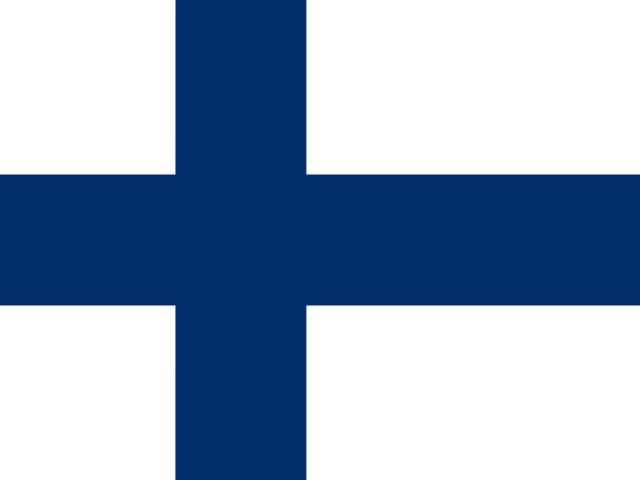
- Description: white with a blue cross extending to the edges of the flag; the cross is shifted to the left in the style of the Dannebrog (Danish flag)Meaning: the blue stands for the country's thousands of lakes, and the white for snow
- National symbols
- lion
- National colours
- blue, white
- National anthem
- Title: "Maamme" (Our Land)Lyrics/music: Paavo Eemil KAJANDER, Johan Ludvig RUNEBERG/Fredrik PACIUSHistory: in use since 1848; although never officially adopted, the anthem has been popular since a student group first sang it in 1848
- UNESCO World Heritage Sites
- Total World Heritage Sites: 7 (6 cultural, 1 natural)Selected World Heritage Site locales: Fortress of Suomenlinna (c); Old Rauma (c); Petäjävesi Old Church (c); Verla Groundwood and Board Mill (c); Bronze Age Burial Site of Sammallahdenmäki (c); High Coast / Kvarken Archipelago (n); Struve Geodetic Arc (c)
Economy
- Overview
- high-income, export-based EU and eurozone economy; major timber, metals, engineering, telecom, and electronics industries; emerging from recession triggered by inflation, weak consumer and export demand, and lower private investment; labor market reform plan to address structural rigidities
- GDP (PPP)
- $313.591 billion (2024 est.)
- GDP per person (PPP)
- $55,600 (2024 est.)
- GDP growth
- -0.2% (2024 est.)
- Inflation
- 1.6% (2024 est.)
- Unemployment
- 8.3% (2024 est.)
- Below poverty line
- 12.2% (2022 est.)
- Farm products
- milk, barley, oats, wheat, potatoes, sugar beets, pork, chicken, peas, rye (2023)
- Industries
- metals and metal products, electronics, machinery and scientific instruments, shipbuilding, pulp and paper, foodstuffs, chemicals, textiles, clothing
- Exports
- $124.531 billion (2024 est.)
- Main exports
- paper, refined petroleum, steel, wood pulp, ships (2023)
- Export partners
- USA 11%, Germany 11%, Sweden 10%, Netherlands 7%, China 5% (2023)
- Main imports
- crude petroleum, cars, refined petroleum, packaged medicine, broadcasting equipment (2023)
- Import partners
- Germany 14%, Sweden 12%, China 9%, Norway 8%, Netherlands 5% (2023)
- Money sent home from abroad
- 0.2% of GDP (2024 est.)
Energy, internet and transport
- Electricity access
- Electrification - total population: 100% (2022 est.)
- Electricity sources
- Fossil fuels: 5.6% of total installed capacity (2023 est.)Nuclear: 41.8% of total installed capacity (2023 est.)Solar: 0.8% of total installed capacity (2023 est.)Wind: 18.7% of total installed capacity (2023 est.)Hydroelectricity: 19.4% of total installed capacity (2023 est.)Biomass and waste: 13.7% of total installed capacity (2023 est.)
- Internet users
- Percent of population: 94% (2023 est.)
- Mobile phones
- Total subscriptions: 7.07 million (2024 est.)Subscriptions per 100 inhabitants: 126 (2024 est.)
- TV and radio
- 3 publicly operated TV stations and numerous privately owned TV stations; several free and special-interest pay-TV channels; cable and satellite multi-channel subscription services are available; all TV signals are digital; 13 national and 25 regional public radio stations; a large number of private radio broadcasters
- Airports
- 98 (2025)
- Railways
- Total: 5,918 km (2020) 3,349 km electrified
- Merchant ships
- Total: 282 (2023)By type: bulk carrier 9, general cargo 75, oil tanker 4, other 194
Military and space
- Armed forces
- Finnish Defense Forces (FDF; Puolustusvoimat): Army (Maavoimat), Navy (Merivoimat), Air Force (Ilmavoimat) (2025)
- Military spending
- 2.8% of GDP (2025 est.)
- Military service
- all Finnish men are obligated to serve 5.5-12 months of service within a branch of the military or the Border Guard upon reaching the age of 18 (length of service depends on the type of duty); women 18-29 may volunteer for service; there is also an option to perform non-military service which lasts for 8.5 or 11.5 months; after completing their initial conscript obligation, individuals enter the reserves and remain eligible for mobilization until the age of 50 for rank-and-file and 60 for non-commissioned and commissioned officers (2025)
Global issues
- Refugees and displaced people
- Refugees: 97,568 (2024 est.)Stateless persons: 1,326 (2024 est.)
Neighbouring countries
- Phone code
- +358
- Internet domain
- .fi