Tunisia
Tunisian Republic · تونس
Carthage, Rome's great rival, was here. Its 2011 revolution started the Arab Spring.
See Tunisia on the 3D globeTake a quiz
Population12 million
Area163,610 km²
CapitalTunis
RegionNorthern Africa
Did you know?
- Some Star Wars Tatooine scenes were filmed here
- El Djem's colosseum is one of the best-preserved Roman amphitheatres
- Its 2011 revolution started the Arab Spring
Key facts about Tunisia
- Government
- Presidential republic (increasingly authoritarian)
- Religion
- Sunni Islam ~99%
- Founded / independence
- 1956 (from France)
- Rich in
- Olive oil, phosphates, tourism
- Languages
- Arabic
Arabic (Tunisian Derja); French; Berber - Currency
- Tunisian dinar (د.ت)
- People are called
- Tunisian
- Main cities
- Tunis, Sfax, Sousse, Kairouan
Timeline of Tunisia
- 814 BCCarthage founded
- 146 BCRome destroys Carthage
- 670Arab conquest
- 1881French protectorate
- 1956Independence
- 2011Revolution
Places to see in Tunisia
- Carthage
- El Djem amphitheatre
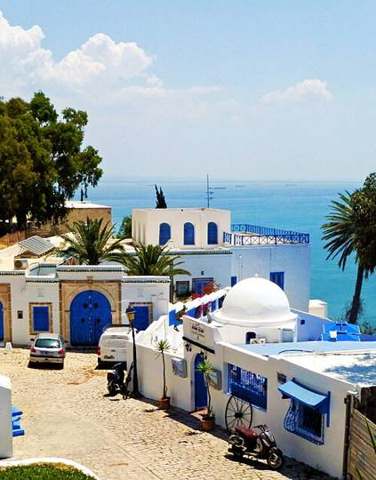
- Sidi Bou Said
- Medina of Tunis
- Djerba
- Matmata cave homes
Food and drink
Couscous · brik · lablabi · harissa
Culture and famous for
Star Wars films shot here; Carthaginian heritage
Popular sports
Football, handball
Geography and climate
- Highest point
- Jebel ech Chambi, 1,544 m
- Rivers, lakes and seas
- Medjerda River
- Climate
- Mediterranean to desert
- Coastline
- Has a sea coast
- Population density
- 73 people per km²
Wars and conflicts
- Punic Wars (Carthage destroyed 146 BC)
- 2011 revolution
Empires and states that once stood here
Alliances and memberships
Political unions and regional organisations
African UnionArab LeagueOrganisation of Islamic Cooperation
Tunisia in depth
Detailed facts from the CIA World Factbook (public domain, latest edition).
Overview
- History in brief
- Many empires have controlled Tunisia, including the Phoenicians (as early as the 12 century B.C.), Carthaginians, Romans, Vandals, Byzantines, various Arab and Berber kingdoms, and Ottomans (16th to late-19th centuries). Rivalry between French and Italian interests in Tunisia culminated in a French invasion in 1881 and the creation of a protectorate. Agitation for independence in the decades after World War I finally convinced the French to recognize Tunisia as an independent state in 1956. The country's first president, Habib BOURGUIBA, established a strict one-party state. He dominated the country for 31 years, repressing Islamic fundamentalism and establishing rights for women. In 1987, Zine el Abidine BEN ALI replaced BOURGUIBA in a bloodless coup.Street protests that began in Tunis in 2010 over high unemployment, corruption, widespread poverty, and high food prices escalated in 2011, culminating in rioting that led to hundreds of deaths and later became known as the start of the regional Arab Spring uprising. BEN ALI dismissed the government and fled the country, and a "national unity government" was formed. Elections for the new Constituent Assembly were held later that year, and human rights activist Moncef MARZOUKI was elected as interim president. The Assembly began drafting a new constitution in 2012 and, after several iterations and a months-long political crisis that stalled the transition, ratified the document in 2014. Parliamentary and presidential elections for a permanent government were held at the end of 2014. Beji CAID ESSEBSI was elected as the first president under the country's new constitution. After ESSEBSI’s death in office in 2019, Kais SAIED was elected. SAIED's term, as well as that of Tunisia's 217-member parliament, was set to expire in 2024. However, in 2021, SAIED used the exceptional powers allowed under Tunisia's constitution to dismiss the prime minister and suspend the legislature. Tunisians approved a new constitution through public referendum in 2022, expanding presidential powers and creating a new bicameral legislature.
Geography
- Location
- Northern Africa, bordering the Mediterranean Sea, between Algeria and Libya
- Size compared
- slightly larger than Georgia
- Land borders
- Total: 1,495 kmBorder countries: Algeria 1,034 km; Libya 461 km
- Coastline
- 1,148 km
- Climate
- temperate in north with mild, rainy winters and hot, dry summers; desert in south
- Terrain
- mountains in north; hot, dry central plain; semiarid south merges into the Sahara
- Elevation
- Highest point: Jebel ech Chambi 1,544 mLowest point: Shatt al Gharsah -17 mMean elevation: 246 m
- Natural resources
- petroleum, phosphates, iron ore, lead, zinc, salt
- Natural hazards
- flooding; earthquakes; droughts
- Notes
- strategic location in central Mediterranean
- Environmental issues
- toxic and hazardous waste disposal; water pollution from raw sewage; limited freshwater resources; deforestation; overgrazing; soil erosion; desertification
People and society
- Population
- Total: 11,962,995 (2025 est.)Male: 5,926,741Female: 6,036,254
- Nationality
- Noun: Tunisian(s)Adjective: Tunisian
- Ethnic groups
- Arab 98%, European 1%, Jewish and other 1%
- Languages
- Arabic (official, one of the languages of commerce), French (commerce), TamazightMajor-language sample(s): كتاب حقائق العالم، أحسن كتاب تتعلم به المعلومات الأساسية (Arabic)The World Factbook, une source indispensable d'informations de base. (French)The World Factbook, the indispensable source for basic information.
- Religions
- Muslim (official; Sunni) 99%, other (includes Christian, Jewish, Shia Muslim, and Baha'i) <1%
- Median age
- Total: 34.1 years (2025 est.)Male: 33.6 yearsFemale: 35.1 years
- Population growth
- 0.38% (2025 est.)
- Life expectancy
- Total population: 77.3 years (2024 est.)Male: 75.7 yearsFemale: 79.1 years
- Children per woman
- 1.59 children born/woman (2025 est.)
- Urbanization
- Urban population: 70.5% of total population (2023)Rate of urbanization: 1.34% annual rate of change (2020-25 est.)
- Largest cities
- 2.475 million TUNIS (capital) (2023)
- Literacy
- Total population: 86.2% (2023 est.)Male: 92.7% (2023 est.)Female: 80.1% (2023 est.)
- Years in school
- Total: 14 years (2016 est.)Male: 14 years (2016 est.)Female: 15 years (2016 est.)
Government
- Official names
- Conventional long form: Republic of TunisiaConventional short form: TunisiaLocal long form: Al Jumhuriyah at TunisiyahLocal short form: TunisEtymology: the country name derives from the capital city of Tunis
- Government type
- parliamentary republic
- Capital
- Name: TunisGeographic coordinates: 36 48 N, 10 11 ETime difference: UTC+1 (6 hours ahead of Washington, DC, during Standard Time)Etymology: the origin of the ancient name is unclear; it is sometimes associated with the name of the Phoenician goddess Tanith
- Regions
- 24 governorates (wilayat, singular - wilayah); Beja (Bajah), Ben Arous (Bin 'Arus), Bizerte (Banzart), Gabes (Qabis), Gafsa (Qafsah), Jendouba (Jundubah), Kairouan (Al Qayrawan), Kasserine (Al Qasrayn), Kebili (Qibili), Kef (Al Kaf), L'Ariana (Aryanah), Mahdia (Al Mahdiyah), Manouba (Manubah), Medenine (Madanin), Monastir (Al Munastir), Nabeul (Nabul), Sfax (Safaqis), Sidi Bouzid (Sidi Bu Zayd), Siliana (Silyanah), Sousse (Susah), Tataouine (Tatawin), Tozeur (Tawzar), Tunis, Zaghouan (Zaghwan)
- Independence
- 20 March 1956 (from France)
- National holiday
- Independence Day, 20 March (1956); Revolution and Youth Day, 14 January (2011)
- Constitution
- History: several previous; latest draft published by the president 30 June 2022, approved by referendum 25 July 2022, and adopted 27 July 2022Amendment process: proposed by the president of the republic or one third of the Assembly of the Representatives of the People membership; following Constitutional Court review, approval to proceed requires an absolute majority vote in the Assembly, and final passage requires a two-thirds Assembly majority vote; the president can opt to submit an amendment to a referendum, which requires an absolute majority of votes cast for passage
- Legal system
- mixed system of civil law, based on the French civil code and Islamic (sharia) law; Supreme Court reviews some legislative acts in joint session
- Voting age
- 18 years of age; universal except for active government security forces (including the police and the military), people with mental disabilities, people who have served more than three months in prison (criminal cases only), and people given a suspended sentence of more than six months
- Flag meaning
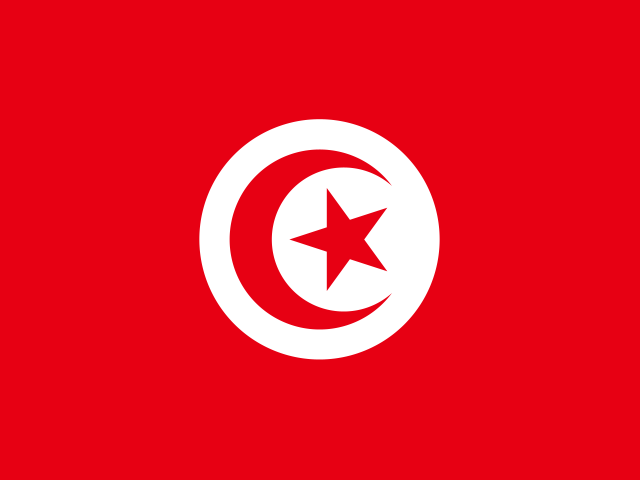
- Description: red with a white disk in the center that displays a red crescent around a five-pointed red starMeaning: red stands for martyrs' blood shed the fight against oppression, and white for peace; the crescent and star are traditional symbols of IslamHistory: resembles the Ottoman flag (red banner with white crescent and star), a reference to Tunisia's history as part of the Ottoman Empire
- National symbols
- red crescent moon and five-pointed star in a white circle
- National colours
- red, white
- National anthem
- Title: "Humat Al Hima" (Defenders of the Homeland)Lyrics/music: Mustafa Sadik AL-RAFII and Aboul-Qacem ECHEBBI/Mohamad Abdel WAHABHistory: adopted 1957, replaced 1958, restored 1987; Mohamad Abdel WAHAB also composed the music for the anthem of the United Arab Emirates
- UNESCO World Heritage Sites
- Total World Heritage Sites: 9 (8 cultural, 1 natural)Selected World Heritage Site locales: Amphitheatre of El Jem (c); Archaeological Site of Carthage (c); Medina of Tunis (c); Ichkeul National Park (n); Punic Town of Kerkuane (c); Kairouan (c); Medina of Sousse (c); Dougga / Thugga (c); Djerba: Testimony to a settlement pattern in an island territory (c)
Economy
- Overview
- lower middle-income North African economy; drafting reforms for foreign lenders; high unemployment, especially for youth and women; hit hard by COVID-19; high public sector wages; high public debt; protectionist austerity measures; key EU trade partner
- GDP (PPP)
- $156.086 billion (2024 est.)
- GDP per person (PPP)
- $12,700 (2024 est.)
- GDP growth
- 1.4% (2024 est.)
- Inflation
- 7.2% (2024 est.)
- Unemployment
- 16.3% (2024 est.)
- Below poverty line
- 16.6% (2021 est.)
- Farm products
- milk, tomatoes, olives, onions, chillies/peppers, watermelons, potatoes, wheat, dates, oranges (2023)
- Industries
- petroleum, mining (particularly phosphate, iron ore), tourism, textiles, footwear, agribusiness, beverages
- Exports
- $19.732 billion (2023 est.)
- Main exports
- garments, insulated wire, olive oil, refined petroleum, crude petroleum (2023)
- Export partners
- France 22%, Italy 17%, Germany 13%, USA 4%, Libya 4% (2023)
- Main imports
- refined petroleum, natural gas, plastic products, cars, plastics (2023)
- Import partners
- Italy 13%, France 12%, China 10%, Russia 8%, Germany 7% (2023)
- Money sent home from abroad
- 6% of GDP (2023 est.)
Energy, internet and transport
- Electricity access
- Electrification - total population: 100% (2022 est.)Electrification - urban areas: 100%Electrification - rural areas: 99.7%
- Electricity sources
- Fossil fuels: 96.1% of total installed capacity (2023 est.)Solar: 2.3% of total installed capacity (2023 est.)Wind: 1.6% of total installed capacity (2023 est.)
- Internet users
- Percent of population: 72% (2023 est.)
- Mobile phones
- Total subscriptions: 14.4 million (2024 est.)Subscriptions per 100 inhabitants: 118 (2024 est.)
- TV and radio
- 2 state-owned TV stations; 10 private local TV stations; satellite TV service available; state-owned radio network with 2 stations; several dozen private radio stations and community radio stations; transmissions of multiple international broadcasters available (2019)
- Airports
- 14 (2025)
- Railways
- Total: 2,173 km (2014) (1,991 in use)Standard gauge: 471 km (2014) 1.435-m gaugeNarrow gauge: 1,694 km (2014) 1.000-m gauge (65 km electrified)Dual gauge: 8 km (2014) 1.435-1.000-m gauge
- Merchant ships
- Total: 72 (2023)By type: container ship 1, general cargo 8, oil tanker 1, other 62
Military and space
- Armed forces
- Tunisian Armed Forces (Forces Armées Tunisiennes, FAT): Tunisian Army (includes Air Defense Force), Tunisian Navy, Tunisia Air ForceMinistry of Interior (MoI): Internal Security Forces (National Police, National Guard) (2025)
- Military spending
- 2.5% of GDP (2024 est.)
- Military service
- 18 years of age for voluntary service for men and women; men 20-35 years of age subject to 12 months of compulsory national service (2025)
Global issues
- Refugees and displaced people
- Refugees: 12,575 (2024 est.)
Neighbouring countries
- Phone code
- +216
- Internet domain
- .tn