Uruguay
Oriental Republic of Uruguay
A buffer state between Argentina and Brazil. Won the first football World Cup in 1930; one of the most stable democracies in Latin America.
See Uruguay on the 3D globeTake a quiz
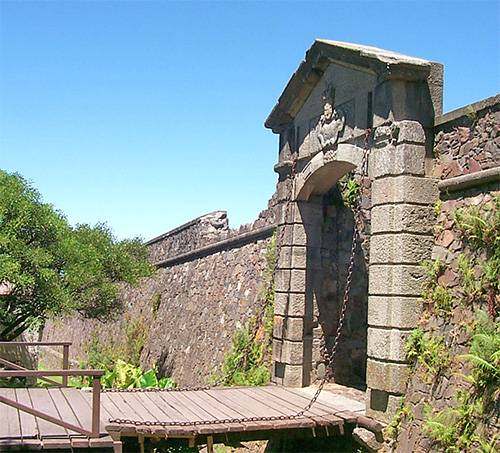
Population3.4 million
Area181,034 km²
CapitalMontevideo
RegionSouth America
Did you know?
- Won the first football World Cup in 1930
- First country to fully legalise cannabis (2013)
- Has more cows than people
Key facts about Uruguay
- Government
- Presidential republic
- Religion
- Catholic ~42%, unaffiliated ~40%
- Founded / independence
- 1825/1828 (from Brazil)
- Rich in
- Beef, wool, soybeans, wind energy
- Languages
- Spanish
Spanish (Rioplatense); Portuñol on the Brazil border - Currency
- Uruguayan peso ($)
- People are called
- Uruguayan
- Main cities
- Montevideo, Salto, Ciudad de la Costa
Timeline of Uruguay
- 1680Portuguese Colonia
- 1828Independence
- 1930First World Cup
- 1973Dictatorship
- 1985Democracy
Places to see in Uruguay
- Colonia del Sacramento
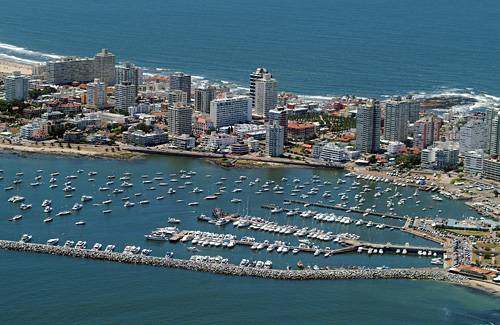
- Punta del Este
- Montevideo's Rambla
- Cabo Polonio
Food and drink
Asado · chivito sandwich · dulce de leche · mate
Culture and famous for
Candombe drumming; mate everywhere
Popular sports
Football (won the first World Cup, 1930)
Geography and climate
- Highest point
- Cerro Catedral, 514 m
- Rivers, lakes and seas
- Río de la Plata, Uruguay River
- Climate
- Temperate
- Coastline
- Has a sea coast
- Population density
- 19 people per km²
Wars and conflicts
- Guerra Grande 1839–51
- Tupamaros
- dictatorship 1973–85
Alliances and memberships
Military and security
Political unions and regional organisations
CELACOrganization of American States
Economy and trade
Uruguay in depth
Detailed facts from the CIA World Factbook (public domain, latest edition).
Overview
- History in brief
- The Spanish founded the city of Montevideo in modern-day Uruguay in 1726 as a military stronghold, and it soon became an important commercial center due to its natural harbor. Argentina initially claimed Uruguay, but Brazil annexed the country in 1821. Uruguay declared its independence in 1825 and secured its freedom in 1828 after a three-year struggle. The administrations of President Jose BATLLE in the early 20th century launched widespread political, social, and economic reforms that established a statist tradition. A violent Marxist urban guerrilla movement named the Tupamaros (or Movimiento de Liberación Nacional-Tupamaros) launched in the late 1960s and pushed Uruguay's president to cede control of the government to the military in 1973. By year-end, the rebels had been crushed, but the military continued to expand its hold over the government. Civilian rule was restored in 1985. In 2004, the left-of-center Frente Amplio (FA) Coalition won national elections that effectively ended 170 years of political control by the Colorado and National (Blanco) parties. The left-of-center coalition retained the presidency and control of both chambers of congress until 2019. Uruguay's political and labor conditions are among the freest on the South American continent.
Geography
- Location
- Southern South America, bordering the South Atlantic Ocean, between Argentina and Brazil
- Size compared
- about the size of Virginia and West Virginia combined; slightly smaller than the state of Washington
- Land borders
- Total: 1,591 kmBorder countries: Argentina 541 km; Brazil 1,050 km
- Coastline
- 660 km
- Climate
- warm temperate; freezing temperatures almost unknown
- Terrain
- mostly rolling plains and low hills; fertile coastal lowland
- Elevation
- Highest point: Cerro Catedral 514 mLowest point: Atlantic Ocean 0 mMean elevation: 109 m
- Natural resources
- arable land, hydropower, minor minerals, fish
- Major rivers
- Rio de la Plata/Parana river mouth (shared with Brazil [s], Argentina, Paraguay) - 4,880 km; Uruguay river mouth (shared with Brazil [s] and Argentina) - 1,610 kmNote: [s] after country name indicates river source; [m] after country name indicates river mouth
- Major lakes
- Salt water lake(s): Lagoa Mirim (shared with Brazil) - 2,970 sq km
- Natural hazards
- seasonally high winds (the pampero is a chilly and occasional violent wind that blows north from the Argentine pampas), droughts, floods; because of the absence of mountains, which act as weather barriers, all locations are particularly vulnerable to rapid changes from weather fronts
- Notes
- second-smallest South American country (after Suriname); most of the low-lying landscape (three-quarters of the country) is grassland, ideal for cattle and sheep
- Environmental issues
- water pollution from meat-packing, tannery industries; heavy metal pollution; inadequate solid and hazardous waste disposal; deforestation
People and society
- Population
- Total: 3,449,444 (2025 est.)Male: 1,678,419Female: 1,771,025
- Nationality
- Noun: Uruguayan(s)Adjective: Uruguayan
- Ethnic groups
- White 87.7%, Black 4.6%, Indigenous 2.4%, other 0.3%, none or unspecified 5% (2011 est.)
- Languages
- Spanish (official, Rioplatense is the most widely spoken dialect)Major-language sample(s): La Libreta Informativa del Mundo, la fuente indispensable de información básica. (Spanish)The World Factbook, the indispensable source for basic information.
- Religions
- Roman Catholic 36.5%, Protestant 5% (Evangelical (non-specific) 4.6%, Adventist 0.2%, Protestant (non-specific) 0.3%), African American Cults/Umbanda 2.8%, Jehovah's Witness 0.6%, Church of Jesus Christ 0.2%, other 1%, Believer (not belonging to the church) 1.8%, agnostic 0.3%, atheist 1.3%, none 47.3%, unspecified 3.4%Roman Catholic 42%, Protestant 15%, other 6%, agnostic 3%, atheist 10%, unspecified 24% (2023 est.)
- Median age
- Total: 37.4 years (2025 est.)Male: 34.9 yearsFemale: 38.2 years
- Population growth
- -0.06% (2025 est.)
- Life expectancy
- Total population: 78.9 years (2024 est.)Male: 75.8 yearsFemale: 82.1 years
- Children per woman
- 1.27 children born/woman (2025 est.)
- Urbanization
- Urban population: 95.8% of total population (2023)Rate of urbanization: 0.4% annual rate of change (2020-25 est.)
- Largest cities
- 1.774 million MONTEVIDEO (capital) (2023)
- Literacy
- Total population: 98.9% (2024 est.)Male: 98.6% (2024 est.)Female: 99.2% (2024 est.)
- Years in school
- Total: 18 years (2022 est.)Male: 16 years (2022 est.)Female: 19 years (2022 est.)
Government
- Official names
- Conventional long form: Oriental Republic of UruguayConventional short form: UruguayLocal long form: República Oriental del UruguayLocal short form: UruguayFormer: Banda Oriental, Cisplatine ProvinceEtymology: name derives from the Uruguay River, which makes up the western border of the country; the river's name comes from the Guarani words uru (bird) and guay (tail)
- Government type
- presidential republic
- Capital
- Name: MontevideoGeographic coordinates: 34 51 S, 56 10 WTime difference: UTC-3 (2 hours ahead of Washington, DC, during Standard Time)Etymology: the origin of the name is disputed but refers to a hill or mountain (monte); one theory combines the Spanish word monte (mountain) with the Latin video (I see)
- Regions
- 19 departments (departamentos, singular - departamento); Artigas, Canelones, Cerro Largo, Colonia, Durazno, Flores, Florida, Lavalleja, Maldonado, Montevideo, Paysandú, Rio Negro, Rivera, Rocha, Salto, San José, Soriano, Tacuarembó, Treinta y Tres
- Independence
- 25 August 1825 (from Brazil)
- National holiday
- Independence Day, 25 August (1825)
- Constitution
- History: several previous; latest approved by plebiscite 27 November 1966, effective 15 February 1967, reinstated in 1985 at the conclusion of military ruleAmendment process: initiated by public petition of at least 10% of qualified voters, proposed by agreement of at least two fifths of the General Assembly membership, or by existing "constitutional laws" sanctioned by at least two thirds of the membership in both houses of the Assembly; proposals can also be submitted by senators, representatives, or by the executive power and require the formation of and approval in a national constituent convention; final passage by either method requires approval by absolute majority of votes cast in a referendum
- Legal system
- civil law system based on the Spanish civil code
- Voting age
- 18 years of age; universal and compulsory
- Flag meaning
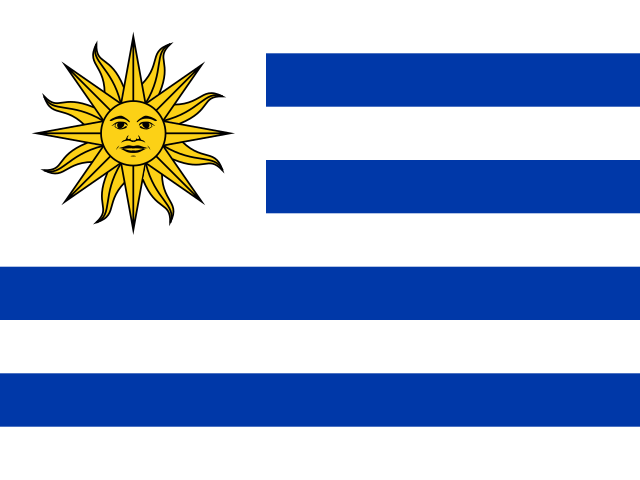
- Description: nine equal horizontal stripes of white (top and bottom) alternating with blue; a white square in the upper-left corner has a yellow sun with a human face (outlined in black) known as the Sun of May, with 16 rays that alternate between triangular and wavyMeaning: the stripes represent the country's nine original departments; the sun refers to the legend of the sun breaking through the clouds on 25 May 1810 as independence was declared from Spain; the sun is said to be Inti, the Inca god of the sun
- National symbols
- Sun of May (a sun-with-face symbol)
- National colours
- blue, white, yellow
- National anthem
- Title: "Himno Nacional" (National Anthem of Uruguay)Lyrics/music: Francisco Esteban ACUNA de Figueroa/Francisco Jose DEBALIHistory: adopted 1848; the anthem is also known as "Orientales, la Patria o la tumba!" ("Uruguayans, the Fatherland or Death!"); it is the world's longest national anthem in terms of music (105 bars; almost five minutes); usually only the first verse and chorus are sung
- UNESCO World Heritage Sites
- Total World Heritage Sites: 3 (all cultural)Selected World Heritage Site locales: Historic City of Colonia del Sacramento; Fray Bentos Industrial Landscape; The work of engineer Eladio Dieste: Church of Atlántida
Economy
- Overview
- high-income, export-oriented South American economy; South America’s largest middle class; low socioeconomic inequality; growing homicide rates; growing Chinese and EU relations; 2019 Argentine recession hurt; key milk, beef, rice, and wool exporter
- GDP (PPP)
- $108.502 billion (2024 est.)
- GDP per person (PPP)
- $32,000 (2024 est.)
- GDP growth
- 3.1% (2024 est.)
- Inflation
- 4.8% (2024 est.)
- Unemployment
- 8.5% (2024 est.)
- Below poverty line
- 10.1% (2023 est.)
- Farm products
- milk, rice, wheat, barley, soybeans, beef, rapeseed, sugarcane, maize, beef offal (2023)
- Industries
- food processing, electrical machinery, transportation equipment, petroleum products, textiles, chemicals, beverages
- Exports
- $23.329 billion (2024 est.)
- Main exports
- wood pulp, beef, milk, rice, wood (2023)
- Export partners
- China 21%, Brazil 17%, USA 8%, Argentina 5%, Netherlands 5% (2023)
- Main imports
- crude petroleum, refined petroleum, cars, trucks, fertilizers (2023)
- Import partners
- Brazil 22%, China 18%, Argentina 11%, USA 9%, Nigeria 4% (2023)
- Money sent home from abroad
- 0.2% of GDP (2024 est.)
Energy, internet and transport
- Electricity access
- Electrification - total population: 100% (2022 est.)
- Electricity sources
- Fossil fuels: 8% of total installed capacity (2023 est.)Solar: 3.8% of total installed capacity (2023 est.)Wind: 37% of total installed capacity (2023 est.)Hydroelectricity: 27.3% of total installed capacity (2023 est.)Biomass and waste: 23.9% of total installed capacity (2023 est.)
- Internet users
- Percent of population: 90% (2023 est.)
- Mobile phones
- Total subscriptions: 4.93 million (2024 est.)Subscriptions per 100 inhabitants: 146 (2024 est.)
- TV and radio
- mix of privately owned and state-run broadcast media; over 100 commercial radio stations and about 20 TV channels; cable TV is available; many community radio and TV stations; adopted the hybrid Japanese/Brazilian HDTV standard (ISDB-T) in 2010 (2019)
- Airports
- 65 (2025)
- Railways
- Total: 1,673 km (2016) (operational; government claims overall length is 2,961 km)Standard gauge: 1,673 km (2016) 1.435-m gauge
- Merchant ships
- Total: 58 (2023)By type: container ship 1, general cargo 4, oil tanker 3, other 50
Military and space
- Armed forces
- Armed Forces of Uruguay (Fuerzas Armadas del Uruguay or FF.AA. del Uruguay): National Army, National Navy (includes Coast Guard (Prefectura Nacional Naval or PRENA)), Uruguayan Air ForceMinistry of Interior: National Police (2025)
- Military spending
- 2.1% of GDP (2024 est.)
- Military service
- generally 18-30 years of age (up to 22 for the Navy and up to 40 for some specialist positions) for voluntary military service for men and women; initial 24-month service obligation (2025)
Global issues
- Refugees and displaced people
- Refugees: 32,149 (2024 est.)IDPs: 33 (2024 est.)Stateless persons: 5 (2024 est.)
Neighbouring countries
- Phone code
- +598
- Internet domain
- .uy