Argentina
Argentine Republic
Freed from Spain under San Martín. Mass European immigration made it one of the world's richest countries around 1900. Coups, Perónism, a military junta and repeated debt crises followed.
See Argentina on the 3D globeTake a quiz
Population46 million
Area2,780,400 km²
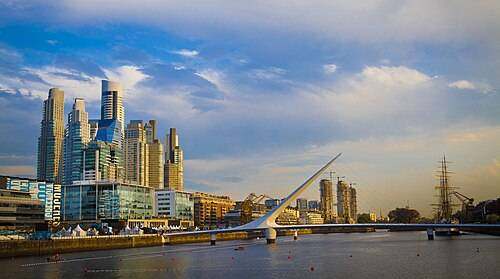
CapitalBuenos Aires
RegionSouth America
Did you know?
- Won the 2022 football World Cup
- Eats among the most beef per person
- Ushuaia is the southernmost city in the world
Key facts about Argentina
- Government
- Federal presidential republic
- Religion
- Catholic ~63%, unaffiliated ~19%, Evangelical ~15%
- Founded / independence
- 1816 (from Spain)
- Rich in
- Beef, soybeans, wheat, lithium, shale (Vaca Muerta), wine
- Languages
- Guaraní, Spanish
Spanish (Rioplatense, with "vos" and Italian-influenced accent); Quechua, Guaraní, Mapudungun - Currency
- Argentine peso ($)
- People are called
- Argentine
- Main cities
- Buenos Aires, Córdoba, Rosario, Mendoza, La Plata
Timeline of Argentina
- 1536Buenos Aires founded
- 1816Independence
- 1946Perón president
- 1976Military junta
- 1982Falklands War
- 1983Democracy returns
- 2022World Cup win
Places to see in Argentina
- Iguazú Falls
- Perito Moreno Glacier
- Buenos Aires' La Boca
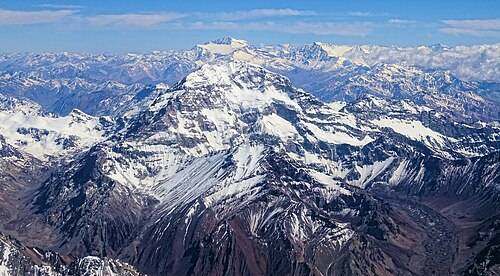
- Aconcagua
- Patagonia
- Ushuaia
Food and drink
Asado (barbecue) · empanadas · dulce de leche · Malbec wine · mate tea
Culture and famous for
Tango; gauchos; writer Borges
Popular sports
Football (Maradona, Messi), polo, rugby
Geography and climate
- Highest point
- Aconcagua, 6,961 m (highest outside Asia)
- Rivers, lakes and seas
- Paraná, Río de la Plata
- Climate
- Subtropical north to subpolar south
- Coastline
- Has a sea coast
- Population density
- 17 people per km²
Wars and conflicts
- War of Independence
- Paraguayan War
- Dirty War 1976–83
- Falklands War 1982
Alliances and memberships
Military and security
Political unions and regional organisations
CELACOrganization of American States
Economy and trade
Argentina in depth
Detailed facts from the CIA World Factbook (public domain, latest edition).
Overview
- History in brief
- In 1816, the United Provinces of the Río de la Plata declared their independence from Spain. After Bolivia, Paraguay, and Uruguay went their separate ways, the area that remained became Argentina. European immigrants heavily shaped the country's population and culture, with Italy and Spain providing the largest percentage of newcomers from 1860 to 1930. Until about the mid-20th century, much of Argentina's history was dominated by periods of internal political unrest and conflict between civilian and military factions. After World War II, former President Juan Domingo PERÓN -- the founder of the Peronist political movement -- introduced an era of populism, serving three non-consecutive terms in office until his death in 1974. Direct and indirect military interference in government throughout the PERÓN years led to a military junta taking power in 1976. In 1982, the junta failed in its bid to seize the Falkland Islands (Islas Malvinas) by force from the United Kingdom. Democracy was reinstated in 1983 and has persisted despite numerous challenges, the most formidable of which was a severe economic crisis in 2001-02 that led to violent public protests and the successive resignations of several presidents. The years 2003-15 saw Peronist rule by Néstor KIRCHNER (2003-07) and his spouse Cristina FERNÁNDEZ DE KIRCHNER (2007-15), who oversaw several years of strong economic growth (2003-11) followed by a gradual deterioration in the government’s fiscal situation and eventual economic stagnation and isolation. Argentina underwent a brief period of economic reform and international reintegration under Mauricio MACRI (2015-19), but a recession in 2018-19 and frustration with MACRI’s economic policies ushered in a new Peronist government in 2019 led by President Alberto FERNÁNDEZ and Vice President Cristina FERNÁNDEZ DE KIRCHNER. Argentina's high public debts, its pandemic-related inflationary pressures, and systemic monetary woes served as the catalyst for the 2023 elections, culminating with President Javier MILEI's electoral success. Argentina has since eliminated half of its government agencies and is seeking shock therapy to amend taxation and monetary policies.
Geography
- Location
- Southern South America, bordering the South Atlantic Ocean, between Chile and Uruguay
- Size compared
- slightly less than three-tenths the size of the US
- Land borders
- Total: 11,968 kmBorder countries: Bolivia 942 km; Brazil 1,263 km; Chile 6,691 km; Paraguay 2,531 km; Uruguay 541 km
- Coastline
- 4,989 km
- Climate
- mostly temperate; arid in southeast; subantarctic in southwest
- Terrain
- rich plains of the Pampas in northern half, flat to rolling plateau of Patagonia in south, rugged Andes along western border
- Elevation
- Highest point: Cerro Aconcagua (located in the northwestern corner of the province of Mendoza; highest point in South America) 6,962 mLowest point: Laguna del Carbón (located between Puerto San Julián and Comandante Luis Piedra Buena in the province of Santa Cruz) -105 mMean elevation: 595 m
- Natural resources
- fertile plains of the pampas, lead, zinc, tin, copper, iron ore, manganese, petroleum, uranium, arable land
- Major rivers
- Río de la Plata/Paraná river mouth (shared with Brazil [s], Paraguay, and Uruguay) - 4,880 km; Paraguay (shared with Brazil [s], and Paraguay [m]) - 2,549 km; Uruguay (shared with Brazil [s] and Uruguay [m]) - 1,610 kmNote: [s] after country name indicates river source; [m] after country name indicates river mouth
- Major lakes
- Fresh water lake(s): Lago Buenos Aires (shared with Chile) - 2,240 sq km; Lago Argentino - 1,410 sq km; Lago Viedma - 1,090 sq km; Lago San Martín (shared with Chile) - 1,010 sq km; Lago Colhué Huapi - 800 sq km; Lago Fagnano (shared with Chile) - 590 sq km; Lago Nahuel Huapi - 550 sq kmSalt water lake(s): Laguna Mar Chiquita - 1,850 sq km;
- Natural hazards
- San Miguel de Tucumán and Mendoza areas in the Andes subject to earthquakes; pamperos are violent windstorms that can strike the pampas and northeast; heavy flooding in some areasVolcanism: volcanic activity in the Andes Mountains along the Chilean border; Copahue (2,997 m) last erupted in 2000; other historically active volcanoes include Llullaillaco, Maipo, Planchón-Peteroa, San José, Tromen, Tupungatito, and Viedma
- Notes
- second-largest country in South America (after Brazil); strategic location relative to sea lanes between the South Atlantic and the South Pacific Oceans (Strait of Magellan, Beagle Channel, Drake Passage); diverse geophysical landscapes range from tropical climates in the north to tundra in the far south; Cerro Aconcagua is the Western Hemisphere's tallest mountain, while Laguna del Carbón is the lowest point in the Western Hemisphere; shares Iguazú Falls, the world's largest waterfalls system, with Brazil
- Environmental issues
- deforestation; soil degradation (erosion, salinization); desertification; air pollution; water pollution
People and society
- Population
- Total: 45,418,098 (2025 est.)Male: 22,535,980Female: 22,882,118
- Nationality
- Noun: Argentine(s)Adjective: Argentine
- Ethnic groups
- European (mostly Spanish and Italian descent) and Mestizo (mixed European and Indigenous ancestry) 97.2%, Indigenous 2.4%, African descent 0.4% (2010 est.)
- Languages
- Spanish (official), Italian, English, German, French, indigenous (Quechua, Guarani, Mapudungun)Major-language sample(s): La Libreta Informativa del Mundo, la fuente indispensable de información básica. (Spanish)The World Factbook, the indispensable source for basic information.
- Religions
- Roman Catholic 62.9%, Evangelical 15.3% (Pentecostal 13%, other Evangelical 2.3%), Jehovah's Witness and Church of Jesus Christ 1.4%, other 1.2% (includes Muslim, Jewish), none 18.9% (includes agnostic and atheist), unspecified 0.3% (2019 est.)
- Median age
- Total: 34.6 years (2025 est.)Male: 32.1 yearsFemale: 34.6 years
- Population growth
- 0.26% (2025 est.)
- Life expectancy
- Total population: 78.8 years (2024 est.)Male: 75.8 yearsFemale: 82 years
- Children per woman
- 1.43 children born/woman (2025 est.)
- Urbanization
- Urban population: 92.5% of total population (2023)Rate of urbanization: 0.97% annual rate of change (2020-25 est.)
- Largest cities
- 15.490 million BUENOS AIRES (capital), 1.612 million Córdoba, 1.594 million Rosario, 1.226 million Mendoza, 1.027 million San Miguel de Tucumán, 914,000 La Plata (2023)
- Literacy
- Total population: 99.1% (2020 est.)Male: 99.1% (2020 est.)Female: 99.2% (2020 est.)
- Years in school
- Total: 19 years (2022 est.)Male: 17 years (2022 est.)Female: 21 years (2022 est.)
Government
- Official names
- Conventional long form: Argentine RepublicConventional short form: ArgentinaLocal long form: República ArgentinaLocal short form: ArgentinaEtymology: the name is derived from one of the Spanish words for "silver," but the origin is unclear; it may have described the land next to the Rio de la Plata ("Silver River"), a major river that forms the boundary between Argentina and Uruguay; another possible source is the Spanish explorers in the 16th century mistakenly believing that the silver ornaments they bought from inhabitants came from a local source of silver
- Government type
- presidential republic
- Capital
- Name: Buenos AiresGeographic coordinates: 34 36 S, 58 22 WTime difference: UTC-3 (2 hours ahead of Washington, DC, during Standard Time)Etymology: the name translates as "fair winds" in Spanish; the full original name, Nuestra Senora Santa Maria de los Buenos Aires, was given only to the port; the city was founded separately from the port in 1536 and was named Ciudad de la Santissima Trinidad (City of the Most Holy Trinity); the shortened version of the port name eventually became the city name
- Regions
- 23 provinces (provincias, singular - provincia) and 1 autonomous city*; Buenos Aires, Catamarca, Chaco, Chubut, Ciudad Autonoma de Buenos Aires*, Cordoba, Corrientes, Entre Rios, Formosa, Jujuy, La Pampa, La Rioja, Mendoza, Misiones, Neuquen, Rio Negro, Salta, San Juan, San Luis, Santa Cruz, Santa Fe, Santiago del Estero, Tierra del Fuego - Antartida e Islas del Atlántico Sur (Tierra del Fuego - Antarctica and the South Atlantic Islands), Tucuman
- Independence
- 9 July 1816 (from Spain)
- National holiday
- Revolution Day (May Revolution Day), 25 May (1810)
- Constitution
- History: several previous; latest effective 11 May 1853Amendment process: a declaration of proposed amendments requires two-thirds majority vote by both houses of the National Congress followed by approval by an ad hoc, multi-member constitutional convention
- Legal system
- civil law system based on Western European legal systems
- Voting age
- 18-70 years of age; universal and compulsory; 16-17 years of age: optional for national elections
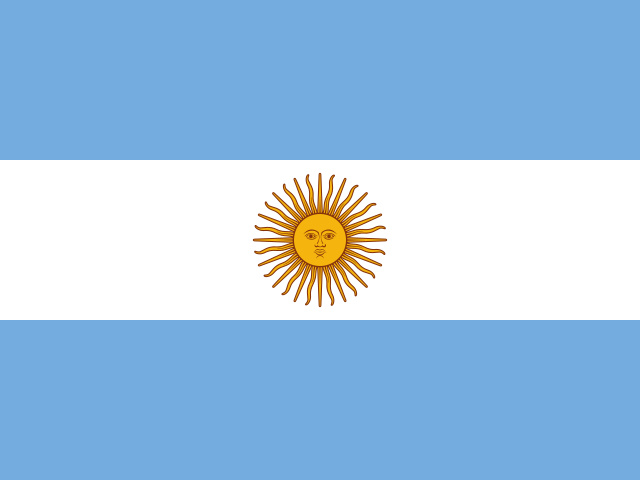
- Flag meaning
- Description: three equal horizontal bands of sky blue (top), white, and sky blue; centered in the white band is a radiant yellow sun with a human face that is known as the Sun of MayMeaning: the colors represent the clear skies and snow of the Andes Mountains; the sun commemorates the first mass demonstration in favor of independence on 25 May 1810, when the sun broke through the clouds; the sun is designed to look like Inti, the Incan god of the sun
- National symbols
- Sun of May (a sun-with-face symbol)
- National colours
- sky blue, white
- National anthem
- Title: "Himno Nacional Argentino" (Argentine National Anthem)Lyrics/music: Vicente LOPEZ y PLANES/Jose Blas PARERAHistory: adopted 1813; Vicente LOPEZ was inspired to write the anthem after watching a play about the 1810 May Revolution against Spain; a 1900 presidential decree declared that only the first and last verses would be considered official, rather than the original nine verses
- UNESCO World Heritage Sites
- Total World Heritage Sites: 12 (7 cultural, 5 natural)Selected World Heritage Site locales: Los Glaciares National Park (n); Jesuit Missions of the Guaranis (c); Iguazú National Park (n); Cueva de las Manos (c); Valdés Península (n); Ischigualasto/Talampaya National Parks (n); Jesuit Block and Estancias of Córdoba (c); Quebrada de Humahuaca (c); Qhapaq Ñan/Andean Road System (c)
Economy
- Overview
- large diversified economy; financial risks from debt obligations, rapid inflation, and reduced investor appetites; resource-rich, export-led growth model; increasing trade relations with China; G20 and OAS leader; tendency to nationalize businesses and under-report inflation
- GDP (PPP)
- $1.213 trillion (2024 est.)
- GDP per person (PPP)
- $26,500 (2024 est.)
- GDP growth
- -1.7% (2024 est.)
- Inflation
- 73.1% (2022 est.)
- Unemployment
- 7.9% (2024 est.)
- Below poverty line
- 41.7% (2023 est.)
- Farm products
- maize, soybeans, sugarcane, wheat, milk, sunflower seeds, barley, beef, potatoes, chicken (2023)
- Industries
- food processing, motor vehicles, consumer durables, textiles, chemicals and petrochemicals, printing, metallurgy, steel
- Exports
- $96.899 billion (2024 est.)
- Main exports
- soybean meal, corn, trucks, soybean oil, crude petroleum (2023)
- Export partners
- Brazil 18%, USA 9%, Chile 8%, China 8%, India 4% (2023)
- Main imports
- soybeans, vehicle parts/accessories, refined petroleum, natural gas, cars (2023)
- Import partners
- Brazil 23%, China 20%, USA 12%, Paraguay 5%, Germany 4% (2023)
- Money sent home from abroad
- 0.2% of GDP (2024 est.)
Energy, internet and transport
- Electricity access
- Electrification - total population: 100% (2022 est.)
- Electricity sources
- Fossil fuels: 61.5% of total installed capacity (2023 est.)Nuclear: 6.9% of total installed capacity (2023 est.)Solar: 2.5% of total installed capacity (2023 est.)Wind: 11% of total installed capacity (2023 est.)Hydroelectricity: 16.5% of total installed capacity (2023 est.)Biomass and waste: 1.7% of total installed capacity (2023 est.)
- Internet users
- Percent of population: 89% (2023 est.)
- Mobile phones
- Total subscriptions: 64.1 million (2024 est.)Subscriptions per 100 inhabitants: 140 (2024 est.)
- TV and radio
- one of South America's biggest media markets; dozens of TV networks, hundreds of radio stations, and more than 150 daily newspapers (2023)
- Airports
- 764 (2025)
- Railways
- Total: 17,866 km (2018)
- Merchant ships
- Total: 201 (2023)By type: container ship 1, bulk carrier 1 general cargo 8, oil tanker 33, other 158
Military and space
- Armed forces
- Armed Forces of the Argentine Republic (Fuerzas Armadas de la República Argentina): Argentine Army (Ejercito Argentino, EA), Navy of the Argentine Republic (Armada Republica, ARA; includes naval aviation and naval infantry), Argentine Air Force (Fuerza Aerea Argentina, FAA)Ministry of Security: Gendarmería Nacional Argentina (National Gendarmerie), Coast Guard (Prefectura Naval) (2025)
- Military spending
- 0.6% of GDP (2024 est.)
- Military service
- 18-24 years of age for voluntary military service for men and women; conscription suspended in 1995; citizens can still be drafted in times of crisis, national emergency, or war, or if the Defense Ministry is unable to fill all vacancies to keep the military functional (2025)
- Space programme
- has a national space program and a history in the development of space-related capabilities, including rockets and satellites; develops, builds, and operates communications, remote sensing (RS), and scientific satellites, often in partnership with other countries; developing additional satellites with more advanced payloads; contracts with commercial and other government space agencies for launches, but has a domestic rocket program and is developing space launch vehicle (SLV) capabilities; cooperates with a broad range of space agencies and industries, including those of Brazil, China, the European Space Agency and its member states (particularly France, Italy), and the US; also has a commercial space industry (2025)
- Space milestones
- 1961-1967 - launched first rocket (Alfa Centauro) and was first country in Latin America to send an animal into space1997 - first domestically built communications satellite (Nahuel-1A) launched on European satellite launch vehicle (SLV)2007 - launch of first sub-orbital test rocket for domestic SLV (Tronador) project2018 - first domestically built, synthetic-aperture-radar remote sensing satellite (SAOCOM 1A) launched by US2020-2021 - worked with Mexico to create the Latin American and Caribbean Space Agency (ALCE)2023 - signed US-led Artemis Accords outlining best practices for space exploration2025 - continued development of two-stage Tronador SLV
Global issues
- Refugees and displaced people
- Refugees: 9,175 (2024 est.)IDPs: 74 (2024 est.)Stateless persons: 34 (2024 est.)
Neighbouring countries
BoliviaBrazilChileParaguayUruguay
- Phone code
- +54
- Internet domain
- .ar