Burkina Faso
Burkina Faso
The Mossi kingdoms ruled for centuries. Known as Upper Volta until revolutionary leader Thomas Sankara renamed it in 1984. Now allied with Mali and Niger in the Alliance of Sahel States.
See Burkina Faso on the 3D globeTake a quiz
Ongoing: Sahel jihadist insurgency
Population24 million
Area272,967 km²
CapitalOuagadougou
RegionWestern Africa
Did you know?
- Its name means "land of upright people"
- Hosts Africa's biggest film festival
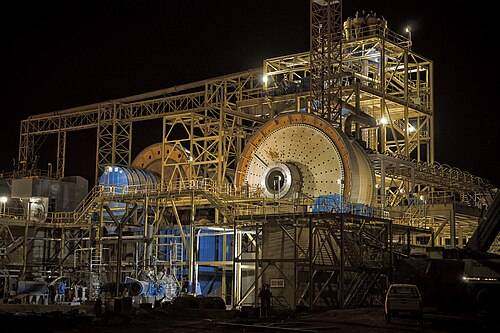
- Gold is the main export
Key facts about Burkina Faso
- Government
- Military junta (since 2022)
- Religion
- Islam ~64%, Christian ~26%
- Founded / independence
- 1960 (from France)
- Rich in
- Gold, cotton
- Languages
- French
French (official status reduced); Mooré, Dioula, Fula - Currency
- West African CFA franc (Fr)
- People are called
- Burkinabe
- Main cities
- Ouagadougou, Bobo-Dioulasso, Koudougou
Timeline of Burkina Faso
- 1100sMossi kingdoms
- 1896French conquest
- 1960Independence
- 1984Renamed by Sankara
- 2022Two coups
Places to see in Burkina Faso
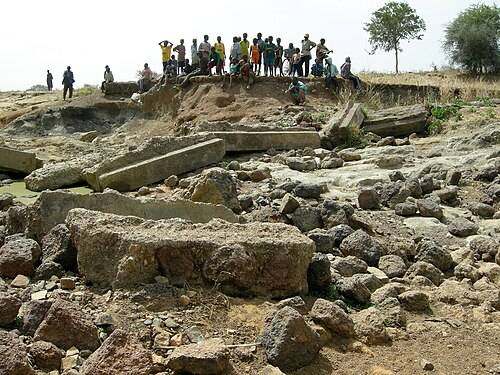
- Ruins of Loropéni
- Sindou Peaks
- Nazinga Ranch
- Grand Mosque of Bobo-Dioulasso
Food and drink
Tô (millet porridge) · riz gras · brochettes
Culture and famous for
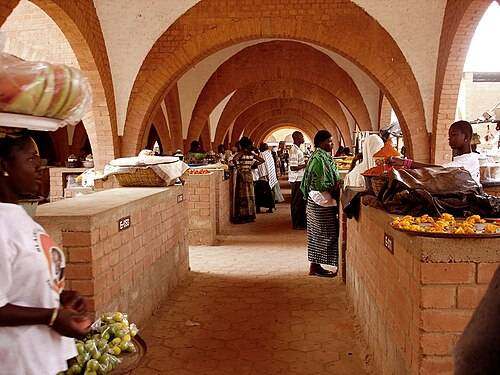
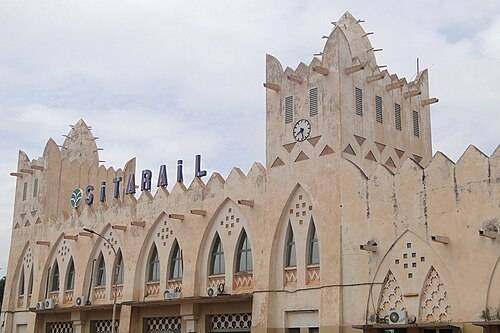
FESPACO, Africa's largest film festival; mud architecture; masks
Popular sports
Football, cycling
Geography and climate
- Highest point
- Mount Tenakourou, 749 m
- Rivers, lakes and seas
- Volta rivers (Black, White, Red)
- Climate
- Sahelian
- Coastline
- Landlocked
- Population density
- 88 people per km²
Wars and conflicts
- Jihadist insurgency since 2015 (thousands killed)
- coups 2022
Alliances and memberships
Military and security
Political unions and regional organisations
African UnionOrganisation of Islamic Cooperation
Burkina Faso in depth
Detailed facts from the CIA World Factbook (public domain, latest edition).
Overview
- History in brief
- Many of Burkina Faso’s ethnic groups arrived in the region between the 12th and 15th centuries. The Gurma and Mossi peoples established several of the largest kingdoms in the area and used horse-mounted warriors in military campaigns. Of the various Mossi kingdoms, the most powerful were Ouagadougou and Yatenga. In the late 19th century, European states competed for control of the region. France eventually conquered the area and established it as a French protectorate.The country achieved independence from France in 1960 and changed its name to Burkina Faso in 1984. Repeated military coups were common in the country’s first few decades. In 1987 Blaise COMPAORE deposed the president, established a government, and ruled for 27 years. In 2014, COMPAORE resigned after protests against his repeated efforts to amend the constitution's two-term presidential limit. An interim administration led a year-long transition, organizing presidential and legislative elections. In 2015, Roch Marc Christian KABORE was elected president, and he was reelected in 2020. In 2022, the military conducted two takeovers: In January, army colonel Paul Henri DAMIBA overthrew KABORE in a coup d'etat, and then in September, army captain Ibrahim TRAORE deposed DAMIBA and declared himself transition president. The transition government planned to hold elections by July 2024, but they may be delayed due to security concerns.Terrorist groups -- including groups affiliated with Al-Qa’ida and the Islamic State -- began attacks in the country in 2016 and conducted attacks in the capital in 2016, 2017, and 2018. By early 2023, insecurity in Burkina Faso had displaced more than 2 million people and led to significant jumps in humanitarian needs and food insecurity. In addition to terrorism, the country faces a myriad of problems including high population growth, recurring drought, pervasive and perennial food insecurity, and limited natural resources. It is one of the world’s poorest countries.
Geography
- Location
- Western Africa, north of Ghana
- Size compared
- slightly larger than Colorado
- Land borders
- Total: 3,611 kmBorder countries: Benin 386 km; Cote d'Ivoire 545 km; Ghana 602 km; Mali 1325 km; Niger 622 km; Togo 131 km
- Coastline
- 0 km (landlocked)
- Climate
- three climate zones including a hot tropical savanna with a short rainy season in the southern half, a tropical hot semi-arid steppe climate typical of the Sahel region in the northern half, and small area of hot desert in the very north of the country bordering the Sahara Desert
- Terrain
- mostly flat to dissected, undulating plains; hills in the west and southeast; occupies an extensive plateau with savanna that is grassy in the north and gradually gives way to sparse forests in the south
- Elevation
- Highest point: Tena Kourou 749 mLowest point: Mouhoun (Black Volta) River 200 mMean elevation: 297 m
- Natural resources
- gold, manganese, zinc, limestone, marble, phosphates, pumice, salt
- Major rivers
- Volta river source (shared with Ghana [m]) - 1,600 kmNote: [s] after country name indicates river source; [m] after country name indicates river mouth
- Natural hazards
- recurring droughts
- Notes
- landlocked savanna cut by the three principal rivers, the Black, Red, and White Voltas
- Environmental issues
- droughts; desertification; overgrazing; soil degradation; deforestation (2019)
People and society
- Population
- Total: 23,490,300 (2025 est.)Male: 11,529,979Female: 11,960,321
- Nationality
- Noun: Burkinabe (singular and plural)Adjective: Burkinabe
- Ethnic groups
- Mossi 53.7%, Fulani (Peuhl) 6.8%, Gurunsi 5.9%, Bissa 5.4%, Gurma 5.2%, Bobo 3.4%, Senufo 2.2%, Bissa 1.5%, Lobi 1.5%, Tuareg/Bella 0.1%, other 12.8%, foreign 0.7% (2021 est.)
- Languages
- Mossi 52.9%, Fula 7.8%, Gourmantche 6.8%, Dyula 5.7%, Bissa 3.3%, Gurunsi 3.2%, French (official) 2.2%, Bwamu 2%, Dagara 2%, San 1.7%, Marka 1.6%, Bobo 1.5%, Senufo 1.5%, Lobi 1.2%, other 6.6% (2019 est.)
- Religions
- Muslim 63.8%, Roman Catholic 20.1%, Animiste 9%, Protestant 6.2%, other 0.2%, none 0.7% (2019 est.)
- Median age
- Total: 19 years (2025 est.)Male: 17.9 yearsFemale: 19.5 years
- Population growth
- 2.39% (2025 est.)
- Life expectancy
- Total population: 64.2 years (2024 est.)Male: 62.3 yearsFemale: 66.1 years
- Children per woman
- 4.02 children born/woman (2025 est.)
- Urbanization
- Urban population: 32.5% of total population (2023)Rate of urbanization: 4.75% annual rate of change (2020-25 est.)
- Largest cities
- 3.204 million OUAGADOUGOU (capital), 1.129 million Bobo-Dioulasso (2023)
- Literacy
- Total population: 41.4% (2023 est.)Male: 48.4% (2023 est.)Female: 35.7% (2023 est.)
- Years in school
- Total: 7 years (2023 est.)Male: 7 years (2023 est.)Female: 7 years (2023 est.)
Government
- Official names
- Conventional long form: noneConventional short form: Burkina FasoLocal long form: noneLocal short form: Burkina FasoFormer: Upper Volta, Republic of Upper VoltaEtymology: name translates as "Land of the Worthy Men," from the Dyula words burkina, or "worthy," and faso, which means "land" or literally "father village," from fa, or "father," and so, or "village"
- Government type
- presidential republic
- Capital
- Name: OuagadougouGeographic coordinates: 12 22 N, 1 31 WTime difference: UTC 0 (5 hours ahead of Washington, DC, during Standard Time)Etymology: Ouagadougou is a Francophone spelling of the native name "Wogodogo," which may come from the personal name "Waga" or "Woga" and the Dyula word "dugu," meaning "village"
- Regions
- 13 regions; Boucle du Mouhoun, Cascades, Centre, Centre-Est, Centre-Nord, Centre-Ouest, Centre-Sud, Est, Hauts-Bassins, Nord, Plateau-Central, Sahel, Sud-Ouest
- Independence
- 5 August 1960 (from France)
- National holiday
- Republic Day, 11 December (1958)
- Constitution
- History: several previous; latest approved by referendum 2 June 1991, adopted 11 June 1991, temporarily suspended late October to mid-November 2014; initial draft of a new constitution to usher in the new republic was completed in January 2017 and a final draft was submitted to the government in December 2017; a constitutional referendum originally scheduled for adoption in March 2019 was postponed; on 1 March 2022 a transition charter was adopted, allowing military authorities to rule for three years and barring the transitional president from being an electoral candidate after the transitionAmendment process: proposed by the president, by a majority of National Assembly membership, or by petition of at least 30,000 eligible voters submitted to the Assembly; passage requires at least three-fourths majority vote in the Assembly; failure to meet that threshold requires majority voter approval in a referendum; constitutional provisions on the form of government, the multiparty system, and national sovereignty cannot be amended
- Legal system
- civil law based on the French model and customary law
- Voting age
- 18 years of age; universal
- Flag meaning
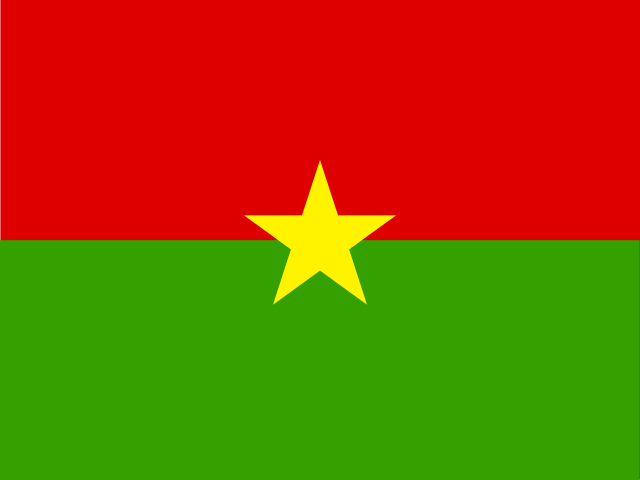
- Description: two equal horizontal bands of red (top) and green, with a five-pointed yellow star in the centerMeaning: red stands for the country's struggle for independence, green for hope and abundance, and yellow for the country's mineral wealthHistory: uses the colors of the Pan-African movement
- National symbols
- white stallion
- National colours
- red, yellow, green
- National anthem
- Title: "Le Ditanye" (Anthem of Victory)Lyrics/music: Thomas SANKARAHistory: adopted 1974; also known as "Une Seule Nuit"(One Single Night) ; written by the country's former president, an avid guitar player
- UNESCO World Heritage Sites
- Total World Heritage Sites: 4 (3 cultural, 1 natural)Selected World Heritage Site locales: Ruins of Loropéni (c); Ancient Ferrous Metallurgy Sites of Burkina Faso (c); W-Arly-Pendjari Complex (n); Royal Court of Tiébélé (c)
Economy
- Overview
- highly agrarian, low-income economy; limited natural resources; widespread poverty; terrorism disrupting potential economic activity; improving trade balance via increases in gold exports; economy inflating after prior deflation; growing public debt but still manageable
- GDP (PPP)
- $60.001 billion (2024 est.)
- GDP per person (PPP)
- $2,500 (2024 est.)
- GDP growth
- 5% (2024 est.)
- Inflation
- 4.2% (2024 est.)
- Unemployment
- 5.2% (2024 est.)
- Below poverty line
- 43.2% (2021 est.)
- Farm products
- maize, sorghum, fruits, vegetables, millet, cowpeas, cotton, groundnuts, sugarcane, rice (2023)
- Industries
- cotton lint, beverages, agricultural processing, soap, cigarettes, textiles, gold
- Exports
- $5.912 billion (2023 est.)
- Main exports
- gold, cotton, oil seeds, coconuts/brazil nuts/cashews, cement (2023)
- Export partners
- Switzerland 72%, UAE 10%, India 3%, Mali 3%, Cote d'Ivoire 2% (2023)
- Main imports
- refined petroleum, plastic products, cement, electricity, packaged medicine (2023)
- Import partners
- Cote d'Ivoire 14%, China 13%, Ghana 9%, Russia 9%, France 7% (2023)
- Money sent home from abroad
- 2.9% of GDP (2023 est.)
Energy, internet and transport
- Electricity access
- Electrification - total population: 19.5% (2022 est.)Electrification - urban areas: 60.5%Electrification - rural areas: 3.4%
- Electricity sources
- Fossil fuels: 82.9% of total installed capacity (2023 est.)Solar: 5.4% of total installed capacity (2023 est.)Hydroelectricity: 6.7% of total installed capacity (2023 est.)Biomass and waste: 5.1% of total installed capacity (2023 est.)
- Internet users
- Percent of population: 17% (2023 est.)
- Mobile phones
- Total subscriptions: 26.9 million (2022 est.)Subscriptions per 100 inhabitants: 119 (2022 est.)
- TV and radio
- 14 digital TV channels, of which 2 are state-owned; over 140 national radio stations (commercial, religious, community), including a national and regional state-owned network; state-owned Radio Burkina and private Radio Omega are among the most widely available and broadcast in both French and local languages (2019)
- Airports
- 49 (2025)
- Railways
- Total: 622 km (2014)Narrow gauge: 622 km (2014) 1.000-m gauge
Military and space
- Armed forces
- Armed Forces of Burkina Faso (FABF; aka National Armed Forces (FAN), aka Defense and Security Forces (Forces de Défense et de Sécurité or FDS)): Army of Burkina Faso, Air Force of Burkina Faso, National Gendarmerie, National Fire Brigade (Brigade Nationale de Sapeurs-Pompiers or BNSP); Homeland Defense Volunteers (Forcés de Volontaires de Défense pour la Patrie or VDP)Ministry of Territorial Administration, Decentralization and Security (Ministère de l'Administration Territoriale, de la Décentralisation et de la Sécurité): National Police of Burkina Faso (includes Border Police, Judicial Police, and Intervention Units, as well as State and Public Security forces) (2025)
- Military spending
- 4.5% of GDP (2024 est.)
- Military service
- generally, 18-35 years of age for voluntary military service for men and women; citizens 18-77 years of age are eligible to volunteer for the VDP (2025)
Global issues
- Refugees and displaced people
- Refugees: 41,408 (2024 est.)IDPs: 2,065,358 (2024 est.)
Neighbouring countries
BeninIvory CoastGhanaMaliNigerTogo
- Phone code
- +226
- Internet domain
- .bf