Niger
Republic of Niger
Part of the Songhai and Kanem-Bornu empires. The 2023 coup expelled French and US troops and turned toward Russia.
See Niger on the 3D globeTake a quiz
Ongoing: Sahel jihadist insurgency, Nigeria insurgencies
Population28 million
Area1,267,000 km²
CapitalNiamey
RegionWestern Africa
Did you know?
- About 80% desert
- Has one of the world's highest birth rates
- Large dinosaur fossils have been found in the Ténéré
Key facts about Niger
- Government
- Military junta (since 2023)
- Religion
- Sunni Islam ~99%
- Founded / independence
- 1960 (from France)
- Rich in
- Uranium, oil, gold
- Languages
- French
Hausa, Zarma, Fula, Tamasheq; French status reduced - Currency
- West African CFA franc (Fr)
- People are called
- Nigerien
- Main cities
- Niamey, Zinder, Maradi, Agadez
Timeline of Niger
- 1500Songhai Empire
- 1922French colony
- 1960Independence
- 2010Coup
- 2023Coup
Places to see in Niger
- Agadez Grand Mosque
- Aïr and Ténéré reserves
- W National Park
- Dinosaur fossil beds
Food and drink
Djerma stew · tuwo · brochettes
Culture and famous for
Tuareg silver jewellery; Gerewol festival of the Wodaabe
Popular sports
Football, traditional wrestling
Geography and climate
- Highest point
- Mont Idoukal-n-Taghès, 2,022 m
- Rivers, lakes and seas
- Niger River
- Climate
- Desert and Sahel
- Coastline
- Landlocked
- Population density
- 22 people per km²
Wars and conflicts
- Tuareg rebellions
- jihadist insurgency
- 2023 coup
Empires and states that once stood here
Kingdom of Benin c. 1180–1897Songhai Empire c. 1430–1591Biafra 1967–1970
Alliances and memberships
Military and security
Political unions and regional organisations
African UnionOrganisation of Islamic Cooperation
Niger in depth
Detailed facts from the CIA World Factbook (public domain, latest edition).
Overview
- History in brief
- Nomadic peoples from the Saharan north and agriculturalists from the south settled present-day Niger. The Taureg kingdom of Takedda was one of the largest kingdoms in the north and played a prominent role in regional trade in the 14th century. In the south, the primary ethnic groups were the Songhai-Zarma in the west, the Hausa in the center, and the Kanuri in the east. When European colonizers arrived in the 19th century, the region was an assemblage of disparate local kingdoms. In the late 19th century, the British and French agreed to partition the middle regions of the Niger River, and France began its conquest of what would become the colony of Niger. France experienced determined local resistance -- particularly during the Tuareg uprising (1916-1917) -- but established a colonial administration in 1922. After achieving independence from France in 1960, Niger experienced single-party or military rule until 1991, when political pressure forced General Ali SAIBOU to allow multiparty elections. Political infighting and democratic backsliding led to coups in 1996 and 1999. In 1999, military officers restored democratic rule and held elections that brought Mamadou TANDJA to power. TANDJA was reelected in 2004 and spearheaded a 2009 constitutional amendment allowing him to extend his presidential term. In 2010, military officers led another coup that deposed TANDJA. ISSOUFOU Mahamadou was elected in 2011 and reelected in 2016. In 2021, BAZOUM Mohamed won the presidential election, marking Niger’s first transition from one democratically elected president to another. Nonetheless, a military junta led by General Abdourahamane TIANI once again seized power in July 2023, detaining President BAZOUM and announcing the creation of a National Council for the Safeguarding of the Homeland (CNSP).Niger is one of the poorest countries in the world with minimal government services and insufficient funds to develop its resource base. It is ranked fourth to last in the world on the UN Development Program's Human Development Index of 2023/2024. The largely agrarian and subsistence-based economy is frequently disrupted by extended droughts common to the Sahel region of Africa. The Nigerien Government continues its attempts to diversify the economy through increased oil production and mining projects. In addition, Niger is facing increased security concerns on its borders from various external threats including insecurity in Libya, spillover from the conflict and terrorism
Geography
- Location
- Western Africa, southeast of Algeria
- Size compared
- slightly less than twice the size of Texas
- Land borders
- Total: 5,834 kmBorder countries: Algeria 951 km; Benin 277 km; Burkina Faso 622 km; Chad 1,196 km; Libya 342 km; Mali 838 km; Nigeria 1,608 km
- Coastline
- 0 km (landlocked)
- Climate
- desert; mostly hot, dry, dusty; tropical in extreme south
- Terrain
- predominately desert plains and sand dunes; flat to rolling plains in south; hills in north
- Elevation
- Highest point: Idoukal-n-Taghes 2,022 mLowest point: Niger River 200 mMean elevation: 474 m
- Natural resources
- uranium, coal, iron ore, tin, phosphates, gold, molybdenum, gypsum, salt, petroleum
- Major rivers
- Niger (shared with Guinea [s], Mali, Benin, and Nigeria [m]) - 4,200 kmNote: [s] after country name indicates river source; [m] after country name indicates river mouth
- Major lakes
- Fresh water lake(s): Lake Chad (endorheic lake shared with Chad, Nigeria, and Cameroon) - 10,360-25,900 sq kmnote - area varies by season and year to year
- Natural hazards
- recurring droughts
- Notes
- landlocked; one of the hottest countries in the world; northern four-fifths is desert, southern one-fifth is savanna that is suitable for livestock and limited agriculture
- Environmental issues
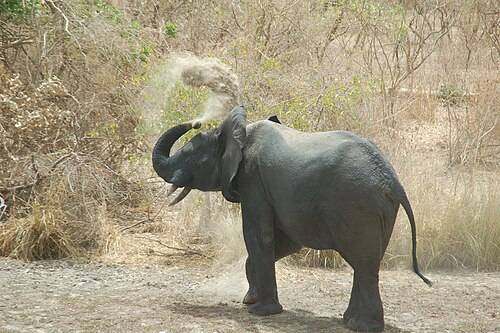
- overgrazing; soil erosion; deforestation; desertification; contaminated water; inadequate potable water; wildlife populations (such as elephant, hippopotamus, giraffe, and lion) threatened by poaching and habitat destruction
People and society
- Population
- Total: 27,322,555 (2025 est.)Male: 13,542,629Female: 13,779,926
- Nationality
- Noun: Nigerien(s)Adjective: Nigerien
- Ethnic groups
- Hausa 53.1%, Zarma/Songhai 21.2%, Tuareg 11%, Fulani (Peuhl) 6.5%, Kanuri 5.9%, Gurma 0.8%, Arab 0.4%, Tubu 0.4%, other/unavailable 0.9% (2006 est.)
- Languages
- Hausa, Zarma, French (official), Fufulde, Tamashek, Kanuri, Gurmancema, Tagdal
- Religions
- Muslim 95.5%, ethnic religionist 4.1%, Christian 0.3%, agnostics and other 0.1% (2020 est.)
- Median age
- Total: 15.3 years (2025 est.)Male: 14.9 yearsFemale: 15.6 years
- Population growth
- 3.65% (2025 est.)
- Life expectancy
- Total population: 60.9 years (2024 est.)Male: 59.3 yearsFemale: 62.5 years
- Children per woman
- 6.55 children born/woman (2025 est.)
- Urbanization
- Urban population: 17.1% of total population (2023)Rate of urbanization: 4.72% annual rate of change (2020-25 est.)
- Largest cities
- 1.437 million NIAMEY (capital) (2023)
- Literacy
- Total population: 35.6% (2022 est.)Male: 47.9% (2022 est.)Female: 25.7% (2022 est.)
- Years in school
- Total: 6 years (2017 est.)Male: 7 years (2017 est.)Female: 6 years (2017 est.)
Government
- Official names
- Conventional long form: Republic of NigerConventional short form: NigerLocal long form: République du NigerLocal short form: NigerEtymology: named for the Niger River that passes through the southwest of the country; the name of the river probably comes from the local Tuareg name, egereou n-igereouen (big rivers)
- Government type
- formerly, semi-presidential republic
- Capital
- Name: NiameyGeographic coordinates: 13 31 N, 2 07 ETime difference: UTC+1 (6 hours ahead of Washington, DC, during Standard Time)Etymology: the origin of the name is unclear; one of many stories says that an African chief told his seven slaves "Wa niammane," meaning "stay here," and the name was later shortened to its present form
- Regions
- 7 regions (régions, singular - région) and 1 capital district* (communauté urbaine); Agadez, Diffa, Dosso, Maradi, Niamey*, Tahoua, Tillaberi, Zinder
- Independence
- 3 August 1960 (from France)
- National holiday
- Republic Day, 18 December (1958)
- Constitution
- History: several previous; passed by referendum 31 October 2010, entered into force 25 November 2010Amendment process: formerly proposed by the president of the republic or the National Assembly; consideration of amendments requires at least three-fourths majority vote by the Assembly; passage requires at least four-fifths majority vote; if disapproved, the proposed amendment is dropped or submitted to a referendum; constitutional articles on the form of government, the multiparty system, the separation of state and religion, disqualification of Assembly members, amendment procedures, and amnesty of participants in the 2010 coup cannot be amended
- Legal system
- Note: following the 26 July 2023 military coup, the National Council for the Safeguard of the Homeland assumed control of all government institutions and rules by decree; formerly, mixed system of civil law, based on French civil law, Islamic law, and customary law
- Voting age
- 18 years of age; universal
- Flag meaning
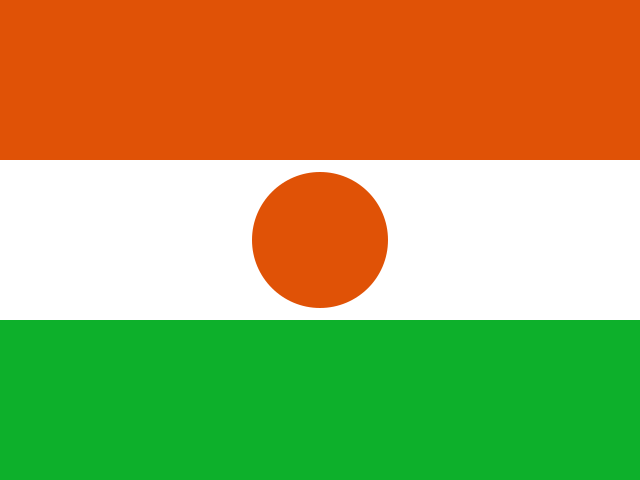
- Description: three equal horizontal bands of orange (top), white, and green, with an orange disk centered on the white bandMeaning: orange stands for the northern Sahara regions, white for purity and innocence, and green for hope and the fertile and productive southern and western areas, as well as the Niger River; the orange disc represents the sun and the people's sacrifices
- National symbols
- zebu
- National colours
- orange, white, green
- National anthem
- Title: "L'Honneur de la Patrie" (The Honor of the Fatherland)Lyrics/music: a government-appointed committee wrote both the lyrics and the musicHistory: adopted 2023; replaced previous national anthem, "La Nigérienne" (The Nigerien), that was adopted in 1961
- UNESCO World Heritage Sites
- Total World Heritage Sites: 3 (1 cultural, 2 natural)Selected World Heritage Site locales: Air and Ténéré Natural Reserves (n); W-Arly-Pendjari Complex (n); Historic Agadez (c)
Economy
- Overview
- low-income Sahel economy; major instability and humanitarian crises limit economic activity; COVID-19 eliminated recent antipoverty gains; economy rebounding since December 2020 Nigerian border reopening and new investments; uranium resource rich
- GDP (PPP)
- $47.921 billion (2024 est.)
- GDP per person (PPP)
- $1,800 (2024 est.)
- GDP growth
- 8.4% (2024 est.)
- Inflation
- 9.1% (2024 est.)
- Unemployment
- 0.4% (2024 est.)
- Below poverty line
- 45.5% (2021 est.)
- Farm products
- millet, cowpeas, sorghum, onions, milk, sugarcane, cabbages, cassava, groundnuts, tomatoes (2023)
- Industries
- uranium mining, petroleum, cement, brick, soap, textiles, food processing, chemicals, slaughterhouses
- Exports
- $1.223 billion (2023 est.)
- Main exports
- gold, oil seeds, uranium and thorium ore, radioactive chemicals, refined petroleum (2023)
- Export partners
- UAE 31%, France 23%, China 18%, India 6%, Sweden 5% (2023)
- Main imports
- rice, aircraft parts, iron structures, refined petroleum, centrifuges (2023)
- Import partners
- China 26%, France 15%, India 12%, Nigeria 7%, UAE 6% (2023)
- Money sent home from abroad
- 3.7% of GDP (2023 est.)
Energy, internet and transport
- Electricity access
- Electrification - total population: 19.5% (2022 est.)Electrification - urban areas: 66.1%Electrification - rural areas: 7.7%
- Electricity sources
- Fossil fuels: 97% of total installed capacity (2023 est.)Solar: 3% of total installed capacity (2023 est.)
- Internet users
- Percent of population: 23% (2023 est.)
- Mobile phones
- Total subscriptions: 17.2 million (2023 est.)Subscriptions per 100 inhabitants: 66 (2023 est.)
- TV and radio
- state-run TV station; 3 private TV stations provide a mix of local and foreign programming; state-run radio has the only radio station with national coverage; about 30 private local radio stations; as many as 100 community radio stations; transmissions of multiple international broadcasters are available
- Airports
- 26 (2025)
Military and space
- Armed forces
- Nigerien Armed Forces (Forces Armees Nigeriennes, FAN): Army, Nigerien Air Force, Niger GendarmerieMinistry of Interior, Public Safety and Decentralization: Niger National Guard, National Police (2025)
- Military spending
- 2.2% of GDP (2024 est.)
- Military service
- 18 is the legal minimum age for selective compulsory or voluntary military service for unmarried men and women; 24-month service term (2025)
Global issues
- Refugees and displaced people
- Refugees: 421,795 (2024 est.)IDPs: 891,565 (2024 est.)
Neighbouring countries
AlgeriaBeninBurkina FasoChadLibyaMaliNigeria
- Phone code
- +227
- Internet domain
- .ne