Ivory Coast
Republic of Côte d'Ivoire · Côte d'Ivoire
The "Ivorian miracle" made it West Africa's economic star. Two civil wars followed disputes over identity and elections.
See Ivory Coast on the 3D globeTake a quiz
Population32 million
Area322,463 km²
CapitalYamoussoukro
RegionWestern Africa
Did you know?
- Produces about 40% of the world's cocoa
- Yamoussoukro's basilica is one of the largest churches in the world
- Abidjan is the de facto economic capital
Key facts about Ivory Coast
- Government
- Presidential republic
- Religion
- Islam ~42%, Christian ~40%
- Founded / independence
- 1960 (from France)
- Rich in
- Cocoa (world's largest producer), coffee, cashews, oil
- Languages
- French
French; Dioula, Baoulé, Bété - Currency
- West African CFA franc (Fr)
- People are called
- Ivorian
- Main cities
- Abidjan, Bouaké, Yamoussoukro, Daloa
Timeline of Ivory Coast
- 1893French colony
- 1960Independence
- 1983Yamoussoukro made capital
- 2002Civil war
- 2011Second civil war ends
Places to see in Ivory Coast
- Basilica of Our Lady of Peace, Yamoussoukro
- Grand-Bassam
- Taï National Park
- Comoé National Park
Food and drink
Attiéké with fish · aloko (fried plantain) · kedjenou
Culture and famous for
Coupé-décalé music; Baoulé and Dan masks
Popular sports
Football (Didier Drogba)
Geography and climate
- Highest point
- Mount Nimba, 1,752 m
- Rivers, lakes and seas
- Bandama, Comoé
- Climate
- Tropical
- Coastline
- Has a sea coast
- Population density
- 99 people per km²
Wars and conflicts
- Civil wars 2002–07 and 2010–11
Alliances and memberships
Political unions and regional organisations
African UnionECOWASOrganisation of Islamic Cooperation
Ivory Coast in depth
Detailed facts from the CIA World Factbook (public domain, latest edition).
Overview
- History in brief
- Various small kingdoms ruled the area of Cote d'Ivoire between the 15th and 19th centuries, when European explorers arrived and then began to expand their presence. In 1844, France established a protectorate. During this period, many of these kingdoms and tribes fought to maintain their cultural identities -- some well into the 20th century. For example, the Sanwi kingdom -- originally founded in the 17th century -- tried to break away from Cote d’Ivoire and establish an independent state in 1969.Cote d’Ivoire achieved independence from France in 1960 but has maintained close ties. Foreign investment and the export and production of cocoa drove economic growth that led Cote d’Ivoire to become one of the most prosperous states in West Africa. Then in 1999, a military coup overthrew the government, and a year later, junta leader Robert GUEI held rigged elections and declared himself the winner. Popular protests forced him to step aside, and Laurent GBAGBO was elected. Ivoirian dissidents and members of the military launched a failed coup in 2002 that developed into a civil war. In 2003, a cease-fire resulted in rebels holding the north, the government holding the south, and peacekeeping forces occupying a buffer zone in the middle. In 2007, President GBAGBO and former rebel leader Guillaume SORO signed an agreement in which SORO joined GBAGBO's government as prime minister. The two agreed to reunite the country by dismantling the buffer zone, integrating rebel forces into the national armed forces, and holding elections.In 2010, Alassane Dramane OUATTARA won the presidential election, but GBAGBO refused to hand over power, resulting in five months of violent conflict. Armed OUATTARA supporters and UN and French troops eventually forced GBAGBO to step down in 2011. OUATTARA won a second term in 2015 and a controversial third term in 2020 -- despite the two-term limit in the Ivoirian constitution -- in an election boycotted by the opposition. Through political compromise with OUATTARA, the opposition participated peacefully in 2021 legislative elections and won a substantial minority of seats. Also in 2021, the International Criminal Court in The Hague ruled on a final acquittal for GBAGBO, who was on trial for crimes against humanity, paving the way for GBAGBO’s return to Abidjan the same year. GBAGBO has publicly met with OUATTARA since his return as a demonstration of political reconciliation.
Geography
- Location
- Western Africa, bordering the North Atlantic Ocean, between Ghana and Liberia
- Size compared
- slightly larger than New Mexico
- Land borders
- Total: 3,458 kmBorder countries: Burkina Faso 545 km; Ghana 720 km; Guinea 816 km; Liberia 778 km; Mali 599 km
- Coastline
- 515 km
- Climate
- tropical along coast, semiarid in far north; three seasons - warm and dry (November to March), hot and dry (March to May), hot and wet (June to October)
- Terrain
- mostly flat to undulating plains; mountains in northwest
- Elevation
- Highest point: Monts Nimba 1,752 mLowest point: Gulf of Guinea 0 mMean elevation: 250 m
- Natural resources
- petroleum, natural gas, diamonds, manganese, iron ore, cobalt, bauxite, copper, gold, nickel, tantalum, silica sand, clay, cocoa beans, coffee, palm oil, hydropower
- Major lakes
- Salt water lake(s): Lagune Aby - 780 sq km
- Natural hazards
- coast has heavy surf and no natural harbors; during the rainy season torrential flooding is possible
- Notes
- most of the inhabitants live along the sandy coastal region; apart from the capital area, the forested interior is sparsely populated
- Environmental issues
- deforestation; water pollution from sewage and from industrial, mining, and agricultural effluents
People and society
- Population
- Total: 31,855,971 (2025 est.)Male: 15,992,906Female: 15,863,065
- Nationality
- Noun: Ivoirian(s)Adjective: Ivoirian
- Ethnic groups
- Akan 38%, Voltaique or Gur 22%, Northern Mande 22%, Kru 9.1%, Southern Mande 8.6%, other 0.3% (2021 est.)
- Languages
- French (official), 60 native dialects of which Dioula is the most widely spokenMajor-language sample(s): The World Factbook, une source indispensable d'informations de base. (French)The World Factbook, the indispensable source for basic information.
- Religions
- Muslim 42.9%, Catholic 17.2%, Evangelical 11.8%, Methodist 1.7%, other Christian 3.2%, animist 3.6%, other religion 0.5%, none 19.1% (2014 est.)
- Median age
- Total: 20 years (2025 est.)Male: 21.2 yearsFemale: 21.2 years
- Population growth
- 2.33% (2025 est.)
- Life expectancy
- Total population: 63.2 years (2024 est.)Male: 60.9 yearsFemale: 65.4 years
- Children per woman
- 3.85 children born/woman (2025 est.)
- Urbanization
- Urban population: 53.1% of total population (2023)Rate of urbanization: 3.38% annual rate of change (2020-25 est.)
- Largest cities
- 231,000 YAMOUSSOUKRO (capital) (2018), 5.686 million ABIDJAN (seat of government) (2023)
- Literacy
- Total population: 50% (2021 est.)Male: 60.2% (2021 est.)Female: 40.3% (2021 est.)
- Years in school
- Total: 11 years (2023 est.)Male: 11 years (2023 est.)Female: 11 years (2023 est.)
Government
- Official names
- Conventional long form: Republic of Côte d'IvoireConventional short form: Côte d'IvoireLocal long form: République de Côte d'IvoireLocal short form: Cote d'IvoireFormer: Ivory CoastEtymology: name, which means "Ivory Coast" in French, reflects the ivory trade in the region from the 15th to 17th centuries; the French version of the name has been used internationally since 1986, at the country's request
- Government type
- presidential republic
- Capital
- Name: Yamoussoukro (legislative capital), Abidjan (administrative and economic capital); note - the US Embassy is in AbidjanGeographic coordinates: 6 49 N, 5 16 WTime difference: UTC 0 (5 hours ahead of Washington, DC, during Standard Time)Etymology: formerly a village named N'Gokro, Yamoussoukro is named after Queen YAMOUSSOU, who ruled during the early 20th century; Abidjan's name may have come from a misunderstanding when a French explorer asked a group of women the name of the village -- thinking it was a question about what they were doing, they replied "t'chan m’bi djan," which in the Ebrie language means "I return from cutting leaves," so the explorer recorded the name of the locale as Abidjan
- Regions
- 12 districts and 2 autonomous districts*; Abidjan*, Bas-Sassandra, Comoe, Denguele, Goh-Djiboua, Lacs, Lagunes, Montagnes, Sassandra-Marahoue, Savanes, Vallée du Bandama, Woroba, Yamoussoukro*, Zanzan
- Independence
- 7 August 1960 (from France)
- National holiday
- Independence Day, 7 August (1960)
- Constitution
- History: previous 1960, 2000; latest draft completed 24 September 2016, approved by the National Assembly 11 October 2016, approved by referendum 30 October 2016, promulgated 8 November 2016Amendment process: proposed by the president of the republic or by Parliament; consideration of drafts or proposals requires an absolute majority vote by the parliamentary membership; passage of amendments affecting presidential elections, presidential term of office and vacancies, and amendment procedures requires approval by absolute majority in a referendum; passage of other proposals by the president requires at least four-fifths majority vote by Parliament; constitutional articles on the sovereignty of the state and its republican and secular form of government cannot be amended
- Legal system
- civil law system based on the French civil code; Constitutional Chamber of the Supreme Court reviews legislation
- Voting age
- 18 years of age; universal
- Flag meaning
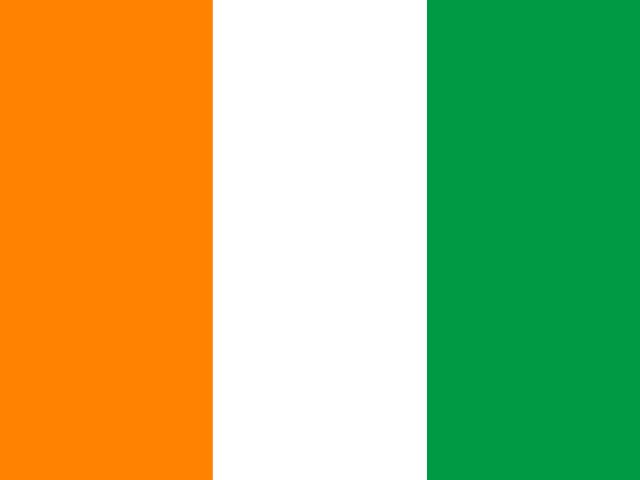
- Description: three equal vertical bands of orange (left side), white, and greenMeaning: orange stands for the savannah and fertility, white for peace and unity, green for the forests of the south and the hope for a bright future; design based on France's flag
- National symbols
- elephant
- National colours
- orange, white, green
- National anthem
- Title: "L'Abidjanaise" (Song of Abidjan)Lyrics/music: Mathieu EKRA, Joachim BONY, and Pierre Marie COTY/Pierre Marie COTY and Pierre Michel PANGOHistory: adopted 1960; named after the former capital city of Abidjan
- UNESCO World Heritage Sites
- Total World Heritage Sites: 5 (2 cultural, 3 natural)Selected World Heritage Site locales: Comoé National Park (n); Historic Grand-Bassam (c); Mount Nimba Strict Nature Reserve (n); Sudanese-style Mosques (c); Taï National Park (n)
Economy
- Overview
- one of West Africa’s most influential, stable, and rapidly developing economies; poverty declines in urban but increases in rural areas; strong construction sector and increasingly diverse economic portfolio; increasing but manageable public debt; large labor force in agriculture
- GDP (PPP)
- $215.018 billion (2024 est.)
- GDP per person (PPP)
- $6,700 (2024 est.)
- GDP growth
- 6% (2024 est.)
- Inflation
- 3.5% (2024 est.)
- Unemployment
- 2.3% (2024 est.)
- Below poverty line
- 37.5% (2021 est.)
- Farm products
- yams, cassava, oil palm fruit, cocoa beans, sugarcane, plantains, rice, rubber, maize, cashews (2023)
- Industries
- foodstuffs, beverages; wood products, oil refining, gold mining, truck and bus assembly, textiles, fertilizer, building materials, electricity
- Exports
- $17.211 billion (2022 est.)
- Main exports
- gold, cocoa beans, rubber, refined petroleum, coconuts/brazil nuts/cashews (2023)
- Export partners
- Switzerland 17%, Netherlands 9%, Mali 7%, USA 5%, Malaysia 4% (2023)
- Main imports
- crude petroleum, ships, refined petroleum, fish, rice (2023)
- Import partners
- China 16%, Nigeria 12%, France 6%, India 5%, USA 4% (2023)
- Money sent home from abroad
- 1.3% of GDP (2023 est.)
Energy, internet and transport
- Electricity access
- Electrification - total population: 70.4% (2022 est.)Electrification - urban areas: 95%Electrification - rural areas: 45.3%
- Electricity sources
- Fossil fuels: 68.9% of total installed capacity (2023 est.)Solar: 0.2% of total installed capacity (2023 est.)Hydroelectricity: 30.1% of total installed capacity (2023 est.)Biomass and waste: 0.8% of total installed capacity (2023 est.)
- Internet users
- Percent of population: 41% (2023 est.)
- Mobile phones
- Total subscriptions: 58.7 million (2024 est.)Subscriptions per 100 inhabitants: 184 (2024 est.)
- TV and radio
- state-controlled Radiodiffusion Télévision Ivoirienne (RTI) is made up of 2 radio stations (Radio Cote d'Ivoire and Fréquence2) and 2 TV stations (RTI1 and RTI2) with nationwide coverage, broadcasting mainly in French; 178 proximity radio stations, 16 religious radio stations, 5 commercial radio stations, and 5 international radio stations; government now runs radio station UNOCIFM, previously owned by the UN Operation in Cote d'Ivoire; in 2016, 4 media companies were granted licenses: Live TV, Optimum Media Cote d'Ivoire, the Audiovisual Company of Cote d'Ivoire (Sedaci), and Sorano-CI (2019)
- Airports
- 29 (2025)
- Railways
- Total: 660 km (2008)Narrow gauge: 660 km (2008) 1.000-m gauge
- Merchant ships
- Total: 25 (2023)By type: oil tanker 2, other 23
Military and space
- Armed forces
- Armed Forces of Cote d'Ivoire (Forces Armees de Cote d'Ivoire, FACI; aka Republican Forces of Ivory Coast, FRCI): Army, National Navy, Air Force, Special Forces; National GendarmerieMinistry of Security and Civil Protection: National Police (2025)
- Military spending
- 0.8% of GDP (2024 est.)
- Military service
- 18-26 (up to 35 for healthcare professionals) years of age for voluntary military service for men and women; conscription is authorized but reportedly not enforced (2025)
- Space programme
- has a small, nascent program focused on satellite technology and geospatial information systems, as well as exploitation for resource management, environmental challenges, agricultural sector support, and national security; member of the African Space Agency and cooperates bilaterally with member states such as Tanzania (2025)
- Space milestones
- 2023 - hosted an Africa-wide space industry conference; announced plans to acquire and launch first small remote sensing satellite (Yam-Sat- CI 01)2024 - began joint project with Tanzania to build a technology-demonstrator cube satellite (TanSat-1)
Global issues
- Refugees and displaced people
- Refugees: 69,176 (2024 est.)Stateless persons: 930,978 (2024 est.)
Neighbouring countries
Burkina FasoGhanaGuineaLiberiaMali
- Phone code
- +225
- Internet domain
- .ci