Central African Republic
Central African Republic · République centrafricaine · Bêafrîka
Became the Central African Empire under Bokassa (1976–79). Conflict between militias has continued since 2013; Russian Wagner forces support the government.
See Central African Republic on the 3D globeTake a quiz
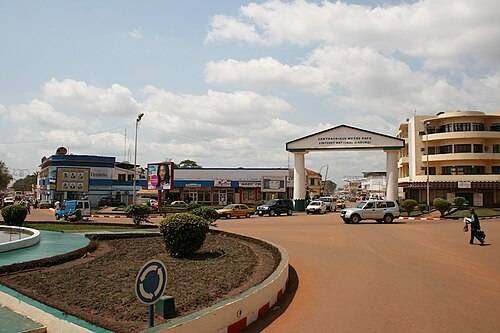
Population5.5 million
Area622,984 km²
CapitalBangui
RegionMiddle Africa
Did you know?
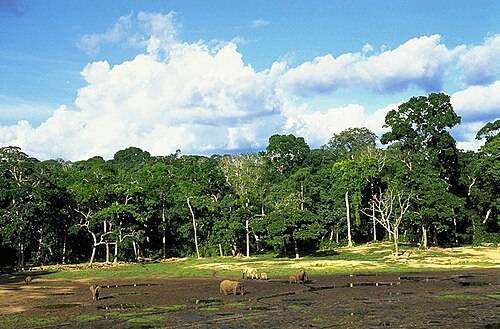
- Dzanga-Sangha has forest elephants and lowland gorillas
- Bokassa crowned himself emperor in 1977
- Among the world's least developed countries
Key facts about Central African Republic
- Government
- Presidential republic
- Religion
- Christian ~89%, Islam ~9%
- Founded / independence
- 1960 (from France)
- Rich in
- Diamonds, gold, timber, uranium
- Languages
- French, Sango
Sango and French - Currency
- Central African CFA franc (Fr)
- People are called
- Central African
- Main cities
- Bangui, Bimbo, Berbérati
Timeline of Central African Republic
- 1903French Ubangi-Shari
- 1960Independence
- 1976Central African Empire
- 2013Civil war
Places to see in Central African Republic
- Dzanga-Sangha Reserve
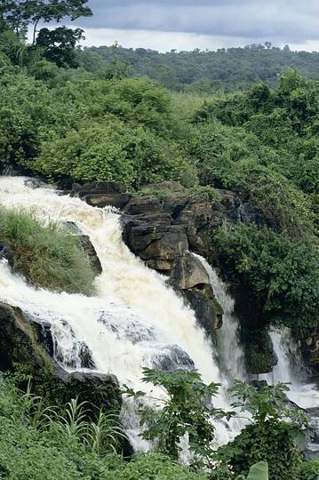
- Boali Falls
- Manovo-Gounda St Floris Park
Food and drink
Kanda (meatballs) · cassava dishes
Culture and famous for
Aka Pygmy polyphonic singing (UNESCO)
Popular sports
Basketball, football
Geography and climate
- Highest point
- Mont Ngaoui, 1,410 m
- Rivers, lakes and seas
- Ubangi River
- Climate
- Tropical
- Coastline
- Landlocked
- Population density
- 9 people per km²
Wars and conflicts
- Civil wars 2004–07, 2012–present
- Bokassa's empire
Alliances and memberships
Political unions and regional organisations
Central African Republic in depth
Detailed facts from the CIA World Factbook (public domain, latest edition).
Overview
- History in brief
- The Central African Republic (CAR) is a perennially weak state that sits at the crossroads of ethnic and linguistic groups in the center of the African continent. Among the last areas of Sub-Saharan Africa to be drawn into the world economy, its introduction into trade networks around the early 1700s fostered significant competition among its population. The local population sought to benefit from the lucrative Atlantic, trans-Saharan, and Indian Ocean trade in enslaved people and ivory. Slave raids aided by the local populations fostered animosity between ethnic groups that remains today. The territory was established as a French colony named Ubangui-Shari in 1903, and France modeled its administration of the colony after the Belgian Congo, subcontracting control of the territory to private companies that collected rubber and ivory. Although France banned the domestic slave trade in CAR in the 1910s, the private companies continued to exploit the population through forced labor. The colony of Ubangi-Shari gained independence from France as the Central African Republic in 1960, but the death of independence leader Barthelemy BOGANDA six months prior led to an immediate struggle for power.CAR’s political history has since been marred by a series of coups, the first of which brought Jean-Bedel BOKASSA to power in 1966. Widespread corruption and intolerance for any political opposition characterized his regime. In an effort to prolong his mandate, BOKASSA named himself emperor in 1976 and changed the country’s name to the Central African Empire. His regime’s economic mismanagement culminated in widespread student protests in 1979 that were violently suppressed by security forces. BOKASSA fell out of favor with the international community and was overthrown in a French-backed coup in 1979. After BOKASSA’s departure, the country’s name once again became the Central African Republic.CAR’s fifth coup in 2013 unseated President Francois BOZIZE after the Seleka, a mainly Muslim rebel coalition, seized the capital and forced BOZIZE to flee the country. The Seleka's widespread abuses spurred the formation of mainly Christian self-defense groups that called themselves the anti-Balaka, which have also committed human rights abuses against Muslim populations in retaliation. Since the rise of these groups, conflict in CAR has become increasingly ethnoreligious, although focused on identity rather than religious ideology. Elections in 2016 installed independent candidat
Geography
- Location
- Central Africa, north of Democratic Republic of the Congo
- Size compared
- slightly smaller than Texas; about four times the size of Georgia
- Land borders
- Total: 5,920 kmBorder countries: Cameroon 901 km; Chad 1556 km; Democratic Republic of the Congo 1,747 km, Republic of the Congo 487 km; South Sudan 1055 km; Sudan 174 km
- Coastline
- 0 km (landlocked)
- Climate
- tropical; hot, dry winters; mild to hot, wet summers
- Terrain
- vast, flat to rolling plateau; scattered hills in northeast and southwest
- Elevation
- Highest point: Mont Ngaoui 1,410 mLowest point: Oubangui River 335 mMean elevation: 635 m
- Natural resources
- diamonds, uranium, timber, gold, oil, hydropower
- Major rivers
- Oubangui (Ubangi) river [s] (shared with Democratic Republic of Congo and Republic of Congo [m]) - 2,270 kmNote: [s] after country name indicates river source; [m] after country name indicates river mouth
- Natural hazards
- hot, dry, dusty harmattan winds affect northern areas; floods are common
- Notes
- landlocked; almost the precise center of Africa
- Environmental issues
- water pollution; tap water not potable; poaching; wildlife mismanagement; desertification; deforestation; soil erosion
People and society
- Population
- Total: 5,750,570 (2025 est.)Male: 2,864,870Female: 2,885,700
- Nationality
- Noun: Central African(s)Adjective: Central African
- Ethnic groups
- Baya 28.8%, Banda 22.9%, Mandjia 9.9%, Sara 7.9%, M'Baka-Bantu 7.9%, Arab-Fulani (Peuhl) 6%, Mbum 6%, Ngbanki 5.5%, Zande-Nzakara 3%, other Central African Republic ethnic groups 2%, non-Central African Republic ethnic groups .1% (2003 est.)
- Languages
- French (official), Sangho (lingua franca and national language), tribal languages
- Religions
- Roman Catholic 34.6%, Protestant 15.7%, other Christian 22.9%, Muslim 13.8%, ethnic religionist 12%, Baha'i 0.2%, agnostic/atheist 0.7% (2020 est.)
- Median age
- Total: 20.6 years (2025 est.)Male: 19.7 yearsFemale: 21.2 years
- Population growth
- 1.74% (2025 est.)
- Life expectancy
- Total population: 56.4 years (2024 est.)Male: 55.1 yearsFemale: 57.7 years
- Children per woman
- 3.89 children born/woman (2025 est.)
- Urbanization
- Urban population: 43.6% of total population (2023)Rate of urbanization: 3.32% annual rate of change (2020-25 est.)
- Largest cities
- 958,000 BANGUI (capital) (2023)
- Literacy
- Total population: 42.4% (2019 est.)Male: 59.8% (2019 est.)Female: 27.1% (2019 est.)
Government
- Official names
- Conventional long form: Central African RepublicConventional short form: noneLocal long form: République centrafricaineLocal short form: noneFormer: Ubangi-Shari, Central African EmpireAbbreviation: CAREtymology: self-descriptive name specifying the country's location on the continent; "Africa" is derived from the Roman designation of the area corresponding to present-day Tunisia, "Africa terra," which meant "Land of the Afri" (the tribe resident in that area), but which eventually came to mean the entire continent
- Government type
- presidential republic
- Capital
- Name: BanguiGeographic coordinates: 4 22 N, 18 35 ETime difference: UTC+1 (6 hours ahead of Washington, DC, during Standard Time)Etymology: established as a French military post in 1889; the name means "rapids" in the local Bobangui language, because of the city's location above the first great rapid on the Ubangi River
- Regions
- 14 prefectures (préfectures, singular - préfecture), 2 economic prefectures* (préfectures économiques, singular - préfecture économique), and 1 commune**; Bamingui-Bangoran, Bangui**, Basse-Kotto, Haute-Kotto, Haut-Mbomou, Kemo, Lobaye, Mambere-Kadei, Mbomou, Nana-Grebizi*, Nana-Mambere, Ombella-Mpoko, Ouaka, Ouham, Ouham-Pende, Sangha-Mbaere*, Vakaga
- Independence
- 13 August 1960 (from France)
- National holiday
- Republic Day, 1 December (1958)
- Constitution
- History: several previous; latest constitution passed by a national referendum on 30 July 2023 and validated by the Constitutional Court on 30 August 2023Amendment process: proposals require support of the government, two thirds of the National Council of Transition, and assent by the "Mediator of the Central African" crisis; passage requires at least three-fourths majority vote by the National Council membership; non-amendable constitutional provisions include those on the secular and republican form of government, fundamental rights and freedoms, amendment procedures, or changes to the authorities of various high-level executive, parliamentary, and judicial officials
- Legal system
- civil law system based on the French model
- Voting age
- 18 years of age; universal
- Flag meaning
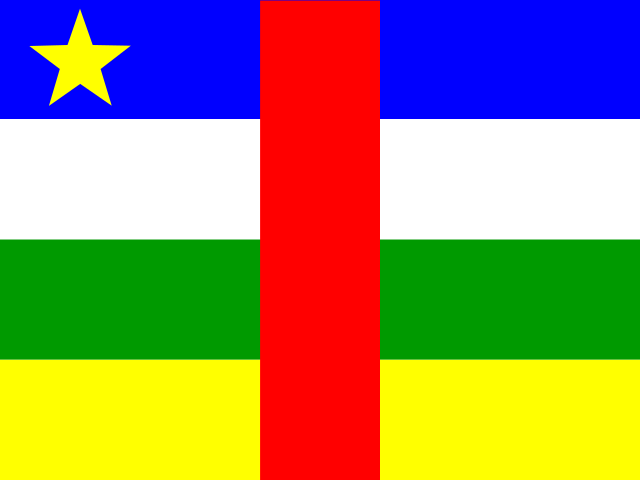
- Description: four equal horizontal bands of blue (top), white, green, and yellow with a vertical red band in the center; a five-pointed yellow star sits in the top left corner of the flag, on the blue bandMeaning: combines the pan-African and French flag colors; red stands for blood spilled in the struggle for independence, blue for the sky and freedom, white for peace and dignity, green for hope and faith, and yellow for tolerance; the star represents aspiring to a vibrant future
- National symbols
- elephant
- National colours
- blue, white, green, yellow, red
- National anthem
- Title: "La Renaissance" (The Renaissance)Lyrics/music: Barthelemy BOGANDA/Herbert PEPPERHistory: adopted 1960; BOGANDA wrote the anthem's lyrics and was the first prime minister of the autonomous French territory
- UNESCO World Heritage Sites
- Total World Heritage Sites: 2 (natural)Selected World Heritage Site locales: Manovo-Gounda St. Floris National Park; Sangha Trinational Forest
Economy
- Overview
- enormous natural resources; extreme poverty; weak public institutions and infrastructure; political and gender-based violence have led to displacement of roughly 25% of population; Bangui-Douala corridor blockade reduced activity and tax collection; strong agricultural performance offset COVID-19 downturn
- GDP (PPP)
- $5.926 billion (2024 est.)
- GDP per person (PPP)
- $1,100 (2024 est.)
- GDP growth
- 1.5% (2024 est.)
- Inflation
- 3% (2023 est.)
- Unemployment
- 5.9% (2024 est.)
- Below poverty line
- 68.8% (2021 est.)
- Farm products
- cassava, groundnuts, yams, coffee, maize, sesame seeds, taro, sugarcane, beef, milk (2023)
- Industries
- gold and diamond mining, logging, brewing, sugar refining
- Exports
- $425.306 million (2024 est.)
- Main exports
- gold, wood, diamonds, vehicle parts/accessories, cotton (2023)
- Export partners
- UAE 54%, China 14%, France 6%, Turkey 5%, Belgium 4% (2023)
- Main imports
- refined petroleum, cars, packaged medicine, vaccines, tanks and armored vehicles (2023)
- Import partners
- China 16%, Cameroon 14%, France 8%, Belgium 6%, Cote d'Ivoire 5% (2023)
- Money sent home from abroad
- 0% of GDP (2023 est.)
Energy, internet and transport
- Electricity access
- Electrification - total population: 15.7% (2022 est.)Electrification - urban areas: 34.7%Electrification - rural areas: 1.6%
- Electricity sources
- Fossil fuels: 0.8% of total installed capacity (2023 est.)Hydroelectricity: 99.2% of total installed capacity (2023 est.)
- Internet users
- Percent of population: 8% (2019 est.)
- Mobile phones
- Total subscriptions: 1.98 million (2022 est.)Subscriptions per 100 inhabitants: 39 (2022 est.)
- TV and radio
- government-owned network, Radiodiffusion Télévision Centrafricaine, provides limited TV broadcasting; state-owned radio network is supplemented by a small number of privately owned broadcast stations, as well as a few community radio stations; transmissions of at least 2 international broadcasters are available (2017)
- Airports
- 43 (2025)
Military and space
- Armed forces
- Central African Armed Forces (Forces Armees Centrafricaines, FACA): Army (includes an air squadron, Escadrille Centrafricaine)Ministry of Interior: National Gendarmerie (Gendarmerie Nationale), National Police (2025)
- Military spending
- 2.5% of GDP (2024 est.)
- Military service
- 18-22 years of age for voluntary military service for men and women; no conscription although the constitution provides for the possibility of conscription in the event of an imminent threat to the country (2025)
Global issues
- Refugees and displaced people
- Refugees: 53,378 (2024 est.)IDPs: 469,342 (2024 est.)
Neighbouring countries
CameroonChadDR CongoRepublic of the CongoSouth SudanSudan
- Phone code
- +236
- Internet domain
- .cf