Sudan
Republic of the Sudan · السودان
Ancient Nubian kingdoms of Kush ruled Egypt; Sudan has more pyramids than Egypt. Since April 2023 the army and RSF militia have fought a war that has displaced over 12 million; RSF captured El Fasher in 2025.
See Sudan on the 3D globeTake a quiz
Ongoing: Sudan civil war
Population51 million
Area1,886,068 km²
CapitalKhartoum
RegionNorthern Africa
Did you know?
- Has about 200 pyramids, more than Egypt
- The Blue and White Nile meet in Khartoum
- Largest producer of gum arabic
Key facts about Sudan
- Government
- Military rule; divided by civil war (army vs RSF)
- Religion
- Sunni Islam ~97%
- Founded / independence
- 1956 (from UK/Egypt)
- Rich in
- Gold, oil, gum arabic, livestock
- Languages
- Arabic, English
Arabic (Sudanese dialect); Beja, Fur, Nubian, English - Currency
- Sudanese pound (PT)
- People are called
- Sudanese
- Main cities
- Khartoum, Omdurman, Port Sudan, Nyala, El Fasher
Timeline of Sudan
- 750 BCKush rules Egypt
- 1821Egyptian conquest
- 1885Mahdist state
- 1956Independence
- 2011South secedes
- 2019Bashir overthrown
- 2023Civil war
Places to see in Sudan
- Meroë pyramids
- Jebel Barkal
- Suakin
- Khartoum confluence of the Niles
Food and drink
Ful medames · kisra · asida
Culture and famous for
Nubian heritage; Sufi dervish ceremonies
Popular sports
Football
Geography and climate
- Highest point
- Deriba Caldera, 3,042 m
- Rivers, lakes and seas
- Blue and White Niles meet at Khartoum
- Climate
- Hot desert
- Coastline
- Has a sea coast
- Population density
- 27 people per km²
Wars and conflicts
- Mahdist war
- civil wars 1955–2005
- Darfur genocide
- civil war 2023–present (world's largest displacement)
Empires and states that once stood here
Kingdom of Kush c. 1070 BC–350 AD
Alliances and memberships
Political unions and regional organisations
African UnionArab LeagueOrganisation of Islamic Cooperation
Economy and trade
OPEC (OPEC+ partner (not a member))
Sudan in depth
Detailed facts from the CIA World Factbook (public domain, latest edition).
Overview
- History in brief
- Long referred to as Nubia, modern-day Sudan was the site of the Kingdom of Kerma (ca. 2500-1500 B.C.) until it was absorbed into the New Kingdom of Egypt. By the 11th century B.C., the Kingdom of Kush gained independence from Egypt; it lasted in various forms until the middle of the 4th century A.D. After the fall of Kush, the Nubians formed three Christian kingdoms of Nobatia, Makuria, and Alodia, with the latter two enduring until around 1500. Between the 14th and 15th centuries, Arab nomads settled much of Sudan, leading to extensive Islamization between the 16th and 19th centuries. Following Egyptian occupation early in the 19th century, an agreement in 1899 set up a joint British-Egyptian government in Sudan, but it was effectively a British colony.Military regimes favoring Islamic-oriented governments have dominated national politics since Sudan gained independence from Anglo-Egyptian co-rule in 1956. During most of the second half of the 20th century, Sudan was embroiled in two prolonged civil wars rooted in northern domination of the largely non-Muslim, non-Arab southern portion of the country. The first civil war ended in 1972, but another broke out in 1983. Peace talks gained momentum in 2002-04, and the final North/South Comprehensive Peace Agreement in 2005 granted the southern rebels autonomy for six years, followed by a referendum on independence for Southern Sudan. South Sudan became independent in 2011, but Sudan and South Sudan have yet to fully implement security and economic agreements to normalize relations between the two countries. Sudan has also faced conflict in Darfur, Southern Kordofan, and Blue Nile starting in 2003.In 2019, after months of nationwide protests, the 30-year reign of President Omar Hassan Ahmad al-BASHIR ended when the military forced him out. Economist and former international civil servant Abdalla HAMDOUK al-Kinani was selected to serve as the prime minister of a transitional government as the country prepared for elections in 2022. In late 2021, however, the Sudanese military ousted HAMDOUK and his government and replaced civilian members of the Sovereign Council (Sudan’s collective Head of State) with individuals selected by the military. HAMDOUK was briefly reinstated but resigned in January 2022. General Abd-al-Fatah al-BURHAN Abd-al-Rahman, the Chair of Sudan’s Sovereign Council and Commander-in-Chief of the Sudanese Armed Forces, currently serves as de facto head of state and government. He presides over
Geography
- Location
- north-eastern Africa, bordering the Red Sea, between Egypt and Eritrea
- Size compared
- slightly less than one-fifth the size of the US
- Land borders
- Total: 6,819 kmBorder countries: Central African Republic 174 km; Chad 1,403 km; Egypt 1,276 km; Eritrea 682 km; Ethiopia 744 km; Libya 382 km; South Sudan 2,158 km
- Coastline
- 853 km
- Climate
- hot and dry; arid desert; rainy season varies by region (April to November)
- Terrain
- generally flat, featureless plain; desert dominates the north
- Elevation
- Highest point: Jabal Marrah 3,042 mLowest point: Red Sea 0 mMean elevation: 568 m
- Natural resources
- petroleum; small reserves of iron ore, copper, chromium ore, zinc, tungsten, mica, silver, gold; hydropower
- Major rivers
- An Nīl (Nile) (shared with Rwanda [s], Tanzania, Uganda, South Sudan, and Egypt [m]) - 6,650 km; Blue Nile river mouth (shared with Ethiopia [s]) - 1,600 kmNote: [s] after country name indicates river source; [m] after country name indicates river mouth
- Natural hazards
- dust storms and periodic persistent droughts
- Notes
- the Nile is Sudan's primary water source; its major tributaries, the White Nile and the Blue Nile, meet at Khartoum to form the River Nile, which flows northward through Egypt to the Mediterranean Sea
- Environmental issues
- water pollution; inadequate supplies of potable water; water scarcity and drought; overhunting; soil erosion; desertification; deforestation; loss of biodiversity
People and society
- Population
- Total: 50,467,278 (2024 est.)Male: 25,335,092Female: 25,132,186
- Nationality
- Noun: Sudanese (singular and plural)Adjective: Sudanese
- Ethnic groups
- Sudanese Arab (approximately 70%), Fur, Beja, Nuba, Ingessana, Uduk, Fallata, Masalit, Dajo, Gimir, Tunjur, Berti; there are over 500 ethnic groups
- Languages
- Arabic (official), English (official), Nubian, Ta Bedawie, FurMajor-language sample(s): كتاب حقائق العالم، المصدر الذي لا يمكن الاستغناء عنه للمعلومات الأساسية (Arabic)The World Factbook, the indispensable source for basic information. (English)
- Religions
- Sunni Muslim, small Christian minority
- Median age
- Total: 19.5 years (2025 est.)Male: 19 yearsFemale: 19.6 years
- Population growth
- 2.54% (2025 est.)
- Life expectancy
- Total population: 67.8 years (2024 est.)Male: 65.5 yearsFemale: 70.2 years
- Children per woman
- 4.41 children born/woman (2025 est.)
- Urbanization
- Urban population: 36.3% of total population (2023)Rate of urbanization: 3.43% annual rate of change (2020-25 est.)
- Largest cities
- 6.344 million KHARTOUM (capital), 1.057 million Nyala (2023)
- Years in school
- Total: 7 years (2015 est.)Male: 7 years (2015 est.)Female: 7 years (2015 est.)
Government
- Official names
- Conventional long form: Republic of the SudanConventional short form: SudanLocal long form: Jumhuriyat as-SudanLocal short form: As-SudanFormer: Anglo-Egyptian Sudan, Democratic Republic of the SudanEtymology: the name derives from the Arabic balad-as-sudan, meaning "Land of the Black [peoples]"
- Government type
- presidential republic
- Capital
- Name: KhartoumGeographic coordinates: 15 36 N, 32 32 ETime difference: UTC+3 (8 hours ahead of Washington, DC, during Standard Time)Etymology: the name derives from the Arabic words ras (head or end) and al-khurtum (elephant's trunk), referring to the narrow strip of land between the Blue and White Niles where the city is located
- Regions
- 18 states (wilayat, singular - wilayah); Blue Nile, Central Darfur, East Darfur, Gedaref, Gezira, Kassala, Khartoum, North Darfur, North Kordofan, Northern, Red Sea, River Nile, Sennar, South Darfur, South Kordofan, West Darfur, West Kordofan, White Nile
- Independence
- 1 January 1956 (from Egypt and the UK)
- National holiday
- Independence Day, 1 January (1956)
- Constitution
- History: previous 1973, 1998, 2005 (interim constitution, which was suspended in April 2019); latest initial draft completed by Transitional Military Council in May 2019; revised draft known as the "Draft Constitutional Charter for the 2019 Transitional Period," or “2019 Constitutional Declaration” was signed by the Council and opposition coalition on 4 August 2019
- Legal system
- mixed system of Islamic law and English common law
- Voting age
- 17 years of age; universal
- Flag meaning
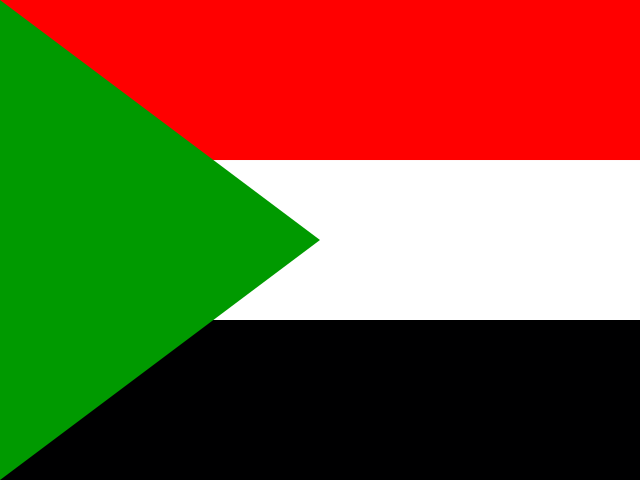
- Description: three equal horizontal bands of red (top), white, and black, with a green isosceles triangle based on the left sideMeaning: red stands for the struggle for freedom; white for peace, light, and love, black for the people; green for Islam, agriculture, and prosperityHistory: colors and design are based on the Arab Revolt flag of World War I
- National symbols
- secretary bird
- National colours
- red, white, black, green
- National anthem
- Title: "Nahnu Djundulla Djundulwatan" (We Are the Army of God and of Our Land)Lyrics/music: Sayed Ahmad Muhammad SALIH/Ahmad MURJANHistory: adopted 1956; originally served as the anthem of the Sudanese military
- UNESCO World Heritage Sites
- Total World Heritage Sites: 3 (2 cultural, 1 natural)Selected World Heritage Site locales: Gebel Barkal and the Sites of the Napatan Region (c); Archaeological Sites of the Island of Meroe (c); Sanganeb Marine National Park and Dungonab Bay – Mukkawar Island Marine National Park (n)
Economy
- Overview
- low-income Sahel economy devastated by ongoing civil war; major impacts on rural income, basic commodity prices, industrial production, agricultural supply chain, communications and commerce; hyperinflation and currency depreciation worsening food access and humanitarian conditions
- GDP (PPP)
- $94.42 billion (2024 est.)
- GDP per person (PPP)
- $1,900 (2024 est.)
- GDP growth
- -13.5% (2024 est.)
- Inflation
- 138.8% (2022 est.)
- Unemployment
- 11.45% (2023 est.)
- Farm products
- sugarcane, sorghum, milk, onions, groundnuts, sesame seeds, goat milk, bananas, mangoes/guavas, millet (2023)
- Industries
- oil, cotton ginning, textiles, cement, edible oils, sugar, soap distilling, shoes, petroleum refining, pharmaceuticals, armaments, automobile/light truck assembly, milling
- Exports
- $5.908 billion (2022 est.)
- Main exports
- crude petroleum, gold, oil seeds, sheep and goats, ground nuts (2023)
- Export partners
- UAE 21%, China 17%, Saudi Arabia 16%, Malaysia 9%, Egypt 8% (2023)
- Main imports
- raw sugar, wheat flours, refined petroleum, garments, packaged medicine (2023)
- Import partners
- China 21%, India 19%, Egypt 16%, UAE 14%, Saudi Arabia 7% (2023)
- Money sent home from abroad
- 2.5% of GDP (2023 est.)
Energy, internet and transport
- Electricity access
- Electrification - total population: 63.2% (2022 est.)Electrification - urban areas: 84%Electrification - rural areas: 49.4%
- Electricity sources
- Fossil fuels: 29.9% of total installed capacity (2023 est.)Solar: 0.8% of total installed capacity (2023 est.)Hydroelectricity: 68.7% of total installed capacity (2023 est.)Biomass and waste: 0.6% of total installed capacity (2023 est.)
- Internet users
- Percent of population: 26% (2020 est.)
- Mobile phones
- Total subscriptions: 34.7 million (2022 est.)Subscriptions per 100 inhabitants: 74 (2022 est.)
- TV and radio
- state-owned broadcasters that self-censor but are somewhat independent (2022)
- Airports
- 45 (2025)
- Railways
- Total: 7,251 km (2014)Narrow gauge: 5,851 km (2014) 1.067-m gauge
- Merchant ships
- Total: 14 (2023)By type: other 14
Military and space
- Armed forces
- Sudanese Armed Forces (SAF): Ground Force (Sudanese Army), Sudanese Navy, Sudanese Air Force; Rapid Support Forces (RSF); Border GuardsMinistry of Interior: Sudan Police Forces (SPF), Central Reserve Police (CRP) (2025)
- Military spending
- 1% of GDP (2021 est.)
- Military service
- 18-33 years of age for compulsory or voluntary military service for men and women; service obligation 12-24 months (2025)
Global issues
- Refugees and displaced people
- Refugees: 837,988 (2024 est.)IDPs: 11,559,970 (2024 est.)
Neighbouring countries
Central African RepublicChadEgyptEritreaEthiopiaLibyaSouth Sudan
- Phone code
- +249
- Internet domain
- .sd