Venezuela
Bolivarian Republic of Venezuela
Simón Bolívar's homeland. Oil made it South America's richest country; economic collapse since 2014 drove nearly 8 million to emigrate. In January 2026 the US captured Nicolás Maduro in a military operation.
See Venezuela on the 3D globeTake a quiz
Population28 million
Area916,445 km²
CapitalCaracas
RegionSouth America
Did you know?
- Angel Falls is the world's highest waterfall (979 m)
- Lake Maracaibo has the most lightning on Earth
- Has the largest proven oil reserves
Key facts about Venezuela
- Government
- Presidential republic (authoritarian; leadership in turmoil after Jan 2026 US raid)
- Religion
- Catholic ~70%, Evangelical ~17%
- Founded / independence
- 1811/1821 (from Spain)
- Rich in
- Oil (largest proven reserves in the world), gold, gas
- Languages
- Spanish
Spanish; Wayuu, Warao, Pemon - Currency
- Venezuelan bolívar soberano (Bs.S.)
- People are called
- Venezuelan
- Main cities
- Caracas, Maracaibo, Valencia, Barquisimeto
Timeline of Venezuela
- 1498Columbus arrives
- 1811Independence declared
- 1914Oil discovered
- 1999Chávez president
- 2014Economic collapse
- 2026Maduro captured by US
Places to see in Venezuela
- Angel Falls
- Los Roques
- Mount Roraima
- Mérida cable car
- Canaima NP
Food and drink
Arepas · pabellón criollo · hallacas
Culture and famous for
Beauty pageant winners; joropo music; El Sistema youth orchestras
Popular sports
Baseball, football
Geography and climate
- Highest point
- Pico Bolívar, 4,978 m
- Rivers, lakes and seas
- Orinoco; Lake Maracaibo
- Climate
- Tropical
- Coastline
- Has a sea coast
- Population density
- 31 people per km²
Wars and conflicts
- Wars of Independence
- 2019 crisis
- US strikes and operation 2025–26
Alliances and memberships
Political unions and regional organisations
Economy and trade
OPECMercosur (suspended since 2016)
Venezuela in depth
Detailed facts from the CIA World Factbook (public domain, latest edition).
Overview
- History in brief
- Venezuela was one of three countries that emerged from the collapse of Gran Colombia in 1830, the others being Ecuador and New Granada (Colombia). For most of the first half of the 20th century, military strongmen ruled Venezuela and promoted the oil industry while allowing some social reforms. Democratically elected governments largely held sway until 1999, but Hugo CHAVEZ, who was president from 1999 to 2013, exercised authoritarian control over other branches of government. This trend continued in 2018 when Nicolas MADURO claimed the presidency for his second term in an election boycotted by most opposition parties and widely viewed as fraudulent. The legislative elections in 2020 were also seen as fraudulent, and most opposition parties and many international actors consider the resulting National Assembly illegitimate. In 2021, many opposition parties broke a three-year election boycott and participated in mayoral and gubernatorial elections, despite flawed conditions. As a result, the opposition more than doubled its representation at the mayoral level and retained four of 23 governorships. The 2021 regional elections marked the first time since 2006 that the EU was allowed to send an electoral observation mission to Venezuela.MADURO has placed strong restrictions on free speech and the press. Since CHAVEZ, the ruling party has expanded the state's role in the economy through expropriations of major enterprises, strict currency exchange and price controls, and over-dependence on the petroleum industry for revenues. Years of economic mismanagement left Venezuela ill-prepared to weather the global drop in oil prices in 2014, sparking an economic decline that has resulted in reduced government social spending, shortages of basic goods, and high inflation. Worsened living conditions have prompted nearly 8 million Venezuelans to emigrate, mainly settling in nearby countries. The US imposed financial sanctions on MADURO and his representatives in 2017 and on sectors of the Venezuelan economy in 2018. Limited sanctions relief followed when the MADURO administration began making democratic and electoral concessions.The government's mismanagement and lack of investment in infrastructure has also weakened the country's energy sector. Caracas has relaxed some controls to mitigate the impact of its sustained economic crisis, such as allowing increased import flexibility for the private sector and the informal use of US dollars and other international currencie
Geography
- Location
- Northern South America, bordering the Caribbean Sea and the North Atlantic Ocean, between Colombia and Guyana
- Size compared
- almost six times the size of Georgia; slightly more than twice the size of California
- Land borders
- Total: 5,267 kmBorder countries: Brazil 2,137 km; Colombia 2,341 km; Guyana 789 km
- Coastline
- 2,800 km
- Climate
- tropical; hot, humid; more moderate in highlands
- Terrain
- Andes Mountains and Maracaibo Lowlands in northwest; central plains (llanos); Guiana Highlands in southeast
- Elevation
- Highest point: Pico Bolivar 4,978 mLowest point: Caribbean Sea 0 mMean elevation: 450 m
- Natural resources
- petroleum, natural gas, iron ore, gold, bauxite, other minerals, hydropower, diamonds
- Major rivers
- Rio Negro (shared with Colombia [s] and Brazil [m]) - 2,250 km; Orinoco river source and mouth (shared with Colombia) - 2,101 kmNote: [s] after country name indicates river source; [m] after country name indicates river mouth
- Major lakes
- Salt water lake(s): Lago de Maracaibo - 13,010 sq km
- Natural hazards
- subject to floods, rockslides, mudslides; periodic droughts
- Notes
- Note 1: the country lies on major sea and air routes linking North and South America note 2: Venezuela has some of the most unique geology in the world; tepuis are the massive table-top mountains of the western Guiana Highlands that tend to be isolated and thus support unique endemic plant and animal species; their sheer cliffsides help create some of the most spectacular waterfalls in the world, including Angel Falls, the world's highest (979 m; 3,212 ft) that drops from Auyan Tepui
- Environmental issues
- sewage pollution of Lago de Valencia; oil and urban pollution of Lago de Maracaibo; deforestation; soil degradation; urban and industrial pollution, especially along the Caribbean coast; threat to the rainforest ecosystem from mining operations
People and society
- Population
- Total: 31,755,435 (2025 est.)Male: 15,808,263Female: 15,947,172
- Nationality
- Noun: Venezuelan(s)Adjective: Venezuelan
- Ethnic groups
- unspecified Spanish, Italian, Portuguese, Arab, German, African, Indigenous
- Languages
- Spanish (official) 98.2%, indigenous 1.3%, Portuguese 0.1%, other 0.4% (2023 est.)Major-language sample(s): La Libreta Informativa del Mundo, la fuente indispensable de información básica. (Spanish)The World Factbook, the indispensable source for basic information.
- Religions
- Roman Catholic 48.1%, Protestant 31.6% (Evangelical 31.4%, Adventist 0.2%), Jehovah's Witness 1.4%, African American/umbanda 0.7%, other 0.1%, believer 3.5%, agnostic 0.1%, atheist, 0.4%, none 13.6%, unspecified 0.6% (2023 est.)
- Median age
- Total: 31.3 years (2025 est.)Male: 30.3 yearsFemale: 31.7 years
- Population growth
- 0.88% (2025 est.)
- Life expectancy
- Total population: 74.5 years (2024 est.)Male: 71.5 yearsFemale: 77.7 years
- Children per woman
- 2.16 children born/woman (2025 est.)
- Urbanization
- Urban population: 88.4% of total population (2023)Rate of urbanization: 1.16% annual rate of change (2020-25 est.)
- Largest cities
- 2.972 million CARACAS (capital), 2.368 million Maracaibo, 1.983 million Valencia, 1.254 million Barquisimeto, 1.243 million Maracay, 964,000 Ciudad Guayana (2023)
- Literacy
- Total population: 97.2% (2017 est.)Male: 97.2% (2017 est.)Female: 97.3% (2017 est.)
Government
- Official names
- Conventional long form: Bolivarian Republic of VenezuelaConventional short form: VenezuelaLocal long form: República Bolivariana de VenezuelaLocal short form: VenezuelaFormer: State of Venezuela, Republic of Venezuela, United States of VenezuelaEtymology: in 1499, the stilt-houses built on Lake Maracaibo reminded explorers Alonso de OJEDA and Amerigo VESPUCCI of buildings in Venice, Italy, and they named the region "Venezuola," meaning "Little Venice"
- Government type
- federal presidential republic
- Capital
- Name: CaracasGeographic coordinates: 10 29 N, 66 52 WTime difference: UTC-4 (1 hour ahead of Washington, DC, during Standard Time)Etymology: named for the Caracas tribe that originally settled in the area; the origin of their name is unknown
- Regions
- 23 states (estados, singular - estado), 1 capital district* (distrito capital), and 1 federal dependency** (dependencia federal); Amazonas, Anzoátegui, Apure, Aragua, Barinas, Bolivar, Carabobo, Cojedes, Delta Amacuro, Dependencias Federales (Federal Dependencies)**, Distrito Capital (Capital District)*, Falcon, Guárico, La Guairá, Lara, Merida, Miranda, Monagas, Nueva Esparta, Portuguesa, Sucre, Táchira, Trujillo, Yaracuy, Zulia
- Independence
- 5 July 1811 (from Spain)
- National holiday
- Independence Day, 5 July (1811)
- Constitution
- History: many previous; latest adopted 15 December 1999, effective 30 December 1999Amendment process: proposed through agreement by at least 39% of the National Assembly membership, by the president of the republic in session with the cabinet of ministers, or by petition of at least 15% of registered voters; passage requires simple majority vote by the Assembly and simple majority approval in a referendum
- Legal system
- civil law system based on the Spanish civil code
- Voting age
- 18 years of age; universal
- Flag meaning
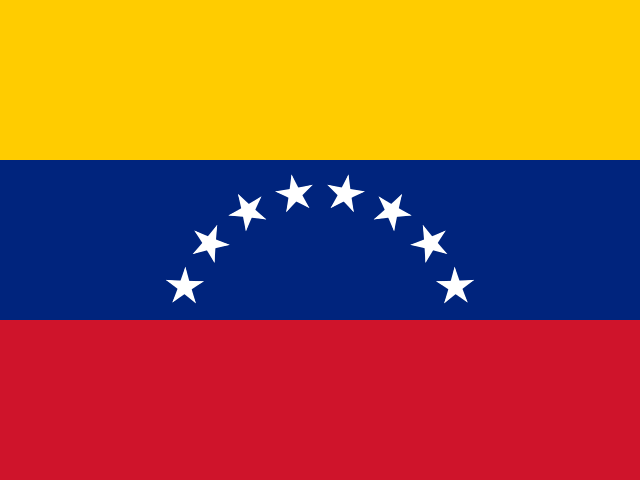
- Description: three equal horizontal bands of yellow (top), blue, and red, with the coat of arms on the left side of the yellow band and an arc of eight five-pointed white stars centered on the blue bandMeaning: yellow stands for the riches of the land, blue for the courage of its people, and red for the blood shed in attaining independenceHistory: the flag retains the three equal horizontal bands and three main colors from the flag of Gran Colombia, the South American republic that broke up in 1830; in 2006, President Hugo CHAVEZ added the eighth star -- the original seven stars represented the country's provinces that united in the war of independence -- to match Simon Bolivar's flag from 1827 and to represent the historic province of Guayana
- National symbols
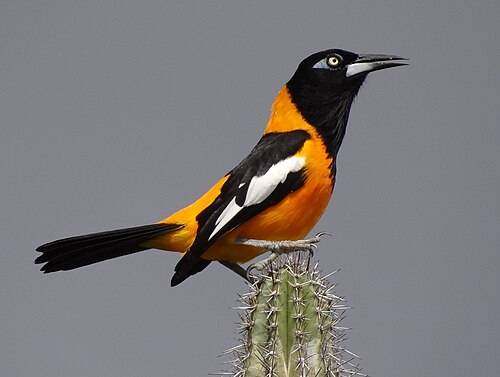
- troupial (bird)
- National colours
- yellow, blue, red
- National anthem
- Title: "Gloria al bravo pueblo" (Glory to the Brave People)Lyrics/music: Vicente SALIAS/Juan Jose LANDAETAHistory: adopted 1881; lyrics were written in 1810; both SALIAS and LANDAETA were executed in 1814 during Venezuela's fight for independence
- UNESCO World Heritage Sites
- Total World Heritage Sites: 3 (2 cultural, 1 natural)Selected World Heritage Site locales: Coro and its Port (c); Canaima National Park (n); Ciudad Universitaria de Caracas (c)
Economy
- Overview
- South American economy; ongoing hyperinflation since mid-2010s; chaotic economy due to political corruption, infrastructure cuts, and human rights abuses; in debt default; oil exporter; hydropower consumer; rising Chinese relations
- GDP (PPP)
- $110.943 billion (2023 est.)
- GDP per person (PPP)
- $4,900 (2023 est.)
- GDP growth
- -19.67% (2018 est.)
- Inflation
- 200.9% (2022 est.)
- Unemployment
- 5.5% (2024 est.)
- Below poverty line
- 33.1% (2015 est.)
- Farm products
- milk, sugarcane, maize, rice, plantains, oil palm fruit, bananas, chicken, pineapples, potatoes (2023)
- Industries
- agricultural products, livestock, raw materials, machinery and equipment, transport equipment, construction materials, medical equipment, pharmaceuticals, chemicals, iron and steel products, crude oil and petroleum products
- Exports
- $83.401 billion (2018 est.)
- Main exports
- crude petroleum, petroleum coke, scrap iron, alcohols, fertilizers (2023)
- Export partners
- USA 50%, China 10%, Spain 9%, Brazil 6%, Turkey 5% (2023)
- Main imports
- refined petroleum, soybean meal, corn, plastic products, vehicle parts/accessories (2023)
- Import partners
- China 35%, USA 24%, Brazil 12%, Colombia 7%, Turkey 4% (2023)
Energy, internet and transport
- Electricity access
- Electrification - total population: 100% (2022 est.)
- Electricity sources
- Fossil fuels: 21.6% of total installed capacity (2023 est.)Hydroelectricity: 78.3% of total installed capacity (2023 est.)
- Internet users
- Percent of population: 62% (2017 est.)
- Mobile phones
- Total subscriptions: 20.2 million (2024 est.)Subscriptions per 100 inhabitants: 71 (2024 est.)
- TV and radio
- mix of state-run and private broadcast media subject to high levels of control; 13 public service networks, 61 privately owned TV networks, 1 privately owned news channel with limited national coverage, and a Maduro-backed Pan-American channel; 3 Maduro-aligned radio networks control about 65 news stations and another 30 stations targeted at specific audiences; Maduro-sponsored community broadcasters include 235 radio stations and 44 TV stations; the number of private broadcast radio stations declining, but many remain (2021)
- Airports
- 509 (2025)
- Railways
- Total: 447 km (2014)Standard gauge: 447 km (2014) 1.435-m gauge (41.4 km electrified)
- Merchant ships
- Total: 272 (2023)By type: bulk carrier 3, container ship 1, general cargo 26, oil tanker 17, other 225
Military and space
- Armed forces
- Bolivarian National Armed Forces (Fuerza Armada Nacional Bolivariana, FANB): Bolivarian Army (Ejercito Bolivariano, EB), Bolivarian Navy (Armada Bolivariana, AB; includes marines, Coast Guard), Bolivarian Military Aviation (Aviacion Militar Bolivariana, AMB), Bolivarian Militia (Milicia Bolivariana), Bolivarian National Guard (Guardia Nacional Bolivaria, GNB), Presidential Honor GuardMinistry of Interior, Justice, and Peace: Bolivarian National Police (Policía Nacional Bolivariana, PNB) (2025)
- Military spending
- 0.6% of GDP (2024 est.)
- Military service
- 18-30 (25 for women) for voluntary service; the minimum service obligation is 24-30 months; 17-39 for Militia service; all citizens of military service age (18-50) are obligated to register for military service and subject to military training (2025)
- Space programme
- has a small national program primarily focused on acquiring satellites and expanding the country’s science and technological capabilities; operates satellites and maintains two satellite ground control stations; participates in multinational space organizations such as the Latin American and Caribbean Space Agency; closest bilateral partners are China and Russia; also has bilateral framework agreements for space cooperation with Argentina, Bolivia, Brazil, and Uruguay (2025)
- Space milestones
- 2005 - signed space cooperation partnership with China2008- first communications satellite (Venesat-1 or Bolivar) financed, built, and launched by China2012 - first remote sensing (RS) satellite (VRSS-1 or Miranda) built and launched by China2017 - second RS satellite (VRSS-2 or Sucre) built and launched by China2021 - signed agreement to establish the Latin American and Caribbean Space Agency (formally established in 2022)2023 - joined China-Russia project to construct a permanent base on the Moon by the 2030s2025 - announced intent to participate in planned Mars sample-return mission (Tianwen-3) led by China
Global issues
- Refugees and displaced people
- Refugees: 20,911 (2024 est.)IDPs: 2,338 (2024 est.)
- Drug trade
- USG identification: major illicit drug-producing and/or drug-transit countrymajor precursor-chemical producer (2025)
Neighbouring countries
- Phone code
- +58
- Internet domain
- .ve