Luxembourg
Grand Duchy of Luxembourg · Luxemburg · Lëtzebuerg
A medieval county whose dynasty produced Holy Roman emperors. Recognised as independent in 1839 and neutral in 1867. A founder of the EU and NATO.
See Luxembourg on the 3D globeTake a quiz
Population670 thousand
Area2,586 km²
CapitalLuxembourg
RegionWestern Europe
Did you know?
- Has the highest income per person in the EU
- All public transport is free since 2020
- The world's last grand duchy
Key facts about Luxembourg
- Government
- Parliamentary constitutional monarchy (grand duchy)
- Religion
- Catholic ~70%
- Founded / independence
- 1839 (from Netherlands)
- Rich in
- Banking and funds, steel (ArcelorMittal), EU institutions; very high income per person
- Languages
- German, French, Luxembourgish
Luxembourgish, French, German — all official - Currency
- Euro (€)
- People are called
- Luxembourger
- Main cities
- Luxembourg City, Esch-sur-Alzette, Differdange
Timeline of Luxembourg
- 963Count Siegfried builds castle
- 1815Grand duchy
- 1867Neutrality
- 1890Own dynasty
- 1940German occupation
- 1957Founds EEC
Places to see in Luxembourg
- Bock Casemates
- Vianden Castle
- Grand Ducal Palace
- Mullerthal "Little Switzerland"
Food and drink
Judd mat Gaardebounen (smoked pork with broad beans) · Riesling wine
Culture and famous for
European institutions: Court of Justice, European Investment Bank
Popular sports
Cycling, football
Geography and climate
- Highest point
- Kneiff, 560 m
- Rivers, lakes and seas
- Moselle, Sûre, Alzette
- Climate
- Temperate
- Coastline
- Landlocked
- Population density
- 259 people per km²
Wars and conflicts
- Occupied in WWI and WWII
Alliances and memberships
Military and security
Political unions and regional organisations
European UnionEurozoneCouncil of EuropeBenelux Union
Economy and trade
Luxembourg in depth
Detailed facts from the CIA World Factbook (public domain, latest edition).
Overview
- History in brief
- Founded in 963, Luxembourg became a grand duchy in 1815 and a constituent part of the Kingdom of the Netherlands after the Congress of Vienna. When Belgium declared independence from the Netherlands in 1839, Luxembourg lost more than half of its territory to Belgium but gained a larger measure of autonomy within the Kingdom of the Netherlands. Luxembourg gained full independence in 1867 by promising to remain permanently neutral. Overrun by Germany in both world wars, its neutrality ended in 1948 when it entered into the Benelux Customs Union and joined NATO the following year. In 1957, Luxembourg became one of the six founding countries of the EEC (later the EU), and in 1999 it joined the euro currency zone.
Geography
- Location
- Western Europe, between France and Germany
- Size compared
- slightly smaller than Rhode Island; about half the size of Delaware
- Land borders
- Total: 327 kmBorder countries: Belgium 130 km; France 69 km; Germany 128 km
- Coastline
- 0 km (landlocked)
- Climate
- modified continental with mild winters, cool summers
- Terrain
- mostly gently rolling uplands with broad, shallow valleys; uplands to slightly mountainous in the north; steep slope down to Moselle flood plain in the southeast
- Elevation
- Highest point: Buurgplaatz 559 mLowest point: Moselle River 133 mMean elevation: 325 m
- Natural resources
- iron ore (no longer exploited), arable land
- Natural hazards
- occasional flooding
- Notes
- landlocked
- Environmental issues
- air and water pollution in urban areas; soil pollution of farmland
People and society
- Population
- Total: 671,254 (2024 est.)Male: 338,702Female: 332,552
- Nationality
- Noun: Luxembourger(s)Adjective: Luxembourg
- Ethnic groups
- Luxembourger 52.9%, Portuguese 14.5%, French 7.6%, Italian 3.7%, Belgian 3%, German 2%, Spanish 1.3%, Romania 1%, other 14% (2022 est.)
- Languages
- Luxembourgish (official administrative, judicial, and national language) 48.9%, Portuguese 15.4%, French (official administrative, judicial, and legislative language) 14.9%, Italian 3.6%, English 3.6%, German (official administrative and judicial language) 2.9%, other 10.8% (2021 est.)
- Religions
- Christian (predominantly Roman Catholic) 70.6%, Muslim 2.3%, other (includes Buddhist, folk religions, Hindu, Jewish) 0.4%, unaffiliated 26.7% (2020 est.)
- Median age
- Total: 40.1 years (2025 est.)Male: 39.4 yearsFemale: 40.4 years
- Population growth
- 1.26% (2025 est.)
- Life expectancy
- Total population: 83.4 years (2024 est.)Male: 80.9 yearsFemale: 85.9 years
- Children per woman
- 1.25 children born/woman (2025 est.)
- Urbanization
- Urban population: 92.1% of total population (2023)Rate of urbanization: 1.43% annual rate of change (2020-25 est.)
- Largest cities
- 120,000 LUXEMBOURG (capital) (2018)
- Years in school
- Total: 14 years (2022 est.)Male: 14 years (2022 est.)Female: 15 years (2022 est.)
Government
- Official names
- Conventional long form: Grand Duchy of LuxembourgConventional short form: LuxembourgLocal long form: Grand Duché de LuxembourgLocal short form: LuxembourgEtymology: probably derived from an early Celtic or Germanic form of the name, Lucilinburhuc, that was thought to mean "little fortress;" the name first referred to the city and was later used for the country
- Government type
- constitutional monarchy
- Capital
- Name: LuxembourgGeographic coordinates: 49 36 N, 6 07 ETime difference: UTC+1 (6 hours ahead of Washington, DC, during Standard Time)Daylight saving time: +1hr, begins last Sunday in March; ends last Sunday in OctoberEtymology: probably derived from an early Celtic or Germanic form of the name, Lucilinburhuc, that was thought to mean "little fortress;" the name first referred to the city and was later used for the country
- Regions
- 12 cantons; Capellen, Clervaux, Diekirch, Echternach, Esch-sur-Alzette, Grevenmacher, Luxembourg, Mersch, Redange, Remich, Vianden, Wiltz
- Independence
- 1839 (from the Netherlands)
- National holiday
- National Day (birthday of Grand Duke HENRI), 23 June
- Constitution
- History: previous 1842 (heavily amended 1848, 1856); latest effective 17 October 1868Amendment process: proposed by the Chamber of Deputies or by the monarch to the Chamber; passage requires at least two-thirds majority vote by the Chamber in two successive readings three months apart; a referendum can be substituted for the second reading if approved by more than a quarter of the Chamber members or by 25,000 valid voters; adoption by referendum requires a majority of all valid voters
- Legal system
- civil law system
- Voting age
- 18 years of age; universal and compulsory
- Flag meaning
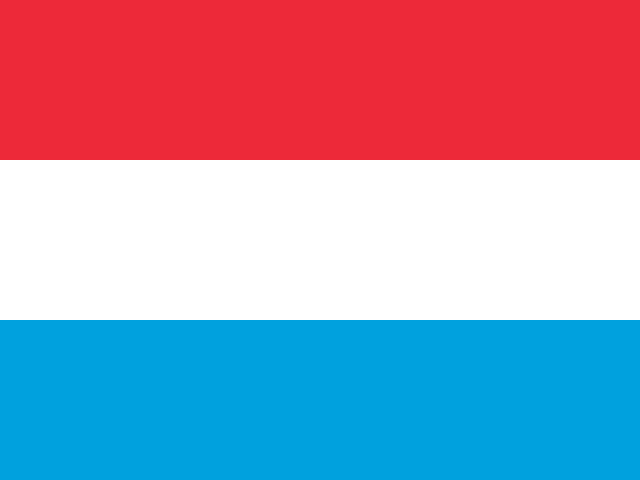
- Description: three equal horizontal bands of red (top), white, and light blueHistory: the colors are derived from the Grand Duke's coat of arms
- National symbols
- red rampant lion
- National colours
- red, white, light blue
- National anthem
- Title: “De Wilhelmus” (The William)Lyrics/music: Nikolaus WELTERHistory: adopted 1919; royal anthem, for use when members of the grand ducal family enter or exit a ceremony in Luxembourg
- UNESCO World Heritage Sites
- Total World Heritage Sites: 1 (cultural)Selected World Heritage Site locales: Luxembourg City Old Quarters and Fortifications
Economy
- Overview
- high-income EU and eurozone economy; global, highly capitalized banking sector; one of highest GDP-per-capita countries; strengthened domestic demand and lower interest rates contributing to economic growth; challenges include pension-system sustainability, labor-market dynamics, and energy price volatility
- GDP (PPP)
- $86.871 billion (2024 est.)
- GDP per person (PPP)
- $128,200 (2024 est.)
- GDP growth
- 1% (2024 est.)
- Inflation
- 2.1% (2024 est.)
- Unemployment
- 6% (2024 est.)
- Below poverty line
- 17.3% (2021 est.)
- Farm products
- milk, wheat, barley, triticale, potatoes, pork, grapes, beef, rye, rapeseed (2023)
- Industries
- banking and financial services, construction, real estate services, iron, metals, and steel, information technology, telecommunications, cargo transportation and logistics, chemicals, engineering, tires, glass, aluminum, tourism, biotechnology
- Exports
- $202.203 billion (2024 est.)
- Main exports
- iron blocks, gas turbines, plastic products, rubber tires, plastics (2023)
- Export partners
- Germany 18%, France 15%, Belgium 8%, Netherlands 7%, Italy 6% (2023)
- Main imports
- cars, refined petroleum, electricity, plastic products, gas turbines (2023)
- Import partners
- Belgium 26%, Germany 23%, France 10%, Netherlands 5%, USA 4% (2023)
- Money sent home from abroad
- 2.6% of GDP (2024 est.)
Energy, internet and transport
- Electricity access
- Electrification - total population: 100% (2022 est.)
- Electricity sources
- Fossil fuels: 10.5% of total installed capacity (2023 est.)Solar: 37.2% of total installed capacity (2023 est.)Wind: 55.6% of total installed capacity (2023 est.)Hydroelectricity: -35.8% of total installed capacity (2023 est.) note: Luxembourg has negative net hydroelectric power generation based on losses from use of pumped storage hydropowerBiomass and waste: 32.5% of total installed capacity (2023 est.)
- Internet users
- Percent of population: 99% (2024 est.)
- Mobile phones
- Total subscriptions: 961,000 (2023 est.)Subscriptions per 100 inhabitants: 137 (2021 est.)
- TV and radio
- long national tradition of operating radio and TV services for pan-European audiences; home to Europe's largest privately owned broadcast media group, the RTL Group, which operates 46 TV stations and 29 radio stations in Europe; also home to Europe's largest satellite operator, Société Européenne des Satellites (SES); domestically, the RTL Group operates TV and radio networks; other domestic private radio and TV operators and French and German stations available; satellite and cable TV services available
- Airports
- 3 (2025)
- Railways
- Total: 271 km (2020) 262 km electrified
- Merchant ships
- Total: 147 (2023)By type: bulk carrier 3, container ship 1, general cargo 24, oil tanker 4, other 115
Military and space
- Armed forces
- Luxembourg Army (l'Armée Luxembourgeoise) (2025)
- Military spending
- 2% of GDP (2025 est.)
- Military service
- 18-26 years of age for voluntary military service for men and women; no conscription (abolished 1969) (2025)
- Space programme
- Luxembourg Space Agency was established in 2018 to develop space policy, encourage and coordinate commercial space ventures, support space education, and promote the country’s space-related capabilities internationally; has a national space strategy; has set up policy and funding initiatives (such as LuxIMPULSE) to encourage research, development, innovation, and entrepreneurship and attract space-based industries; focuses on developing commercial satellites and infrastructure, as well as other capabilities and technologies; hosts some of the largest commercial satellite companies in the world; member of the ESA since 2005 and participates in a variety of ESA programs; cooperates bilaterally with individual ESA and EU member states; also works with other foreign space agencies and industries, including those of Canada, China, Japan, New Zealand, South Korea, the UAE, and the US (2025)
- Space milestones
- 1980s - began creating a satellite telecommunications infrastructure for Europe2014 - first privately built probe to successfully fly by the Moon (launched by China)2018 - developed communications satellite (GOVSAT-1) to support the EU’s secure communications and space situational awareness program (GOVSATCOM)2020 - signed US-led Artemis Accords for space exploration and agreed to join the Moon exploration mission2021 - launched Luxembourg’s Quantum Communications Infrastructure project (LuxQCI) in support of the EU’s Quantum Communications Infrastructure (EuroQCI)2025 - launched the Luxembourg Earth Observation System (LUXEOSys) satellite, part of a national space-based remote sensing program
Global issues
- Refugees and displaced people
- Refugees: 14,344 (2024 est.)Stateless persons: 85 (2024 est.)
Neighbouring countries
- Phone code
- +352
- Internet domain
- .lu