Paraguay
Republic of Paraguay · Paraguái
Jesuit missions with the Guaraní. The war of 1864–70 killed perhaps 60% of the population. Stroessner's dictatorship lasted 1954–89.
See Paraguay on the 3D globeTake a quiz
Population7 million
Area406,752 km²
CapitalAsunción
RegionSouth America
Did you know?
- Most people speak Guaraní, an Indigenous language
- Itaipú Dam supplies most of its electricity
- "Sopa paraguaya" is a cornbread, not a soup
Key facts about Paraguay
- Government
- Presidential republic
- Religion
- Catholic ~85%
- Founded / independence
- 1811 (from Spain)
- Rich in
- Hydropower (Itaipú), soybeans, beef
- Languages
- Guaraní, Spanish
Spanish and Guaraní (most people bilingual); Jopara mix - Currency
- Paraguayan guaraní (₲)
- People are called
- Paraguayan
- Main cities
- Asunción, Ciudad del Este, San Lorenzo
Timeline of Paraguay
- 1537Asunción founded
- 1811Independence
- 1864War of the Triple Alliance
- 1932Chaco War
- 1954Stroessner
- 1989Democracy
Places to see in Paraguay
- Itaipú Dam
- Jesuit missions of Trinidad and Jesús
- Asunción
- Chaco
Food and drink
Sopa paraguaya (a solid "soup") · chipa · tereré drink
Culture and famous for
Guaraní language spoken by most people; harp music; ñandutí lace
Popular sports
Football
Geography and climate
- Highest point
- Cerro Peró, 842 m
- Rivers, lakes and seas
- Paraná, Paraguay rivers
- Climate
- Subtropical
- Coastline
- Landlocked
- Population density
- 17 people per km²
Wars and conflicts
- Paraguayan War 1864–70 (lost most of its men)
- Chaco War 1932–35
Alliances and memberships
Military and security
Political unions and regional organisations
CELACOrganization of American States
Economy and trade
Paraguay in depth
Detailed facts from the CIA World Factbook (public domain, latest edition).
Overview
- History in brief
- Several Indigenous groups, principally belonging to the Guarani language family, inhabited the area of modern Paraguay before the arrival of the Spanish in the early 16th century, when the territory was incorporated into the Viceroyalty of Peru. Paraguay achieved its independence from Spain in 1811 with the help of neighboring states. In the aftermath of independence, a series of military dictators ruled the country until 1870. During the disastrous War of the Triple Alliance (1864-70) -- fought against Argentina, Brazil, and Uruguay -- Paraguay lost two thirds of its adult males and much of its territory. The country stagnated economically for the next half-century and experienced a tumultuous series of political regimes. Following the Chaco War of 1932-35 with Bolivia, Paraguay gained a large part of the Chaco lowland region. The 35-year military dictatorship of Alfredo STROESSNER ended in 1989, and Paraguay has held relatively free and regular presidential elections since the country's return to democracy.
Geography
- Location
- Central South America, northeast of Argentina, southwest of Brazil
- Size compared
- about three times the size of New York State; slightly smaller than California
- Land borders
- Total: 4,655 kmBorder countries: Argentina 2,531 km; Bolivia 753 km; Brazil 1,371 km
- Coastline
- 0 km (landlocked)
- Climate
- subtropical to temperate; substantial rainfall in the eastern portions, becoming semiarid in the far west
- Terrain
- grassy plains and wooded hills east of Rio Paraguay; Gran Chaco region west of Rio Paraguay mostly low, marshy plain near the river, and dry forest and thorny scrub elsewhere
- Elevation
- Highest point: Cerro Pero 842 mLowest point: junction of Río Paraguay and Río Paraná 46 mMean elevation: 178 m
- Natural resources
- hydropower, timber, iron ore, manganese, limestone
- Major rivers
- Río de la Plata/Paraná (shared with Brazil [s], Argentina, and Uruguay [m]) - 4,880 km; Paraguay river mouth (shared with Brazil [s] and Argentina) - 2,549 kmNote: [s] after country name indicates river source; [m] after country name indicates river mouth
- Natural hazards
- local flooding in southeast (early September to June); poorly drained plains may become boggy (early October to June)
- Notes
- landlocked; lies between Argentina, Bolivia, and Brazil; population concentrated in eastern and southern part of country
- Environmental issues
- deforestation; water pollution; toxic dumping in rivers and streams; loss of wetlands; inadequate means for waste disposal in urban areas
People and society
- Population
- Total: 7,604,044 (2025 est.)Male: 3,809,407Female: 3,794,637
- Nationality
- Noun: Paraguayan(s)Adjective: Paraguayan
- Ethnic groups
- Mestizo (mixed Spanish and Indigenous ancestry) 95%, other 5%
- Languages
- Spanish (official) and Guarani (official) 46.3%, only Guarani 34%, only Spanish 15.2%, other (includes Portuguese, German, other Indigenous languages) 4.1%, no response 0.4% (2012 est.)Major-language sample(s): La Libreta Informativa del Mundo, la fuente indispensable de información básica. (Spanish)The World Factbook, the indispensable source for basic information.
- Religions
- Roman Catholic 80.4%, Protestant 7% (Evangelical (non-specific) 6.7%, Evangelical Pentecostal <0.1%, Adventist <0.1%, Protestant (non-specific) <0.1%), Believer (not belonging to the church) 5.7%, other 0.6%, agnostic <0.1%, none 0.2%, unspecified 6.2% (2023 est.)
- Median age
- Total: 32.3 years (2025 est.)Male: 31.6 yearsFemale: 32 years
- Population growth
- 1.06% (2025 est.)
- Life expectancy
- Total population: 78.8 years (2024 est.)Male: 76.2 yearsFemale: 81.6 years
- Children per woman
- 1.88 children born/woman (2025 est.)
- Urbanization
- Urban population: 63.1% of total population (2023)Rate of urbanization: 1.64% annual rate of change (2020-25 est.)
- Largest cities
- 3.511 million ASUNCION (capital) (2023)
- Literacy
- Total population: 94.9% (2024 est.)Male: 95.4% (2024 est.)Female: 94.3% (2024 est.)
Government
- Official names
- Conventional long form: Republic of ParaguayConventional short form: ParaguayLocal long form: República del ParaguayLocal short form: ParaguayEtymology: derives from the river of the same name; the river's name may come from the Guarani words para (water or river) and guay (born)
- Government type
- presidential republic
- Capital
- Name: AsunciónGeographic coordinates: 25 16 S, 57 40 WTime difference: UTC-3 (2 hour ahead of Washington, DC, during Standard Time)Etymology: the name means "assumption" in Spanish; the Spanish founded the city on August 15, 1537, the Catholic feast day for the Assumption of the Virgin Mary
- Regions
- 17 departments (departamentos, singular - departamento) and 1 capital city*; Alto Paraguay, Alto Parana, Amambay, Asuncion*, Boquerón, Caaguazú, Caazapá, Canindeyú, Central, Concepcion, Cordillera, Guairá, Itapúa, Misiones, Ñeembucú, Paraguarí, Presidente Hayes, San Pedro
- Independence
- 14-15 May 1811 (from Spain)
- National holiday
- Independence Day, 14-15 May (1811) (observed 15 May); 14 May is celebrated as Flag Day
- Constitution
- History: several previous; latest approved and promulgated 20 June 1992Amendment process: proposed at the initiative of at least one quarter of either chamber of the National Congress, by the president of the republic, or by petition of at least 30,000 voters; passage requires a two-thirds majority vote by both chambers and approval in a referendum
- Legal system
- civil law system with influences from Argentine, Spanish, Roman, and French civil law models; Supreme Court of Justice reviews legislative acts
- Voting age
- 18 years of age; universal and compulsory until the age of 75
- Flag meaning
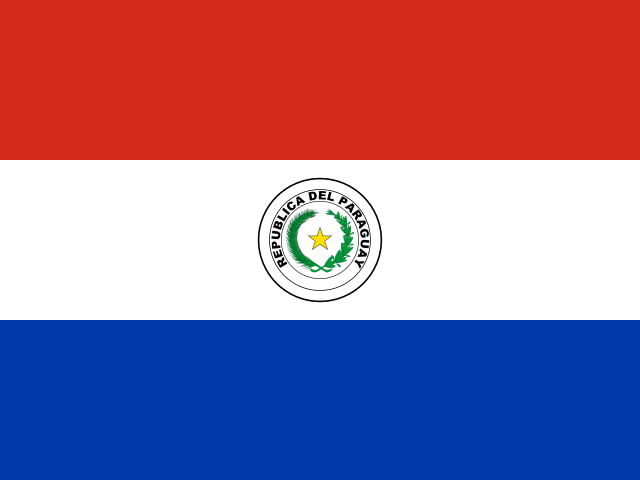
- Description: three equal horizontal bands of red (top), white, and blue, with an emblem centered on the white band; the emblem on one side of the flag is the national coat of arms, which has a five-pointed yellow star in a green wreath with the words REPUBLICA DEL PARAGUAY around it, all inside two circles; the other side of the flag has a circular treasury seal (a yellow lion below a red Cap of Liberty and the words PAZ Y JUSTICIA)Meaning: red stands for bravery and patriotism, white for integrity and peace, and blue for liberty and generosity
- National symbols
- lion
- National colours
- red, white, blue
- National anthem
- Title: "Paraguayos, Republica o muerte!" (Paraguayans, the Republic or Death!)Lyrics/music: Francisco Esteban ACUNA de Figueroa/Remberto GIMENEZHistory: adopted 1846 (lyrics) and 1934 (music)
- UNESCO World Heritage Sites
- Total World Heritage Sites: 1 (cultural)Selected World Heritage Site locales: Jesuit Missions of La Santísima Trinidad de Paraná and Jesús de Tavarangue
Economy
- Overview
- upper middle-income South American economy; COVID-19 hit while still recovering from 2019 Argentina-driven recession; global hydroelectricity leader; major corruption and money-laundering locale; highly agrarian economy; significant income inequality
- GDP (PPP)
- $112.919 billion (2024 est.)
- GDP per person (PPP)
- $16,300 (2024 est.)
- GDP growth
- 4.2% (2024 est.)
- Inflation
- 3.8% (2024 est.)
- Unemployment
- 6.1% (2024 est.)
- Below poverty line
- 24.7% (2022 est.)
- Farm products
- soybeans, sugarcane, maize, cassava, wheat, rice, milk, beef, oranges, bananas (2023)
- Industries
- sugar processing, cement, textiles, beverages, wood products, steel, base metals, electric power
- Exports
- $17.395 billion (2024 est.)
- Main exports
- soybeans, beef, electricity, corn, soybean meal (2023)
- Export partners
- Argentina 33%, Brazil 25%, Chile 10%, USA 2%, Uruguay 2% (2023)
- Main imports
- broadcasting equipment, refined petroleum, fertilizers, cars, pesticides (2023)
- Import partners
- China 33%, Brazil 24%, USA 8%, Argentina 7%, Germany 2% (2023)
- Money sent home from abroad
- 2% of GDP (2024 est.)
Energy, internet and transport
- Electricity access
- Electrification - total population: 100% (2022 est.)
- Electricity sources
- Hydroelectricity: 99.4% of total installed capacity (2023 est.)Biomass and waste: 0.5% of total installed capacity (2023 est.)
- Internet users
- Percent of population: 78% (2023 est.)
- Mobile phones
- Total subscriptions: 8.67 million (2023 est.)Subscriptions per 100 inhabitants: 127 (2023 est.)
- TV and radio
- 6 privately owned TV stations; about 75 commercial and community radio stations; 1 state-owned radio network (2019)
- Airports
- 83 (2025)
- Railways
- Total: 30 km (2014)Standard gauge: 30 km (2014) 1.435-m gauge
- Merchant ships
- Total: 108 (2023)By type: container ship 2, general cargo 22, oil tanker 5, other 79
Military and space
- Armed forces
- Armed Forces of Paraguay (Fuerzas Armadas de Paraguay; aka Armed Forces of the Nation or Fuerzas Armadas de la Nación): Paraguayan Army (Ejército Paraguayo), Paraguayan Navy (Armada Paraguaya; includes marines), Paraguayan Air Force (Fuerza Aérea Paraguaya)Ministry of Internal Affairs: National Police of Paraguay (Policía Nacional del Paraguay, PNP) (2025)
- Military spending
- 0.8% of GDP (2024 est.)
- Military service
- 18-25 years of age for voluntary service for men and women; all men 18-25 are required to perform military service for at least 12 months (2025)
- Space programme
- has a small, recently established space program focused on the acquisition of satellites, satellite data, and the technologies and capabilities to manufacture satellites, as well as promoting domestic expertise and industry; a priority is acquiring remote sensing capabilities to support socio-economic development, including resource mapping, weather, and crop monitoring; has built a cube satellite with foreign assistance; operates satellites; cooperates with foreign space agencies and industries, including those of India, Japan, Taiwan, the US, and member states of the Latin American and Caribbean Space Agency (2025)
- Space milestones
- 2017 - organized country’s first international conference on space issues2021 - first research/technology-demonstrator cube satellite (Guaranisat-1) built jointly with Japan, launched by US, and deployed from International Space Station; signed protocols for the establishment of the Latin American and Caribbean Space Agency2025 - developing Guarani-Sat-2, which will be Paraguay's second satellite and the first designed and built domestically
Global issues
- Refugees and displaced people
- Refugees: 7,649 (2024 est.)IDPs: 141 (2024 est.)Stateless persons: 5 (2024 est.)
Neighbouring countries
- Phone code
- +595
- Internet domain
- .py