Bolivia
Plurinational State of Bolivia · Wuliwya · Volívia · Buliwya
Tiwanaku and Inca lands; Potosí's silver funded the Spanish Empire. Lost its coastline to Chile in 1884. In 2025 voters ended about 20 years of MAS party rule.
See Bolivia on the 3D globeTake a quiz
Population12.4 million
Area1,098,581 km²
CapitalSucre
RegionSouth America
Did you know?
- La Paz is the world's highest seat of government (about 3,600 m)
- Salar de Uyuni is the largest salt flat on Earth
- Has two capitals: Sucre and La Paz
Key facts about Bolivia
- Government
- Presidential republic (plurinational state)
- Religion
- Catholic ~70%, Evangelical ~18%
- Founded / independence
- 1825 (from Spain)
- Rich in
- Lithium (largest reserves), natural gas, tin, silver (Potosí)
- Languages
- Aymara, Guaraní, Quechua, Spanish
Spanish, Quechua, Aymara, Guaraní and 33 other official languages - Currency
- Bolivian boliviano (Bs.)
- People are called
- Bolivian
- Main cities
- Santa Cruz, El Alto, La Paz, Cochabamba, Sucre
Timeline of Bolivia
- 1438Inca rule
- 1545Potosí silver
- 1825Independence
- 1884Loses coastline
- 2006First Indigenous president
- 2025MAS loses power
Places to see in Bolivia
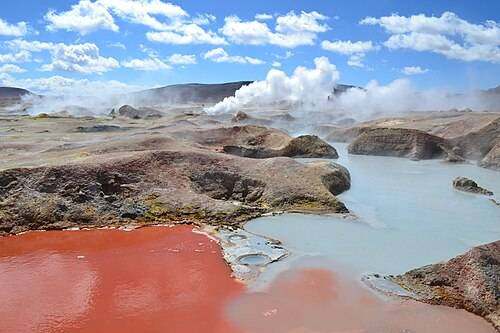
- Salar de Uyuni
- Lake Titicaca
- Tiwanaku
- La Paz cable cars
- Potosí's Cerro Rico
- Madidi National Park
Food and drink
Salteñas · silpancho · api drink
Culture and famous for
Cholita wrestlers; Aymara and Quechua culture; Oruro carnival
Popular sports
Football
Geography and climate
- Highest point
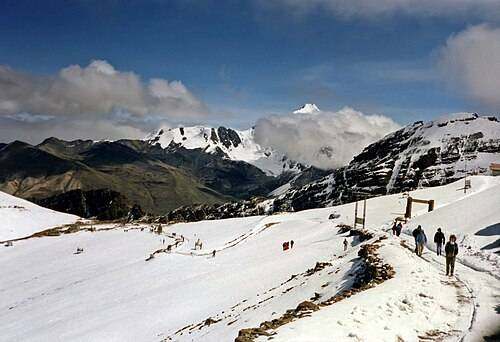
- Nevado Sajama, 6,542 m
- Rivers, lakes and seas
- Lake Titicaca; Amazon tributaries
- Climate
- Tropical lowlands, cold highlands
- Coastline
- Landlocked
- Population density
- 11 people per km²
Wars and conflicts
- War of the Pacific (lost coast)
- Chaco War 1932–35
- many coups
Empires and states that once stood here
Tiwanaku c. 500–1000Inca Empire 1438–1533
Alliances and memberships
Political unions and regional organisations
BRICS (partner country)CELACOrganization of American States
Economy and trade
Bolivia in depth
Detailed facts from the CIA World Factbook (public domain, latest edition).
Overview
- History in brief
- Bolivia, named after independence fighter Simón BOLÍVAR, broke away from Spanish rule in 1825. Much of its subsequent history has consisted of a series of coups and countercoups, with the last coup occurring in 1980. Democratic civilian rule was established in 1982, but leaders have faced problems of deep-seated poverty, social unrest, and illegal drug production.In 2005, Bolivians elected Movement Toward Socialism leader Evo MORALES as president -- by the widest margin of any leader since 1982 -- after he ran on a promise to change the country's traditional political class and empower the poor and indigenous majority. In 2009 and 2014, MORALES easily won reelection, and his party maintained control of the legislative branch. In 2016, MORALES narrowly lost a referendum to approve a constitutional amendment that would have allowed him to compete in the 2019 presidential election. A subsequent Supreme Court ruling stating that term limits violate human rights provided the justification for MORALES to run despite the referendum, but rising violence, pressure from the military, and widespread allegations of electoral fraud ultimately forced him to flee the country. An interim government, led by President Jeanine AÑEZ Chávez, held new elections in 2020, and Luis Alberto ARCE Catacora was elected president.
Geography
- Location
- Central South America, southwest of Brazil
- Size compared
- slightly less than three times the size of Montana
- Land borders
- Total: 7,252 kmBorder countries: Argentina 942 km; Brazil 3,403 km; Chile 942 km; Paraguay 753 km; Peru 1,212 km
- Coastline
- 0 km (landlocked)
- Climate
- varies with altitude; humid and tropical to cold and semiarid
- Terrain
- rugged Andes Mountains with a highland plateau (Altiplano), hills, lowland plains of the Amazon Basin
- Elevation
- Highest point: Nevado Sajama 6,542 mLowest point: Rio Paraguay 90 mMean elevation: 1,192 m
- Natural resources
- lithium, tin, natural gas, petroleum, zinc, tungsten, antimony, silver, iron, lead, gold, timber, hydropower
- Major lakes
- Fresh water lake(s): Lago Titicaca (shared with Peru) - 8,030 sq kmSalt water lake(s): Lago Poopo - 1,340 sq km
- Natural hazards
- flooding in the northeast (March to April)Volcanism: volcanic activity in Andes Mountains on the border with Chile; historically active volcanoes in this region are Irruputuncu (5,163 m), which last erupted in 1995, and the Olca-Paruma volcanic complex (5,762 m to 5,167 m)
- Notes
- landlocked; shares control of Lago Titicaca, world's highest navigable lake (elevation 3,805 m), with Peru
- Environmental issues
- deforestation from agricultural clearing and international demand for timber; soil erosion from overgrazing and poor cultivation methods (including slash-and-burn agriculture); desertification; loss of biodiversity; industrial pollution of water supplies used for drinking and irrigation
People and society
- Population
- Total: 12,436,103 (2025 est.)Male: 6,257,914Female: 6,178,189
- Nationality
- Noun: Bolivian(s)Adjective: Bolivian
- Ethnic groups
- Mestizo (mixed White and Indigenous ancestry) 68%, Indigenous 20%, White 5%, Cholo/Chola 2%, African descent 1%, other 1%, unspecified 3%; 44% other Indigenous group, predominantly Quechua or Aymara (2009 est.)
- Languages
- Spanish (official) 68.1%, Quechua (official) 17.2%, Aymara (official) 10.5%, Guarani (official) 0.6%, other 1.5%, unspecified 2.1%; note - Spanish and all Indigenous languages are official (2012 est.)Major-language sample(s): La Libreta Informativa del Mundo, la fuente indispensable de información básica. (Spanish)The World Factbook, the indispensable source for basic information.
- Religions
- Roman Catholic 65%, Protestant 19.6% (Evangelical (non-specific) 11.9%, Evangelical Baptist 2.1%, Evangelical Pentecostal 1.8%, Evangelical Methodist 0.7%, Adventist 2.8%, Protestant (non-specific) 0.3%), Believer (not belonging to the church) 0.9%, other 4.8%, atheist 1.7%, agnostic 0.6%, none 6.1%, unspecified 1.3% (2023 est.)
- Median age
- Total: 27 years (2025 est.)Male: 26.2 yearsFemale: 27 years
- Population growth
- 1.01% (2025 est.)
- Life expectancy
- Total population: 72.5 years (2024 est.)Male: 71 yearsFemale: 74 years
- Children per woman
- 2.13 children born/woman (2025 est.)
- Urbanization
- Urban population: 71.2% of total population (2023)Rate of urbanization: 1.87% annual rate of change (2020-25 est.)
- Largest cities
- 1.936 million LA PAZ (capital), 1.820 million Santa Cruz, 1.400 million Cochabamba (2022); 278,000 Sucre (constitutional capital) (2018)
- Literacy
- Total population: 95.6% (2023 est.)Male: 97.8% (2023 est.)Female: 93.5% (2023 est.)
Government
- Official names
- Conventional long form: Plurinational State of BoliviaConventional short form: BoliviaLocal long form: Estado Plurinacional de BoliviaLocal short form: BoliviaFormer: Upper PeruEtymology: the country is named in honor of Simón BOLÍVAR, a 19th-century leader in the South American wars for independence
- Government type
- presidential republic
- Capital
- Name: La Paz (administrative capital); Sucre (constitutional [legislative and judicial] capital)Geographic coordinates: 16 30 S, 68 09 WTime difference: UTC-4 (1 hour ahead of Washington, DC, during Standard Time)Etymology: La Paz is a shortening of the original name of the city, Pueblo Nuevo de Nuestra Señora de La Paz (New Town of Our Lady of Peace); Sucre is named after Antonio José de SUCRE (1795-1830), the second president of Bolivia
- Regions
- 9 departments (departamentos, singular - departamento); Beni, Chuquisaca, Cochabamba, La Paz, Oruro, Pando, Potosi, Santa Cruz, Tarija
- Independence
- 6 August 1825 (from Spain)
- National holiday
- Independence Day, 6 August (1825)
- Constitution
- History: many previous; latest drafted 6 August 2006 to 9 December 2008, approved by referendum 25 January 2009, effective 7 February 2009Amendment process: proposed through public petition by at least 20% of voters or by the Plurinational Legislative Assembly; passage requires approval by at least two-thirds majority vote of the total membership of the Assembly and approval in a referendum
- Legal system
- civil law system with influences from Roman, Spanish, canon (religious), French, and ethnic groups' pre-colonial law
- Voting age
- 18 years of age; universal and compulsory
- Flag meaning
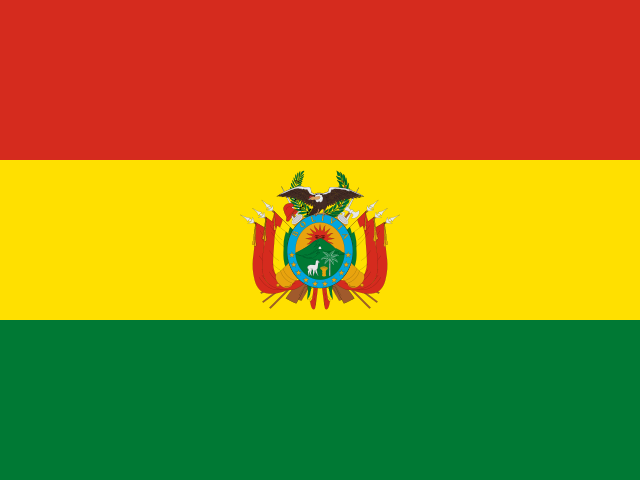
- Description: three equal horizontal bands of red (top), yellow, and green, with the coat of arms centered on the yellow bandMeaning: red stands for bravery and the blood of national heroes, yellow for the nation's mineral resources, and green for the land's fertilityHistory: in 2009, a presidential decree made it mandatory for a wiphala -- a square, multi-colored flag representing the country's ethnic groups -- to be used alongside the national flag
- National symbols
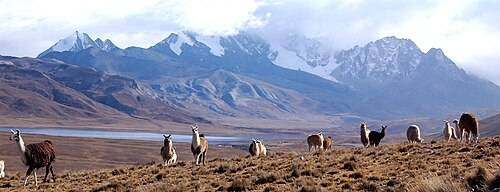
- llama, Andean condor; two national flowers, the cantuta and the patuju
- National colours
- red, yellow, green
- National anthem
- Title: "Cancion Patriotica" (Patriotic Song)Lyrics/music: Jose Ignacio de SANJINES/Leopoldo Benedetto VINCENTIHistory: adopted 1852
- UNESCO World Heritage Sites
- Total World Heritage Sites: 7 (6 cultural, 1 natural)Selected World Heritage Site locales: City of Potosi (c); El Fuerte de Samaipata (c); Historic Sucre (c); Jesuit Missions of Chiquitos (c); Noel Kempff Mercado National Park (n); Tiahuanacu (c); Qhapaq Ñan/Andean Road System (c)
Economy
- Overview
- resource-rich economy benefits during commodity booms; has bestowed juridical rights to Mother Earth, impacting extraction industries; increasing Chinese lithium mining trade relations; hard hit by COVID-19; increased fiscal spending amid poverty increases; rampant banking and finance corruption
- GDP (PPP)
- $122.2 billion (2024 est.)
- GDP per person (PPP)
- $9,800 (2024 est.)
- GDP growth
- 1.4% (2024 est.)
- Inflation
- 5.1% (2024 est.)
- Unemployment
- 3.1% (2024 est.)
- Below poverty line
- 37.7% (2022 est.)
- Farm products
- sugarcane, soybeans, maize, potatoes, sorghum, rice, milk, chicken, plantains, beef (2023)
- Industries
- mining, smelting, electricity, petroleum, food and beverages, handicrafts, clothing, jewelry
- Exports
- $11.905 billion (2023 est.)
- Main exports
- gold, natural gas, precious metal ore, zinc ore, soybean meal (2023)
- Export partners
- Brazil 15%, India 13%, China 11%, Argentina 11%, UAE 8% (2023)
- Main imports
- refined petroleum, cars, pesticides, trucks, plastics (2023)
- Import partners
- China 22%, Brazil 18%, Chile 13%, USA 7%, Peru 5% (2023)
- Money sent home from abroad
- 3.2% of GDP (2023 est.)
Energy, internet and transport
- Electricity access
- Electrification - total population: 99.9% (2022 est.)Electrification - urban areas: 100%Electrification - rural areas: 95.6%
- Electricity sources
- Fossil fuels: 65% of total installed capacity (2023 est.)Solar: 2.9% of total installed capacity (2023 est.)Wind: 3.7% of total installed capacity (2023 est.)Hydroelectricity: 24.9% of total installed capacity (2023 est.)Biomass and waste: 3.5% of total installed capacity (2023 est.)
- Internet users
- Percent of population: 70% (2023 est.)
- Mobile phones
- Total subscriptions: 12.2 million (2024 est.)Subscriptions per 100 inhabitants: 98 (2024 est.)
- TV and radio
- large number of radio and TV stations broadcasting with private media outlets dominating; state-owned and private radio and TV stations generally operating freely, although both pro-government and anti-government groups have attacked media outlets in response to their reporting (2019)
- Airports
- 201 (2025)
- Railways
- Total: 3,960 km (2019)Narrow gauge: 3,960 km (2014) 1.000-m gauge
- Merchant ships
- Total: 50 (2023)By type: general cargo 30, oil tanker 2, other 18
Military and space
- Armed forces
- Bolivian Armed Forces (Fuerzas Armadas de Bolivia or FAB): Bolivian Army (Ejercito de Boliviano), Bolivian Navy (Armada Boliviana), Bolivian Air Force (Fuerza Aerea Boliviana)Ministry of Government: National Police (Policía Nacional de Bolivia, PNB) (2025)
- Military spending
- 1.2% of GDP (2024 est.)
- Military service
- voluntary service for men and women 18-22 years of age; selective 12-month compulsory service for men, 18-22 (24 months of search and rescue service can be substituted for military service) (2025)
- Space programme
- has a small space program focused on acquiring and operating satellites; operates a telecommunications satellite and ground stations; has cooperated with China and India and member states of the Latin American and Caribbean Space Agency (2025)
- Space milestones
- 2013 - first communications satellite (Túpac Katari, TKSAT-1) built and launched by China2016 - began independently operating the TKSAT-1 satellite2021 - signed protocols for establishment of the Latin American and Caribbean Space Agency
Global issues
- Refugees and displaced people
- Refugees: 1,163 (2024 est.)IDPs: 12,070 (2024 est.)
- Drug trade
- USG identification: major illicit drug-producing and/or drug-transit countrymajor precursor-chemical producer (2025)
Neighbouring countries
ArgentinaBrazilChileParaguayPeru
- Phone code
- +591
- Internet domain
- .bo