Armenia
Republic of Armenia · Հայաստան
The first state to adopt Christianity, in 301. Divided for centuries between Persia, Ottomans and Russia; the Ottoman genocide killed up to 1.5 million. Lost Nagorno-Karabakh in 2023; signed a US-brokered peace framework with Azerbaijan in 2025.
See Armenia on the 3D globeTake a quiz
Did you know?
- Chess is a compulsory school subject
- The world's oldest known leather shoe (5,500 years) was found here
- Has the world's longest double-track reversible cable car at Tatev
Key facts about Armenia
- Government
- Parliamentary republic
- Religion
- Armenian Apostolic ~93%
- Founded / independence
- 1991 (from USSR); ancient kingdom c. 6th c. BC
- Rich in
- Mining (copper, molybdenum), brandy, IT
- Languages
- Armenian
Armenian (Eastern; Western in diaspora) - Currency
- Armenian dram (֏)
- People are called
- Armenian
- Main cities
- Yerevan, Gyumri, Vanadzor
Timeline of Armenia
- 301First Christian state
- 405Alphabet created
- 1915Genocide
- 1918First republic
- 1991Independence
- 2023Nagorno-Karabakh lost
- 2025Peace framework with Azerbaijan
Places to see in Armenia
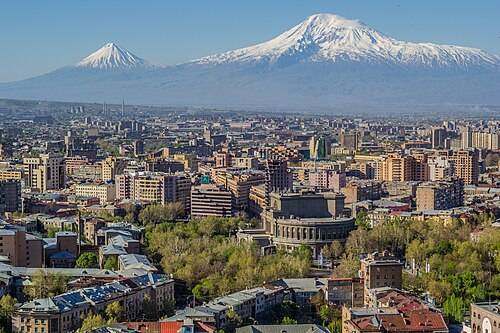
- Mount Ararat views
- Geghard Monastery
- Tatev Monastery and cable car
- Garni Temple
- Lake Sevan
- Khor Virap
Food and drink
Khorovats (barbecue) · dolma · lavash · harissa · Armenian brandy
Culture and famous for
Its own alphabet (405 AD); apricots; duduk music; composer Khachaturian
Popular sports
Chess (taught in all schools), wrestling, weightlifting
Geography and climate
- Highest point
- Mount Aragats, 4,090 m
- Rivers, lakes and seas
- Lake Sevan; Aras River
- Climate
- Highland continental
- Coastline
- Landlocked
- Population density
- 101 people per km²
Wars and conflicts
- Armenian Genocide 1915–17
- Nagorno-Karabakh wars 1988–94, 2020, 2023
Empires and states that once stood here
Republic of Artsakh (Nagorno-Karabakh) 1991–2023
Alliances and memberships
Military and security
CSTO (participation frozen since 2024; lost voting rights November 2026)
Political unions and regional organisations
Council of EuropeEurasian Economic UnionCommonwealth of Independent States
Armenia in depth
Detailed facts from the CIA World Factbook (public domain, latest edition).
Overview
- History in brief
- Armenia prides itself on being the first state to formally adopt Christianity (early 4th century). Armenia has existed as a political entity for centuries, but for much of its history it was under the sway of various empires, including the Roman, Byzantine, Arab, Persian, Ottoman, and Russian. During World War I, the Ottoman Empire instituted a policy of forced resettlement that, coupled with other harsh practices targeting its Armenian subjects, resulted in at least 1 million deaths; these actions have been widely recognized as constituting genocide. During the early 19th century, significant Armenian populations fell under Russian rule. Armenia declared its independence in 1918 in the wake of the Bolshevik Revolution in Russia, but it was conquered by the Soviet Red Army in 1920. Armenia, along with Azerbaijan and Georgia, was initially incorporated into the USSR as part of the Transcaucasian Federated Soviet Socialist Republic; in 1936, the republic was separated into its three constituent entities, which were maintained until the dissolution of the Soviet Union in 1991. For over three decades, Armenia had a longstanding conflict with neighboring Azerbaijan about the status of the Nagorno-Karabakh region, which historically had a mixed Armenian and Azerbaijani population, although ethnic Armenians have constituted the majority since the late 19th century. In 1921, Moscow placed Nagorno-Karabakh within Soviet Azerbaijan as an autonomous oblast. In the late Soviet period, a separatist movement developed that sought to end Azerbaijani control over the region. Fighting over Nagorno-Karabakh began in 1988 and escalated after Armenia and Azerbaijan declared independence from the Soviet Union in 1991. By the time a cease-fire took effect in 1994, separatists with Armenian support controlled Nagorno‑Karabakh and seven surrounding Azerbaijani territories. Armenia and Azerbaijan engaged in a second military conflict over Nagorno-Karabakh in 2020; Armenia lost control over much of the territory it had previously captured, returning the southern part of Nagorno-Karabakh and the territories around it to Azerbaijan. In September 2023, Azerbaijan took military action to regain control over Nagorno-Karabakh; after an armed conflict that lasted only one day, nearly the entire ethnic Armenian population of Nagorno-Karabakh fled to Armenia. Turkey closed its border with Armenia in 1993 in support of Azerbaijan during the first period of conflict with Armenia and has since
Geography
- Location
- Southwestern Asia, between Turkey (to the west) and Azerbaijan; note - Armenia views itself as part of Europe; geopolitically, it can be classified as falling within Europe, the Middle East, or both
- Size compared
- slightly smaller than Maryland
- Land borders
- Total: 1,570 kmBorder countries: Azerbaijan 996 km; Georgia 219 km; Iran 44 km; Turkey 311 km
- Coastline
- 0 km (landlocked)
- Climate
- highland continental, hot summers, cold winters
- Terrain
- Armenian Highland with mountains; little forest land; fast flowing rivers; good soil in Aras River valley
- Elevation
- Highest point: Aragats Lerrnagagat' 4,090 mLowest point: Debed River 400 mMean elevation: 1,792 m
- Natural resources
- small deposits of gold, copper, molybdenum, zinc, bauxite
- Major lakes
- Fresh water lake(s): Lake Sevan - 1,360 sq km
- Natural hazards
- occasionally severe earthquakes; droughts
- Notes
- landlocked in the Lesser Caucasus Mountains; Sevana Lich (Lake Sevan) is the largest lake in this mountain range
- Environmental issues
- soil pollution from toxic chemicals; deforestation; river pollution; threats to drinking water supplies from use of hydropower; nuclear power plant located in earthquake zone
People and society
- Population
- Total: 2,963,837 (2025 est.)Male: 1,451,842Female: 1,511,995
- Nationality
- Noun: Armenian(s)Adjective: Armenian
- Ethnic groups
- Armenian 98.1%, Yezidi 1.1%; less than 1%: Russian, other, Assyrian, Kurd, Ukrainian, Greek (2022 est.)
- Languages
- Armenian 97.2%, Russian 1.4%, Ezidian 1.0%; less than 1%: other, unknown (2022)Major-language sample(s): Աշխարհի Փաստագիրք, Անփոխարինելի Աղբյւր Հիմնական Տեղեկատվւթյան. (Armenian)The World Factbook, the indispensable source for basic information.
- Religions
- Armenian Apostolic 95.2%, not stated 1.7%; less than 1%: Catholic, no religion, Evangelical, Shar-fadinian, other, Armenian Orthodox, Jehovah's Witness, Pagan, Molokan (2022 est.)
- Median age
- Total: 39.5 years (2025 est.)Male: 37.6 yearsFemale: 40.3 years
- Population growth
- -0.45% (2025 est.)
- Life expectancy
- Total population: 76.7 years (2024 est.)Male: 73.4 yearsFemale: 80.1 years
- Children per woman
- 1.66 children born/woman (2025 est.)
- Urbanization
- Urban population: 63.7% of total population (2023)Rate of urbanization: 0.23% annual rate of change (2020-25 est.)
- Largest cities
- 1.095 million YEREVAN (capital) (2023)
- Literacy
- Total population: 99.8% (2023 est.)Male: 99.8% (2023 est.)Female: 99.9% (2023 est.)
- Years in school
- Total: 14 years (2023 est.)Male: 14 years (2023 est.)Female: 14 years (2023 est.)
Government
- Official names
- Conventional long form: Republic of ArmeniaConventional short form: ArmeniaLocal long form: Hayastani Hanrapetut'yunLocal short form: HayastanFormer: Armenian Soviet Socialist Republic, Armenian RepublicEtymology: the etymology of the country's name remains obscure; according to tradition, the local name for the country, Hayastan, comes from Hayk, the legendary patriarch of the Armenians and the great-great-grandson of Noah; the name Armenia was first recorded in a rock inscription from A.D. 521 in modern-day Iran
- Government type
- parliamentary democracy; note - constitutional changes adopted in December 2015 transformed the government to a parliamentary system
- Capital
- Name: YerevanGeographic coordinates: 40 10 N, 44 30 ETime difference: UTC+4 (9 hours ahead of Washington, DC, during Standard Time)Etymology: name origin is unclear; it may derive from the name of a local ethnic group, or from the ancient fortress of Erebuni that was built on the current site of Yerevan in 782 B.C.
- Regions
- 11 provinces (marzer, singular - marz); Aragatsotn, Ararat, Armavir, Geghark'unik', Kotayk', Lorri, Shirak, Syunik', Tavush, Vayots' Dzor, Yerevan
- Independence
- 21 September 1991 (from the Soviet Union); notable earlier dates: 321 B.C. (Kingdom of Armenia established under the Orontid Dynasty), A.D. 884 (Armenian Kingdom reestablished under the Bagratid Dynasty); 1198 (Cilician Kingdom established); 28 May 1918 (Democratic Republic of Armenia declared)
- National holiday
- Independence Day, 21 September (1991)
- Constitution
- History: previous 1915, 1978; latest adopted 5 July 1995Amendment process: proposed by the president of the republic or by the National Assembly; passage requires approval by the president, the National Assembly, and a referendum with at least 25% registered-voter participation and more than 50% of votes; constitutional articles on the form of government and democratic procedures are not amendable
- Legal system
- civil law system
- Voting age
- 18 years of age; universal
- Flag meaning
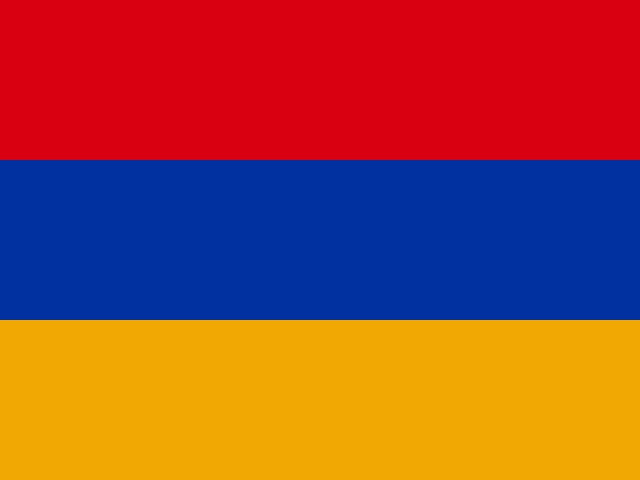
- Description: three equal horizontal bands of red (top), blue, and orangeMeaning: red stands for the blood shed for liberty, blue for the Armenian skies and hope, and orange for the land and the courage of the workers who farm it
- National symbols
- Mount Ararat, eagle, lion
- National colours
- red, blue, orange
- National anthem
- Title: "Mer Hayrenik" (Our Fatherland)Lyrics/music: Mikael NALBANDIAN/Barsegh KANACHYANHistory: adopted 1991; based on the anthem of the Democratic Republic of Armenia (1918-1922), but with different lyrics
- UNESCO World Heritage Sites
- Total World Heritage Sites: 3 (3 cultural)Selected World Heritage Site locales: Monasteries of Haghpat and Sanahin; Monastery of Geghard and the Upper Azat Valley; Cathedral and Churches of Echmiatsin
Economy
- Overview
- upper-middle income, fast-growing Caucasus economy; stable fiscal and monetary regime but vulnerable to geopolitical shocks; economic and energy ties to Russia but seeking more EU and US trade; key copper and gold exporter; business-friendly and anti-corruption reforms; persistent unemployment; influx of migrants from Ukraine war easing
- GDP (PPP)
- $60.909 billion (2024 est.)
- GDP per person (PPP)
- $20,100 (2024 est.)
- GDP growth
- 5.9% (2024 est.)
- Inflation
- 0.3% (2024 est.)
- Unemployment
- 13.4% (2024 est.)
- Below poverty line
- 24.8% (2022 est.)
- Farm products
- milk, potatoes, grapes, vegetables, wheat, tomatoes, watermelons, apricots, apples, barley (2023)
- Industries
- brandy, mining, diamond processing, metal-cutting machine tools, forging and pressing machines, electric motors, knitted wear, hosiery, shoes, silk fabric, chemicals, trucks, instruments, microelectronics, jewelry, software, food processing
- Exports
- $18.618 billion (2024 est.)
- Main exports
- gold, diamonds, copper ore, broadcasting equipment, jewelry (2023)
- Export partners
- Russia 37%, UAE 25%, Hong Kong 7%, China 5%, Georgia 4% (2023)
- Main imports
- cars, gold, diamonds, broadcasting equipment, natural gas (2023)
- Import partners
- Russia 29%, China 12%, Vietnam 6%, Georgia 5%, Iran 4% (2023)
- Money sent home from abroad
- 4.6% of GDP (2024 est.)
Energy, internet and transport
- Electricity access
- Electrification - total population: 100% (2022 est.)
- Electricity sources
- Fossil fuels: 43% of total installed capacity (2023 est.)Nuclear: 29% of total installed capacity (2023 est.)Solar: 8.9% of total installed capacity (2023 est.)Hydroelectricity: 19% of total installed capacity (2023 est.)
- Internet users
- Percent of population: 80% (2023 est.)
- Mobile phones
- Total subscriptions: 4.01 million (2024 est.)Subscriptions per 100 inhabitants: 135 (2024 est.)
- TV and radio
- government-run Public Television network operates alongside 100 privately owned TV stations that provide local to near-nationwide coverage; three Russian TV companies are broadcast under interstate agreements; subscription cable TV services are available in most regions; several major international broadcasters are available, including CNN; Armenian TV completed conversion from analog to digital broadcasting in 2016; Public Radio of Armenia is a national, state-run broadcast network that operates alongside 18 privately owned radio stations (2024)
- Airports
- 11 (2025)
- Railways
- Total: 686 km (2017)
Military and space
- Armed forces
- Armenian Republic Armed Forces: Armenian Army (includes land, air, air defense forces) (2025)
- Military spending
- 5.5% of GDP (2024 est.)
- Military service
- 18-27 for voluntary (men and women), contract (men and women) or compulsory (men) military service; contract military service is 3-12 months or up to 5 years; conscripts serve 24 months; all citizens aged 27-50 are registered in the military reserve and may be called to serve if mobilization is declared (2025)
Global issues
- Refugees and displaced people
- Refugees: 145,354 (2024 est.)IDPs: 4 (2024 est.)Stateless persons: 373 (2024 est.)
Neighbouring countries
- Phone code
- +374
- Internet domain
- .am