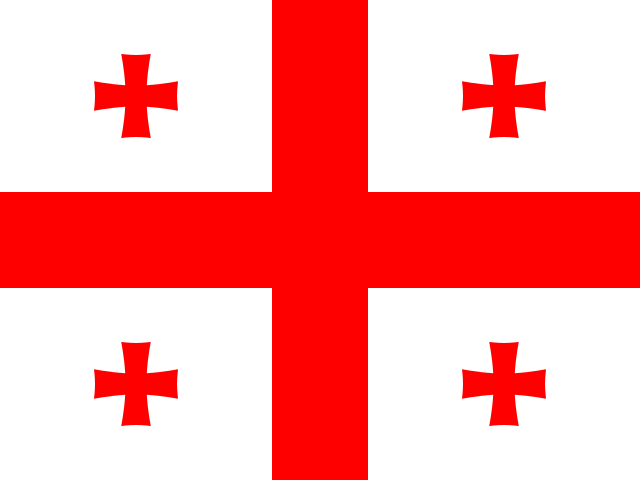
Georgia
Georgia · საქართველო
Ancient kingdoms of Colchis and Iberia; golden age under Queen Tamar. Absorbed by Russia in 1801. Russia occupies about 20% of its territory after the 2008 war; mass protests since 2024.
See Georgia on the 3D globeTake a quiz
Population3.7 million
Area69,700 km²
CapitalTbilisi
RegionWestern Asia
Did you know?
- Has the oldest evidence of winemaking (about 6000 BC)
- Its alphabet is one of only 14 in the world
- Europe's oldest human remains outside Africa were found at Dmanisi
Key facts about Georgia
- Government
- Parliamentary republic
- Religion
- Georgian Orthodox ~84%, Islam ~11%
- Founded / independence
- 1991 (from USSR)
- Rich in
- Wine (8,000-year tradition), manganese, tourism, transit
- Languages
- Georgian
Georgian (Kartvelian): Imeretian, Kakhetian, Gurian dialects; Mingrelian, Svan - Currency
- lari (₾)
- People are called
- Georgian
- Main cities
- Tbilisi, Batumi, Kutaisi, Rustavi
Timeline of Georgia
- 1008Unified kingdom
- 1184Queen Tamar's golden age
- 1801Russian annexation
- 1918Independence
- 1921Soviet rule
- 1991Independence
- 2008War with Russia
Places to see in Georgia
- Old Tbilisi and sulphur baths
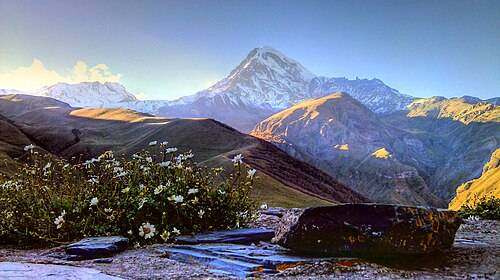
- Gergeti Trinity Church below Mount Kazbek
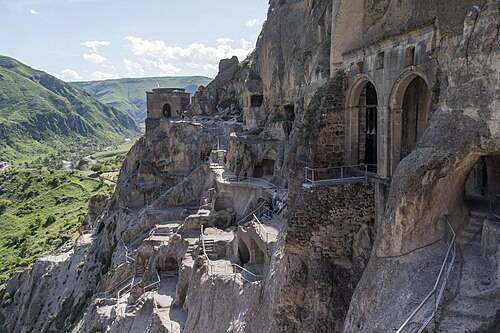
- Uplistsikhe cave town
- Mtskheta
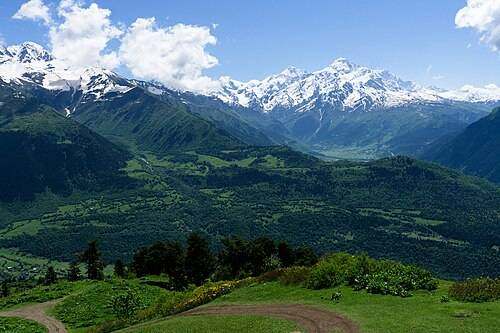
- Svaneti towers
- Batumi
Food and drink
Khachapuri (cheese bread) · khinkali dumplings · churchkhela · wine in qvevri jars
Culture and famous for
8,000 years of winemaking; polyphonic singing; supra feasts with a toastmaster
Popular sports
Rugby, wrestling, judo, chess
Geography and climate
- Highest point
- Shkhara, 5,193 m
- Rivers, lakes and seas
- Mtkvari (Kura), Rioni
- Climate
- Subtropical coast, alpine mountains
- Coastline
- Has a sea coast
- Population density
- 53 people per km²
Wars and conflicts
- Russo-Georgian War 2008
- Abkhazia and South Ossetia conflicts
Alliances and memberships
Political unions and regional organisations
EU candidate countriesCouncil of Europe
Georgia in depth
Detailed facts from the CIA World Factbook (public domain, latest edition).
Overview
- History in brief
- The region of present-day Georgia once contained the ancient kingdoms of Colchis (known as Egrisi locally) and Kartli-Iberia. The area came under Roman influence in the first centuries A.D., and Christianity became the state religion in the 330s. Persian, Arab, and Turk domination was followed by a Georgian golden age (11th-13th centuries) that was cut short when the Mongols invaded in 1236. Subsequently, the Ottoman and Persian empires competed for influence in the region. Georgia was absorbed into the Russian Empire in the 19th century. Independent for three years (1918-1921) following the Russian revolution, it was forcibly incorporated into the USSR in 1921 and regained its independence when the Soviet Union dissolved in 1991.In 2003, mounting public discontent over rampant corruption, ineffective government services, and a government attempt to manipulate parliamentary elections touched off widespread protests that led to the resignation of Eduard SHEVARDNADZE, who had been president since 1995. In the aftermath of this "Rose Revolution," new elections in 2004 swept Mikheil SAAKASHVILI and his United National Movement (UNM) party into power. SAAKASHVILI made progress on market reforms and governance, but he faced accusations of abuse of office. Progress was further complicated when Russian support for the separatist regions of Abkhazia and South Ossetia led to a five-day conflict between Russia and Georgia in August 2008, which included Russia invading large portions of Georgian territory. Russia initially pledged to pull back from most Georgian territory but then unilaterally recognized the independence of Abkhazia and South Ossetia, and Russian military forces have remained in those regions.Billionaire Bidzina IVANISHVILI's unexpected entry into politics in 2011 brought the divided opposition together under his Georgian Dream coalition, which won a majority of seats in the 2012 parliamentary elections and removed UNM from power. Conceding defeat, SAAKASHVILI named IVANISHVILI as prime minister and left the country after his presidential term ended in 2013. IVANISHVILI voluntarily resigned from office after the presidential succession, and in the years since, the prime minister position has seen frequent turnover. In 2021, SAAKASHVILI returned to Georgia, where he was immediately arrested to serve six years in prison on outstanding abuse-of-office convictions.Popular support for integration with the West is high in Georgia. Joining the EU and NATO
Geography
- Location
- Southwestern Asia, bordering the Black Sea, between Turkey and Russia, with a sliver of land north of the Caucasus extending into Europe; note - Georgia views itself as part of Europe; geopolitically, it can be classified as falling within Europe, the Middle East, or both
- Size compared
- slightly smaller than South Carolina; slightly larger than West Virginia
- Land borders
- Total: 1,814 kmBorder countries: Armenia 219 km; Azerbaijan 428 km; Russia 894 km; Turkey 273 km
- Coastline
- 310 km
- Climate
- warm and pleasant; Mediterranean-like on Black Sea coast
- Terrain
- largely mountainous with Great Caucasus Mountains in the north and Lesser Caucasus Mountains in the south; Kolkhet'is Dablobi (Kolkhida Lowland) opens to the Black Sea in the west; Mtkvari River Basin in the east; fertile soils in river valley flood plains and foothills of Kolkhida Lowland
- Elevation
- Highest point: Mt'a Shkhara 5,193 mLowest point: Black Sea 0 mMean elevation: 1,432 m
- Natural resources
- timber, hydropower, manganese deposits, iron ore, copper, minor coal and oil deposits; coastal climate and soils allow for important tea and citrus growth
- Natural hazards
- earthquakes
- Notes
- Note 1: strategically located east of the Black Sea, Georgia controls much of the Caucasus Mountains and the routes through themNote 2: the world's four deepest caves are all in Georgia, including two that are the only known caves on earth deeper than 2,000 m: Krubera Cave at -2,197 m (-7,208 ft; reached in 2012) and Veryovkina Cave at -2,212 (-7,257 ft; reached in 2018)
- Environmental issues
- air pollution, particularly in Rust'avi; heavy water pollution of Mtkvari River and the Black Sea; inadequate supplies of potable water; soil pollution from toxic chemicals; land and forest degradation; biodiversity loss; waste management
People and society
- Population
- Total: 4,900,961 (2024 est.)Male: 2,343,068Female: 2,557,893
- Nationality
- Noun: Georgian(s)Adjective: Georgian
- Ethnic groups
- Georgian 86.8%, Azeri 6.3%, Armenian 4.5%, other 2.3% (includes Russian, Ossetian, Yazidi, Ukrainian, Kist, Greek) (2014 est.)
- Languages
- Georgian (official) 87.6%, Azeri 6.2%, Armenian 3.9%, Russian 1.2%, other 1% (including Abkhaz, the official language in Abkhazia) (2014 est.)Major-language sample(s): მსოფლიო ფაქტების წიგნი, ძირითადი ინფორმაციის აუცილებელი წყარო. (Georgian)The World Factbook, the indispensable source for basic information.
- Religions
- Eastern Orthodox Christian (official) 83.4%, Muslim 10.7%, Armenian Apostolic Christian 2.9%, other 1.2% (includes Roman Catholic Christian, Jehovah's Witness, Yazidi, Protestant Christian, Jewish), none 0.5%, unspecified/no answer 1.2% (2014 est.)
- Median age
- Total: 38.6 years (2025 est.)Male: 35.9 yearsFemale: 40.6 years
- Population growth
- -0.45% (2025 est.)
- Life expectancy
- Total population: 72.8 years (2024 est.)Male: 68.7 yearsFemale: 77.2 years
- Children per woman
- 1.94 children born/woman (2025 est.)
- Urbanization
- Urban population: 60.7% of total population (2023)Rate of urbanization: 0.35% annual rate of change (2020-25 est.)
- Largest cities
- 1.082 million TBILISI (capital) (2023)
- Literacy
- Total population: 99.7% (2024 est.)Male: 99.8% (2024 est.)Female: 99.6% (2024 est.)
- Years in school
- Total: 16 years (2023 est.)Male: 16 years (2023 est.)Female: 17 years (2023 est.)
Government
- Official names
- Conventional long form: noneConventional short form: GeorgiaLocal long form: Republic of GeorgiaLocal short form: Sak'art'veloFormer: Georgian Soviet Socialist RepublicEtymology: the Western name probably derives from the name of the local people, the Gurz, whose name origin is uncertain; the native name "Sak'art'velo" means "Land of the Kartvelians" and refers to the core central Georgian region of Kartli
- Government type
- semi-presidential republic
- Capital
- Name: TbilisiGeographic coordinates: 41 41 N, 44 50 ETime difference: UTC+4 (9 hours ahead of Washington, DC, during Standard Time)Etymology: the name comes from the Georgian word tbili, meaning "warm" and referring to the hot sulfur springs in the area
- Regions
- 9 regions (mkharebi, singular - mkhare), 1 city (kalaki), and 2 autonomous republics (avtomnoy respubliki, singular - avtom respublika)Regions: Guria, Imereti, Kakheti, Kvemo Kartli, Mtskheta Mtianeti, Racha-Lechkhumi and Kvemo Svaneti, Samegrelo and Zemo Svaneti, Samtskhe-Javakheti, Shida Kartli; note - the breakaway region of South Ossetia consists of the northern part of Shida Kartli, eastern slivers of the Imereti region and Racha-Lechkhumi and Kvemo Svaneti, and part of western Mtskheta-MtianetiCity: TbilisiAutonomous republics: Abkhazia or Ap'khazet'is Avtonomiuri Respublika (Sokhumi), Ajaria or Acharis Avtonomiuri Respublika (Bat'umi)
- Independence
- 9 April 1991 (from the Soviet Union); notable earlier date: A.D. 1008 (Georgia unified under King BAGRAT III)
- National holiday
- Independence Day, 26 May (1918)
- Constitution
- History: previous 1921, 1978 (based on 1977 Soviet Union constitution); latest approved 24 August 1995, effective 17 October 1995Amendment process: proposed as a draft law supported by more than one half of the Parliament membership or by petition of at least 200,000 voters; passage requires support by at least three fourths of the Parliament membership in two successive sessions three months apart and the signature and promulgation by the president of Georgia
- Legal system
- civil law system
- Voting age
- 18 years of age; universal
- Flag meaning
- Description: white rectangle with a central red cross extending to all four sides of the flag; each of the four quadrants displays a small red bolnur-katskhuri cross (also known as Bolnisi cross), which has equal-length arms that are slightly wider at the end than in the centerHistory: sometimes referred to as the Five-Cross Flag, the design is based on a 14th-century banner of the Kingdom of Georgia
- National symbols
- Saint George, lion
- National colours
- red, white
- National anthem
- Title: "Tavisupleba" (Liberty)Lyrics/music: Davit MAGRADSE/Zakaria PALIASHVILI (adapted by Joseb KETSCHAKMADSE)History: adopted 2004, after the Rose Revolution; based on music from the operas "Abesalom da Eteri" and "Daisi"
- UNESCO World Heritage Sites
- Total World Heritage Sites: 4 (3 cultural, 1 natural)Selected World Heritage Site locales: Gelati Monastery (c); Historical Monuments of Mtskheta (c); Upper Svaneti (c); Colchic Rainforests and Wetlands (n)
Economy
- Overview
- upper-middle income, fast-growing South Caucasus economy; regionally focused exporter of cars, metal ores, and energy; financial and migrant inflows resulting from Ukraine conflict; EU accession talks suspended over disputed election and foreign influence law; low inflation but persistent high unemployment
- GDP (PPP)
- $91.849 billion (2024 est.)
- GDP per person (PPP)
- $25,000 (2024 est.)
- GDP growth
- 9.4% (2024 est.)
- Inflation
- 1.1% (2024 est.)
- Unemployment
- 11.5% (2024 est.)
- Below poverty line
- 11.8% (2023 est.)
- Farm products
- milk, grapes, potatoes, maize, wheat, tangerines/mandarins, tomatoes, barley, apples, eggs (2023)
- Industries
- steel, machine tools, electrical appliances, mining (manganese, copper, gold), chemicals, wood products, wine
- Exports
- $16.321 billion (2024 est.)
- Main exports
- cars, copper ore, electricity, garments, wine (2023)
- Export partners
- Azerbaijan 13%, Turkey 11%, Armenia 11%, Russia 10%, Kyrgyzstan 8% (2023)
- Main imports
- cars, refined petroleum, packaged medicine, natural gas, garments (2023)
- Import partners
- Turkey 16%, USA 13%, Russia 11%, China 8%, Germany 6% (2023)
- Money sent home from abroad
- 11.8% of GDP (2024 est.)
Energy, internet and transport
- Electricity access
- Electrification - total population: 100% (2022 est.)
- Electricity sources
- Fossil fuels: 23.9% of total installed capacity (2023 est.)Wind: 0.6% of total installed capacity (2023 est.)Hydroelectricity: 75.5% of total installed capacity (2023 est.)
- Internet users
- Percent of population: 82% (2023 est.)
- Mobile phones
- Total subscriptions: 5.91 million (2023 est.)Subscriptions per 100 inhabitants: 156 (2022 est.)
- TV and radio
- state-owned Georgian Public Broadcaster (GPB) includes Channel 1, Channel 2, and Adjara TV; independent commercial TV broadcasters include Imedi, Rustavi 2, Pirveli TV, Maestro, Kavkasia, Georgian Dream Studios (GDS), Obiektivi, Mtavari Arkhi, and TOK TV (Russian language); Tabula and Post TV are web-based TV outlets; Georgian Orthodox Church operates a satellite-based television station called Unanimity; 26 regional TV broadcasters; TV shifted to digital in 2015; several dozen private radio stations; GPB operates 2 radio stations (2019)
- Airports
- 21 (2025)
- Railways
- Total: 1,363 km (2014)Narrow gauge: 37 km (2014) 0.912-m gauge (37 km electrified)Broad gauge: 1,326 km (2014) 1.520-m gauge (1,251 km electrified)
- Merchant ships
- Total: 26 (2023)By type: general cargo 3, other 23
Military and space
- Armed forces
- Georgian Defense Forces (GDF; aka Defense Forces of Georgia, DFG): Ground Forces, Air Force, Special Operations Forces, National GuardMinistry of Internal Affairs: Police, Border Police of Georgia, Coast Guard of Georgia (includes naval forces, which were merged with the Coast Guard in 2009) (2025)
- Military spending
- 1.7% of GDP (2024 est.)
- Military service
- 18-35 years of age for voluntary military service for men and women; conscription was abolished in 2016, but reinstated in 2017 for men 18-27 years of age; conscript service obligation is up to 11 months depending on the assigned ministry, job specialty, and if the service is carried out in a combat unit (2025)
Global issues
- Refugees and displaced people
- Refugees: 31,791 (2024 est.)IDPs: 347,754 (2024 est.)Stateless persons: 488 (2024 est.)
Neighbouring countries
ArmeniaAzerbaijanRussiaTürkiye
- Phone code
- +995
- Internet domain
- .ge