Iran
Islamic Republic of Iran · ایران
Cyrus the Great founded the first Persian Empire, and successive Persian empires shaped the region. The 1979 revolution created an Islamic republic. In February 2026 the US and Israel attacked, killing Supreme Leader Ali Khamenei; a June 2026 memorandum ended major fighting.
See Iran on the 3D globeTake a quiz

Ongoing: US–Israel war with Iran
Did you know?
- Produces about 90% of the world's saffron
- Celebrates Nowruz on the spring equinox
- Persian gardens and qanat water tunnels are UNESCO heritage
Key facts about Iran
- Government
- Islamic theocratic republic
- Religion
- Shia Islam ~90%, Sunni ~9%
- Founded / independence
- 550 BC (Achaemenid Persia); 1979 Islamic Republic
- Rich in
- Oil and gas (second-largest gas reserves), saffron, pistachios, carpets
- Languages
- Persian (Farsi)
Persian (Farsi); Azerbaijani, Kurdish, Luri, Gilaki, Mazandarani, Balochi, Arabic - Currency
- Iranian rial (﷼)
- People are called
- Iranian
- Main cities
- Tehran, Mashhad, Isfahan, Karaj, Shiraz, Tabriz
Timeline of Iran
- 550 BCCyrus founds empire
- 651Arab conquest
- 1501Safavid dynasty
- 1925Pahlavi dynasty
- 1979Islamic Revolution
- 1980Iran-Iraq War
- 2026US–Israeli war, Khamenei killed
Places to see in Iran
- Persepolis
- Naqsh-e Jahan Square, Isfahan
- Shiraz gardens
- Yazd windcatchers
- Imam Reza Shrine, Mashhad
Food and drink
Chelo kebab · ghormeh sabzi · tahdig · saffron rice · fesenjan
Culture and famous for
Persian carpets; poets Hafez, Rumi, Ferdowsi; Nowruz new year
Popular sports
Wrestling, football, weightlifting
Geography and climate
- Highest point
- Damavand, 5,609 m
- Rivers, lakes and seas
- Caspian Sea; Karun River; Lake Urmia
- Climate
- Arid and semi-arid
- Coastline
- Has a sea coast
- Population density
- 55 people per km²
Wars and conflicts
- Iran-Iraq War 1980–88
- 12-day war with Israel 2025
- US–Israeli war on Iran 2026 (ceasefire, fragile)
Empires and states that once stood here
Achaemenid Persian Empire 550–330 BCParthian and Sasanian Persia 247 BC–651 ADSeljuk Empire 1037–1194Khwarazmian Empire 1077–1231Safavid Empire 1501–1736
Alliances and memberships
Military and security
Shanghai Cooperation Organisation
Political unions and regional organisations
Eurasian Economic Union (free-trade partner)BRICSOrganisation of Islamic Cooperation
Economy and trade
Iran in depth
Detailed facts from the CIA World Factbook (public domain, latest edition).
Overview
- History in brief
- Known as Persia until 1935, Iran became an Islamic republic in 1979 after the ruling monarchy was overthrown and Shah Mohammad Reza PAHLAVI was forced into exile. Conservative clerical forces led by Ayatollah Ruhollah KHOMEINI established a theocratic system of government with ultimate political authority vested in a religious scholar known as the Supreme Leader, who is accountable only to the Assembly of Experts -- an elected 88-member body of clerics. US-Iran relations became strained when Iranian students seized the US Embassy in Tehran in November 1979 and held embassy personnel hostage until mid-January 1981. The US cut off diplomatic relations with Iran in April 1980. From 1980 to 1988, Iran fought a bloody, indecisive war with Iraq that eventually expanded into the Persian Gulf and led to clashes between US Navy and Iranian military forces. Iran has been designated a state sponsor of terrorism since 1984.After the election of reformer Hojjat ol-Eslam Mohammad KHATAMI as president in 1997 and a reformist Majles (legislature) in 2000, a political reform campaign in response to popular dissatisfaction was initiated, but conservative politicians blocked reform measures while increasing repression. Municipal and legislative elections in 2003 and 2004 saw conservatives reestablish control over Iran's elected government institutions, culminating in the 2005 inauguration of hardliner Mahmud AHMADI-NEJAD as president. His reelection in 2009 sparked nationwide protests over allegations of electoral fraud, and the protests persisted until 2011. In 2013, Iranians elected to the presidency centrist cleric Dr. Hasan Fereidun RUHANI, a longtime senior regime member who promised to reform society and foreign policy. In 2019, Tehran's sudden decision to increase the gasoline price sparked nationwide protests, which the regime violently suppressed. Conservatives won the majority in Majles elections in 2020, and hardline cleric Ebrahim RAISI was elected president in 2021, resulting in a conservative monopoly across the regime's elected and unelected institutions.Iran continues to be subject to a range of international sanctions and export controls because of its involvement in terrorism, weapons proliferation, human rights abuses, and concerns over the nature of its nuclear program. Iran received nuclear-related sanctions relief in exchange for nuclear concessions under the Joint Comprehensive Plan of Action's (JCPOA) Implementation Day beginning in 2016. However, t
Geography
- Location
- Middle East, bordering the Gulf of Oman, the Persian Gulf, and the Caspian Sea, between Iraq and Pakistan
- Size compared
- almost 2.5 times the size of Texas; slightly smaller than Alaska
- Land borders
- Total: 5,894 kmBorder countries: Afghanistan 921 km; Armenia 44 km; Azerbaijan 689 km; Iraq 1,599 km; Pakistan 959 km; Turkey 534 km; Turkmenistan 1,148 km
- Coastline
- 2,440 km
- Climate
- mostly arid or semiarid, subtropical along Caspian coast
- Terrain
- rugged, mountainous rim; high, central basin with deserts, mountains; small, discontinuous plains along both coasts
- Elevation
- Highest point: Kuh-e Damavand 5,625 mLowest point: Caspian Sea -28 mMean elevation: 1,305 m
- Natural resources
- petroleum, natural gas, coal, chromium, copper, iron ore, lead, manganese, zinc, sulfur
- Major rivers
- Euphrates (shared with Turkey [s], Syria, and Iraq [m]) - 3,596 km; Tigris (shared with Turkey, Syria, and Iraq [m]) - 1,950 km; Helmand (shared with Afghanistan [s]) - 1,130 kmNote: [s] after country name indicates river source; [m] after country name indicates river mouth
- Major lakes
- Salt water lake(s): Caspian Sea (shared with Russia, Azerbaijan, Turkmenistan, and Kazakhstan) - 374,000 sq km; Lake Urmia - 5,200 sq km; Lake Namak - 750 sq km
- Natural hazards
- periodic droughts, floods; dust storms, sandstorms; earthquakes
- Notes
- strategic location on the Persian Gulf and Strait of Hormuz
- Environmental issues
- air pollution, especially in urban areas, from vehicle emissions, refinery operations, and industrial effluents; deforestation; overgrazing; desertification; oil pollution in the Persian Gulf; wetland losses from drought; soil degradation (salination); inadequate potable water; water pollution from raw sewage and industrial waste
People and society
- Population
- Total: 89,177,357 (2025 est.)Male: 45,098,223Female: 44,079,134
- Nationality
- Noun: Iranian(s)Adjective: Iranian
- Ethnic groups
- Persian, Azeri, Kurd, Lur, Baloch, Arab, Turkmen, and Turkic tribes
- Languages
- Persian Farsi (official), Azeri and other Turkic dialects, Kurdish, Gilaki and Mazandarani, Luri, Balochi, ArabicMajor-language sample(s): چکیده نامه جهان، منبعی ضروری برای کسب اطلاعات کلی جهان (Persian)The World Factbook, the indispensable source for basic information.
- Religions
- Muslim (official) 98.5%, Christian 0.7%, Baha'i 0.3%, agnostic 0.3%, other (includes Zoroastrian, Jewish, Hindu) 0.2% (2020 est.)
- Median age
- Total: 35.2 years (2025 est.)Male: 33.6 yearsFemale: 34.1 years
- Population growth
- -0.87% (2025 est.)
- Life expectancy
- Total population: 75.6 years (2024 est.)Male: 74.3 yearsFemale: 77.1 years
- Children per woman
- 1.53 children born/woman (2025 est.)
- Urbanization
- Urban population: 77.3% of total population (2023)Rate of urbanization: 1.32% annual rate of change (2020-25 est.)
- Largest cities
- 9.500 million TEHRAN (capital), 3.368 million Mashhad, 2.258 million Esfahan, 1.721 million Shiraz, 1.661 million Tabriz, 1.594 million Karaj (2023)
- Literacy
- Total population: 86% (2016 est.)Male: 90% (2016 est.)Female: 81% (2016 est.)
- Years in school
- Total: 14 years (2020 est.)Male: 14 years (2020 est.)Female: 14 years (2020 est.)
Government
- Official names
- Conventional long form: Islamic Republic of IranConventional short form: IranLocal long form: Jomhuri-ye Eslami-ye IranLocal short form: IranFormer: PersiaEtymology: the name derives from the Sanskrit word arya, referring to people living in a mountainous land, from the root word ar-, or "mountain;" the former name, Persia, was originally "Pars" (or the Arabic-influenced variant "Fars") from the Old Persian parsi, meaning "pure"
- Government type
- theocratic republic
- Capital
- Name: TehranGeographic coordinates: 35 42 N, 51 25 ETime difference: UTC+3.5 (8.5 hours ahead of Washington, DC)Daylight saving time: does not observe daylight savings timeEtymology: the name probably means "flat" or "lower," referring to its location in the foothills of the Elburz Mountains
- Regions
- 31 provinces (ostanha, singular - ostan); Alborz, Ardabil, Azarbayjan-e Gharbi (West Azerbaijan), Azarbayjan-e Sharqi (East Azerbaijan), Bushehr, Chahar Mahal va Bakhtiari, Esfahan, Fars, Gilan, Golestan, Hamadan, Hormozgan, Ilam, Kerman, Kermanshah, Khorasan-e Jonubi (South Khorasan), Khorasan-e Razavi (Razavi Khorasan), Khorasan-e Shomali (North Khorasan), Khuzestan, Kohgiluyeh va Bowyer Ahmad, Kordestan, Lorestan, Markazi, Mazandaran, Qazvin, Qom, Semnan, Sistan va Baluchestan, Tehran, Yazd, Zanjan
- Independence
- 1 April 1979 (Islamic Republic of Iran proclaimed); notable earlier dates: ca. 550 B.C. (Achaemenid or Persian Empire established); A.D. 1501 (Iran reunified under the Safavid dynasty); 1794 (beginning of Qajar dynasty); 12 December 1925 (modern Iran established under the PAHLAVI dynasty)
- National holiday
- Republic Day, 1 April (1979)
- Constitution
- History: previous 1906; latest adopted 24 October 1979, effective 3 December 1979Amendment process: proposed by the supreme leader – after consultation with the Exigency Council – and submitted as an edict to the "Council for Revision of the Constitution," a body consisting of various executive, legislative, judicial, and academic leaders and members; passage requires absolute majority vote in a referendum and approval of the supreme leader; articles including Iran’s political system, its religious basis, and its form of government cannot be amended
- Legal system
- religious system based on secular and Islamic law
- Voting age
- 18 years of age; universal
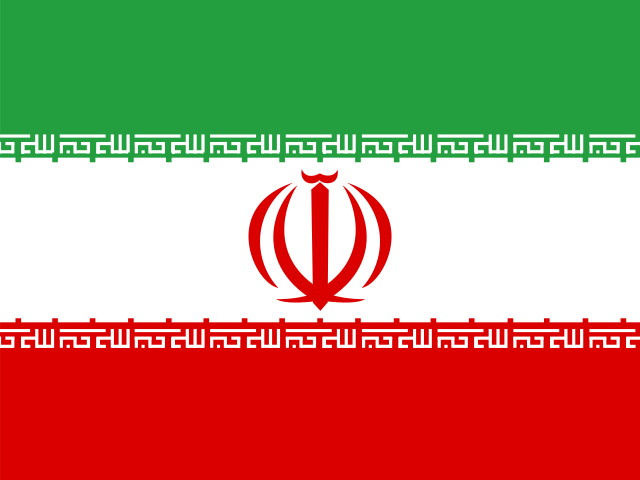
- Flag meaning
- Description: three equal horizontal bands of green (top), white, and red; centered in the white band is the red national emblem, a stylization of the word Allah in the shape of a tulip (a symbol of martyrdom); ALLAH AKBAR (God is Great) in white Arabic script is repeated 11 times along the bottom edge of the green band and 11 times along the top edge of the red bandMeaning: green is the color of Islam and also represents growth, white stands for honesty and peace, and red for bravery and martyrdom
- National symbols
- lion
- National colours
- green, white, red
- National anthem
- Title: "Soroud-e Melli-ye Jomhouri-ye Eslami-ye Iran" (National Anthem of the Islamic Republic of Iran)Lyrics/music: multiple authors/Hassan RIAHIHistory: adopted 1990
- UNESCO World Heritage Sites
- Total World Heritage Sites: 29 (27 cultural, 2 natural)Selected World Heritage Site locales: Persepolis (c); Tchogha Zanbil (c); Bam and its Cultural Landscape (c); Golestan Palace (c); Shushtar Historical Hydraulic System (c); Pasargadae (c); Hyrcanian Forests (n); Tabriz Historic Bazaar Complex (c); Meidan Emam, Esfahan (c); Bisotun (c); Takht-e Soleyman (c); Soltaniyeh(c); Bisotun (c); Armenian Monastic Ensembles of Iran(c); Sheikh Safi al-din Khānegāh and Shrine Ensemble in Ardabil (c); The Persian Garden (c); Gonbad-e Qābus (c); Masjed-e Jāmé of Isfahan (c); Shahr-i Sokhta (c); Cultural Landscape of Maymand (c); Susa (c); Lut Desert (n);The Persian Qanat (c); Historic City of Yazd (c); Sassanid Archaeological Landscape of Fars Region (c); Cultural Landscape of Hawraman/Uramanat (c); Trans-Iranian Railway (c); The Persian Caravanserai (c); Hegmataneh (c); Prehistoric Sites of the Khorramabad Valley (c)
Economy
- Overview
- traditionally state-controlled economy but reforming state-owned financial entities; strong oil/gas, agricultural, and service sectors; recent massive inflation due to exchange rate depreciation, international sanctions, and investor uncertainty; increasing poverty
- GDP (PPP)
- $1.486 trillion (2024 est.)
- GDP per person (PPP)
- $16,200 (2024 est.)
- GDP growth
- 3% (2024 est.)
- Inflation
- 32.5% (2024 est.)
- Unemployment
- 9.2% (2024 est.)
- Farm products
- wheat, sugarcane, milk, sugar beets, rice, tomatoes, barley, potatoes, oranges, apples (2023)
- Industries
- petroleum, petrochemicals, gas, fertilizer, caustic soda, textiles, cement and other construction materials, food processing (particularly sugar refining and vegetable oil production), ferrous and nonferrous metal fabrication, armaments
- Exports
- $100.031 billion (2024 est.)
- Main exports
- plastics, iron ore, alcohols, natural gas, refined copper (2023)
- Export partners
- China 35%, Turkey 16%, India 8%, Pakistan 7%, Armenia 5% (2023)
- Main imports
- broadcasting equipment, vehicle parts/accessories, corn, soybeans, vehicle bodies (2023)
- Import partners
- China 34%, UAE 20%, Turkey 11%, Brazil 8%, Germany 4% (2023)
- Money sent home from abroad
- 0% of GDP (2023 est.)
Energy, internet and transport
- Electricity access
- Electrification - total population: 100% (2022 est.)
- Electricity sources
- Fossil fuels: 94.6% of total installed capacity (2023 est.)Nuclear: 1.6% of total installed capacity (2023 est.)Solar: 0.2% of total installed capacity (2023 est.)Wind: 0.2% of total installed capacity (2023 est.)Hydroelectricity: 3.4% of total installed capacity (2023 est.)
- Internet users
- Percent of population: 80% (2023 est.)
- Mobile phones
- Total subscriptions: 159 million (2024 est.)Subscriptions per 100 inhabitants: 174 (2024 est.)
- TV and radio
- state-run broadcast media with no private, independent broadcasters; Islamic Republic of Iran Broadcasting (IRIB), the state-run TV broadcaster, operates over 60 television channels, over 50 radio stations, and dozens of newspapers and websites; about 20 foreign Persian-language TV stations broadcasting on satellite TV can be seen in Iran; satellite dishes are illegal and sometimes confiscated; most major international broadcasters transmit to Iran (2023)
- Airports
- 177 (2025)
- Railways
- Total: 8,483.5 km (2014)Standard gauge: 8,389.5 km (2014) 1.435-m gauge (189.5 km electrified)Broad gauge: 94 km (2014) 1.676-m gauge
- Merchant ships
- Total: 965 (2023)By type: bulk carrier 32, container ship 28, general cargo 398, oil tanker 86, other 421
Military and space
- Armed forces
- the military forces of Iran are divided between the Islamic Republic of Iran Regular Forces (Artesh) and the Islamic Revolutionary Guard Corps (IRGC or Sepah):Artesh: Ground Forces, Navy (includes marines), Air Force, Air Defense ForcesIRGC: Ground Forces, Navy (includes marines), Aerospace Force (controls strategic missile force), Qods Force (aka Quds Force; special operations), Cyber Electronic Command, Basij Paramilitary ForcesMinistry of Interior: Law Enforcement Command (FARAJA)Ministry of Intelligence and Security (2025)
- Military spending
- 2% of GDP (2024 est.)
- Military service
- 16 for voluntary military service for men; military service is compulsory for all Iranian men at age 18 or 19 years of age; compulsory service obligation 14-21 months, depending on the location of service; women exempted from conscription but may volunteer (2025)
- Space programme
- has an ambitious civil and military space program focused on satellites and satellite launch vehicles (SLV); designs, builds, and operates satellites, including communications, remote sensing (RS), and scientific; manufactures and operates SLVs; researching and developing other space-related capabilities and technologies in areas such as telecommunications, RS, navigation, and space situational awareness; international sanctions against Iran’s weapons of mass destruction program have severely limited Iran’s cooperation with foreign space agencies and commercial space industries; in recent years, however, it has worked with North Korea and Russia, as well as regional and international space organizations such as the Asia-Pacific Space Cooperation Organization and the International Telecommunications Satellite Organization; Iran was a founding member of the UN Committee on the Peaceful Uses of Outer Space (COPUOS) in 1958; has an active private space industry (2025)
- Space milestones
- 1998 - began development of 2-stage satellite/space launch vehicle (SLV) (Safir)2006 - first successful launch of a small, domestically produced communications and research satellite (Omid) on the Safir SLV2010 - began developing a more capable 2-stage orbital SLV (Simorgh; aka Safir-2)2011 - launched first domestically produced remote sensing (RS) satellite (Rasad) on Safir SLV2020 - placed RS microsatellite (Noor) in orbit on 3-stage SLV (Qased or Messenger)2021 - first launch of road-mobile 3-stage SLV (Zuljanah)2022 - completed suborbital test of new small-lift SLV (Quam-100)
Global issues
- Refugees and displaced people
- Refugees: 3,489,257 (2024 est.)IDPs: 421 (2024 est.)
Neighbouring countries
AfghanistanArmeniaAzerbaijanIraqPakistanTürkiyeTurkmenistan
- Phone code
- +98
- Internet domain
- .ir