Croatia
Republic of Croatia · Hrvatska
Croatian kingdom from 925, then in union with Hungary from 1102 and later the Habsburgs. Part of Yugoslavia 1918–1991; independence was won in a war against Serb forces. Joined the EU in 2013 and the euro in 2023.
See Croatia on the 3D globeTake a quiz
Population3.8 million
Area56,594 km²
CapitalZagreb
RegionSoutheast Europe
Did you know?
- The necktie is named after Croatian soldiers' scarves
- Reached the football World Cup final in 2018
- Dubrovnik was a filming location for Game of Thrones
Key facts about Croatia
- Government
- Parliamentary republic
- Religion
- Roman Catholic ~79%
- Founded / independence
- 1991 (from Yugoslavia)
- Rich in
- Tourism, Adriatic coast, shipbuilding, natural gas
- Languages
- Croatian
Croatian with three dialect groups: Shtokavian, Kajkavian (Zagreb), Chakavian (coast) - Currency
- Euro (€)
- People are called
- Croatian
- Main cities
- Zagreb, Split, Rijeka, Osijek, Zadar, Dubrovnik
Timeline of Croatia
- 925Kingdom of Croatia
- 1102Union with Hungary
- 1918Joins Yugoslavia
- 1991Independence
- 1995War ends
- 2013Joins EU
- 2023Adopts euro and Schengen
Places to see in Croatia
- Dubrovnik old town
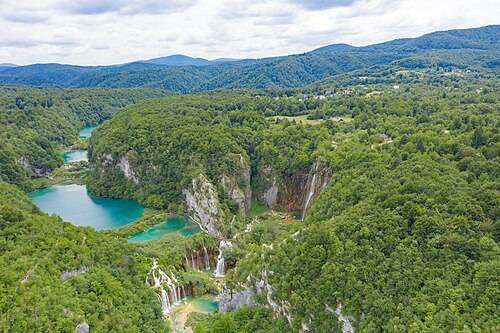
- Plitvice Lakes
- Diocletian's Palace, Split
- Pula Arena
- Hvar island
Food and drink
Peka (slow-cooked meat) · Dalmatian prosciutto · black risotto · štrukli
Culture and famous for
The necktie (cravat) originated here; Dalmatian dog breed; klapa singing
Popular sports
Football, handball, water polo, tennis
Geography and climate
- Highest point
- Dinara, 1,831 m
- Rivers, lakes and seas
- Sava, Drava, Danube; over 1,000 islands
- Climate
- Mediterranean coast, continental inland
- Coastline
- Has a sea coast
- Population density
- 67 people per km²
Wars and conflicts
- Croatian War of Independence 1991–95
Empires and states that once stood here
Kingdom/SFR of Yugoslavia 1918–1992
Alliances and memberships
Military and security
Political unions and regional organisations
European UnionEurozoneCouncil of Europe
Economy and trade
Croatia in depth
Detailed facts from the CIA World Factbook (public domain, latest edition).
Overview
- History in brief
- The lands that today comprise Croatia were part of the Austro-Hungarian Empire until the end of World War I. In 1918, the Croats, Serbs, and Slovenes formed a kingdom known after 1929 as Yugoslavia. Following World War II, Yugoslavia became a federal independent communist state consisting of six socialist republics, including Croatia, under the strong hand of Josip Broz, aka TITO. Although Croatia declared its independence from Yugoslavia in 1991, it took four years of sporadic, but often bitter, fighting before Yugoslav forces were cleared from Croatian lands, along with a majority of Croatia's ethnic Serb population. Under UN supervision, the last Serb-held enclave in eastern Slavonia was returned to Croatia in 1998. The country joined NATO in 2009 and the EU in 2013. In January 2023, Croatia further integrated into the EU by joining the Eurozone and the Schengen Area.
Geography
- Location
- Southeastern Europe, bordering the Adriatic Sea, between Bosnia and Herzegovina and Slovenia
- Size compared
- slightly smaller than West Virginia
- Land borders
- Total: 2,237 kmBorder countries: Bosnia and Herzegovina 956 km; Hungary 348 km; Montenegro 19 km; Serbia 314 km; Slovenia 600 km
- Coastline
- 5,835 km (mainland 1,777 km; islands 4,058 km)
- Climate
- Mediterranean and continental; continental climate predominant with hot summers and cold winters; mild winters, dry summers along coast
- Terrain
- geographically diverse; flat plains along Hungarian border, low mountains and highlands near Adriatic coastline and islands
- Elevation
- Highest point: Dinara 1,831 mLowest point: Adriatic Sea 0 mMean elevation: 331 m
- Natural resources
- oil, some coal, bauxite, low-grade iron ore, calcium, gypsum, natural asphalt, silica, mica, clays, salt, hydropower
- Major rivers
- Dunav (Danube) (shared with Germany [s], Austria, Slovakia, Hungary, Serbia, Bulgaria, Ukraine, Moldova, and Romania [m]) - 2,888 kmNote: [s] after country name indicates river source; [m] after country name indicates river mouth
- Natural hazards
- destructive earthquakes
- Notes
- controls most land routes from Western Europe to the Aegean Sea and Turkish Straits; most Adriatic Sea islands lie off the coast of Croatia -- some 1,200 islands, islets, ridges, and rocks
- Environmental issues
- air pollution in urban areas, as well as emissions from neighboring countries; surface water pollution in the Danube River Basin
People and society
- Population
- Total: 4,071,208 (2025 est.)Male: 1,968,334Female: 2,102,874
- Nationality
- Noun: Croat(s), Croatian(s)Adjective: Croatian
- Ethnic groups
- Croat 91.6%, Serb 3.2%, other 3.9% (including Bosniak, Romani, Albanian, Italian, and Hungarian), unspecified 1.3% (2021 est.)
- Languages
- Croatian (official) 95.2%, Serbian 1.2%, other 3.1% (including Bosnian, Romani, Albanian, and Italian) unspecified 0.5% (2021 est.)Major-language sample(s): Knjiga svjetskih činjenica, nužan izvor osnovnih informacija. (Croatian)The World Factbook, the indispensable source for basic information.
- Religions
- Roman Catholic 79%, Orthodox 3.3%, Protestant 0.3%, other Christian 4.8%, Muslim 1.3%, other 1.1%, agnostic 1.7%, none or atheist 4.7%, unspecified 3.9% (2021 est.)
- Median age
- Total: 44.9 years (2025 est.)Male: 43.2 yearsFemale: 47 years
- Population growth
- -0.53% (2025 est.)
- Life expectancy
- Total population: 77.7 years (2024 est.)Male: 74.6 yearsFemale: 81 years
- Children per woman
- 1.43 children born/woman (2025 est.)
- Urbanization
- Urban population: 58.6% of total population (2023)Rate of urbanization: 0.05% annual rate of change (2020-25 est.)
- Largest cities
- 684,000 ZAGREB (capital) (2023)
- Years in school
- Total: 16 years (2022 est.)Male: 15 years (2022 est.)Female: 17 years (2022 est.)
Government
- Official names
- Conventional long form: Republic of CroatiaConventional short form: CroatiaLocal long form: Republika HrvatskaLocal short form: HrvatskaFormer: People's Republic of Croatia, Socialist Republic of CroatiaEtymology: name probably derives from the Croats, a Slavic tribe who migrated to the Balkans in the 7th century A.D., but that name may be related to the Russian word khrebet, meaning "mountain chain"
- Government type
- parliamentary republic
- Capital
- Name: ZagrebGeographic coordinates: 45 48 N, 16 00 ETime difference: UTC+1 (6 hours ahead of Washington, DC, during Standard Time)Daylight saving time: +1hr, begins last Sunday in March; ends last Sunday in OctoberEtymology: the city's name means "beyond the bank (or ditch)"; za in Old Croat means "beyond," and greb means "bank" or "ditch," relating to the city's original site above the Sava River
- Regions
- 20 counties (zupanije, singular - zupanija) and 1 city* (grad - singular) with special county status; Bjelovarsko-Bilogorska (Bjelovar-Bilogora), Brodsko-Posavska (Brod-Posavina), Dubrovacko-Neretvanska (Dubrovnik-Neretva), Istarska (Istria), Karlovacka (Karlovac), Koprivnicko-Krizevacka (Koprivnica-Krizevci), Krapinsko-Zagorska (Krapina-Zagorje), Licko-Senjska (Lika-Senj), Medimurska (Medimurje), Osjecko-Baranjska (Osijek-Baranja), Pozesko-Slavonska (Pozega-Slavonia), Primorsko-Goranska (Primorje-Gorski Kotar), Sibensko-Kninska (Sibenik-Knin), Sisacko-Moslavacka (Sisak-Moslavina), Splitsko-Dalmatinska (Split-Dalmatia), Varazdinska (Varazdin), Viroviticko-Podravska (Virovitica-Podravina), Vukovarsko-Srijemska (Vukovar-Syrmia), Zadarska (Zadar), Zagreb*, Zagrebacka (Zagreb county)
- Independence
- 25 June 1991 (from Yugoslavia); notable earlier dates: ca. 925 (Kingdom of Croatia established), 1 December 1918 (Kingdom of Serbs, Croats, and Slovenes established, later became Yugoslavia)
- National holiday
- Statehood Day (National Day), 30 May (1990)
- Constitution
- History: several previous; latest adopted 22 December 1990Amendment process: proposed by at least one fifth of the Assembly membership, by the president of the republic, by the Government of Croatia, or through petition by at least 10% of the total electorate; proceedings to amend require majority vote by the Assembly; passage requires two-thirds majority vote by the Assembly; passage by petition requires a majority vote in a referendum and promulgation by the Assembly
- Legal system
- civil law system influenced by legal heritage of Austria-Hungary
- Voting age
- 18 years of age; universal
- Flag meaning
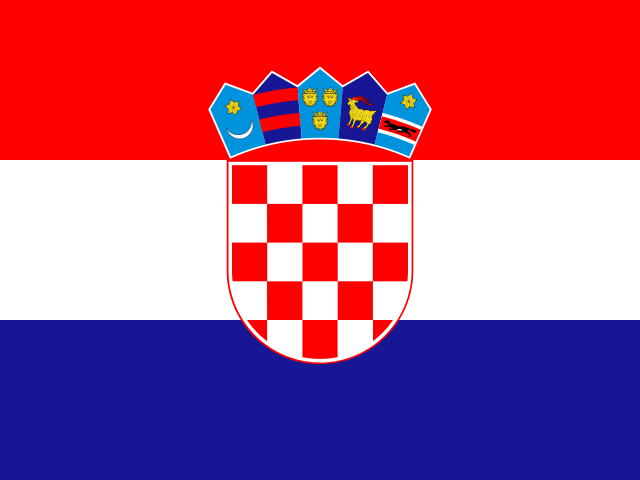
- Description: three equal horizontal bands of red (top), white, and blue -- the pan-Slav colors -- with the Croatian coat of arms in the center, which consists of a main shield (a checkerboard of 13 red and 12 silver fields) with five smaller shields that form a crown over the main shieldMeaning: the small shields represent the five historic regions (from left to right): Croatia, Dubrovnik, Dalmatia, Istria, and SlavoniaHistory: Russia's 19th-century flag inspired the pan-Slav colors
- National symbols
- red-and-white checkerboard
- National colours
- red, white, blue
- National anthem
- Title: "Lijepa nasa domovino" (Our Beautiful Homeland)Lyrics/music: Antun MIHANOVIC/Josip RUNJANINHistory: adopted in 1972 while still part of Yugoslavia; the lyrics were written in 1835, and it served as an unofficial anthem beginning in 1891
- UNESCO World Heritage Sites
- Total World Heritage Sites: 10 (8 cultural, 2 natural)Selected World Heritage Site locales: Plitvice Lakes National Park (n); Historic Split (c); Old City of Dubrovnik (c); Euphrasian Basilica; Historic Trogir (c); Šibenik Cathedral (c); Stari Grad Plain (c); Zadar and Fort St. Nikola Venetian Defense Works (c); Primeval Beech Forests (n); Stećci Medieval Tombstones Graveyards (c)
Economy
- Overview
- upper-middle-income Balkan economy; newest euro user (introduced in 2023); increased investments from EU structural funds and tourism sector contributing to strong but moderating economic growth; declining energy prices and restrictive monetary policy easing inflation; historically low unemployment rate with labor shortages within services and manufacturing sectors
- GDP (PPP)
- $164.825 billion (2024 est.)
- GDP per person (PPP)
- $42,600 (2024 est.)
- GDP growth
- 3.8% (2024 est.)
- Inflation
- 3% (2024 est.)
- Unemployment
- 5.3% (2024 est.)
- Below poverty line
- 18% (2021 est.)
- Farm products
- maize, wheat, sugar beets, milk, barley, soybeans, sunflower seeds, potatoes, pork, grapes (2023)
- Industries
- chemicals and plastics, machine tools, fabricated metal, electronics, pig iron and rolled steel products, aluminum, paper, wood products, construction materials, textiles, shipbuilding, petroleum and petroleum refining, food and beverages, tourism
- Exports
- $46.601 billion (2024 est.)
- Main exports
- ships, garments, electricity, packaged medicine, wood (2023)
- Export partners
- Italy 14%, Germany 11%, Slovenia 11%, Bosnia & Herzegovina 6%, Austria 6% (2023)
- Main imports
- refined petroleum, cars, garments, natural gas, crude petroleum (2023)
- Import partners
- Italy 14%, Germany 14%, Slovenia 11%, Hungary 6%, Austria 5% (2023)
- Money sent home from abroad
- 7.3% of GDP (2024 est.)
Energy, internet and transport
- Electricity access
- Electrification - total population: 100% (2022 est.)
- Electricity sources
- Fossil fuels: 31.2% of total installed capacity (2023 est.)Solar: 1.7% of total installed capacity (2023 est.)Wind: 14.8% of total installed capacity (2023 est.)Hydroelectricity: 48.5% of total installed capacity (2023 est.)Geothermal: 0.1% of total installed capacity (2023 est.)Biomass and waste: 3.7% of total installed capacity (2023 est.)
- Internet users
- Percent of population: 83% (2023 est.)
- Mobile phones
- Total subscriptions: 4.72 million (2024 est.)Subscriptions per 100 inhabitants: 122 (2024 est.)
- TV and radio
- the national state-owned public broadcaster, Croatian Radiotelevision, operates 4 terrestrial TV networks, a satellite channel that rebroadcasts programs for Croatians overseas, and 6 regional TV centers; 2 private broadcasters with national terrestrial networks; 29 privately owned regional TV stations; multi-channel cable and satellite TV subscription services are available; state-owned public broadcaster operates 4 national radio networks and 23 regional radio stations; 2 privately owned national radio networks and 117 local radio stations (2019)
- Airports
- 45 (2025)
- Railways
- Total: 2,617 km (2020) 980 km electrified
- Merchant ships
- Total: 384 (2023)By type: bulk carrier 10, general cargo 32, oil tanker 14, other 328
Military and space
- Armed forces
- Armed Forces of the Republic of Croatia (Oruzane Snage Republike Hrvatske, OSRH): Croatian Army (Hrvatska Kopnena Vojska, HKoV), Croatian Navy (Hrvatska Ratna Mornarica, HRM; includes Coast Guard), Croatian Air Force (Hrvatsko Ratno Zrakoplovstvo, HRZ) (2025)
- Military spending
- 2% of GDP (2025 est.)
- Military service
- 18-29 years of age for voluntary military service for men and women; conscription abolished in 2008 but will be reinstated in 2026 when it will become mandatory for men aged 19-29 to undergo two months of basic military training (2025)
Global issues
- Refugees and displaced people
- Refugees: 29,927 (2024 est.)Stateless persons: 758 (2024 est.)
Neighbouring countries
Bosnia and HerzegovinaHungaryMontenegroSerbiaSlovenia
- Phone code
- +385
- Internet domain
- .hr