Serbia
Republic of Serbia · Србија
Medieval empire under Stefan Dušan before Ottoman conquest. Regained independence in the 19th century, then led Yugoslavia from 1918. The 1990s wars under Milošević led to sanctions and NATO bombing in 1999.
See Serbia on the 3D globeTake a quiz

Population6.6 million
Area88,361 km²
CapitalBelgrade
RegionSoutheast Europe
Did you know?
- Belgrade is one of Europe's oldest cities, fought over in 115 wars
- Exports a large share of the world's raspberries
- Đoković holds the record for most men's Grand Slam singles titles
Key facts about Serbia
- Government
- Parliamentary republic
- Religion
- Serbian Orthodox ~85%
- Founded / independence
- 1217 kingdom; 1878 independence
- Rich in
- Agriculture, cars, mining (copper, lithium deposits)
- Languages
- Serbian
Serbian (Cyrillic and Latin): Shtokavian and Torlakian dialects - Currency
- Serbian dinar (дин.)
- People are called
- Serbian
- Main cities
- Belgrade, Novi Sad, Niš, Kragujevac
Timeline of Serbia
- 1217Kingdom of Serbia
- 1389Battle of Kosovo
- 1459Ottoman rule
- 1878Independence
- 1914WWI begins with Austrian attack
- 1918Yugoslavia
- 1999NATO bombing
- 2006Fully independent
Places to see in Serbia
- Belgrade Fortress (Kalemegdan)
- Studenica Monastery
- Novi Sad's Petrovaradin
- Đavolja Varoš rock towers
Food and drink
Ćevapi · pljeskavica · sarma · rakija
Culture and famous for
Nikola Tesla was ethnically Serbian; EXIT music festival
Popular sports
Tennis (Novak Đoković), basketball, water polo
Geography and climate
- Highest point
- Midžor, 2,169 m
- Rivers, lakes and seas
- Danube, Sava, Morava
- Climate
- Continental
- Coastline
- Landlocked
- Population density
- 75 people per km²
Wars and conflicts
- Battle of Kosovo 1389
- Serbian revolutions
- Balkan Wars
- WWI (began with Sarajevo assassination)
- Yugoslav wars
Empires and states that once stood here
Serbian Empire 1346–1371Kingdom/SFR of Yugoslavia 1918–1992
Alliances and memberships
Political unions and regional organisations
EU candidate countriesCouncil of Europe
Serbia in depth
Detailed facts from the CIA World Factbook (public domain, latest edition).
Overview
- History in brief
- In 1918, the Croats, Serbs, and Slovenes formed a kingdom known after 1929 as Yugoslavia. The monarchy remained in power until 1945, when the communist Partisans headed by Josip Broz (aka TITO) took control of the newly created Socialist Federal Republic of Yugoslavia (SFRY). After TITO died in 1980, communism in Yugoslavia gradually gave way to resurgent nationalism. In 1989, Slobodan MILOSEVIC became president of the Republic of Serbia, and his calls for Serbian domination led to the violent breakup of Yugoslavia along ethnic lines. In 1991, Croatia, Slovenia, and Macedonia declared independence, followed by Bosnia in 1992. The remaining republics of Serbia and Montenegro declared a new Federal Republic of Yugoslavia (FRY) in 1992, and MILOSEVIC led military campaigns to unite ethnic Serbs in neighboring republics into a "Greater Serbia." These actions ultimately failed, and international intervention led to the signing of the Dayton Accords in 1995. In 1998, an ethnic Albanian insurgency in the formerly autonomous Serbian province of Kosovo resulted in a brutal Serbian counterinsurgency campaign. Serbia rejected a proposed international settlement, and NATO responded with a bombing campaign that forced Serbian forces to withdraw from Kosovo in June 1999. In 2003, the FRY became the State Union of Serbia and Montenegro, a loose federation of the two republics. In 2006, Montenegro seceded and declared itself an independent nation. In 2008, Kosovo also declared independence -- an action Serbia still refuses to recognize. In 2013, Serbia and Kosovo signed the first agreement of principles governing the normalization of relations between the two countries. Additional agreements were reached in 2015 and 2023, but implementation remains incomplete. Serbia has been an official candidate for EU membership since 2012, and President Aleksandar VUCIC has promoted the ambitious goal of Serbia joining the EU by 2025.
Geography
- Location
- Southeastern Europe, between Macedonia and Hungary
- Size compared
- slightly smaller than South Carolina
- Land borders
- Total: 2,322 kmBorder countries: Bosnia and Herzegovina 345 km; Bulgaria 344 km; Croatia 314 km; Hungary 164 km; Kosovo 366 km; North Macedonia 101 km; Montenegro 157 km; Romania 531 km
- Coastline
- 0 km (landlocked)
- Climate
- in the north, continental climate (cold winters and hot, humid summers with well-distributed rainfall); in other parts, continental and Mediterranean climate (relatively cold winters with heavy snowfall and hot, dry summers and autumns)
- Terrain
- extremely varied; to the north, rich fertile plains; to the east, limestone ranges and basins; to the southeast, ancient mountains and hills
- Elevation
- Highest point: Midzor 2,169 mLowest point: Danube and Timok Rivers 35 mMean elevation: 442 m
- Natural resources
- oil, gas, coal, iron ore, copper, zinc, antimony, chromite, gold, silver, magnesium, pyrite, limestone, marble, salt, arable land
- Major rivers
- Dunav (Danube) (shared with Germany [s], Austria, Slovakia, Hungary, Croatia, Bulgaria, Ukraine, Moldova, and Romania [m]) - 2,888 kmNote: [s] after country name indicates river source; [m] after country name indicates river mouth
- Natural hazards
- destructive earthquakes
- Notes
- landlocked; controls one of the major land routes from Western Europe to Turkey and the Near East
- Environmental issues
- air pollution around Belgrade and other industrial cities; water pollution from industrial wastes in rivers; inadequate management of domestic, industrial, and hazardous waste
People and society
- Population
- Total: 6,652,212 (2024 est.)Male: 3,242,751Female: 3,409,461
- Nationality
- Noun: Serb(s)Adjective: Serbian
- Ethnic groups
- Serb 83.3%, Hungarian 3.5%, Romani 2.1%, Bosniak 2%, other 5.7%, undeclared or unknown 3.4% (2011 est.)
- Languages
- Serbian (official) 88.1%, Hungarian 3.4%, Bosnian 1.9%, Romani 1.4%, other 3.4%, undeclared or unknown 1.8% (2011 est.)Major-language sample(s): Knjiga svetskih činjenica, neophodan izvor osnovnih informacija. (Serbian)The World Factbook, the indispensable source for basic information.
- Religions
- Serbian Orthodox 81.1%, unknown 5.3%, Islam 4.2%, Catholic 3.9%, no response 2.5%, atheist 1.1%; less than 1%: other Christians, Protestant, agnostic (2022)
- Median age
- Total: 44.1 years (2025 est.)Male: 42.4 yearsFemale: 45.4 years
- Population growth
- -0.6% (2025 est.)
- Life expectancy
- Total population: 75.3 years (2024 est.)Male: 72.7 yearsFemale: 78.1 years
- Children per woman
- 1.47 children born/woman (2025 est.)
- Urbanization
- Urban population: 57.1% of total population (2023)Rate of urbanization: 0.04% annual rate of change (2020-25 est.)
- Largest cities
- 1.408 million BELGRADE (capital) (2023)
- Literacy
- Total population: 99.3% (2022 est.)Male: 99.6% (2022 est.)Female: 99.1% (2022 est.)
- Years in school
- Total: 15 years (2022 est.)Male: 14 years (2022 est.)Female: 16 years (2022 est.)
Government
- Official names
- Conventional long form: Republic of SerbiaConventional short form: SerbiaLocal long form: Republika SrbijaLocal short form: SrbijaFormer: People's Republic of Serbia, Socialist Republic of SerbiaEtymology: the country takes its name from the Serb people; the origin of their name is unclear but may derive from the Caucasian root word ser, meaning "man"
- Government type
- parliamentary republic
- Capital
- Name: Belgrade (Beograd)Geographic coordinates: 44 50 N, 20 30 ETime difference: UTC+1 (6 hours ahead of Washington, DC, during Standard Time)Daylight saving time: +1hr, begins last Sunday in March; ends last Sunday in OctoberEtymology: the name comes from the Serbian words beo (white) and grad (city); it probably referred to the white stone of the city fortress
- Regions
- 117 municipalities (opstine, singular - opstina) and 28 cities (gradovi, singular - grad)Municipalities: Ada*, Aleksandrovac, Aleksinac, Alibunar*, Apatin*, Arandelovac, Arilje, Babusnica, Bac*, Backa Palanka*, Backa Topola*, Backi Petrovac*, Bajina Basta, Batocina, Becej*, Bela Crkva*, Bela Palanka, Beocin*, Blace, Bogatic, Bojnik, Boljevac, Bosilegrad, Brus, Bujanovac, Cajetina, Cicevac, Coka*, Crna Trava, Cuprija, Despotovac, Dimitrov, Doljevac, Gadzin Han, Golubac, Gornji Milanovac, Indija*, Irig*, Ivanjica, Kanjiza*, Kladovo, Knic, Knjazevac, Koceljeva, Kosjeric, Kovacica*, Kovin*, Krupanj, Kucevo, Kula*, Kursumlija, Lajkovac, Lapovo, Lebane, Ljig, Ljubovija, Lucani, Majdanpek, Mali Idos*, Mali Zvornik, Malo Crnice, Medveda, Merosina, Mionica, Negotin, Nova Crnja*, Nova Varos, Novi Becej*, Novi Knezevac*, Odzaci*, Opovo*, Osecina, Paracin, Pecinci*, Petrovac na Mlavi, Plandiste*, Pozega, Presevo, Priboj, Prijepolje, Raca, Raska, Razanj, Rekovac, Ruma*, Secanj*, Senta*, Sid*, Sjenica, Smederevska Palanka, Sokobanja, Srbobran*, Sremski Karlovci*, Stara Pazova*, Surdulica, Svilajnac, Svrljig, Temerin*, Titel*, Topola, Trgoviste, Trstenik, Tutin, Ub, Varvarin, Velika Plana, Veliko Gradiste, Vladicin Han, Vladimirci, Vlasotince, Vrbas*, Vrnjacka Banja, Zabalj*, Zabari, Zagubica, Zitiste*, ZitoradaCities: Beograd (Belgrade), Bor, Cacak, Jagodina, Kikinda*, Kragujevac, Kraljevo, Krusevac, Leskovac, Loznica, Nis, Novi Pazar, Novi Sad*, Pancevo*, Pirot, Pozarevac, Prokuplje, Sabac, Smederevo, Sombor*, Sremska Mitrovica*, Subotica*, Uzice, Valjevo, Vranje, Vrsac*, Zajecar, Zrenjanin*
- Independence
- 5 June 2006 (from the State Union of Serbia and Montenegro); notable earlier dates: 1217 (Serbian Kingdom established); 16 April 1346 (Serbian Empire established); 13 July 1878 (Congress of Berlin recognizes Serbian independence); 1 December 1918 (Kingdom of Serbs, Croats, and Slovenes established, later known as Yugoslavia)
- National holiday
- Statehood Day, 15 February (1835), the day the first constitution of the country was adopted
- Constitution
- History: many previous; latest adopted 30 September 2006, approved by referendum 28-29 October 2006, effective 8 November 2006Amendment process: proposed by at least one third of deputies in the National Assembly, by the president of the republic, by the government, or by petition of at least 150,000 voters; passage of proposals and draft amendments each requires at least two-thirds majority vote in the Assembly; amendments to constitutional articles including the preamble, constitutional principles, and human and minority rights and freedoms also require passage by simple majority vote in a referendum
- Legal system
- civil law system
- Voting age
- 18 years of age, 16 if employed; universal
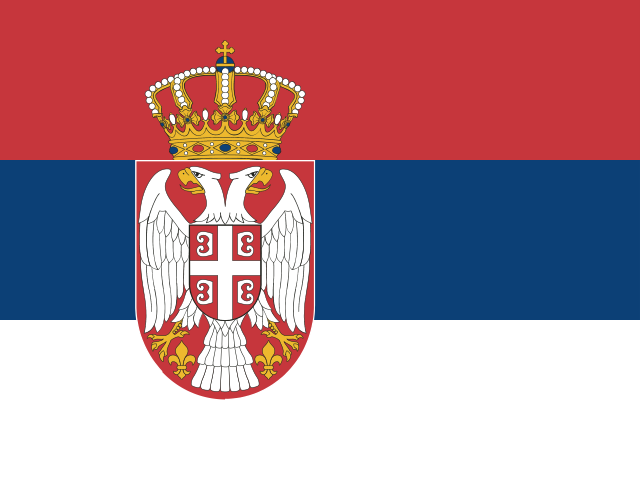
- Flag meaning
- Description: three equal horizontal stripes of red (top), blue, and white; the national coat of arms is shifted to the left side; the principal field of the coat of arms displays a two-headed white eagle on a red shield; a smaller red shield on the eagle is divided into four quarters by a white cross; a royal crown is on top of the coat of armsMeaning: red, blue, and white are the pan-Slav colors that represent freedom and revolutionary ideals; the eagle on a red shield represents the government; the smaller shield represents the country; the meaning and origin of the curved white symbols in each quarter are not clear
- National symbols
- white double-headed eagle
- National colours
- red, blue, white
- National anthem
- Title: "Boze pravde" (God of Justice)Lyrics/music: Jovan DORDEVIC/Davorin JENKOHistory: adopted 1904; song originally written as part of a play in 1872, and the Serbian people have used it as an anthem in the 20th and 21st centuries
- UNESCO World Heritage Sites
- Total World Heritage Sites: 4 (all cultural)Selected World Heritage Site locales: Stari Ras and Sopoćani; Studenica Monastery; Gamzigrad-Romuliana, Palace of Galerius; Stećci Medieval Tombstone Graveyards
Economy
- Overview
- upper middle-income Balkan economy; current EU accession candidate; hit by COVID-19; pursuing green growth development; manageable public debt; new anticorruption efforts; falling unemployment; historic Russian relations; energy import-dependent
- GDP (PPP)
- $177.093 billion (2024 est.)
- GDP per person (PPP)
- $26,900 (2024 est.)
- GDP growth
- 3.9% (2024 est.)
- Inflation
- 4.7% (2024 est.)
- Unemployment
- 7.4% (2024 est.)
- Below poverty line
- 20% (2021 est.)
- Farm products
- maize, wheat, sugar beets, milk, sunflower seeds, soybeans, potatoes, barley, apples, plums (2023)
- Industries
- automobiles, base metals, furniture, food processing, machinery, chemicals, sugar, tires, clothes, pharmaceuticals
- Exports
- $44.352 billion (2023 est.)
- Main exports
- insulated wire, electricity, copper ore, plastic products, electric motors (2023)
- Export partners
- Germany 15%, Hungary 7%, Bosnia & Herzegovina 5%, Italy 5%, Romania 5% (2023)
- Main imports
- crude petroleum, natural gas, packaged medicine, plastic products, cars (2023)
- Import partners
- Germany 12%, China 10%, Italy 7%, Turkey 5%, Hungary 5% (2023)
- Money sent home from abroad
- 7.1% of GDP (2023 est.)
Energy, internet and transport
- Electricity access
- Electrification - total population: 100% (2022 est.)
- Electricity sources
- Fossil fuels: 65.1% of total installed capacity (2023 est.)Solar: 1% of total installed capacity (2023 est.)Wind: 2.6% of total installed capacity (2023 est.)Hydroelectricity: 30.7% of total installed capacity (2023 est.)Biomass and waste: 0.6% of total installed capacity (2023 est.)
- Internet users
- Percent of population: 85% (2023 est.)
- Mobile phones
- Total subscriptions: 8.53 million (2023 est.)Subscriptions per 100 inhabitants: 124 (2021 est.)
- Airports
- 46 (2025)
- Railways
- Total: 3,333 km (2020) 1,274 km electrified
Military and space
- Armed forces
- Serbian Armed Forces (Vojska Srbije, VS): Army (aka Land Forces; includes Riverine Component, consisting of a naval flotilla on the Danube), Air and Air Defense Forces, Serbian GuardSerbian Ministry of Internal Affairs: Police Directorate (2025)
- Military spending
- 2.5% of GDP (2024 est.)
- Military service
- 18 years of age for voluntary military service for men and women; conscription abolished in 2011 (2025)
Global issues
- Refugees and displaced people
- Refugees: 36,270 (2024 est.)IDPs: 194,171 (2024 est.)Stateless persons: 1,715 (2024 est.)
Neighbouring countries
Bosnia and HerzegovinaBulgariaCroatiaHungaryNorth MacedoniaMontenegroRomania
- Phone code
- +381
- Internet domain
- .rs