Hungary
Hungary · Magyarország
Magyar tribes arrived around 895 and founded a Christian kingdom in 1000. Partly Ottoman, then Habsburg, then co-ruler of Austria-Hungary. The 1920 Trianon treaty cost two-thirds of its territory; Soviets crushed the 1956 revolution. EU member since 2004.
See Hungary on the 3D globeTake a quiz
Did you know?
- Budapest has the most thermal springs of any capital
- Hungarians invented the Rubik's Cube
- Has won more Olympic medals per person than almost any country
Key facts about Hungary
- Government
- Parliamentary republic
- Religion
- Catholic ~30%, Calvinist ~10%, many unaffiliated
- Founded / independence
- 1000 (Kingdom of Hungary)
- Rich in
- Car manufacturing, agriculture, pharmaceuticals, thermal spas
- Languages
- Hungarian
Hungarian (Magyar, Uralic family); Palóc and Csángó dialects - Currency
- Hungarian forint (Ft)
- People are called
- Hungarian
- Main cities
- Budapest, Debrecen, Szeged, Miskolc, Pécs
Timeline of Hungary
- 895Magyar settlement
- 1000Kingdom under Stephen I
- 1526Ottoman victory at Mohács
- 1867Austria-Hungary
- 1920Trianon treaty
- 1956Revolution crushed
- 2004Joins EU
Places to see in Hungary
- Hungarian Parliament
- Buda Castle
- Széchenyi thermal baths
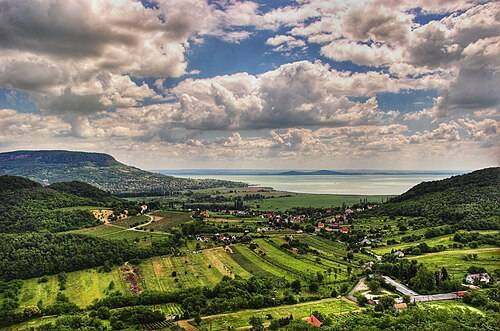
- Lake Balaton
- Hortobágy plain
Food and drink
Goulash · paprikás · lángos · chimney cake · Tokaji wine
Culture and famous for
Rubik's Cube; the ballpoint pen (Bíró); composers Liszt and Bartók
Popular sports
Water polo, fencing, football, swimming
Geography and climate
- Highest point
- Kékes, 1,014 m
- Rivers, lakes and seas
- Danube, Tisza; Lake Balaton
- Climate
- Continental
- Coastline
- Landlocked
- Population density
- 103 people per km²
Wars and conflicts
- Mongol invasion 1241
- Ottoman wars
- 1848 revolution
- WWI and WWII
- 1956 uprising
Empires and states that once stood here
Habsburg Monarchy (Austrian Empire) 1526–1867Austria-Hungary 1867–1918
Alliances and memberships
Military and security
Political unions and regional organisations
European UnionCouncil of EuropeOrganization of Turkic States (observer)Visegrád Group
Economy and trade
Hungary in depth
Detailed facts from the CIA World Factbook (public domain, latest edition).
Overview
- History in brief
- Hungary became a Christian kingdom in A.D. 1000 and for many centuries served as a bulwark against Ottoman Turkish expansion in Europe. The kingdom eventually became part of the Austro-Hungarian Empire, which collapsed during World War I. The country fell under communist rule after World War II. In 1956, Moscow responded to a Hungarian revolt and announcement of its withdrawal from the Warsaw Pact with a massive military intervention. Under the leadership of Janos KADAR in 1968, Hungary began liberalizing its economy, introducing so-called "Goulash Communism." Hungary held its first multiparty elections in 1990 and initiated a free market economy. It joined NATO in 1999 and the EU five years later.
Geography
- Location
- Central Europe, northwest of Romania
- Size compared
- slightly smaller than Virginia; about the same size as Indiana
- Land borders
- Total: 2,106 kmBorder countries: Austria 321 km; Croatia 348 km; Romania 424 km; Serbia 164 km; Slovakia 627 km; Slovenia 94 km; Ukraine 128 km
- Coastline
- 0 km (landlocked)
- Climate
- temperate; cold, cloudy, humid winters; warm summers
- Terrain
- mostly flat to rolling plains; hills and low mountains on the Slovakian border
- Elevation
- Highest point: Kekes 1,014 mLowest point: Tisza River 78 mMean elevation: 143 m
- Natural resources
- bauxite, coal, natural gas, fertile soils, arable land
- Major rivers
- Duna (Danube) (shared with Germany [s], Austria, Slovakia, Croatia, Serbia, Bulgaria, Ukraine, Moldova, and Romania [m]) - 2,888 kmNote: [s] after country name indicates river source; [m] after country name indicates river mouth
- Major lakes
- Fresh water lake(s): Lake Balaton - 590 sq km
- Notes
- landlocked; strategic location on main land routes between Western Europe and Balkan Peninsula, as well as between Ukraine and the Mediterranean basin; the Duna (Danube) and Tisza Rivers divide the country into three large regions
- Environmental issues
- air and soil pollution; water pollution from industry and large-scale agriculture
People and society
- Population
- Total: 9,855,745 (2024 est.)Male: 4,812,668Female: 5,043,077
- Nationality
- Noun: Hungarian(s)Adjective: Hungarian
- Ethnic groups
- Hungarian 84.3%, Romani 2.1%, German 1%, other 1.2%, unspecified 13.7% (2022 est.)
- Languages
- Hungarian (official) 98.8%, English 25.3%, German 12.6%, Russian 2.1%, French 1.5%, Romanian 1.4%, other 5.1% (2022 est.)Major-language sample(s): A World Factbook nélkülözhetetlen forrása az alapvető információnak. (Hungarian)The World Factbook, the indispensable source for basic information.
- Religions
- Catholic 30.1% (Roman Catholic 27.5%, Greek Catholic 1.7%, other Catholic 0.9%), Calvinist 9.8%, Lutheran 1.8%, other Christian (includes Orthodox) 1.6%, other 0.4%, none 16.1%, no answer 40.1% (2022 est.)
- Median age
- Total: 45.1 years (2025 est.)Male: 42.8 yearsFemale: 46.7 years
- Population growth
- -0.29% (2025 est.)
- Life expectancy
- Total population: 76 years (2024 est.)Male: 72.9 yearsFemale: 79.3 years
- Children per woman
- 1.6 children born/woman (2025 est.)
- Urbanization
- Urban population: 72.9% of total population (2023)Rate of urbanization: 0.05% annual rate of change (2020-25 est.)
- Largest cities
- 1.778 million BUDAPEST (capital) (2023)
- Years in school
- Total: 16 years (2023 est.)Male: 15 years (2023 est.)Female: 16 years (2023 est.)
Government
- Official names
- Conventional long form: noneConventional short form: HungaryLocal long form: noneLocal short form: MagyarorszagFormer: Kingdom of Hungary, Hungarian People's Republic, Hungarian Soviet Republic, Hungarian RepublicEtymology: the Byzantine Greeks referred to the tribes that arrived on the steppes of Eastern Europe in the 9th century as the "Oungroi," a name that later became "Hungari," which originally meant an "[alliance of] ten tribes;" the Hungarian name Magyarorszag means "Country of the Magyars," which may be derived from the name of the most prominent of the Hungarian tribes
- Government type
- parliamentary republic
- Capital
- Name: BudapestGeographic coordinates: 47 30 N, 19 05 ETime difference: UTC+1 (6 hours ahead of Washington, DC, during Standard Time)Daylight saving time: +1hr, begins last Sunday in March; ends last Sunday in OctoberEtymology: Buda on the western shore of the Danube and Pest on the eastern shore merged in 1873 to form Budapest; Buda's name may derive from the name of its founder or from a local word meaning "water;" Pest derives from a Slavic word meaning "furnace" or "oven"
- Regions
- 19 counties (megyek, singular - megye), 25 cities with county rights (megyei jogu varosok, singular - megyei jogu varos), and 1 capital city (fovaros)Counties: Bacs-Kiskun, Baranya, Bekes, Borsod-Abauj-Zemplen, Csongrad-Csanad, Fejer, Gyor-Moson-Sopron, Hajdu-Bihar, Heves, Jasz-Nagykun-Szolnok, Komarom-Esztergom, Nograd, Pest, Somogy, Szabolcs-Szatmar-Bereg, Tolna, Vas, Veszprem, ZalaCities with county rights: Baja, Bekescsaba, Debrecen, Dunaujvaros, Eger, Erd, Esztergom, Gyor, Hodmezovasarhely, Kaposvar, Kecskemet, Miskolc, Nagykanizsa, Nyiregyhaza, Pecs, Salgotarjan, Sopron, Szeged, Szekesfehervar, Szekszard, Szolnok, Szombathely, Tatabanya, Veszprem, ZalaegerszegCapital city: Budapest
- Independence
- 16 November 1918 (republic proclaimed); notable earlier dates: 25 December 1000 (crowning of King STEPHEN I, traditional founding date); 30 March 1867 (Austro-Hungarian dual monarchy established)
- National holiday
- Saint Stephen's Day, 20 August (1083)
- Constitution
- History: previous 1949 (heavily amended in 1989 following the collapse of communism); latest approved 18 April 2011, signed 25 April 2011, effective 1 January 2012Amendment process: proposed by the president of the republic, by the government, by parliamentary committee, or by Parliament members; passage requires two-thirds majority vote of Parliament members and approval by the president
- Legal system
- civil system influenced by the German model
- Voting age
- 18 years of age, 16 if married and marriage is registered in Hungary; universal
- Flag meaning
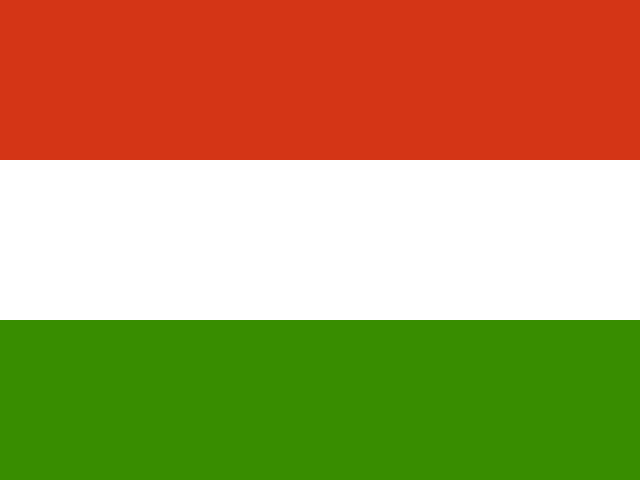
- Description: three equal horizontal bands of red (top), white, and greenMeaning: folklore attributes virtues to the colors: red for strength, white for faithfulness, and green for hope; alternatively, the red can stand for the blood spilled in defense of the land, white for freedom, and green for pasturelandsHistory: the flag dates to the national movement of the 18th and 19th centuries and fuses the medieval colors of the Hungarian coat of arms with the revolutionary tricolor of the French flag
- National symbols
- Holy Crown of Hungary (Crown of Saint Stephen)
- National colours
- red, white, green
- National anthem
- Title: "Himnusz" (Hymn)Lyrics/music: Ferenc KOLCSEY/Ferenc ERKELHistory: adopted 1844
- UNESCO World Heritage Sites
- Total World Heritage Sites: 8 (7 cultural, 1 natural)Selected World Heritage Site locales: Budapest, including the Banks of the Danube, the Buda Castle Quarter, and Andrássy Avenue (c); Old Village of Hollókő and its Surroundings (c); Caves of Aggtelek Karst and Slovak Karst (n); Millenary Benedictine Abbey of Pannonhalma and its Natural Environment (c); Hortobágy National Park - the Puszta (c); Early Christian Necropolis of Pécs (Sopianae) (c); Fertö / Neusiedlersee Cultural Landscape (c); Tokaj Wine Region Historic Cultural Landscape (c)
Economy
- Overview
- high-income EU and OECD economy; modest recovery from 2024 recession driven by private consumption and moderated inflation; challenges include high fiscal deficits, frozen access to EU funds, and risks from export reliance; implementing tax exemptions, price controls, and mortgage interest caps ahead of 2026 elections
- GDP (PPP)
- $389.207 billion (2024 est.)
- GDP per person (PPP)
- $40,700 (2024 est.)
- GDP growth
- 0.5% (2024 est.)
- Inflation
- 3.7% (2024 est.)
- Unemployment
- 4.5% (2024 est.)
- Below poverty line
- 12.1% (2021 est.)
- Farm products
- maize, wheat, barley, milk, sunflower seeds, sugar beets, rapeseed, apples, pork, grapes (2023)
- Industries
- mining, metallurgy, construction materials, processed foods, textiles, chemicals (especially pharmaceuticals), motor vehicles
- Exports
- $166.503 billion (2024 est.)
- Main exports
- cars, vehicle parts/accessories, electric batteries, packaged medicine, computers (2023)
- Export partners
- Germany 25%, Italy 6%, Romania 6%, USA 5%, Slovakia 4% (2023)
- Main imports
- vehicle parts/accessories, natural gas, integrated circuits, broadcasting equipment, industrial acids/oils/alcohols (2023)
- Import partners
- Germany 23%, China 7%, Austria 6%, Poland 6%, S. Korea 6% (2023)
- Money sent home from abroad
- 2.3% of GDP (2024 est.)
Energy, internet and transport
- Electricity access
- Electrification - total population: 100% (2022 est.)
- Electricity sources
- Fossil fuels: 28.9% of total installed capacity (2023 est.)Nuclear: 44.2% of total installed capacity (2023 est.)Solar: 19.4% of total installed capacity (2023 est.)Wind: 1.8% of total installed capacity (2023 est.)Hydroelectricity: 0.6% of total installed capacity (2023 est.)Biomass and waste: 4.9% of total installed capacity (2023 est.)
- Internet users
- Percent of population: 92% (2024 est.)
- Mobile phones
- Total subscriptions: 10.2 million (2023 est.)Subscriptions per 100 inhabitants: 104 (2022 est.)
- TV and radio
- mixed system of state-supported media and private broadcasters; the 5 publicly owned TV channels and the 2 main privately owned TV stations are the major national broadcasters; large number of special-interest channels; highly developed market for satellite and cable TV with about two-thirds of viewers utilizing the services; 4 state-supported radio networks; large number of local stations, including commercial, public service, nonprofit, and community radio stations; digital transition completed in 2013 (2019)
- Airports
- 109 (2025)
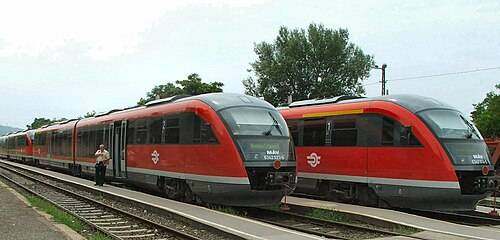
- Railways
- Total: 7,687 km (2020) 3,111 km electrified
- Merchant ships
- Total: 1 (2023)By type: other 1
Military and space
- Armed forces
- Hungarian Defense Forces (HDF or Magyar Honvédség): the HDF is organized as a joint force under a general staff with commands for land, air, cyber, special operations, territorial defense, and support forces (2025)
- Military spending
- 2.1% of GDP (2025 est.)
- Military service
- 18 years of age for voluntary military service; no conscription (abolished 2005) (2026)
Global issues
- Refugees and displaced people
- Refugees: 72,359 (2024 est.)Stateless persons: 101 (2024 est.)
Neighbouring countries
AustriaCroatiaRomaniaSerbiaSlovakiaSloveniaUkraine
- Phone code
- +36
- Internet domain
- .hu