Greece
Hellenic Republic · Ελλάδα
Birthplace of democracy, philosophy and the Olympics. Ruled by Macedon, Rome, Byzantium and the Ottomans before independence in 1830. A 1967–74 military junta ended in democracy; it went through a severe debt crisis in 2009–18.
See Greece on the 3D globeTake a quiz
Population10.4 million
Area131,990 km²
CapitalAthens
RegionSouthern Europe
Did you know?
- Has about 6,000 islands, of which around 200 are inhabited
- Greek is one of the oldest recorded living languages
- Hosted the first modern Olympics in 1896 and again in 2004
Key facts about Greece
- Government
- Parliamentary republic
- Religion
- Greek Orthodox ~90%
- Founded / independence
- 1830 (from Ottoman Empire)
- Rich in
- Shipping (largest merchant fleet), tourism, olives
- Languages
- Greek
Greek: Standard Modern Greek; Cretan, Cypriot, Pontic dialects; Tsakonian - Currency
- Euro (€)
- People are called
- Greek
- Main cities
- Athens, Thessaloniki, Patras, Heraklion, Larissa
Timeline of Greece
- 776 BCFirst Olympics
- 508 BCAthenian democracy
- 1453Ottoman rule
- 1830Independence
- 1967Military junta
- 1981Joins EEC
- 2010Debt crisis bailout
Places to see in Greece
- Acropolis and Parthenon
- Delphi
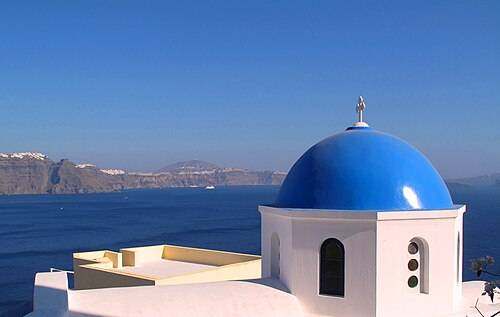
- Santorini
- Meteora monasteries
- Olympia
- Knossos, Crete
Food and drink
Moussaka · souvlaki · Greek salad · feta · tzatziki · baklava
Culture and famous for
Birthplace of democracy, theatre, philosophy (Socrates, Plato, Aristotle) and the Olympics
Popular sports
Football, basketball
Geography and climate
- Highest point
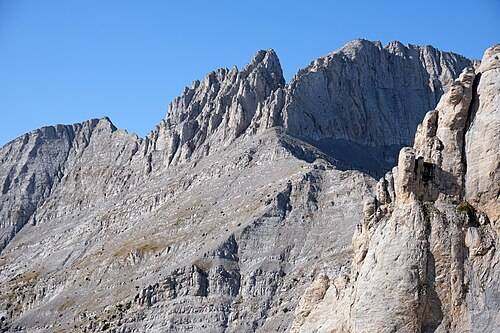
- Mount Olympus, 2,918 m
- Rivers, lakes and seas
- About 6,000 islands; Aegean and Ionian seas
- Climate
- Mediterranean
- Coastline
- Has a sea coast
- Population density
- 79 people per km²
Wars and conflicts
- Persian Wars
- Peloponnesian War
- War of Independence 1821–30
- Balkan Wars
- Greco-Turkish War
- Civil War 1946–49
Empires and states that once stood here
Athens and Classical Greece c. 800–146 BCByzantine Empire 330–1453
Alliances and memberships
Military and security
Political unions and regional organisations
European UnionEurozoneCouncil of Europe
Economy and trade
Defence treaties
- France–Greece Strategic Partnership (2021): Defence pact with a mutual-assistance clause.
Greece in depth
Detailed facts from the CIA World Factbook (public domain, latest edition).
Overview
- History in brief
- Greece won independence from the Ottoman Empire in 1830 and became a kingdom. During the second half of the 19th century and the first half of the 20th century, it gradually added neighboring islands and territories, most with Greek-speaking populations. In World War II, Greece was first invaded by Italy (1940) and subsequently occupied by Germany (1941-44); fighting endured in a protracted civil war between supporters of the king and other anti-communist and communist rebels. The communists were defeated in 1949, and Greece joined NATO in 1952. In 1967, a military coup forced the king to flee the country. The ensuing military dictatorship collapsed in 1974, and Greece abolished the monarchy to become a parliamentary republic.In 1981, Greece joined the EC (now the EU); it became the 12th member of the European Economic and Monetary Union in 2001. From 2009 until 2019, Greece suffered a severe economic crisis due to nearly a decade of chronic overspending and structural rigidities. Beginning in 2010, Greece entered three bailout agreements -- the first two with the European Commission, the European Central Bank, and the IMF; and the third in 2015 with the European Stability Mechanism -- worth in total about $300 billion. The Greek Government formally exited the third bailout in 2018, and Greece's economy has since improved significantly. In 2022, the country finalized its early repayment to the IMF and graduated on schedule from the EU's enhanced surveillance framework.
Geography
- Location
- Southern Europe, bordering the Aegean Sea, Ionian Sea, and the Mediterranean Sea, between Albania and Turkey
- Size compared
- slightly smaller than Alabama
- Land borders
- Total: 1,110 kmBorder countries: Albania 212 km; Bulgaria 472 km; North Macedonia 234 km; Turkey 192 km
- Coastline
- 13,676 km
- Climate
- temperate; mild, wet winters; hot, dry summers
- Terrain
- mountainous with ranges extending into the sea as peninsulas or chains of islands
- Elevation
- Highest point: Mount Olympus 2,917Lowest point: Mediterranean Sea 0 mMean elevation: 498 m
- Natural resources
- lignite, petroleum, iron ore, bauxite, lead, zinc, nickel, magnesite, marble, salt, hydropower potential
- Natural hazards
- severe earthquakesVolcanism: Santorini (367 m) has been deemed a Decade Volcano by the International Association of Volcanology and Chemistry of the Earth's Interior, worthy of study due to its explosive history and close proximity to human populations; Methana and Nisyros in the Aegean are also classified as historically active
- Notes
- strategic location dominating the Aegean Sea and southern approach to Turkish Straits; a peninsular country, with an archipelago of about 2,000 islands
- Environmental issues
- air pollution; air emissions from transport and electricity power stations; water pollution; degradation of coastal zones; loss of biodiversity; municipal and industrial waste disposal
People and society
- Population
- Total: 10,424,536 (2025 est.)Male: 5,105,879Female: 5,318,657
- Nationality
- Noun: Greek(s)Adjective: Greek
- Ethnic groups
- Greek 91.6%, Albanian 4.4%, other 4% (2011 est.)
- Languages
- Greek (official) 99%, other (includes English and French) 1%Major-language sample(s): Το Παγκόσμιο Βιβλίο Δεδομένων, η απαραίτητη πηγή βασικών πληροφοριών. (Greek)The World Factbook, the indispensable source for basic information.
- Religions
- Greek Orthodox 81-90%, Muslim 2%, other 3%, none 4-15%, unspecified 1% (2015 est.)
- Median age
- Total: 46.8 years (2025 est.)Male: 44.6 yearsFemale: 48.3 years
- Population growth
- -0.35% (2025 est.)
- Life expectancy
- Total population: 81.9 years (2024 est.)Male: 79.4 yearsFemale: 84.6 years
- Children per woman
- 1.42 children born/woman (2025 est.)
- Urbanization
- Urban population: 80.7% of total population (2023)Rate of urbanization: 0.11% annual rate of change (2020-25 est.)
- Largest cities
- 3.154 million ATHENS (capital), 815,000 Thessaloniki (2023)
- Years in school
- Total: 21 years (2022 est.)Male: 21 years (2022 est.)Female: 21 years (2022 est.)
Government
- Official names
- Conventional long form: Hellenic RepublicConventional short form: GreeceLocal long form: Elliniki DimokratiaLocal short form: Ellas or ElladaFormer: Hellenic State, Kingdom of GreeceEtymology: the English name derives from the Roman (Latin) designation Graecia, meaning "Land of the Greeks"; the Greeks call their country Ellas or Ellada, which is probably derived from Hellas, the name of the mythical son of Deucalian
- Government type
- parliamentary republic
- Capital
- Name: AthensGeographic coordinates: 37 59 N, 23 44 ETime difference: UTC+2 (7 hours ahead of Washington, DC, during Standard Time)Daylight saving time: +1hr, begins last Sunday in March; ends last Sunday in OctoberEtymology: the origin of the name is uncertain; according to tradition, the city is named after Athena, the Greek goddess of wisdom, but the name is probably pre-Hellenic
- Regions
- 13 regions (perifereies, singular - perifereia) and 1 autonomous monastic state* (aftonomi monastiki politeia); Agion Oros* (Mount Athos), Anatoliki Makedonia kai Thraki (East Macedonia and Thrace), Attiki (Attica), Dytiki Ellada (West Greece), Dytiki Makedonia (West Macedonia), Ionia Nisia (Ionian Islands), Ipeiros (Epirus), Kentriki Makedonia (Central Macedonia), Kriti (Crete), Notio Aigaio (South Aegean), Peloponnisos (Peloponnese), Sterea Ellada (Central Greece), Thessalia (Thessaly), Voreio Aigaio (North Aegean)
- Independence
- 3 February 1830 (from the Ottoman Empire)
- National holiday
- Independence Day, 25 March (1821)
- Constitution
- History: many previous; latest entered into force 11 June 1975Amendment process: proposed by at least 50 members of Parliament and agreed by three-fifths majority vote in two separate ballots at least 30 days apart; passage requires absolute majority vote by the next elected Parliament; entry into force finalized through a "special parliamentary resolution"; articles on human rights and freedoms and the form of government cannot be amended
- Legal system
- civil legal system based on Roman law
- Voting age
- 17 years of age; universal and compulsory
- Flag meaning
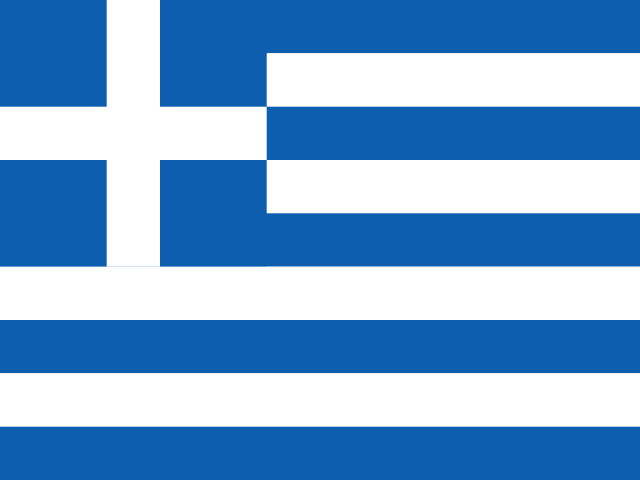
- Description: nine equal horizontal stripes of blue alternating with white; a blue square with a white cross is in the upper-left cornerMeaning: the cross symbolizes Greek Orthodoxy, the established religion; there is no set meaning for the stripes and colors
- National symbols
- Greek cross (white cross on a blue field)
- National colours
- blue, white
- National anthem
- Title: "Ymnos eis tin Eleftherian" (Hymn to Freedom)Lyrics/music: Dionysios SOLOMOS/Nikolaos MANTZAROSHistory: adopted 1864; the anthem is based on a 158-stanza poem by the same name, which was inspired by the Greek Revolution of 1821 against the Ottomans (only the first two stanzas are used); Cyprus also uses "Hymn to Freedom" as its anthem
- UNESCO World Heritage Sites
- Total World Heritage Sites: 20 (18 cultural, 2 mixed)Selected World Heritage Site locales: Acropolis, Athens (c); Archaeological site of Delphi (c); Meteora (m); Medieval City of Rhodes (c); Archaeological site of Olympia (c); Archaeological site of Mycenae and Tiryns (c); Old Town of Corfu (c); Mount Athos (m); Delos (c); Archaeological Site of Philippi (c); Minoan Palatial Centres (c)
Economy
- Overview
- high-income EU and eurozone economy; growth above euro average, supported by private consumption and EU fund investments; structural reforms strengthening public finances and enhancing resilience within banking system; declining unemployment but low labor productivity and skill shortages
- GDP (PPP)
- $392.205 billion (2024 est.)
- GDP per person (PPP)
- $37,800 (2024 est.)
- GDP growth
- 2.3% (2024 est.)
- Inflation
- 2.7% (2024 est.)
- Unemployment
- 10.2% (2024 est.)
- Below poverty line
- 18.8% (2021 est.)
- Farm products
- maize, wheat, sheep milk, oranges, tomatoes, milk, peaches/nectarines, grapes, watermelons, barley (2023)
- Industries
- tourism, food and tobacco processing, textiles, chemicals, metal products; mining, petroleum
- Exports
- $108.424 billion (2024 est.)
- Main exports
- refined petroleum, packaged medicine, aluminum, olive oil, tobacco (2023)
- Export partners
- Italy 12%, Germany 6%, Cyprus 6%, Bulgaria 4%, USA 4% (2023)
- Main imports
- crude petroleum, refined petroleum, natural gas, cars, packaged medicine (2023)
- Import partners
- Germany 10%, China 10%, Italy 8%, Iraq 7%, Netherlands 6% (2023)
- Money sent home from abroad
- 0.2% of GDP (2024 est.)
Energy, internet and transport
- Electricity access
- Electrification - total population: 100% (2022 est.)
- Electricity sources
- Fossil fuels: 48.9% of total installed capacity (2023 est.)Solar: 17.5% of total installed capacity (2023 est.)Wind: 23.3% of total installed capacity (2023 est.)Hydroelectricity: 9.8% of total installed capacity (2023 est.)Biomass and waste: 0.6% of total installed capacity (2023 est.)
- Internet users
- Percent of population: 85% (2023 est.)
- Mobile phones
- Total subscriptions: 11.4 million (2024 est.)Subscriptions per 100 inhabitants: 114 (2024 est.)
- TV and radio
- broadcast media dominated by the private sector; roughly 150 private TV channels, about 10 of which broadcast nationwide; 1 state-owned terrestrial TV channel with national coverage; 3 privately owned satellite channels; multi-channel satellite and cable TV services available; over 1,500 radio stations, all privately owned; state-owned broadcaster has 2 national radio stations
- Airports
- 82 (2025)
- Railways
- Total: 2,345 km (2020) 731 km electrified
- Merchant ships
- Total: 1,215 (2023)By type: bulk carrier 132, container ship 4, general cargo 79, oil tanker 299, other 701
Military and space
- Armed forces
- Hellenic Armed Forces (HAF; Ellinikes Enoples Dynamis, EED): Hellenic Army (Ellinikos Stratos, ES; includes National Guard), Hellenic Navy (Elliniko Polemiko Navtiko, EPN), Hellenic Air Force (Elliniki Polemiki Aeroporia, EPA; includes air defense) (2025)
- Military spending
- 2.9% of GDP (2025 est.)
- Military service
- 18 years of age for voluntary military service for men and women; all Greek men 19-45 are subject to compulsory military service; 12-month obligation for all services (note - as an exception, the duration of the full military service is 9 instead of 12 months if conscripts, after the initial training, serve the entire remaining time in certain areas of the eastern borders, in Cyprus, or in certain military units) (2026)
- Space programme
- focuses on building and operating satellites for communications and remote sensing (RS); researches and develops space-related technologies in a variety of sectors, including agriculture, defense, environmental studies, RS, and telecommunications; contributes to and participates in ESA capabilities and programs; also participates in EU space programs and cooperates bilaterally with European and US space agencies and commercial space sectors; has a commercial space sector that researches, develops, and produces a variety of space technologies and capabilities (2025)
- Space milestones
- 1994 - signed first cooperation agreement with the ESA2005 - first satellite (Hellas-Sat) for a domestic telecommunications satellite network launched by US; joined ESA (became member state in 2011)2017 - first domestically manufactured communications satellite (UPSat) released from International Space Station2019 - began participating in ESA’s quantum communications infrastructure (EuroQCI or “fiber in the sky”) and the US Gateway Lunar orbital/landing programs2021 - launched ESA-assisted national program to develop, manufacture, launch, and operate small satellites2024 - signed US-led Artemis Accords for space and Moon exploration2025 - launched demonstrator/experimental RS cube satellite (DUTHSat-2) under ESA-assisted national small satellite program
Global issues
- Refugees and displaced people
- Refugees: 144,694 (2024 est.)Stateless persons: 3,743 (2024 est.)
Neighbouring countries
AlbaniaBulgariaTürkiyeNorth Macedonia
- Phone code
- +30
- Internet domain
- .gr