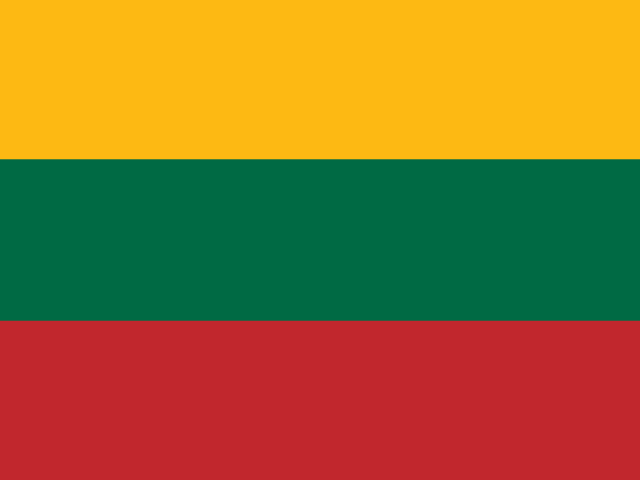
Lithuania
Republic of Lithuania · Lietuva
The Grand Duchy of Lithuania was once Europe's largest state, joining Poland in 1569. Absorbed by Russia in 1795. First Soviet republic to declare independence, in 1990.
See Lithuania on the 3D globeTake a quiz
Population2.9 million
Area65,300 km²
CapitalVilnius
RegionNorthern Europe
Did you know?
- Basketball is so popular it is called a second religion
- First Soviet republic to declare independence
- Uses one of the oldest living Indo-European languages
Key facts about Lithuania
- Government
- Semi-presidential republic
- Religion
- Catholic ~74%
- Founded / independence
- 1253 kingdom; 1918; restored 1990
- Rich in
- Lasers, fintech, furniture, agriculture, transport
- Languages
- Lithuanian
Lithuanian (one of the most archaic Indo-European languages): Aukštaitian and Samogitian dialects - Currency
- Euro (€)
- People are called
- Lithuanian
- Main cities
- Vilnius, Kaunas, Klaipėda, Šiauliai
Timeline of Lithuania
- 1253King Mindaugas crowned
- 1410Victory at Grunwald
- 1569Union with Poland
- 1795Russian rule
- 1918Independence
- 1990Independence restored
- 2004Joins EU and NATO
Places to see in Lithuania
- Trakai Island Castle
- Vilnius Old Town
- Hill of Crosses
- Curonian Spit
- Kaunas
Food and drink
Cepelinai (potato dumplings) · šaltibarščiai (pink cold soup) · kugelis
Culture and famous for
Amber; sutartinės polyphonic songs; Baroque Vilnius
Popular sports
Basketball (national passion)
Geography and climate
- Highest point
- Aukštojas Hill, 294 m
- Rivers, lakes and seas
- Neman; about 3,000 lakes
- Climate
- Cool continental
- Coastline
- Has a sea coast
- Population density
- 44 people per km²
Wars and conflicts
- Battle of Grunwald 1410
- uprisings 1830 and 1863
- Soviet occupation
Empires and states that once stood here
Teutonic Order State 1230–1525
Alliances and memberships
Military and security
Political unions and regional organisations
European UnionEurozoneCouncil of Europe
Economy and trade
Lithuania in depth
Detailed facts from the CIA World Factbook (public domain, latest edition).
Overview
- History in brief
- Lithuanian lands were united under MINDAUGAS in 1236; over the next century, Lithuania extended its territory through alliances and conquest to include most of present-day Belarus and Ukraine. By the end of the 14th century, Lithuania was the largest state in Europe. An alliance with Poland in 1386 led the two countries into a union through a common ruler. In 1569, Lithuania and Poland formally united into a single dual state, the Polish-Lithuanian Commonwealth. This entity survived until 1795 when surrounding countries partitioned its remnants. Lithuania regained its independence after World War I, but the USSR annexed it in 1940 -- an action never recognized by the US and many other countries. In 1990, Lithuania became the first of the Soviet republics to declare its independence, but Moscow did not recognize this proclamation until 1991. The last Russian troops withdrew in 1993. Lithuania subsequently restructured its economy for integration into West European institutions; it joined both NATO and the EU in 2004. In 2015, Lithuania joined the euro zone, and it joined the Organization for Economic Cooperation and Development in 2018.
Geography
- Location
- Eastern Europe, bordering the Baltic Sea, between Latvia and Russia, west of Belarus
- Size compared
- slightly larger than West Virginia
- Land borders
- Total: 1,545 kmBorder countries: Belarus 640 km; Latvia 544 km; Poland 100 km; Russia (Kaliningrad) 261 km
- Coastline
- 90 km
- Climate
- transitional, between maritime and continental; wet, moderate winters and summers
- Terrain
- lowland, many scattered small lakes, fertile soil
- Elevation
- Highest point: Aukstojas 294 mLowest point: Baltic Sea 0 mMean elevation: 110 m
- Natural resources
- peat, arable land, amber
- Major lakes
- Salt water lake(s): Curonian Lagoon (shared with Russia) - 1,620 sq km
- Natural hazards
- occasional floods, droughts
- Notes
- fertile central plains are separated by hilly uplands that are ancient glacial deposits
- Environmental issues
- water pollution; air pollution; deforestation; groundwater pollution from chemicals and waste; soil degradation and erosion
People and society
- Population
- Total: 2,815,687 (2025 est.)Male: 1,334,600Female: 1,481,087
- Nationality
- Noun: Lithuanian(s)Adjective: Lithuanian
- Ethnic groups
- Lithuanian 84.6%, Polish 6.5%, Russian 5%, Belarusian 1%, other 1.1%, unspecified 1.8% (2021 est.)
- Languages
- Lithuanian (official) 85.3%, Russian 6.8%, Polish 5.1%, other 1.1%, two mother tongues 1.7% (2021 est.)Major-language sample(s): Pasaulio enciklopedija – naudingas bendrosios informacijos šaltinis. (Lithuanian)The World Factbook, the indispensable source for basic information.
- Religions
- Roman Catholic 74.2%, Russian Orthodox 3.7%, Old Believer 0.6%, Evangelical Lutheran 0.6%, Evangelical Reformist 0.2%, other (including Sunni Muslim, Jewish, Greek Catholic, and Karaite) 0.9%, none 6.1%, unspecified 13.7% (2021 est.)
- Median age
- Total: 44 years (2025 est.)Male: 40.9 yearsFemale: 49.2 years
- Population growth
- -0.71% (2025 est.)
- Life expectancy
- Total population: 76.1 years (2024 est.)Male: 70.8 yearsFemale: 81.7 years
- Children per woman
- 1.22 children born/woman (2025 est.)
- Urbanization
- Urban population: 68.7% of total population (2023)Rate of urbanization: -0.12% annual rate of change (2020-25 est.)
- Largest cities
- 541,000 VILNIUS (capital) (2023)
- Years in school
- Total: 17 years (2022 est.)Male: 16 years (2022 est.)Female: 17 years (2022 est.)
Government
- Official names
- Conventional long form: Republic of LithuaniaConventional short form: LithuaniaLocal long form: Lietuvos RespublikaLocal short form: LietuvaFormer: Lithuanian Soviet Socialist Republic (while occupied by the USSR)Etymology: meaning of the name is obscure; may be derived from the local words lietava, meaning "small river," or lietus, meaning "rain" or "land of rain," or the Latin word litus, meaning "shore"
- Government type
- semi-presidential republic
- Capital
- Name: VilniusGeographic coordinates: 54 41 N, 25 19 ETime difference: UTC+2 (7 hours ahead of Washington, DC, during Standard Time)Daylight saving time: +1hr, begins last Sunday in March; ends last Sunday in OctoberEtymology: named after the Vilnia River; the river name is said to derive from the Lithuanian word vilnis, meaning "wave"
- Regions
- 60 municipalities (savivaldybe, singular - savivaldybe); Akmene, Alytaus Miestas, Alytus, Anksciai, Birstonas, Birzai, Druskininkai, Elektrenai, Ignalina, Jonava, Joniskis, Jurbarkas, Kaisiadorys, Kalvarija, Kauno Miestas, Kaunas, Kazlu Rudos, Kedainiai, Kelme, Klaipedos Miestas, Klaipeda, Kretinga, Kupiskis, Lazdijai, Marijampole, Mazeikiai, Moletai, Neringa, Pagegiai, Pakruojis, Palangos Miestas, Panevezio Miestas, Panevezys, Pasvalys, Plunge, Prienai, Radviliskis, Raseiniai, Rietavas, Rokiskis, Sakiai, Salcininkai, Siauliu Miestas, Siauliai, Silale, Silute, Sirvintos, Skuodas, Svencionys, Taurage, Telsiai, Trakai, Ukmerge, Utena, Varena, Vilkaviskis, Vilniaus Miestas, Vilnius, Visaginas, Zarasai
- Independence
- 16 February 1918 (from Soviet Russia and Germany); 11 March 1990 (declared from the Soviet Union); 6 September 1991 (recognized by the Soviet Union); notable earlier dates: 6 July 1253 (coronation of MINDAUGAS, traditional founding date); 1 July 1569 (Polish-Lithuanian Commonwealth created)
- National holiday
- Independence Day (or National Day), 16 February (1918)
- Constitution
- History: several previous; latest adopted by referendum 25 October 1992, entered into force 2 November 1992Amendment process: proposed by at least one fourth of all Parliament members or by petition of at least 300,000 voters; passage requires two-thirds majority vote of Parliament in each of two readings three months apart and a presidential signature; amendments to constitutional articles on national sovereignty and constitutional amendment procedure also require three-fourths voter approval in a referendum
- Legal system
- civil law system; legislative acts can be appealed to the Constitutional Court
- Voting age
- 18 years of age; universal
- Flag meaning
- Description: three equal horizontal bands of yellow (top), green, and redMeaning: yellow stands for golden fields, the sun, light, and goodness; green for the forests, nature, freedom, and hope; red for courage and the blood spilled in defense of the homeland
- National symbols
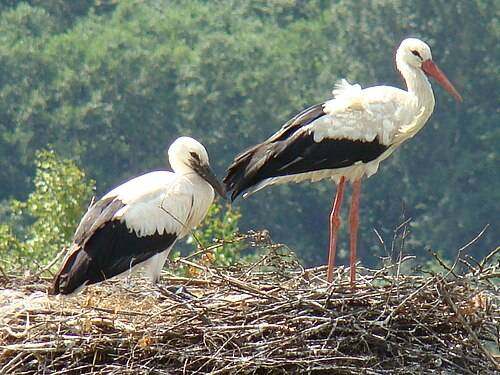
- mounted knight known as Vytis (the Chaser), white stork
- National colours
- yellow, green, red
- National anthem
- Title: "Tautiska giesme" (The National Song)Lyrics/music: Vincas KUDIRKAHistory: adopted 1918, restored 1990; written in 1898 when Lithuania was part of Russia; banned during the Soviet occupation from 1940 to 1990
- UNESCO World Heritage Sites
- Total World Heritage Sites: 5 (all cultural)Selected World Heritage Site locales: Vilnius Historic Center; Curonian Spit; Kernavė Archaeological Site; Struve Geodetic Arc; Modernist Kaunas: Architecture of Optimism, 1919-1939
Economy
- Overview
- high-income EU and eurozone member, largest Baltic economy; recovery supported by private consumption and EU fund-driven investments; structural challenges include pension reform, aging workforce, and high energy-import costs
- GDP (PPP)
- $136.227 billion (2024 est.)
- GDP per person (PPP)
- $47,200 (2024 est.)
- GDP growth
- 2.8% (2024 est.)
- Inflation
- 0.7% (2024 est.)
- Unemployment
- 7.6% (2024 est.)
- Below poverty line
- 20.9% (2021 est.)
- Farm products
- wheat, milk, sugar beets, rapeseed, barley, potatoes, triticale, oats, beans, peas (2023)
- Industries
- metal-cutting machine tools, electric motors, televisions, refrigerators and freezers, petroleum refining, shipbuilding (small ships), furniture, textiles, food processing, fertilizer, agricultural machinery, optical equipment, lasers, electronic components, computers, amber jewelry, information technology, video game development, app/software development, biotechnology
- Exports
- $62.896 billion (2024 est.)
- Main exports
- refined petroleum, furniture, plastic products, wheat, cars (2023)
- Export partners
- Latvia 11%, Poland 8%, Germany 7%, Netherlands 6%, Russia 6% (2023)
- Main imports
- crude petroleum, cars, natural gas, packaged medicine, plastic products (2023)
- Import partners
- Germany 13%, Poland 13%, Latvia 8%, USA 7%, Norway 5% (2023)
- Money sent home from abroad
- 1.2% of GDP (2024 est.)
Energy, internet and transport
- Electricity access
- Electrification - total population: 100% (2022 est.)
- Electricity sources
- Fossil fuels: 16.3% of total installed capacity (2023 est.)Solar: 14.1% of total installed capacity (2023 est.)Wind: 51% of total installed capacity (2023 est.)Hydroelectricity: 4.8% of total installed capacity (2023 est.)Biomass and waste: 13.8% of total installed capacity (2023 est.)
- Internet users
- Percent of population: 89% (2023 est.)
- Mobile phones
- Total subscriptions: 3.97 million (2024 est.)Subscriptions per 100 inhabitants: 139 (2024 est.)
- TV and radio
- public broadcaster operates 3 channels, with the third channel (satellite) introduced in 2007; various privately owned commercial TV broadcasters operate national and multiple regional channels; many privately owned local TV stations; multi-channel cable and satellite TV services available; publicly owned broadcaster operates 3 radio networks; many privately owned commercial broadcasters, with repeater stations in various regions
- Airports
- 64 (2025)
- Railways
- Total: 1,911 km (2020) 152 km electrified
- Merchant ships
- Total: 59 (2023)By type: container ship 3, general cargo 19, oil tanker 2, other 35
Military and space
- Armed forces
- Lithuanian Armed Forces (Lietuvos Ginkluotosios Pajegos): Lithuanian Land Forces (LLF), Lithuanian Navy, Lithuanian Air Force (LTAF), Lithuanian Special Operations Forces (LITHSOF); National Defense Volunteer Forces (2025)
- Military spending
- 4% of GDP (2025 est.)
- Military service
- 19-26 years of age for conscripted military service for men; 9-month service obligation; 18-38 for voluntary service for men and women; 18-60 for the National Defense Volunteer Services (2025)
Global issues
- Refugees and displaced people
- Refugees: 53,859 (2024 est.)Stateless persons: 2,236 (2024 est.)
Neighbouring countries
- Phone code
- +370
- Internet domain
- .lt